
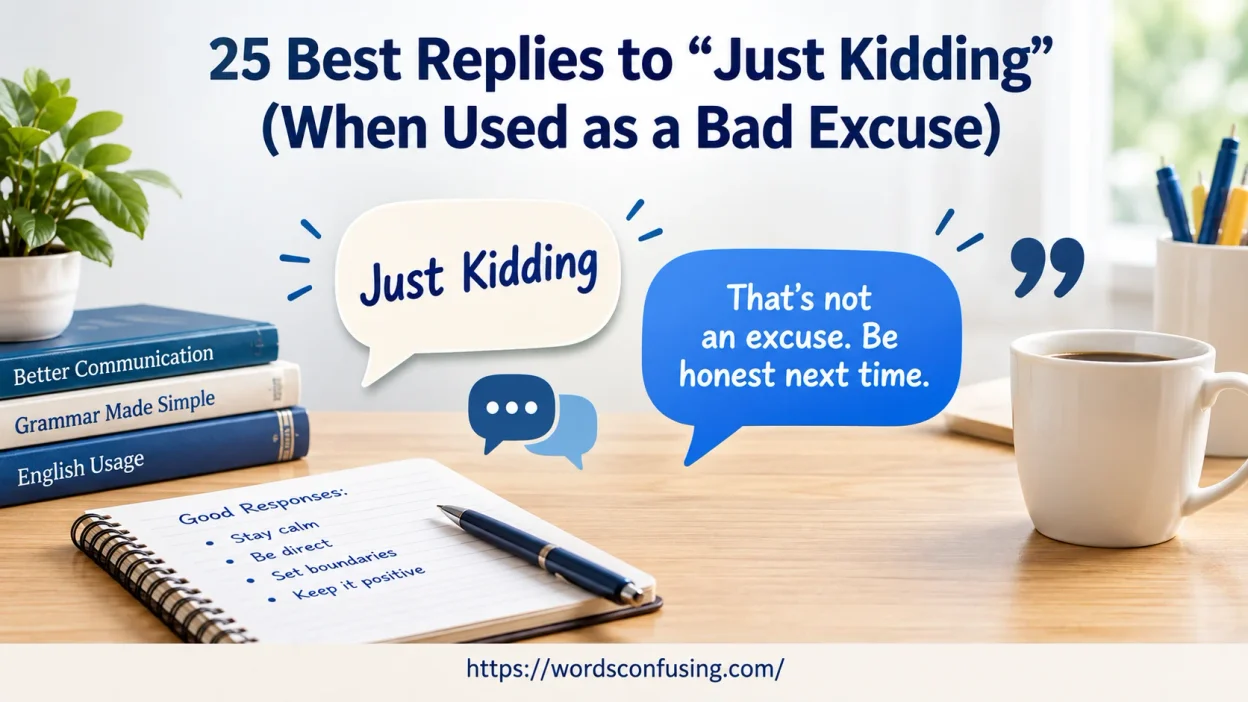
The 25 Best Replies to “Just Kidding” When It’s Used as a Bad Excuse can help you respond when a casual joke crosses a line.
With friends, “Just kidding” or “I’m only joking” may sound harmless, but those words don’t magically erase an insulting comment. A joke defense shouldn’t become a free pass to say anything, especially about appearance, job, marital status, or a health condition.
On social media and while texting, people may post mean-spirited, derogatory, or offensive comments, then hide behind “JK,” “LOL,” or a winky-face emoji. When the recipient calls out the jokester, “You’re so sensitive!” can make the emotional impact worse.
A direct reply can protect your feelings without creating unnecessary drama. Saying “you’re not very funny” works when someone repeatedly makes hurtful jokes at your expense. This approach can shift the power dynamic, establish boundaries, and show confidence without giving them the reaction they want.
If someone is gaslighting, acting rude, or using humor to mask feelings, stay calm and focus on the behavior. Teasing can build affection, bonding, and connection among loved ones, but mocking, invalidation, and disrespect can damage a relationship.
A thoughtful response lets you maintain control, communicate support, and handle a bad excuse with clear assertiveness.
Quick Answer
When someone says “Just kidding” after making a rude or hurtful comment, you don’t have to laugh it off. A simple response like “Maybe, but it wasn’t funny” can make your point without starting a bigger argument. If the comment crosses a clear boundary, try “Joking is fine, but disrespect isn’t.” For a lighter moment, “Nice save” keeps things playful. The best reply depends on the situation, your relationship with the person, and how far their comment went. When the phrase becomes a repeated excuse for disrespect, skip the clever comeback and set a firm boundary instead.
What Does “Just Kidding” Mean?
“Just kidding” usually tells someone that a previous statement wasn’t meant seriously. The speaker may have intended the comment as a joke rather than a factual statement.
For example:
“You really think you can finish that entire pizza? Just kidding.”
Here, the phrase simply signals playful teasing.
However, context matters. The same phrase can take on a very different meaning after a harsh comment.
“Nobody wants to hear your opinion. Just kidding.”
The second sentence doesn’t automatically erase the first one. Instead, it can function as a quick escape from accountability.
A genuine joke normally doesn’t require the speaker to scramble for an excuse. When someone says “just kidding” only after noticing that their comment upset you, the phrase may be serving a different purpose.
“Just Kidding” Can Have Several Meanings
Depending on the situation, the phrase can:
- Clarify that a statement wasn’t serious.
- Keep playful teasing from sounding too serious.
- Reduce awkwardness after an unusual comment.
- Cover up an insult.
- Avoid responsibility for something hurtful.
- Test how someone reacts to a sensitive topic.
- Change the tone after a joke fails.
- End an uncomfortable conversation.
The words themselves aren’t automatically good or bad. The surrounding behavior tells you much more.
When “Just Kidding” Becomes a Bad Excuse
A joke can cross a line when it attacks someone’s dignity, appearance, personal life, intelligence, relationships, or vulnerabilities.
For instance, imagine someone says:
“You look terrible today. Just kidding!”
The second sentence doesn’t necessarily make the first comment funny. It may simply soften the speaker’s retreat after realizing the remark landed badly.
A useful distinction is intent versus impact. Someone can intend to be funny while still causing embarrassment or hurt.
That doesn’t mean every unsuccessful joke deserves outrage. Humor is subjective. People misread situations all the time.
The bigger issue appears when someone refuses to acknowledge the effect of their words and repeatedly uses “just kidding” as a shield.
Common Signs That “Just Kidding” Is Being Used as an Excuse
Watch for patterns such as:
- The comment was clearly insulting.
- The speaker targets the same person repeatedly.
- They laugh while everyone else becomes uncomfortable.
- They become defensive when challenged.
- They blame you for not understanding the joke.
- They say “you’re too sensitive.”
- They repeat the behavior after you’ve objected.
- They only call it a joke after receiving a negative reaction.
- The comment exposes something deeply personal.
- They use humor to avoid admitting what they actually meant.
One awkward joke doesn’t automatically prove bad intentions. Repeated behavior provides more useful context than one isolated sentence.
Read more: As Of, As At, As From: Difference Explained With Helpful Examples
How to Respond When Someone Says “Just Kidding”
Before choosing a comeback, consider what you actually want to accomplish.
Do you want to keep things playful? Do you want to make it clear that the comment wasn’t acceptable? Or do you simply want the conversation to end?
Your answer should shape your response.
If someone makes a harmless joke, a witty reply can keep the mood relaxed. If someone insults you and then retreats behind “just kidding,” a firm response may be more appropriate.
Keep These Factors in Mind
Match the tone. A serious situation doesn’t always need a sarcastic comeback.
Keep it brief. Long explanations can give the other person more opportunities to argue.
Protect your boundary. You don’t have to laugh at something that genuinely bothers you.
Consider the relationship. A close friend may deserve an honest conversation rather than a cutting one-liner.
Look for patterns. Repeated disrespect matters more than one poorly judged joke.
Know when to disengage. Sometimes the strongest response is ending the conversation.
25 Best Replies to “Just Kidding”
The best comeback isn’t necessarily the harshest one. It should fit the moment and communicate exactly what you mean.
Here are 25 replies to “just kidding” that cover different situations.
Calm and Direct Replies
“Maybe, but it wasn’t funny.”
This works when you don’t want to create unnecessary drama.
You aren’t arguing about the speaker’s intention. You’re simply stating your reaction. The response is short enough to stop the conversation from becoming a debate.
It also makes an important distinction: calling something a joke doesn’t guarantee that it’s funny.
“I understand, but that still wasn’t okay.”
Use this when you want to acknowledge the explanation without accepting the behavior.
This response works particularly well with friends, family members, or coworkers. It keeps the focus on the comment rather than attacking the person.
“Joking is fine. Disrespect isn’t.”
This is a strong choice when the problem isn’t humor itself.
You can enjoy jokes and still have boundaries. The statement separates playful teasing from disrespectful behavior.
It’s especially useful when someone tries to make you seem unreasonable for objecting.
“If you were kidding, you could’ve said something else.”
This response challenges the excuse without resorting to another insult.
It also puts the responsibility back where it belongs. The person who made the comment controls what they choose to say.
“I know you were joking, but I didn’t appreciate it.”
Sometimes the cleanest response is the most honest one.
This works when you want to preserve the relationship while making your feelings clear. It doesn’t accuse the person of having malicious intentions.
Witty Replies to “Just Kidding”
Witty responses can work when you want to call out the excuse without turning the exchange into a serious confrontation.
“Funny. The joke disappeared when you got called out.”
This reply points directly at the timing of the explanation.
It works best when someone clearly changes their position after seeing your reaction.
“That’s a convenient explanation.”
Short and pointed, this response suggests that “just kidding” appeared at a very convenient moment.
It can be useful when someone repeatedly uses the same excuse.
“Ah, the classic ‘just kidding’ escape route.”
This has a lighter tone while still making your point.
The phrase works particularly well among friends who understand sarcasm and don’t take playful banter too seriously.
“Good save. Almost believable.”
This response is more sarcastic.
Use it carefully because sarcasm can escalate an argument. It works better when the original exchange is already lighthearted.
“So the joke only became a joke afterward?”
This question forces attention onto the timing.
Instead of trading insults, you’re asking the speaker to explain why the comment suddenly became a joke after your reaction.
Sarcastic Replies to “Just Kidding”
Sarcasm can be effective when you want to show that you aren’t buying the excuse.
Still, it isn’t always the smartest option. If the situation involves a serious conflict, sarcasm may add fuel instead of resolving anything.
“Sure. That makes it completely fine.”
This response uses irony to challenge the assumption that calling something a joke automatically fixes it.
“Of course you were. What else would you say?”
This comeback questions the credibility of the explanation without becoming excessively personal.
It works best when the person has already established a pattern of making comments and then retreating behind humor.
“Nice recovery.”
This short response works when the person clearly tries to backtrack.
It can also keep the conversation brief. Sometimes that’s exactly what you need.
“That excuse has gotten a lot of mileage.”
Use this when someone repeatedly relies on “just kidding” after inappropriate remarks.
The phrase points toward a pattern rather than one isolated incident.
“Interesting way to rewrite the joke.”
This response works when the person suddenly changes the meaning of what they said.
It keeps the focus on the conversation instead of attacking their character.
Short and Confident Replies to “Just Kidding”
Sometimes you don’t need a clever comeback. Confidence often sounds simple.
“Not funny.”
Three words can end an entire exchange.
If someone expects you to laugh after making a disrespectful comment, this response makes your position obvious.
“I’m not buying it.”
Use this when the explanation doesn’t seem convincing.
It communicates skepticism without requiring a long argument.
“That doesn’t make it okay.”
This is useful when the speaker believes the phrase itself excuses the original remark.
It doesn’t debate whether the person intended harm. It simply establishes that intent doesn’t automatically settle the matter.
“Keep the jokes respectful.”
This works particularly well when you want to set a boundary without sounding aggressive.
It tells the other person exactly what needs to change.
“You crossed a line.”
Use this when the comment clearly went beyond acceptable teasing.
The statement is direct, specific, and difficult to misunderstand.
Replies That Set a Clear Boundary
When someone repeatedly uses “just kidding” to excuse disrespect, a boundary may accomplish more than another witty comeback.
“You can joke without making me the target.”
This response works when the problem involves repeated teasing.
It doesn’t demand that the other person stop joking. Instead, it identifies what needs to change.
“If that’s your idea of joking, leave me out of it.”
This is firmer and works when you no longer want to participate in the exchange.
It communicates distance without making threats or escalating the conflict.
“I’m fine with jokes, but not comments like that.”
This response is useful when you want to make your position unmistakable.
You aren’t rejecting humor. You’re rejecting a particular kind of comment.
“Please don’t use ‘just kidding’ to excuse disrespect.”
This directly addresses the behavior.
It can work especially well when someone repeatedly uses the same phrase after crossing boundaries.
“If you have something serious to say, say it directly.”
Sometimes humor becomes a disguise for a real criticism.
This response invites the person to communicate honestly instead of hiding behind a joke.
Best Reply to “Just Kidding” in Different Situations
The same comeback doesn’t work equally well everywhere. Context changes everything.
When Someone Insults You
If someone says something insulting and immediately adds “just kidding,” don’t feel obligated to laugh.
A calm response such as “Maybe, but it wasn’t funny” makes your position clear without creating another insult.
If the behavior continues, become more direct:
“You’ve made comments like that before. I don’t appreciate them.”
The second response addresses the pattern rather than only the latest incident.
When Someone Makes a Hurtful Personal Joke
Personal subjects require more care.
Comments about someone’s appearance, family, relationships, finances, mistakes, or insecurities can hit harder than ordinary teasing.
In that situation, try:
“I know you were joking, but that’s not something I want joked about.”
This response creates a boundary while leaving room for the other person to adjust their behavior.
When Someone Says “Just Kidding” After Flirting
Flirting can become awkward when one person makes an unwanted comment and then immediately retreats behind humor.
A direct response can prevent confusion:
“If you’re joking, keep it respectful.”
Or:
“I’m not interested in that kind of comment.”
You don’t need to decode the speaker’s intentions. You can simply communicate your own boundary.
When a Friend Says Something Mean
Friendship often creates more room for teasing. It doesn’t eliminate boundaries.
If a friend makes a comment that genuinely hurts, a simple statement may work better than a sharp comeback.
“I know you were joking, but that actually bothered me.”
A good friendship can survive an honest conversation. In many cases, clarity prevents resentment from quietly building.
When a Coworker Says Something Inappropriate
Workplace conversations require extra caution.
A sarcastic comeback may feel satisfying in the moment, but it can complicate an already uncomfortable interaction.
A professional response might be:
“I understand you were joking, but I’d prefer you not make comments like that.”
This keeps the focus on the conduct and the boundary.
When Someone Says “Just Kidding” After Lying
Sometimes a person reveals something, watches your reaction, and then claims it was a joke.
For example:
“I told everyone your secret. Just kidding!”
That situation deserves a different response because the subject involves trust.
You could say:
“That isn’t something to joke about.”
If they actually disclosed private information, the issue becomes more serious than whether the original statement was humorous.
When Someone Keeps Saying “Just Kidding”
Repeated behavior changes the conversation.
If someone constantly insults you and then says “just kidding,” another clever comeback may not solve anything.
Try:
“I’ve already told you I don’t like those comments. Please stop.”
That sentence communicates three things: the behavior happened, you noticed it, and you expect it to stop.
Funny Replies to “Just Kidding”
Not every situation requires seriousness.
If the original joke was harmless, playful replies can keep the exchange entertaining.
Some options include:
- “Sure you were.”
- “Nice save.”
- “I’ll pretend I believe you.”
- “That excuse came out fast.”
- “You almost had me.”
- “Good recovery.”
- “And here I thought you meant it.”
- “Too late. The joke already escaped.”
These work best when both people understand the playful tone.
The goal isn’t to embarrass the other person. It’s simply to keep the banter moving.
Sharp Replies to “Just Kidding”
A sharp reply usually means a clever comeback designed to expose the excuse.However, the strongest response doesn’t have to become cruel. A clever line can make the point without attacking someone’s appearance, identity, or personal vulnerabilities.
Consider these:
- “Calling it a joke doesn’t magically make it funny.”
- “That sounded more like a retreat than a punchline.”
- “Interesting how quickly the joke changed.”
- “You might want to work on the punchline next time.”
- “That was a bold comment for someone already preparing an excuse.”
- “If the joke needs an explanation, something went wrong.”
These responses focus on the comment and the excuse, rather than turning the exchange into a personal attack.
Polite Replies to “Just Kidding”
Polite replies become especially useful with coworkers, relatives, acquaintances, teachers, clients, or people you don’t know well.
Try these:
- “I understand you were joking, but I’d rather you not say that.”
- “I know you didn’t mean it seriously, but I didn’t appreciate the comment.”
- “Let’s keep the jokes respectful.”
- “I understand the humor, but that topic isn’t comfortable for me.”
- “I’d prefer if we left that kind of joke out of the conversation.”
- “No problem. Just don’t make that joke about me again.”
Politeness doesn’t mean weakness. A respectful boundary can be extremely firm.
How to Choose the Right Reply
Choosing a response becomes easier when you identify the situation first.
| Situation | Useful Response Style | Example |
| Harmless joke | Playful | “I’ll pretend I believe you.” |
| Mildly rude comment | Witty | “That’s a convenient explanation.” |
| Personal insult | Direct | “That wasn’t funny.” |
| Repeated behavior | Firm | “Please stop making comments like that.” |
| Workplace comment | Professional | “I understand you were joking, but I’d prefer you not say that.” |
| Close friend | Honest | “I know you were joking, but that bothered me.” |
| Public embarrassment | Calm and direct | “That wasn’t appropriate.” |
| Serious hurt | Clear boundary | “That topic isn’t something I want joked about.” |
The table reveals an important principle: the right response isn’t always the cleverest one.
Sometimes you need humor. Sometimes you need clarity. Occasionally, you need no response at all.
What Not to Say After “Just Kidding”
A comeback can feel satisfying while making the situation worse.
If your goal is to protect your dignity, avoid responses that create a second problem.
Don’t Escalate Every Joke
Not every awkward comment deserves a verbal battle.
If someone makes an innocent joke and immediately clarifies it, a simple laugh or playful response may be enough.
Don’t Attack Personal Vulnerabilities
Avoid bringing up someone’s insecurities simply because they made you uncomfortable.
You can defend yourself without becoming equally hurtful.
Don’t Make Threats
Threats turn a verbal disagreement into something much more serious.
A clear boundary is usually more effective:
“Don’t speak to me like that.”
Don’t Overexplain
You don’t need a five-minute speech after every inappropriate comment.
A sentence such as “That wasn’t okay” can communicate more than a long argument.
Don’t Let Someone Define Your Reaction
You don’t have to laugh because someone insists the comment was funny.
Likewise, you don’t have to accept “you’re too sensitive” as the final word.
Your response can remain simple:
“You can see it differently. I still didn’t appreciate it.”
“Just Kidding” vs. Genuine Humor
The difference between a genuine joke and an excuse often appears in what happens afterward.
Someone who genuinely misjudged a joke may respond:
“Sorry. I didn’t realize that would bother you.”
Someone using humor to avoid accountability may respond:
“Relax. You’re too sensitive. I was just kidding.”
Those responses create very different conversations.
A Useful Comparison
| Genuine Humor | “Just Kidding” as an Excuse |
| The joke isn’t meant to cause harm | The phrase appears after a negative reaction |
| The person can accept that it wasn’t funny | The person argues about your reaction |
| They may apologize | They may blame you for being sensitive |
| They respect your boundary | They repeat the behavior |
| They don’t need humor to avoid accountability | Humor becomes a shield |
This doesn’t mean every person who says “just kidding” has bad intentions. People sometimes use the phrase because they genuinely feel embarrassed after a joke falls flat.
The key is to examine the overall interaction, not one phrase in isolation.
Case Study: A Friend Who Keeps Crossing the Line
Imagine two friends joking about each other’s habits.
One friend says:
“You always take forever to get ready.”
That’s ordinary teasing in many friendships.
Later, the same person says:
“Nobody wants you at parties anyway. Just kidding!”
The second comment carries more personal weight.
If the targeted friend responds with another insult, the exchange may become a competition. Instead, a direct response can change the pattern:
“I know you’re joking, but don’t make comments like that about me.”
Now the boundary is clear.
If the friend respects it, the situation may end there. If the same behavior continues repeatedly, the problem isn’t simply a failed joke anymore. It’s a repeated boundary issue.
Case Study: “Just Kidding” at Work
Imagine a coworker makes a personal comment during a meeting.
Everyone becomes quiet. The coworker quickly adds:
“Relax. Just kidding.”
A sarcastic response could create unnecessary tension in front of colleagues.
A professional response works better:
“I understand you were joking, but I’d prefer to keep comments like that out of our conversations.”
The response doesn’t accuse the coworker of having a particular motive. It simply establishes a professional boundary.
That distinction matters in workplace communication.
Case Study: When a Joke Is Actually Harmless
Now consider a different situation.
A friend says:
“You’re definitely going to order dessert again. Just kidding.”
There’s no personal attack. The comment is light teasing.
Responding with a harsh comeback could make the conversation unnecessarily tense.
A playful answer works better:
“You know me too well.”
This example shows why context matters. The same phrase can signal either harmless humor or an attempt to escape an uncomfortable comment.
Why Short Responses Often Work Better
When someone tries to provoke you, long explanations can create more opportunities for disagreement.
A short response gives them less material to argue against.
Compare these:
Long version:
“I don’t understand why you think that’s funny because you said something similar last week and I already told you that I don’t appreciate comments like that.”
Short version:
“I’ve already said I don’t appreciate those comments.”
The second version is easier to understand and harder to derail.
Short doesn’t mean shallow. It can mean precise.
When Ignoring “Just Kidding” Is the Best Response
Not every comment deserves your attention.
If someone clearly wants a reaction, refusing to participate can remove the reward they’re seeking.
You might simply:
- Change the subject.
- Walk away.
- Stop responding.
- Continue with what you were doing.
- Say “Okay” and move on.
- End the conversation.
Ignoring someone isn’t always avoidance. Sometimes it’s a deliberate choice to not give a pointless exchange more oxygen.
However, ignoring repeated disrespect isn’t always enough. If the behavior continues, a direct boundary may become necessary.
How to Respond Without Losing Your Composure
The most effective response often comes from controlling your own tone.
Before replying, pause for a moment.
Ask yourself:
- Was the comment actually harmful?
- Was it probably harmless teasing?
- Is this person joking regularly?
- Have I already told them I dislike this?
- Do I want to preserve the relationship?
- Do I need to set a boundary?
- Would another comeback improve the situation?
These questions can stop a quick emotional reaction from becoming a larger argument.
A calm voice can make a simple sentence surprisingly powerful.
FAQs
What should I say when someone says “Just kidding” after insulting me?
You can calmly say, “A joke is supposed to be funny, not hurtful.” This makes it clear that calling something a joke doesn’t erase its impact.
How do I respond to “You’re so sensitive”?
Try, “Maybe you see it as a joke, but I didn’t find it funny.” It keeps the conversation focused on the comment rather than turning into an argument about your personality.
What is a good comeback to “I’m only joking”?
A simple response like “Then try making a joke that doesn’t put someone down” can set a clear boundary without unnecessary drama.
Should I ignore someone who always says “Just kidding”?
Ignoring them can work if the comment is minor. However, repeated hurtful jokes may deserve a direct response, especially when they keep crossing your boundaries.
Can “Just kidding” be used as an excuse?
Yes. Someone may use those words to avoid responsibility after making an offensive or disrespectful comment. Calling something a joke doesn’t automatically remove its emotional impact.
How can I respond without sounding rude?
Stay calm and describe the behavior rather than attacking the person. For example, “I know you meant it as a joke, but that comment crossed a line for me.”
Conclusion
Not every “Just kidding” deserves a laugh. Sometimes those two words arrive after a comment that was clearly meant to sting. When that happens, you don’t need to argue, insult them back, or pretend everything is fine. A calm response can say enough.
The right comeback isn’t always the cleverest one. Sometimes it’s a simple boundary that makes the other person think twice before repeating the joke. Whether you choose humor, honesty, or a firm response, trust your own reaction. If something consistently feels disrespectful, calling it out isn’t being too sensitive. It’s knowing where the joke ends and your self-respect begins.