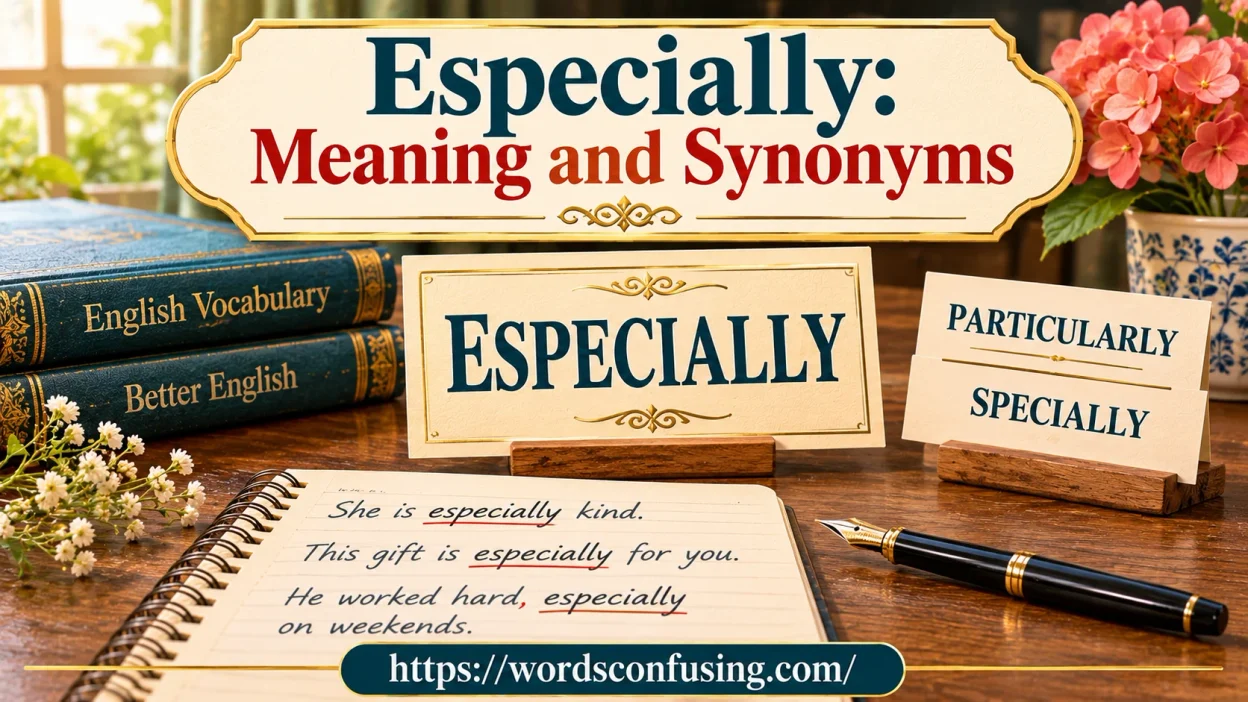
Choosing the right synonyms for especially can make your English writing sound more natural and professional. The meaning of especially is to give extra attention or importance to someone or something.
However, using repeated words creates repetition and weakens your writing style. You can use particularly, mainly, chiefly, above all, and in particular as alternative words or similar words. These expressions and phrases improve your word choice and strengthen your vocabulary.
Understanding their exact meaning, definitions, and usage helps you select appropriate synonyms and maintain correct usage in different sentences. For example, particularly highlights specific details, while mainly and chiefly describe a primary reason or primary purpose.
Learning through real sentences and sentence examples makes it easier to apply correctly each expression in different types of writing. This guide focuses on synonym selection, word variety, and contextual usage to develop your language skills and communication.
Using natural language, polished writing, and professional language can help you improve English, upgrade English, and achieve effective writing with better content quality. Strong English vocabulary and useful English expressions also support writing improvement.
As you practice, you’ll develop confident writing habits, reduce hesitation, and avoid unnecessary repetition. Most importantly, you’ll learn how to replace especially naturally and express your ideas clearly without hesitation.
Quick Answer
Especially means particularly, above all, or more than others. You use it to highlight something important or show a particular preference.
Example: I love reading books, especially mystery novels.
Here, especially highlights mystery novels as a particular favorite among different types of books.
Remember: Especially means particularly, while specially usually means for a particular purpose.
What Does Especially Mean?
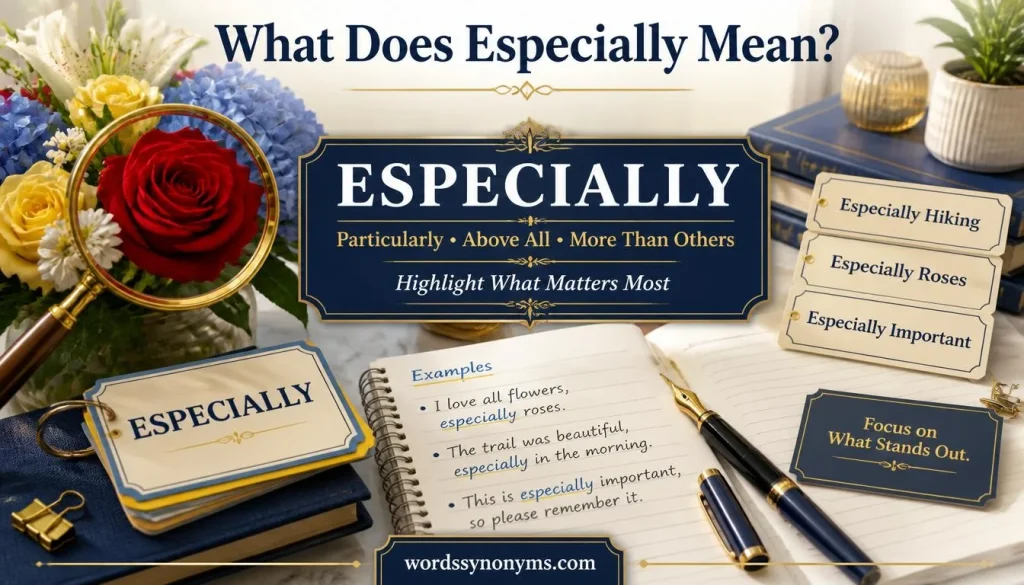
Especially means particularly, above all, or more than others. It emphasizes one person, thing, situation, or detail within a larger group.
You use this word when you want to draw attention to something specific. It tells readers or listeners that one detail deserves special consideration.
For example:
- I enjoy outdoor activities, especially hiking.
- This restaurant is especially popular with families.
- She loves all flowers, especially roses.
- Exercise is especially important during winter.
- I appreciate your help, especially during difficult times.
In the first example, hiking receives more attention than other outdoor activities. The sentence doesn’t suggest that you dislike other activities. Instead, it highlights your particular interest.
Similarly, the fourth example emphasizes the importance of exercise during winter. It suggests that exercise deserves extra attention during that period.
In simple words, especially helps you highlight something that stands out.
You can use it in positive, negative, and neutral statements. Its meaning depends on the surrounding sentence rather than expressing a particular emotion.
Especially Meaning and Definition
The word especially is an adverb used to emphasize something or distinguish it from other possibilities.
It commonly expresses three related ideas:
- Particular importance: Something deserves more attention than other things.
- Special preference: Someone likes or prefers one thing over others.
- Specific circumstances: Something becomes more relevant under particular conditions.
Especially Definition
| Word detail | Explanation |
| Word | Especially |
| Part of speech | Adverb |
| Meaning | Particularly, above all, or to a greater degree |
| Pronunciation | ih-SPESH-uh-lee |
| Phonetic spelling | /ɪˈspeʃəli/ |
| Syllables | Four |
| Root word | Special |
| Common usage | Emphasis, preference, and importance |
What Part of Speech Is Especially?
Especially is an adverb. An adverb modifies or adds information to a verb, adjective, another adverb, or sometimes an entire statement.
Consider these examples:
Especially modifying an adjective:
- This lesson is especially useful.
- The weather is especially cold today.
- Her explanation was especially clear.
In these sentences, especially modifies the adjectives useful, cold, and clear.
Especially modifying a verb:
- I especially enjoyed the final chapter.
- She especially appreciates honest people.
- They especially value teamwork.
Here, especially emphasizes the actions or feelings expressed by the verbs.
Especially modifying a phrase or statement:
- Especially during difficult times, friendship matters.
- I enjoy traveling, especially when the weather is pleasant.
These examples show how especially adds emphasis to different parts of a sentence.
Origin and Word Formation of Especially
The word especially comes from special, which relates to something distinct, particular, or different from others.
The adjective special developed from the Latin word specialis, meaning particular or individual. The suffix -ly helps form the adverb especially.
Its word formation follows this pattern:
- Special: An adjective describing something particular or distinctive.
- Especially: An adverb highlighting something particular or noteworthy.
For example:
- Special: This is a special occasion.
- Especially: This occasion is especially important to us.
The two words share the same basic idea but perform different grammatical functions.
How to Use Especially in a Sentence
Using especially correctly becomes easier when you understand what you want to emphasize. It usually introduces a particular detail within a broader statement.
Here are several common ways to use it.
Using Especially to Highlight a Particular Person or Thing
One common use involves selecting something from a larger group.
For example:
- I love Italian food, especially pizza.
- She enjoys spending time with her family, especially her grandmother.
- Many students struggle with grammar, especially punctuation.
- He likes sports, especially basketball and football.
In each example, especially introduces a specific person or thing. It narrows the reader’s attention without changing the general meaning.
Using Especially to Emphasize Importance
You can also use especially when something deserves additional attention or consideration.
For example:
- Good communication is especially important in relationships.
- Sleep is especially necessary for growing children.
- This information is especially useful for beginners.
- Safety becomes especially important during bad weather.
This construction works well in educational, professional, and everyday writing.
Using Especially With Adjectives
Especially frequently appears before adjectives to strengthen their meaning.
For example:
- The movie was especially entertaining.
- This book is especially helpful for beginners.
- Her performance was especially impressive.
- The instructions are especially clear.
Notice how especially increases the emphasis without changing the adjective’s basic meaning.
Using Especially With Adverbs
You can place especially before another adverb to emphasize how something happens.
For example:
- She sings especially beautifully.
- The team performed especially well.
- He responded especially quickly.
- The children behaved especially nicely.
These sentences highlight the degree or quality of an action.
Using Especially to Express Preferences
When discussing personal interests, especially helps identify your favorite option.
For example:
- I enjoy different kinds of music, especially jazz.
- She likes traveling, especially visiting historical places.
- My brother loves desserts, especially chocolate cake.
- I enjoy reading, especially before bedtime.
This usage sounds natural in casual conversations and personal writing.
Using Especially to Explain Particular Circumstances
Especially can introduce circumstances in which something becomes more important or noticeable.
For example:
- Carry an umbrella, especially when rain is expected.
- Drink enough water, especially during hot weather.
- Students should revise regularly, especially before examinations.
- Be careful when driving, especially at night.
Here, especially introduces a condition that deserves extra attention.
Especially Sentence Examples
The best way to understand a word is to see how people use it naturally. The following examples demonstrate different sentence positions and everyday situations.
Especially at the Beginning of a Sentence
You can begin a sentence with especially when it introduces an important condition or highlights a particular point.
Examples:
- Especially during winter, warm clothing becomes essential.
- Especially for beginners, simple instructions make learning easier.
- Especially when you’re tired, making decisions can become difficult.
- Especially in large cities, traffic congestion creates daily problems.
- Especially after a long journey, a comfortable bed feels wonderful.
Grammar tip: When especially introduces an introductory phrase, a comma often separates that phrase from the main clause.
However, punctuation depends on the sentence structure. Not every sentence beginning with especially needs a comma.
Especially in the Middle of a Sentence
This is one of the most common positions for especially.
Examples:
- I especially enjoy reading books about history.
- She is especially interested in environmental science.
- We especially appreciate your honesty and kindness.
- This advice is especially helpful for new employees.
- Children especially enjoy outdoor games during summer.
Here, especially appears naturally before the word or phrase receiving emphasis.
Especially at the End of a Sentence
Especially can also appear at the end when the context already makes the emphasized detail clear.
Examples:
- I enjoy spending time outdoors, especially.
- The entire family loves traveling, especially.
- She appreciates thoughtful gifts, especially.
These examples sound incomplete or unnatural without additional context. In ordinary writing, it’s better to place the emphasized detail after especially.
More natural alternatives include:
- I enjoy spending time outdoors, especially in spring.
- The entire family loves traveling, especially abroad.
- She appreciates thoughtful gifts, especially handmade ones.
Remember: Especially usually sounds most natural when readers can immediately identify what it emphasizes.
Especially in Everyday Conversations
Here are some examples you might hear in ordinary conversations:
- “I love this place, especially the food.”
- “You should visit during summer, especially in July.”
- “I’m tired today, especially after work.”
- “I enjoy spending time with you, especially on weekends.”
- “This song sounds especially beautiful.”
- “I like watching movies, especially comedies.”
These expressions sound friendly and natural without making everyday conversations unnecessarily formal.
Especially in Academic and Professional Writing
Especially also works well in formal and academic contexts.
Examples:
- This research is especially relevant to environmental studies.
- Clear communication is especially important in healthcare.
- The findings are especially significant for future research.
- This approach is especially effective in educational settings.
- Data accuracy is especially important when preparing financial reports.
The word isn’t limited to casual conversations. You can use it whenever you need to emphasize a relevant detail.
Especially vs. Specially: What’s the Difference?
Especially and specially look similar and share the same root word. However, they express different ideas.
Especially means particularly or above all. Specially generally means for a particular purpose or in a particular way.
The distinction becomes clearer when you compare their examples.
Meaning of Especially
Use especially when highlighting something over other things.
Examples:
- I enjoy fruits, especially strawberries.
- This subject is especially difficult for beginners.
- She likes all animals, especially dogs.
- Your advice was especially helpful.
In each example, especially emphasizes something within a broader context.
Meaning of Specially
Use specially when something has been designed, prepared, or arranged for a particular purpose.
Examples:
- This cake was specially made for your birthday.
- She bought a specially designed notebook.
- The room was specially prepared for the guests.
- These shoes were specially designed for running.
Here, specially explains the purpose or particular arrangement behind something.
Especially vs. Specially Comparison Table
| Especially | Specially |
| Means particularly or above all | Means for a particular purpose |
| Highlights importance or preference | Highlights purpose or preparation |
| Especially useful | Specially designed |
| Especially interesting | Specially prepared |
| Especially important | Specially made |
| Especially for beginners | Specially for this occasion |
Especially vs. Specially: Side-by-Side Examples
Consider these sentences:
Example 1:
- I especially like this gift.
- I specially ordered this gift.
The first sentence highlights your preference. The second explains that you ordered the gift for a particular reason or purpose.
Example 2:
- This book is especially useful for students.
- This book was specially written for students.
The first sentence emphasizes the book’s usefulness. The second explains its intended audience.
Example 3:
- She especially enjoyed the dinner.
- She specially prepared the dinner.
The first sentence describes her enjoyment. The second describes the preparation.
Can Especially and Specially Be Interchanged?
Sometimes their meanings overlap, particularly when discussing something intended for a particular person.
For example:
- This message is especially for you.
- This message is specially for you.
Both constructions can communicate that the message is intended for you. However, specially emphasizes the intended purpose more strongly.
In most situations, choosing the word based on its meaning will produce clearer writing.
Easy way to remember:
- Especially = Particularly.
- Specially = For a particular purpose.
Especially vs. Particularly: What’s the Difference?
Especially and particularly are close synonyms. Both words emphasize something or draw attention to a specific detail.
However, they sometimes carry slightly different shades of meaning.
Especially often highlights something as more important, noticeable, or preferred. Particularly often means specifically or to a greater degree than usual.
When to Use Especially
Use especially when highlighting one thing among several possibilities.
Examples:
- I love desserts, especially chocolate cake.
- This lesson is especially important for beginners.
- She enjoys outdoor activities, especially swimming.
- The restaurant is especially popular with tourists.
When to Use Particularly
Use particularly when emphasizing a specific detail, degree, or characteristic.
Examples:
- I’m particularly interested in modern history.
- The weather was particularly cold yesterday.
- She wasn’t particularly happy with the results.
- This problem affects particularly young children.
The final example sounds less natural than “This problem particularly affects young children” or “This problem especially affects young children.”
Especially vs. Particularly Comparison
| Especially | Particularly |
| Highlights something important or preferred | Highlights a specific detail or degree |
| Often introduces a preferred example | Often emphasizes a quality or characteristic |
| I love fruit, especially mangoes. | I’m particularly interested in mangoes. |
| This is especially useful. | This is particularly useful. |
| She especially enjoys reading. | She is particularly interested in reading. |
Can You Use Especially and Particularly Interchangeably?
Yes, many sentences allow both words without changing their overall meaning.
For example:
- This information is especially important.
- This information is particularly important.
Both sentences emphasize the importance of the information.
However, the words aren’t interchangeable in every construction. Consider:
- I enjoy all sports, especially tennis.
- I enjoy all sports, particularly tennis.
Both sentences work naturally because each word introduces a particular example.
The best choice depends on your intended emphasis and the surrounding sentence.
Read more: What Does It Mean When Someone Calls You Sunshine? Meanings
Especially vs. Specifically: What’s the Difference?
Especially and specifically sometimes appear in similar sentences. However, their meanings serve different purposes.
Especially highlights importance, preference, or distinction. Specifically identifies something precisely or clearly.
When to Use Especially
Use especially when one thing deserves more attention than others.
Examples:
- I enjoy several subjects, especially mathematics.
- This advice is especially helpful for students.
- She likes traveling, especially during spring.
When to Use Specifically
Use specifically when identifying an exact person, thing, detail, or purpose.
Examples:
- I specifically asked for a vegetarian meal.
- Which subject are you specifically interested in?
- The instructions specifically mention page five.
- This message was specifically written for new employees.
Especially vs. Specifically Comparison Table
| Especially | Specifically |
| Means particularly or above all | Means precisely or explicitly |
| Highlights importance | Identifies exact details |
| I especially like coffee. | I specifically ordered coffee. |
| This is especially useful. | This is specifically designed for beginners. |
| She enjoys sports, especially tennis. | She specifically requested tennis lessons. |
The easiest distinction is simple: especially highlights something while specifically identifies something precisely.
Synonyms of Especially
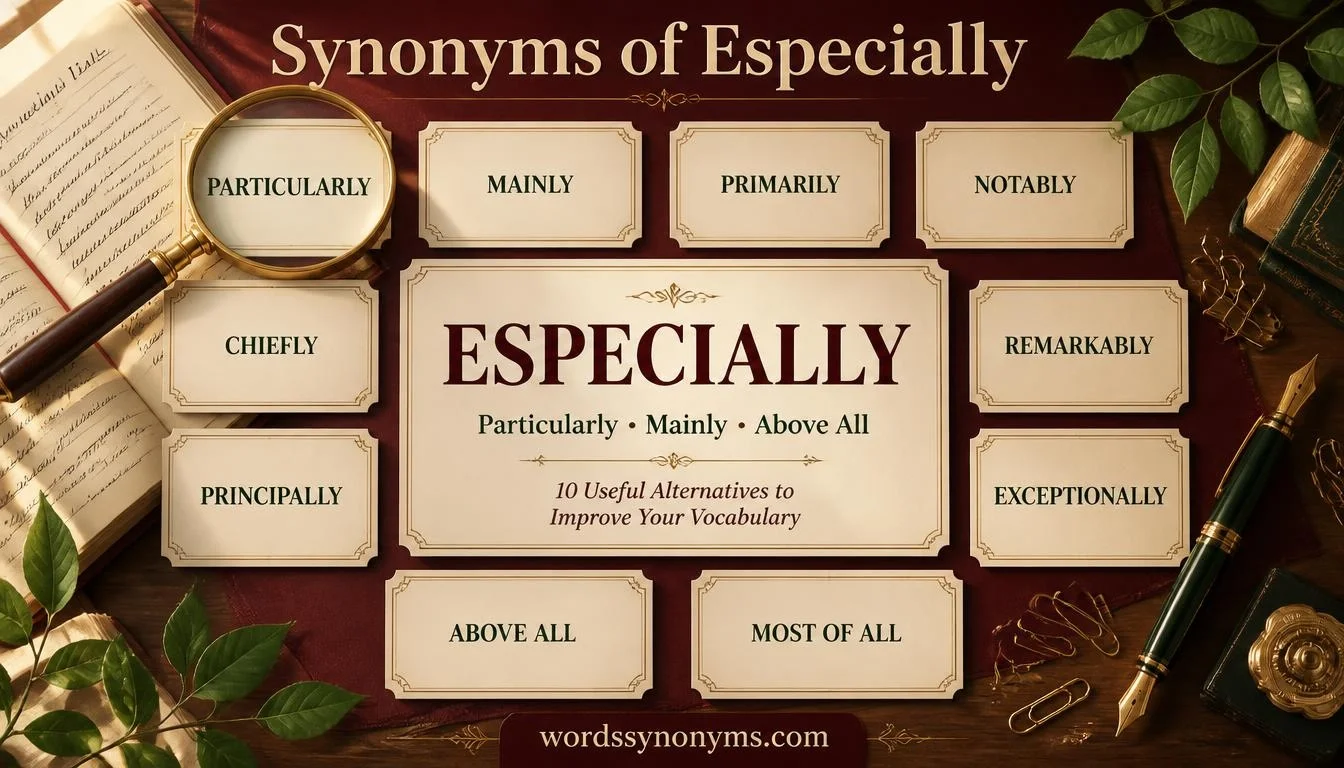
Sometimes repeating especially throughout an article makes your writing sound monotonous. Using suitable synonyms helps improve vocabulary and sentence variety.
However, not every synonym fits every situation. Some emphasize importance while others describe quantity, frequency, or distinction.
Here are useful alternatives to especially.
| Synonym | Meaning | Example |
| Particularly | To a greater degree or specifically | I particularly enjoy reading. |
| Mainly | Mostly or chiefly | The event mainly attracts students. |
| Primarily | First or chiefly | The course is primarily designed for beginners. |
| Notably | In a noticeable or important way | The results were notably different. |
| Chiefly | Mainly or principally | The business chiefly serves local customers. |
| Principally | Mainly or primarily | The building is principally used for offices. |
| Remarkably | In a surprising or unusual way | She performed remarkably well. |
| Exceptionally | To an unusual or outstanding degree | The service was exceptionally good. |
| Above all | More importantly than anything else | Above all, honesty matters. |
| Most of all | More than anything else | I enjoy spending time with family most of all. |
Particularly
Particularly is one of the closest alternatives to especially.
Example:
- I especially enjoy historical novels.
- I particularly enjoy historical novels.
Both sentences express a strong preference.
Mainly
Mainly means mostly or for the greatest part.
Example:
- The audience mainly consisted of university students.
Unlike especially, mainly doesn’t necessarily highlight a favorite or particularly important detail.
Primarily
Primarily emphasizes the principal purpose, reason, or focus of something.
Example:
- This website is primarily intended for English learners.
It works particularly well in professional and academic writing.
Notably
Notably highlights something that deserves attention because it’s interesting, important, or unusual.
Example:
- Several students improved their scores, notably those who practiced daily.
It often introduces a noticeable example or result.
Exceptionally
Exceptionally describes something that stands out because of its unusually high or low degree.
Example:
- The hotel provided exceptionally comfortable rooms.
It carries stronger emphasis than especially in many contexts.
Which Synonym Should You Choose?
Choose your replacement according to the meaning you want.
- Use particularly for emphasis or preference.
- Use mainly for the largest part.
- Use primarily for the principal purpose.
- Use notably for noticeable details.
- Use exceptionally for unusual degrees.
- Use above all for the most important consideration.
These alternatives can make your writing more precise without changing its intended message.
Antonyms of Especially
Especially doesn’t have one perfect opposite in every context. However, several words express generality rather than particular emphasis.
These alternatives can help you understand the difference between highlighting something and describing something broadly.
| Contextual opposite | Meaning | Example |
| Generally | In most cases or overall | Generally, students enjoy practical lessons. |
| Usually | In most situations | She usually walks to work. |
| Typically | In a normal or common way | Children typically enjoy outdoor games. |
| Ordinarily | Under normal circumstances | I don’t ordinarily drink coffee. |
| Commonly | Frequently or widely | This expression is commonly used. |
| Equally | To the same degree | Both options are equally useful. |
Especially vs. Generally
Especially highlights one particular detail. Generally describes something in a broad or overall sense.
- I especially enjoy science fiction.
- I generally enjoy fiction.
The first sentence emphasizes a particular preference. The second describes a broader interest.
Especially vs. Usually
Especially emphasizes importance or distinction. Usually describes something that happens regularly.
- I especially enjoy morning walks.
- I usually take morning walks.
The first sentence expresses preference. The second describes a habit.
Especially vs. Equally
Equally means to the same degree. Especially highlights something above other things.
- I especially like chocolate.
- I like chocolate and vanilla equally.
These sentences express different preferences.
Common Phrases and Expressions With Especially
Especially appears in several useful expressions. Understanding these combinations helps you recognize the word in everyday English.
Especially Important
This phrase highlights something that deserves particular attention.
Examples:
- Time management is especially important for students.
- Honesty is especially important in friendships.
- Regular practice is especially important when learning a language.
Especially Useful
Use this expression when something provides considerable help in a particular situation.
Examples:
- This guide is especially useful for beginners.
- These shortcuts are especially useful when working online.
- The dictionary is especially useful for learning new vocabulary.
Especially When
Especially when introduces a situation in which something becomes particularly relevant.
Examples:
- Take breaks, especially when working for long hours.
- Be patient, especially when teaching young children.
- Carry water, especially when exercising outdoors.
Especially For You
This expression emphasizes that something is intended for a particular person.
Examples:
- I saved this book especially for you.
- This opportunity is especially for you.
- She prepared a beautiful surprise especially for you.
Especially In This Case
Use this phrase when emphasizing the importance of something within a particular situation.
Examples:
- Clear instructions matter, especially in this case.
- We need accurate information, especially in this case.
- Experience can be valuable, especially in this case.
Especially During
This phrase introduces a period when something deserves additional attention.
Examples:
- Stay hydrated, especially during summer.
- Traffic becomes heavy, especially during holidays.
- Children need encouragement, especially during difficult times.
Especially Because
Especially because emphasizes a particular reason behind a statement.
Examples:
- I enjoy this neighborhood, especially because it’s peaceful.
- She likes the school, especially because the teachers are helpful.
- We chose this hotel, especially because it offers convenient transportation.
Especially Since
This expression highlights a reason or circumstance that makes something more important.
Examples:
- You should prepare early, especially since the examination is approaching.
- I appreciate your help, especially since you’ve been busy.
- We need extra time, especially since the project involves several departments.
Not Especially
Not especially means not particularly or not to a significant degree.
Examples:
- I’m not especially interested in sports.
- The movie wasn’t especially entertaining.
- She isn’t especially fond of spicy food.
This expression often softens a negative opinion. It can sound less direct than saying you dislike something.
Especially So
Especially so means particularly true or noticeable in the situation being discussed.
Examples:
- The road is dangerous at night, especially so during heavy rain.
- Exercise benefits people of all ages, especially so as they grow older.
This expression works better in formal or carefully structured writing.
Common Mistakes to Avoid When Using Especially
Although especially is easy to understand, certain mistakes can make your sentences awkward or unclear.
Here are some common problems and their corrections.
Confusing Especially With Specially
These words aren’t identical.
Incorrect: This dress was especially designed for the event.
Correct: This dress was specially designed for the event.
The second sentence emphasizes that someone designed the dress for a particular purpose.
However, you could write:
This dress is especially beautiful.
Here, especially highlights the dress’s appearance.
Using Especially When Specifically Is More Appropriate
Especially highlights importance. Specifically identifies something exact.
Awkward: I especially asked for a window seat.
Better: I specifically asked for a window seat.
The second sentence clearly communicates that you made an exact request.
Repeating Especially Too Often
Using the same word repeatedly can make your writing feel monotonous.
Repetitive:
- This book is especially useful.
- This lesson is especially important.
- This exercise is especially helpful.
Improved:
- This book is particularly useful.
- This lesson is especially important.
- This exercise is remarkably helpful.
However, don’t replace every occurrence with an unusual synonym. Natural wording matters more than vocabulary variety.
Placing Especially in an Awkward Position
Word placement affects how clearly a sentence communicates its meaning.
Awkward: I like especially reading historical books.
Better: I especially like reading historical books.
Also correct: I like reading historical books, especially historical biographies.
Place especially close to the word, phrase, or idea you want to emphasize.
Using Especially Without a Clear Emphasis
Especially should highlight something meaningful. Adding it unnecessarily can make sentences less direct.
Unnecessary: I especially went to the store yesterday.
Better: I went to the store yesterday.
However, this sentence makes sense:
I especially wanted to visit the bookstore yesterday.
Here, especially emphasizes the speaker’s particular intention.
Using Incorrect Punctuation Around Especially
Especially doesn’t automatically require commas.
Consider these examples:
- I especially enjoy reading novels.
- I enjoy reading novels, especially historical ones.
- Especially during winter, people need warm clothing.
The comma separates introductory or supplementary information where the sentence structure requires it. It isn’t part of the word itself.
Read more: On the Market or In the Market: Meaning and Correct Usage
Is Especially Formal or Informal?
Especially works in both formal and informal English. Its tone depends on the surrounding sentence and the situation.
You can use it in casual conversations, academic assignments, business communication, and professional documents.
Especially in Casual Conversations
People frequently use especially when expressing personal preferences or discussing everyday situations.
Examples:
- I love weekends, especially Sundays.
- This coffee tastes especially good today.
- I enjoy watching movies, especially thrillers.
These expressions sound relaxed and natural.
Especially in Academic Writing
Especially can emphasize important findings, conditions, or research topics.
Examples:
- This issue is especially relevant to environmental studies.
- The results are especially significant for younger participants.
- These findings are especially important for future research.
It helps writers highlight meaningful details without adding unnecessary words.
Especially in Business Communication
You can use especially in professional emails and workplace discussions.
Examples:
- Your feedback is especially valuable to our team.
- This deadline is especially important for the project.
- We appreciate your cooperation, especially during busy periods.
The word sounds professional without being overly formal.
Is Especially Suitable for Every Situation?
Although especially is widely accepted, another word may sometimes communicate your meaning more accurately.
For example:
- Use specifically when identifying an exact detail.
- Use mainly when describing the largest part.
- Use particularly when emphasizing a characteristic.
- Use specially when describing something prepared for a purpose.
Choosing the right word improves clarity and makes your writing more natural.
Is It Correct to Start a Sentence With Especially?
Yes, you can start a sentence with especially. However, the sentence must communicate a complete thought.
Especially often appears at the beginning when introducing a condition, person, or situation that deserves additional attention.
Correct Examples of Starting With Especially
- Especially during exams, students need proper rest.
- Especially for beginners, this explanation is easy to understand.
- Especially when traveling abroad, keeping your documents safe matters.
- Especially in crowded cities, public transportation can save time.
Each example contains a complete main clause.
Incorrect or Incomplete Sentence Structures
Consider this example:
Incorrect: Especially during winter.
This is a fragment because it doesn’t express a complete thought.
Correct: Especially during winter, people should protect their skin from dry weather.
Another example:
Incorrect: Especially for young children.
Correct: This activity is especially beneficial for young children.
The difference is simple. An introductory phrase needs a complete statement to communicate its meaning.
Should You Put a Comma After Especially?
Not always.
Compare these examples:
- Especially during winter, heating becomes important.
- Especially young children need regular sleep.
- Especially when temperatures drop, roads can become dangerous.
The first and third examples use introductory phrases followed by commas. The second doesn’t require one because especially directly modifies young children.
Grammar tip: Punctuation depends on sentence structure, not simply on whether especially appears first.
Practical Examples: Especially in Real-Life Situations
Understanding grammar rules becomes easier when you apply them to familiar situations.
Here are several practical examples showing how especially works in everyday communication.
Case Study: Talking About Food Preferences
Imagine someone asks about your favorite foods.
You could respond:
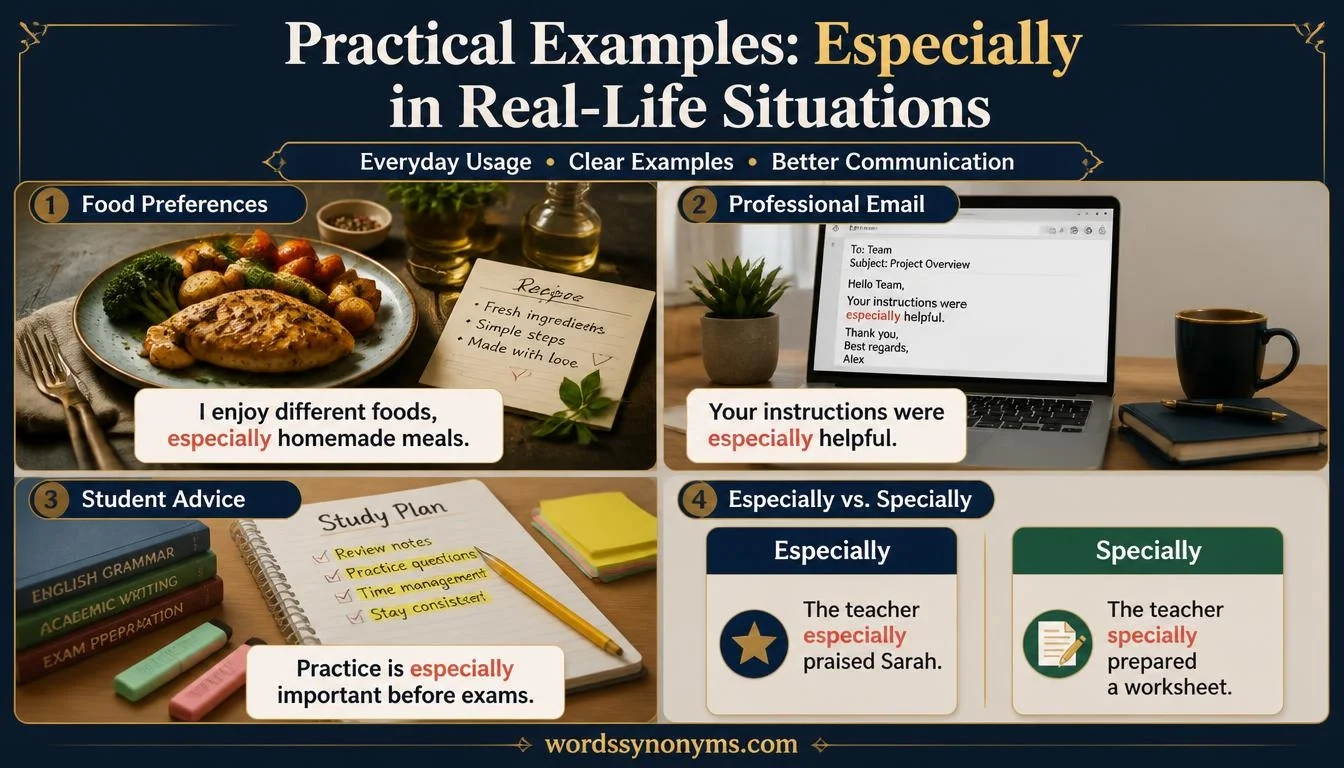
“I enjoy different kinds of food, especially homemade meals.”
This sentence communicates a general preference while highlighting homemade meals.
You could also say:
“I especially enjoy homemade meals because they remind me of family gatherings.”
Both sentences are correct. The first emphasizes a particular example while the second highlights your personal preference.
Case Study: Writing a Professional Email
Imagine your manager asks you to review an important project.
You might write:
“Your instructions were especially helpful when preparing the final report.”
This sentence expresses appreciation while highlighting the value of the instructions.
Alternatively:
“The deadline is especially important because the client expects delivery tomorrow.”
Here, especially emphasizes the importance of the deadline.
Case Study: Giving Advice to Students
Imagine you’re advising someone preparing for an examination.
You could say:
“Practice is especially important when preparing for competitive examinations.”
The sentence emphasizes one important condition for success.
Another example:
“Review difficult topics regularly, especially those you struggled with during class.”
Here, especially introduces a particular group of topics that deserve additional attention.
Case Study: Comparing Especially and Specially
Consider two sentences:
- The teacher especially praised Sarah.
- The teacher specially prepared a worksheet for Sarah.
The first sentence emphasizes Sarah as the person receiving praise. The second explains that the worksheet was prepared for a particular student.
Although the sentences look similar, their meanings differ.
FAQs
1. What does especially mean?
Especially means particularly or more than usual. It highlights something that deserves extra attention, importance, or consideration.
2. What are the most common synonyms for especially?
Common synonyms include particularly, mainly, chiefly, above all, and in particular. Each word adds a slightly different emphasis to your sentence.
3. Is particularly the same as especially?
Yes, particularly and especially have very similar meanings. Both emphasize a specific person, thing, or situation.
4. Can I use mainly instead of especially?
Yes, but only when the sentence focuses on the primary reason, purpose, or part of something. Mainly doesn’t always work as a direct replacement.
5. Is especially suitable for formal writing?
Absolutely! Especially works well in academic papers, professional emails, reports, and everyday communication. It helps highlight important information clearly.
6. How can I avoid repeating the word especially?
Try using particularly, chiefly, mainly, or in particular when they fit your sentence. Choosing words according to their context makes your writing smoother and more engaging.
Conclusion
Choosing the right synonym for especially can make a noticeable difference in your writing. Words like particularly, mainly, chiefly, above all, and in particular help you express emphasis without repeating the same word. However, each alternative carries a slightly different meaning, so consider your sentence before making a replacement. A word that sounds perfect in one situation might feel awkward in another.
The best way to improve your vocabulary is to practice using these alternatives in everyday conversations, emails, and articles. Pay attention to how each word changes the meaning or tone of a sentence. With regular practice, you’ll develop better word choices and make your English sound clearer, smoother, and more confident.

Franklin Hayes is a writer and editor at WordsConfusing.com, focused on making English vocabulary, grammar, and commonly confused words easy to understand. He writes clear, practical articles with simple explanations and useful examples to help readers improve their English with confidence.
His goal is simple: Making Confusing Words Simple.