
Yours or Your’s or Yours’? Which Is Correct? becomes easier when you understand how the possessive form of you works with pronouns, nouns, and the object in a sentence.
When providing an object alongside a pronoun, its position matters. In English grammar, the correct possessive form is yours, which refers to a possessed object that is already understood or mentioned.
For example, This book is yours shows that the book belongs to you. In contrast, your is a possessive determiner, so the object comes after it, as in This is your book. Through everyday writing, saying, and regular practice, I’ve found that this rule becomes natural and easier to remember when you focus on the object and subject.
Many English learners and native speakers get confused by your’s and yours’ because they look similar to other possessive words such as John’s and dog’s. However, those examples use regular nouns, while yours follows the rules for a possessive pronoun.
This article helps explore these possessive forms, their meanings, and useful examples, helping learners understand the difference and avoid common grammar mistakes and common mistakes. People frequently search for your’s or yours’ because they want to write correctly in emails, assignments, social media posts, and professional communication.
Learning the correct usage helps you communicate clearly and confidently, while simple tips make the grammar rules easier to remember forever.
Quick Answer
Let’s settle the main question first.
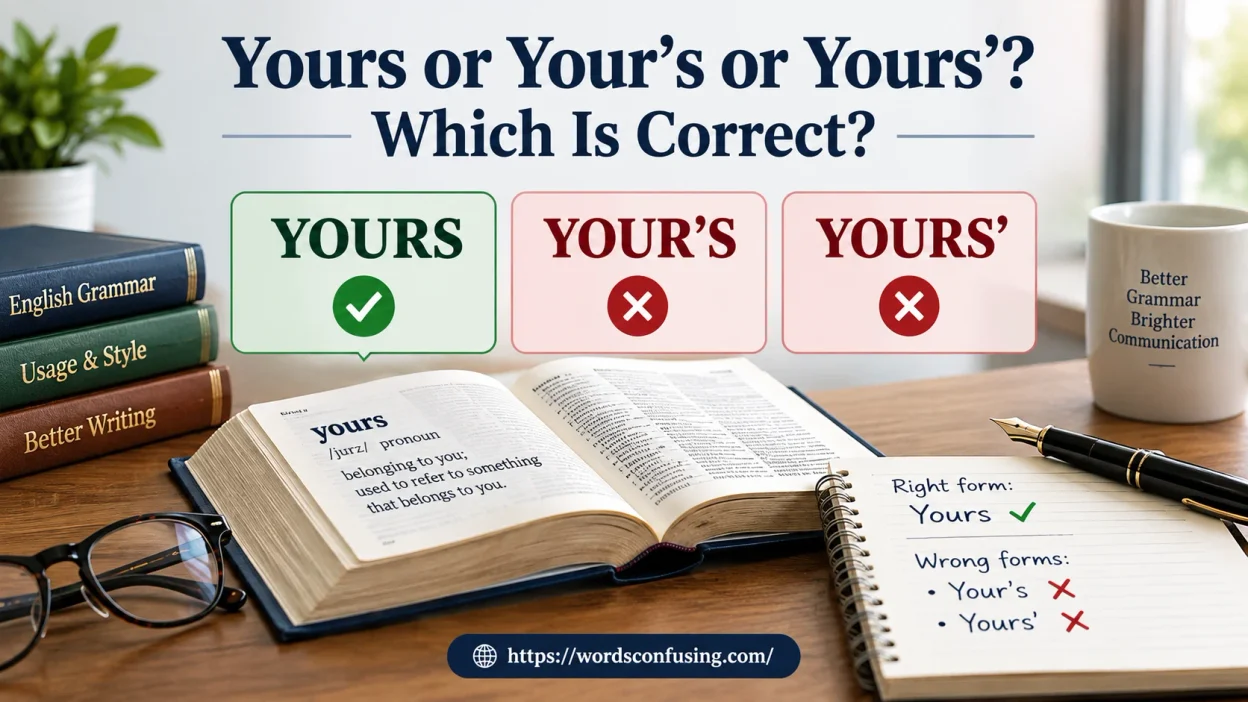
| Form | Correct? | Explanation |
| yours | ✅ Correct | Possessive pronoun |
| your’s | ❌ Incorrect | Unnecessary apostrophe |
| yours’ | ❌ Incorrect | Incorrect apostrophe placement |
If you need to show that something belongs to the person you’re speaking to, use yours.
For example:
- This book is yours.
- Is this jacket yours?
- The final decision is yours.
- That seat is yours.
Don’t write:
- ❌ This book is your’s.
- ❌ Is this jacket yours’?
The correct versions are:
- ✅ This book is yours.
- ✅ Is this jacket yours?
The easiest rule to remember is this:
Yours is already possessive, so it doesn’t need an apostrophe.
Once you remember that principle, the yours vs. your’s problem becomes much easier.
Is “Yours” Correct?
Yes. Yours is the correct standard English form.
It’s a possessive pronoun that means something belongs to the person or people being addressed.
Consider this sentence:
This phone is yours.
Here, yours tells us who owns the phone. It replaces a longer phrase such as your phone.
You could say:
This is your phone.
Or:
This phone is yours.
Both sentences communicate possession. The grammatical structure simply changes.
This distinction matters because your and yours don’t perform exactly the same job.
What Does “Yours” Mean?
Yours means belonging to you.
It can refer to one item, several items, or even something abstract.
Examples include:
- This bag is yours.
- These keys are yours.
- The choice is yours.
- The responsibility is yours.
- That idea was yours.
- The blue seats are yours.
Notice something important: yours doesn’t change form depending on whether the thing owned is singular or plural.
You can say:
This book is yours.
You can also say:
These books are yours.
The word yours stays exactly the same.
Why Is “Your’s” Incorrect?
The spelling your’s looks reasonable because English often uses apostrophes to show possession.
For example:
- Sarah’s phone
- John’s car
- the dog’s bowl
- the teacher’s desk
So it’s understandable why someone might think:
your + ‘s = your’s
Unfortunately, that pattern doesn’t work here.
Your’s is not the standard possessive form of your.
English has a separate group of words called possessive pronouns. These words already express possession without an apostrophe.
The relevant forms include:
- mine
- yours
- his
- hers
- ours
- theirs
You wouldn’t normally write:
- ❌ mine’s
- ❌ her’s
- ❌ our’s
- ❌ their’s
Likewise, you shouldn’t write:
- ❌ your’s
The apostrophe isn’t needed because yours already carries the possessive meaning.
Why the Apostrophe Causes Confusion
Apostrophes perform several jobs in English. They can indicate possession with nouns:
Maria’s laptop
They can also form contractions:
don’t = do not
you’re = you are
it’s = it is
That variety can make apostrophe rules feel inconsistent.
However, yours isn’t a contraction, and it isn’t a regular possessive noun like Maria’s.
It’s a possessive pronoun.
That’s why the spelling stays:
yours
Not:
your’s
Why Is “Yours’” Incorrect?
The form yours’ creates another common problem.
Some writers understand that your’s looks suspicious. They then move the apostrophe after the s and write yours’.
That doesn’t solve the problem.
Yours’ is also incorrect when used as the possessive pronoun meaning “belonging to you.”
For example:
❌ The car is yours’.
Correct:
✅ The car is yours.
The apostrophe has no grammatical job in that sentence.
The same principle applies to statements such as:
- ❌ The house is yours’.
- ✅ The house is yours.
- ❌ The choice is yours’.
- ✅ The choice is yours.
- ❌ These books are yours’.
- ✅ These books are yours.
There’s no need to attach an apostrophe simply because the word expresses ownership.
Your vs. Yours: What’s the Difference?
Understanding your vs. yours is the best way to avoid the apostrophe mistake.
The simplest distinction is:
Your comes before a noun.
Yours normally stands alone.
Compare these sentences:
This is your car.
This car is yours.
In the first sentence, your modifies the noun car.
In the second sentence, yours replaces the phrase your car.
That’s the central difference.
When to Use “Your”
Use your before a noun when you’re describing something that belongs to the person you’re addressing.
Examples:
- your house
- your phone
- your computer
- your idea
- your answer
- your family
- your friend
- your decision
Here are some complete sentences:
I like your jacket.
Where did you park your car?
That’s your responsibility.
I understand your point.
Did you finish your homework?
Notice that your doesn’t stand alone in these examples. A noun follows it.
When to Use “Yours”
Use yours when the noun doesn’t need to be repeated.
For example:
My phone is old. Yours is newer.
Here, yours means your phone.
You could also say:
My seat is near the door. Yours is by the window.
Again, yours replaces your seat.
This makes writing less repetitive and often sounds more natural.
Your vs. Yours at a Glance
| Word | Function | Example |
| your | Possessive determiner | This is your book. |
| yours | Possessive pronoun | This book is yours. |
| your’s | Incorrect form | ❌ This book is your’s. |
| yours’ | Incorrect form | ❌ This book is yours’. |
A useful memory trick is:
Your needs a noun. Yours doesn’t.
That’s not a rule without exceptions in every possible construction, but it’s an excellent practical guide for everyday English.
Yours or Your’s Examples
Examples make this rule much easier to recognize.
Correct Examples With “Yours”
Here are natural examples:
- Is this notebook yours?
- That blue car is yours.
- The final choice is yours.
- Which bag is yours?
- This responsibility is yours.
- The idea was yours.
- Those seats are yours.
- The decision is ultimately yours.
- This opportunity could be yours.
- The room on the left is yours.
In each sentence, yours indicates possession without an apostrophe.
Incorrect Examples With “Your’s”
These sentences contain a common mistake:
- ❌ Is this your’s?
- ❌ That laptop is your’s.
- ❌ The decision is your’s.
- ❌ This seat is your’s.
- ❌ Which one is your’s?
Correct them like this:
- ✅ Is this yours?
- ✅ That laptop is yours.
- ✅ The decision is yours.
- ✅ This seat is yours.
- ✅ Which one is yours?
Incorrect Examples With “Yours’”
The same rule applies to yours’:
- ❌ The house is yours’.
- ❌ That bag is yours’.
- ❌ The responsibility is yours’.
- ❌ The choice is yours’.
Correct:
- ✅ The house is yours.
- ✅ That bag is yours.
- ✅ The responsibility is yours.
- ✅ The choice is yours.
Possessive Pronouns and Apostrophes
The bigger grammar rule becomes clearer when you compare all the possessive pronouns.
| Personal form | Possessive determiner | Possessive pronoun |
| I | my | mine |
| you | your | yours |
| he | his | his |
| she | her | hers |
| we | our | ours |
| they | their | theirs |
The possessive pronoun generally stands independently.
For example:
This is my book.
This book is mine.
Similarly:
That is your book.
That book is yours.
And:
This is their house.
This house is theirs.
The possessive pronouns already have their own forms. You don’t create them by adding an apostrophe.
A Common Group of Apostrophe Mistakes
The confusion doesn’t stop with your’s.
Writers sometimes produce these forms:
- ❌ her’s
- ❌ our’s
- ❌ their’s
- ❌ your’s
The standard forms are:
- ✅ hers
- ✅ ours
- ✅ theirs
- ✅ yours
This pattern is worth remembering because learning one rule helps prevent several mistakes at once.
Yours vs. Your’s vs. Yours’: A Simple Grammar Test
When you’re unsure which form to use, ask yourself one question:
Am I trying to say that something belongs to you?
If the answer is yes and the word stands alone, use:
yours
For example:
Is this pen yours?
Don’t think of the word as your + s.
Think of yours as one complete possessive pronoun.
That mental shift makes a surprising difference.
Try This Quick Test
Choose the correct form:
- Is this phone ___?
- I think that jacket is ___.
- This is ___ notebook.
- The final decision is ___.
- Are these keys ___?
- I like ___ new car.
Answers:
- yours
- yours
- your
- yours
- yours
- your
The pattern becomes obvious once you look for the noun.
Your notebook.
Your car.
But:
The notebook is yours.
The car is yours.
“Yours” in Everyday English
You probably use yours more often than you realize.
People commonly use it when asking about ownership:
Is this yours?
Which one is yours?
Are these keys yours?
It’s also common when comparing things:
My phone is older than yours.
Her house is larger than yours.
Their team played better than yours.
The word also appears in expressions involving decisions and responsibility:
The choice is yours.
The decision is yours.
The next move is yours.
These phrases show that possession doesn’t always involve a physical object.
You can “own” an idea, decision, responsibility, opportunity, or choice in a broader sense.
“A Friend of Yours”: Is It Correct?
Yes.
The construction a friend of yours is completely natural in English.
For example:
I met a friend of yours yesterday.
Here, yours doesn’t directly follow a noun. Instead, it appears in the of yours construction.
Compare:
your friend
and:
a friend of yours
Both can refer to a person who is your friend.
The second structure can sound especially natural when introducing someone or referring to one person among several people connected to you.
Other examples include:
- a colleague of yours
- a neighbor of yours
- a relative of yours
- an old classmate of yours
- an idea of yours
- a suggestion of yours
None of these require an apostrophe after yours.
Read more: 7 Words for Someone Who Uses Other People
Can “Yours” Be Singular or Plural?
Yes.
Yours can refer to one thing or multiple things.
For one thing:
This book is yours.
For multiple things:
These books are yours.
The form doesn’t change.
That’s another useful feature of possessive pronouns. The number of the possessed item doesn’t turn yours into another word.
Consider these examples:
| Number | Example |
| Singular | This phone is yours. |
| Plural | These phones are yours. |
| Singular | That idea is yours. |
| Plural | Those ideas are yours. |
The surrounding words show whether you’re talking about one item or several.
Can “Yours” Refer to More Than One Person?
Yes.
Modern English uses you for both singular and plural audiences. Therefore, yours can also refer to something belonging to one person or multiple people.
For one person:
Is this jacket yours?
For multiple people:
Are these seats yours?
Context tells the reader whether you means one person or several.
The possessive form remains yours in both situations.
Yours in Formal Letters and Emails
You’ve probably seen yours at the end of letters.
Common expressions include:
- Yours sincerely
- Yours faithfully
- Yours truly
- Sincerely yours
This use is different from the possessive meaning we discussed earlier.
For example:
Yours sincerely,
Alex
Here, yours forms part of a traditional letter closing.
It doesn’t mean that the writer owns something.
By contrast:
The blue folder is yours.
Here, yours clearly expresses possession.
Understanding the difference prevents confusion.
“Yours Sincerely” vs. “Yours Faithfully”
Traditional formal correspondence often uses different closings depending on how the letter begins and the conventions being followed.
For example, some traditional style guides distinguish between:
Dear Mr. Smith → Yours sincerely
and:
Dear Sir or Madam → Yours faithfully
Modern business communication often uses more flexible conventions. However, both expressions remain recognizable formal sign-offs.
The important point for this article is simple: yours remains spelled without an apostrophe.
Your vs. You’re vs. Yours
Three words often get mixed up:
your, you’re, and yours.
They look similar, but their meanings differ.
| Word | Meaning | Example |
| your | Belonging to you | I like your idea. |
| you’re | You are | You’re ready. |
| yours | Belonging to you | The idea is yours. |
Here’s a simple test.
If you can replace you’re with you are, then you’re is probably correct.
You’re late.
becomes:
You are late.
But:
This bag is yours.
cannot become:
This bag is you are.
That tells you the correct word is yours.
Your vs. Yours vs. You’re Examples
Compare these sentences:
Your phone is ringing.
The phone is yours.
You’re holding the phone.
Each sentence uses a different word.
Your modifies phone.
Yours replaces your phone.
You’re means you are.
Once you separate these three functions, the spelling becomes much easier.
Common Mistakes With Yours
A few mistakes appear repeatedly in everyday writing.
Mistake: Writing “Your’s”
Incorrect:
That book is your’s.
Correct:
That book is yours.
The apostrophe doesn’t belong in the possessive pronoun.
Mistake: Writing “Yours’”
Incorrect:
The decision is yours’.
Correct:
The decision is yours.
The apostrophe after the s is unnecessary.
Mistake: Using “Yours” Before a Noun
Incorrect:
This is yours book.
Correct:
This is your book.
Yours normally doesn’t directly modify a following noun.
Use your instead.
Mistake: Using “Your” Alone
Incorrect:
This book is your.
Correct:
This book is yours.
When the noun is understood but omitted, yours does the job.
Yours or Your’s: A Practical Comparison
Here’s the entire rule in one table:
| Situation | Correct Form | Example |
| Before a noun | your | Your phone is here. |
| Standing alone | yours | The phone is yours. |
| Showing possession with a noun | your | I found your keys. |
| Replacing “your + noun” | yours | I found mine. Are these yours? |
| Adding an apostrophe to “your” | ❌ your’s | Incorrect |
| Adding an apostrophe after “yours” | ❌ yours’ | Incorrect |
This distinction solves most yours or your’s questions immediately.
A Short Case Study: Why “Yours” Looks Strange
Imagine you’re writing a message to a friend:
“I found your headphones. Are they your’s?”
The sentence feels familiar because you’ve probably seen your’s written many times.
But look at the structure:
your headphones
becomes:
the headphones are yours
The possessive pronoun isn’t formed by adding an apostrophe to your.
Instead, English uses the established form yours.
So the corrected message reads:
I found your headphones. Are they yours?
It’s a tiny spelling change. Yet it reflects an important grammatical distinction.
How to Remember “Yours” Without an Apostrophe
If apostrophes keep tempting you, use a simple memory trick.
Remember the Possessive Pronoun Family
Think of:
mine, yours, his, hers, ours, theirs
Most of these forms don’t use apostrophes.
You wouldn’t normally write:
mine’s
to mean possession.
You wouldn’t write:
hers’
either.
So don’t add an apostrophe to yours.
Another useful trick is:
“Your” owns a noun. “Yours” owns the idea without the noun.
For example:
Your car.
The car is yours.
That small contrast is enough to settle most situations.
Is “Yours” Ever Written With an Apostrophe?
For the standard possessive pronoun meaning belonging to you, use yours without an apostrophe.
In standard English, your’s isn’t the accepted spelling for this purpose, and yours’ isn’t the correct plural possessive form either.
It’s important not to confuse the spelling with unrelated apostrophe uses elsewhere in English.
For example:
you’re = you are
That apostrophe represents missing letters in a contraction.
But:
yours = belonging to you
No apostrophe is needed.
The two words may look related, but they follow different grammatical patterns.
FAQs
Is “Your’s” ever correct in English?
No. Your’s is not the standard possessive form of you. The correct word is yours, with no apostrophe.
Can “Yours’” be used for plural possession?
No. Yours’ is incorrect because yours is already a possessive pronoun and doesn’t need an apostrophe.
What is the difference between “your” and “yours”?
Use your before a noun, such as “your phone.” Use yours when the noun is understood, such as “The phone is yours.”
Why does “yours” not have an apostrophe?
Yours is a possessive pronoun. Unlike possessive nouns such as John’s, it doesn’t form possession with an apostrophe.
Is “This book is yours” grammatically correct?
Yes. Yours replaces the phrase “your book,” so “This book is yours” is completely correct.
How can I remember whether to use “your” or “yours”?
Use your + noun and yours when the noun doesn’t follow. For example, “This is your jacket” but “This jacket is yours.”
Conclusion
Getting yours, your’s, and yours’ right becomes much simpler once you understand one basic rule: yours is the correct possessive pronoun. It doesn’t need an apostrophe. Use your before a noun, as in “your book,” but use yours when the noun is already clear, as in “The book is yours.”
So, the next time you hesitate between your’s or yours’, skip the apostrophe and choose yours. A quick check of what comes before and after the word can help you spot the correct form instantly. With a little regular practice, this small grammar choice will soon feel natural and you’ll be able to write with confidence in emails, assignments, and everyday communication.