

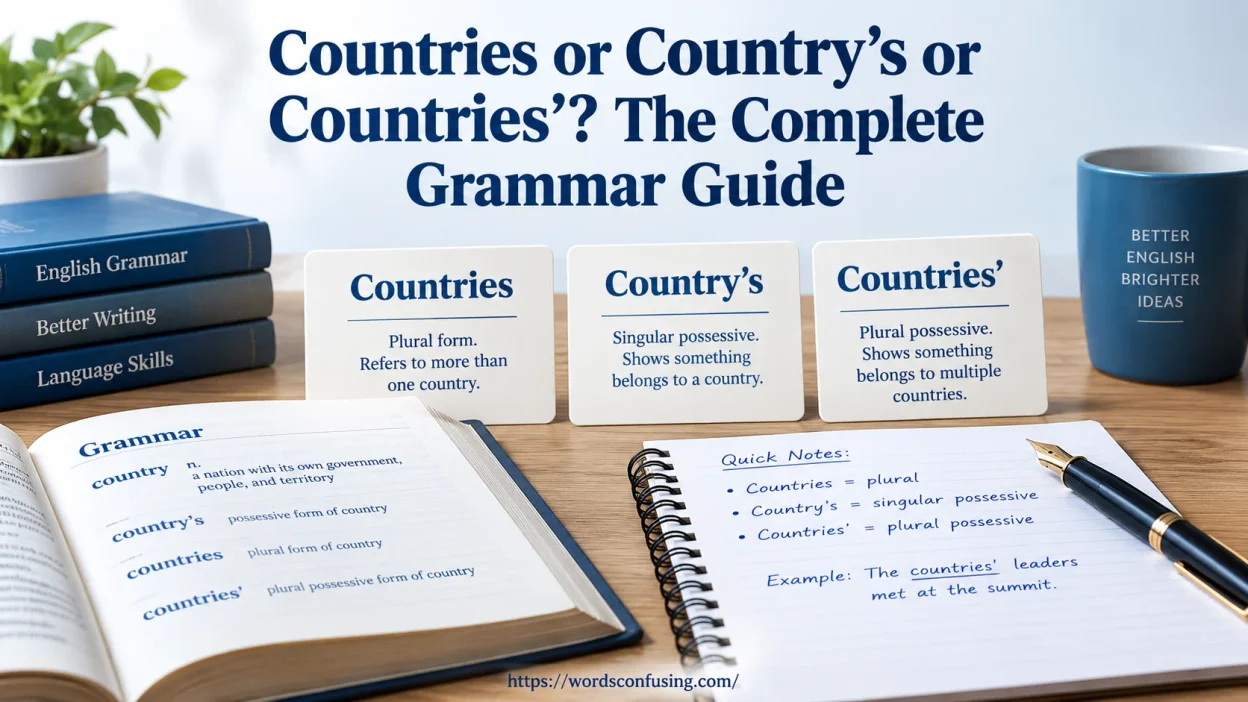
Countries or Country’s or Countries’ can confuse you because these forms look similar, but their meanings are different.
Country is a singular noun, while Countries is the plural form for more than one country. When forming the plural of words ending in y, the y becomes ies, so country becomes countries. Therefore, countrys is an incorrect spelling.
This simple rule helps improve accuracy in writing, school assignments, business communication, travel content, emails, blogs, and everyday conversations. A spell checker can flag the error, helping English learners and native speakers remember the correct spelling.
Country’s is the singular possessive form, showing possession or ownership when something belongs to one country, such as country’s culture. Countries’ is the plural possessive form, showing that something belongs to multiple countries, such as countries’ cultures.
The apostrophe marks possession, while these possessive rules apply in English, US English, and UK English. Once you understand this difference, choosing the correct form becomes much easier in everyday sentences.
Quick Answer
Here’s the fastest way to understand the difference:
| Form | What it means | Grammar | Example |
| country | One nation | Singular noun | The country is beautiful. |
| countries | More than one nation | Plural noun | Several countries participated. |
| country’s | Something belonging to one country | Singular possessive | The country’s economy is growing. |
| countries’ | Something belonging to multiple countries | Plural possessive | The countries’ leaders met. |
The key is to separate plural from possessive.
A plural tells you how many. A possessive tells you who owns or is associated with something.
For example:
- Countries = more than one country.
- Country’s economy = the economy of one country.
- Countries’ economies = the economies of multiple countries.
Think of the apostrophe as a signpost. It tells you that the noun has a possessive relationship with another word.
When to Use “Countries”
Countries is simply the plural form of country. Use it when you’re talking about two or more nations without showing possession.
For example:
Several countries attended the international conference.
Here, countries doesn’t own anything. It simply refers to multiple nations.
Other examples include:
- Many countries have different political systems.
- She has traveled to several countries.
- These countries share a common border.
- Developing countries face different economic challenges.
- The two countries signed a trade agreement.
- European countries attract millions of visitors every year.
Notice something important: none of these sentences requires an apostrophe.
Countries Is the Plural of Country
The word country follows a common English spelling rule.
When a noun ends in a consonant followed by y, English usually changes the y to ies when forming the plural.
So:
- country → countries
- city → cities
- family → families
- company → companies
- policy → policies
- university → universities
That’s why countrys is incorrect.
The correct spelling is:
country → countries
However, not every word ending in y follows this pattern. If a vowel comes before the y, English generally keeps the y and adds s.
For example:
- boy → boys
- key → keys
- day → days
- toy → toys
That distinction explains why we write countries, not countrys.
Examples of Countries in Sentences
Consider these examples:
The countries agreed to reduce trade restrictions.
The word countries means several nations. Nothing belongs to them grammatically in this sentence.
Five countries participated in the tournament.
Again, countries simply expresses plurality.
The neighboring countries maintain strong diplomatic ties.
The noun remains plural because you’re referring to more than one country.
Here’s another useful contrast:
One country joined the program.
Three countries joined the program.
The first sentence describes one nation. The second describes multiple nations.
When to Use “Country’s”
Country’s is the singular possessive form of country.
Use it when something belongs to, comes from, or relates to one country.
The construction is:
country + ’s = country’s
For example:
The country’s economy is growing rapidly.
The economy belongs to or is associated with one country.
You can often understand the possessive relationship by replacing country’s with of the country:
The country’s economy
= The economy of the country
This simple substitution works surprisingly well when you’re unsure.
Examples of Country’s in Sentences
Here are several examples:
- The country’s population has increased.
- The country’s capital attracts thousands of visitors.
- The country’s economy depends heavily on exports.
- The country’s government announced new policies.
- The country’s history stretches back centuries.
- The country’s borders have changed over time.
- The country’s education system serves millions of students.
- The country’s currency lost value against the dollar.
- The country’s culture attracts international attention.
- The country’s leaders addressed the crisis.
In every example, country’s refers to one country.
How to Recognize Singular Possession
When you see country’s, ask yourself:
“Does this refer to something connected with one country?”
If the answer is yes, country’s is usually the correct choice.
For example:
The country’s president delivered a speech.
There’s one country involved in the possessive relationship.
Compare that with:
The countries’ presidents delivered speeches.
Now several countries are involved.
That single distinction explains most errors involving these forms.
When to Use “Countries’”
Countries’ is the plural possessive form.
Use it when something belongs to, relates to, or is associated with more than one country.
The construction works like this:
countries + ’ = countries’
Notice where the apostrophe goes.
Because countries already ends in s, you don’t add another s after the apostrophe.
Correct:
countries’
Incorrect:
countries’s
For example:
The countries’ leaders met to discuss the agreement.
The leaders represent multiple countries. Therefore, countries’ is correct.
Examples of Countries’ in Sentences
Consider these examples:
- The countries’ leaders met yesterday.
- The countries’ economies are closely connected.
- The countries’ governments signed the agreement.
- The countries’ citizens welcomed the decision.
- The countries’ borders were carefully monitored.
- The countries’ policies differ considerably.
- The countries’ markets have expanded rapidly.
- The countries’ representatives attended the meeting.
- The countries’ histories contain many similarities.
- The countries’ cultures influence one another.
Each example involves multiple countries.
Why “Countries’s” Is Incorrect
A common mistake is writing:
❌ The countries’s governments agreed.
This form doesn’t follow standard English possessive rules.
The word countries is already plural. For a regular plural noun ending in s, add only an apostrophe to create the possessive:
countries → countries’
The same pattern appears in other plural nouns:
- students → students’
- teachers → teachers’
- companies → companies’
- nations → nations’
- countries → countries’
So:
The countries’ governments agreed.
That’s the correct form.
Country vs. Countries vs. Country’s vs. Countries’
These four forms become much easier when you compare them directly.
| Form | Singular/Plural | Possessive? | Basic meaning |
| country | Singular | No | One nation |
| countries | Plural | No | Multiple nations |
| country’s | Singular | Yes | Belonging to one nation |
| countries’ | Plural | Yes | Belonging to multiple nations |
Here’s how the meaning changes:
The country is large.
One nation.
The countries are large.
More than one nation.
The country’s population is large.
The population belongs to or is associated with one nation.
The countries’ populations are large.
The populations belong to or are associated with multiple nations.
The apostrophe doesn’t make a word plural. That’s one of the most important points to remember.
The letter “s” usually handles plurality. The apostrophe helps indicate possession.
Common Mistakes With Countries, Country’s, and Countries’
Apostrophe mistakes often happen because writers treat every s as though it requires the same rule. It doesn’t.
Mistake 1: Using “Country’s” as the Plural
Incorrect:
❌ There are many country’s in Europe.
Correct:
✅ There are many countries in Europe.
Why? You’re talking about multiple nations. You’re not showing possession.
Remember:
Plural only → countries
Mistake 2: Using “Countries” to Show Possession
Incorrect:
❌ The countries economy is growing.
Correct:
✅ The country’s economy is growing.
The economy belongs to or is associated with one country.
Therefore, the singular possessive form country’s is required.
Mistake 3: Using “Country’s” for Multiple Countries
Incorrect:
❌ The country’s leaders signed the agreement.
This sentence could be correct if you’re referring to one country. However, if you’re talking about leaders from multiple countries, it should be:
✅ The countries’ leaders signed the agreement.
The difference is subtle but important.
Mistake 4: Writing “Countries’s”
Incorrect:
❌ The countries’s governments agreed.
Correct:
✅ The countries’ governments agreed.
Because countries already forms the plural, the apostrophe goes after the final s.
Mistake 5: Adding an Apostrophe to Every Plural
Incorrect:
❌ Several countries’ participated.
Correct:
✅ Several countries participated.
Why?
The sentence doesn’t show possession. Countries is simply the plural subject.
Compare:
Several countries participated.
with:
Several countries’ governments participated.
In the second sentence, the governments belong to or represent the countries. That’s why the apostrophe appears.
Countries or Country’s in Real-World Sentences
Grammar becomes easier when you see these forms working naturally in context.
Travel and Geography
Many countries offer visa-free travel to certain visitors.
Here, countries simply means multiple nations.
The country’s mountains attract hikers from around the world.
Here, one country’s mountains are being discussed.
The countries’ tourism industries compete for international visitors.
Here, multiple nations possess or operate tourism industries.
Government and Politics
Several countries voted on the proposal.
No possession exists, so there’s no apostrophe.
The country’s government announced new regulations.
One country’s government is involved.
The countries’ governments released a joint statement.
Multiple governments are associated with multiple countries.
Business and Economics
The company operates in several countries.
This is simple plural usage.
The country’s economy relies heavily on exports.
The economy relates to one country.
The countries’ economies are closely linked.
Multiple economies are being discussed.
Education and Research
Students studied different countries during the semester.
No possession.
The country’s education system needs additional funding.
One education system belongs to or operates within one country.
Researchers compared the countries’ education systems.
Multiple countries have multiple education systems.
Countries’ vs. Country’s: The Difference in Possession
This is arguably the most important distinction in the entire topic.
The difference isn’t merely where the apostrophe sits. It tells you how many countries are involved.
One Country → Country’s
The country’s president spoke to reporters.
This refers to one country’s president.
You can rewrite it as:
The president of the country spoke to reporters.
Multiple Countries → Countries’
The countries’ presidents spoke to reporters.
This refers to presidents associated with several countries.
You can rewrite it as:
The presidents of the countries spoke to reporters.
That substitution provides a useful editing trick.
If of the country makes sense, country’s may be right.
If of the countries makes sense, countries’ may be right.
A Quick Visual Rule
| Meaning | Correct form |
| One country | country |
| More than one country | countries |
| Belonging to one country | country’s |
| Belonging to several countries | countries’ |
A useful memory trick is:
One country owns it → country’s. Multiple countries own it → countries’.
Why Is “Country” Changed to “Countries”?
The spelling of countries often causes confusion because English changes the final y.
The singular noun is:
country
The plural is:
countries
Why does the spelling change?
Because country ends with a consonant plus y. English commonly changes y to ies in this situation.
For example:
| Singular | Plural |
| country | countries |
| city | cities |
| family | families |
| story | stories |
| party | parties |
| company | companies |
However, the rule changes when a vowel comes before the final y:
| Singular | Plural |
| boy | boys |
| day | days |
| key | keys |
| toy | toys |
So countrys isn’t the standard plural spelling.
The correct spelling is always:
countries
Is There a Difference in American and British English?
For this particular issue, there isn’t a meaningful difference between standard American and British English.
Both varieties use:
- country for one nation
- countries for multiple nations
- country’s for singular possession
- countries’ for plural possession
For example:
The country’s economy is growing.
This construction follows the same basic possessive rule in both varieties.
Likewise:
The countries’ economies are growing.
The grammar remains the same.
Some English spelling and vocabulary rules differ between American and British English. This isn’t one of those cases.
Countries or Country’s in Formal Writing
Correct apostrophe usage matters even more in professional and academic writing because a tiny punctuation error can make otherwise polished work look careless.
You might encounter these forms in:
- research papers
- government reports
- international business documents
- news articles
- policy reports
- academic essays
- travel publications
- legal documents
- economic analyses
Consider the difference:
The countries economy depends on exports.
The missing apostrophe makes the relationship unclear.
A better version is:
The country’s economy depends on exports.
If several nations are involved:
The countries’ economies depend on exports.
Don’t Add Apostrophes to Ordinary Plurals
One of the most useful editing habits is to stop treating apostrophes as plural markers.
Apostrophes don’t normally make ordinary nouns plural.
So write:
- three countries
- five companies
- several cities
- many families
Not:
- ❌ three country’s
- ❌ five company’s
- ❌ several city’s
- ❌ many family’s
An apostrophe belongs there only when the grammatical relationship requires possession.
Countries or Country’s: A Practical Editing Method
When proofreading, don’t stare at the apostrophe first. Start with the meaning.
Take this sentence:
The countries economy is expanding.
Ask:
How many countries are involved?
If it’s one, the sentence becomes:
The country’s economy is expanding.
If it’s multiple countries, change the entire structure:
The countries’ economies are expanding.
Notice that changing from singular to plural can affect more than one word.
This is why proofreading by meaning works better than checking punctuation in isolation.
A Useful Substitution Trick
Replace the possessive phrase with an of phrase.
For singular possession:
The country’s population
becomes:
The population of the country
For plural possession:
The countries’ populations
becomes:
The populations of the countries
If the rewritten phrase makes sense, you’ve probably chosen the correct possessive form.
Read more: Series or Series’s or Series’? Grammar Guide
Countries, Country’s, and Countries’ in a Mini Case Study
Consider a sentence from an international economics report:
The countries economies are growing at different rates.
At first glance, the meaning is understandable. However, the grammar needs correction.
If the report compares multiple nations, the correct version is:
The countries’ economies are growing at different rates.
Why?
- countries = multiple nations
- countries’ = possession involving multiple nations
- economies = multiple economies
Now consider a different sentence:
The country’s economy is growing at 4%.
Here, country’s is correct because the sentence discusses the economy of one country.
The contrast is clear:
The country’s economy = one country’s economy.
The countries’ economies = multiple countries’ economies.
That distinction becomes much easier when you identify the number of owners first.
Quick Grammar Cheat Sheet
Save this simple reference if you regularly confuse these forms.
| What you mean | Use | Example |
| One nation | country | The country is peaceful. |
| More than one nation | countries | Several countries attended. |
| Something belonging to one nation | country’s | The country’s flag changed. |
| Something belonging to several nations | countries’ | The countries’ flags changed. |
The Simplest Memory Trick
Remember these four patterns:
One → country
Many → countries
One + possession → country’s
Many + possession → countries’
There’s no need to overcomplicate it.
Practice Quiz: Countries, Country’s, or Countries’?
Choose the correct form in each sentence.
Choose the Correct Form
The ______ population is growing rapidly.
A. country
B. country’s
C. countries
D. countries’
Answer: B — country’s
The population belongs to or is associated with one country.
Several ______ signed the agreement.
A. country’s
B. countries
C. countries’
D. country
Answer: B — countries
The word simply refers to multiple nations.
The ______ leaders met to discuss trade.
A. country’s
B. countries
C. countries’
D. country
Answer: C — countries’
Multiple countries are associated with multiple leaders.
She has visited six ______.
A. country’s
B. countries
C. countries’
D. country
Answer: B — countries
The sentence needs the plural noun.
The ______ capital is located near the coast.
A. country’s
B. countries
C. countries’
D. country
Answer: A — country’s
One country’s capital is being discussed.
The ______ economies have grown substantially.
A. country’s
B. countries
C. countries’
D. country
Answer: C — countries’
The sentence refers to the economies of multiple countries.
Many ______ have introduced similar policies.
A. country’s
B. countries
C. countries’
D. country
Answer: B — countries
The word functions only as a plural noun.
The ______ government announced the new policy.
A. countries
B. countries’
C. country’s
D. country
Answer: C — country’s
The government belongs to or represents one country.
FAQs
1. Is “countrys” a correct spelling?
No. Countrys is incorrect. The correct plural form is countries.
2. When should I use “countries”?
Use countries when you mean more than one country, such as “Many countries have different cultures.”
3. What does “country’s” mean?
Country’s is the singular possessive form. It shows that something belongs to one country, such as “the country’s economy.”
4. When should I use “countries’”?
Use countries’ when something belongs to multiple countries, such as “the countries’ agreements.”
5. Why does “country” become “countries”?
Because country ends in y. In this plural form, the y changes to ies, creating countries.
6. Is the apostrophe important in “country’s” and “countries’”?
Yes. The apostrophe changes the meaning by showing possession. Country’s refers to one country, while countries’ refers to several.
Conclusion
In the end, choosing between Countries, Country’s, and Countries’ becomes much easier when you focus on what you mean. I’ve found that checking whether you’re talking about one country, several countries, or ownership helps prevent small spelling mistakes. Once this simple habit becomes natural, your writing feels clearer and more confident.
Whether you’re working on school assignments, writing an email, creating travel content, or simply having an everyday conversation, using the right form helps your message sound polished and easy to understand.

Shafiq Ur Rehman is a writer and content contributor at WordsConfusing.com. He enjoys exploring the English language, common word confusions, vocabulary, and practical writing tips. His goal is to make English easier to understand through clear, simple, and useful articles.