
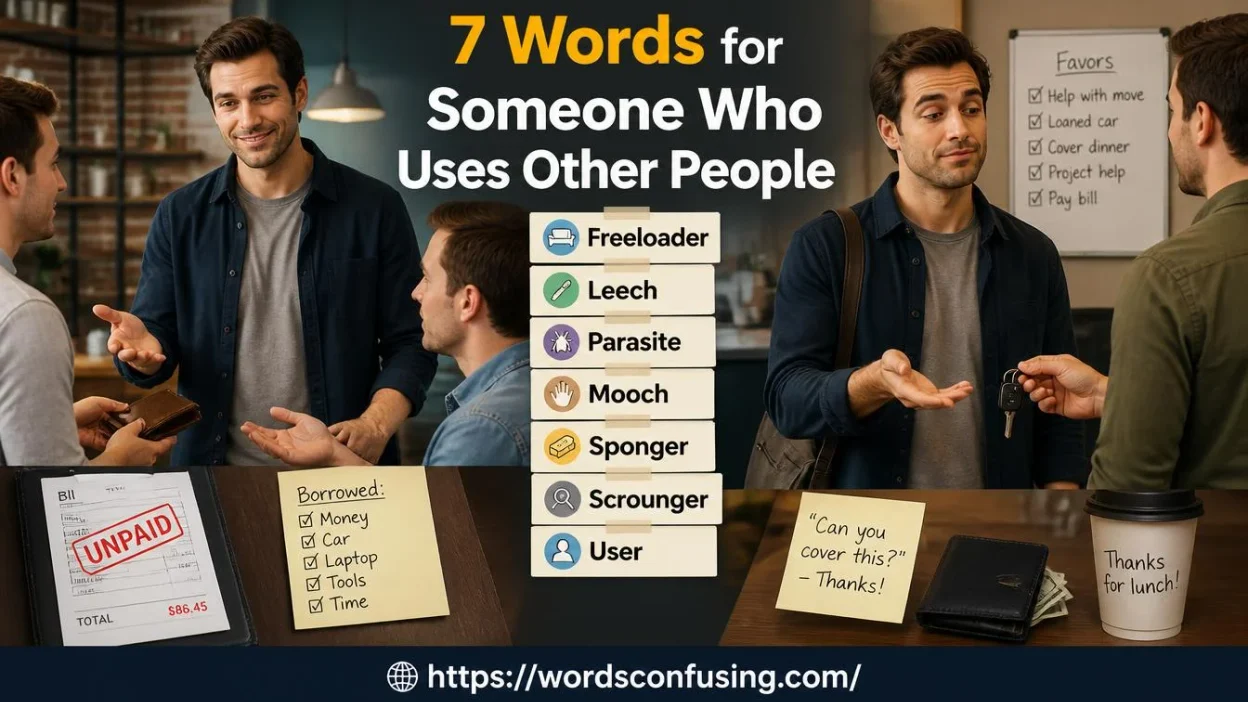
The phrase 7 Words for Someone Who Uses Other People helps you choose a precise term for harmful behavior in everyday English usage.
When you need the right word for someone who constantly takes advantage of other people for personal gain, context matters. Words such as manipulate, exploit, and benefit can describe selfishness, manipulation, opportunism, dishonesty, or exploitation.
The exact meaning can change depending on whether someone like this uses others through pressure, deception, or a lack of genuine concern for their well-being. Understanding these nuanced terms can make your English vocabulary stronger and help you communicate more naturally.
This guide explains seven useful words with their meanings, examples, and differences, helping you understand the best words to describe this type of person. These word choices can help you communicate ideas more clearly and confidently in different situations, including conversations, formal writing, workplace discussions, and business communication.
If you’re interested in improving vocabulary, learning a few words and knowing how to apply them can improve accurate expression. Good grammar also supports clear writing, while an effective, professional approach helps you learn and use these terms naturally in your article or other writing.
Quick Answer
The best words for someone who uses other people include user, exploiter, freeloader, leech, parasite, mooch, and sponger. Each term describes a different type of selfish or exploitative behavior. User is the broadest word, while exploiter describes someone who unfairly takes advantage of others for personal gain. If the person mainly takes money, food, favors, or other free benefits, freeloader or mooch may be more accurate.
Which Words Can Describe Someone Who Uses Other People?
The seven most useful words are freeloader, leech, parasite, mooch, sponger, scrounger, and user.
Some focus mainly on money and material support. Others describe a broader pattern of exploitation.
| Word | Main meaning | Typical context | Tone |
| Freeloader | Takes benefits without contributing fairly | Money, food, housing, expenses | Negative |
| Leech | Clings to someone for personal gain | Money, relationships, support | Strongly negative |
| Parasite | Lives off or exploits others | Long-term dependence | Very strong |
| Mooch | Repeatedly asks for things without paying or returning them | Food, money, small favors | Informal, negative |
| Sponger | Depends on others for support | Housing, money, daily expenses | Negative |
| Scrounger | Gets things by asking instead of buying or earning them | Money, food, resources | Disapproving |
| User | Takes advantage of people for personal benefit | Relationships, favors, connections | Negative |
Dictionary sources treat these terms as related without making them perfect equivalents. Merriam-Webster, for example, connects freeloader with terms such as parasite, sponge, leech, sponger, and moocher, while its synonym guidance highlights different shades of meaning.
The easiest way to remember the differences is to think about what the person takes and how they take it.
Someone who never pays their share at dinner might be a freeloader. A person who constantly attaches themselves to wealthy friends could be called a leech. Meanwhile, anyone who uses a friend only to gain introductions to influential people might simply be a user.
Context changes the best word.
Freeloader
Freeloader is probably the most useful everyday word when someone receives benefits without making a fair contribution.
Cambridge defines a freeloader as someone who uses things such as money, food, or accommodation provided by others without giving anything in exchange. Merriam-Webster similarly describes a freeloader as someone supported by another person without making an adequate return.
The word usually suggests a pattern, rather than one isolated favor.
For example, if your friend forgets their wallet once and you buy lunch, calling them a freeloader would probably be unfair. If they conveniently “forget” their wallet every week, never reimburse you, and expect you to keep paying, the word fits much better.
What Does “Freeloader” Mean?
A freeloader enjoys someone else’s resources while avoiding their share of the cost, effort, or responsibility.
Common examples include someone who:
- Lives in a friend’s home without contributing to expenses
- Regularly lets others pay for meals
- Uses someone else’s streaming accounts indefinitely
- Accepts free transportation without returning the favor
- Relies on friends to cover recurring expenses
- Avoids shared responsibilities while enjoying shared benefits
The central idea is getting something for nothing.
Examples of “Freeloader”
“He’s become a freeloader who expects everyone else to pay for him.”
“She invited him to stay for a few days, but the freeloader never left.”
“Nobody minds helping occasionally, but he can’t keep acting like a freeloader.”
Freeloader vs. Mooch
These words sit very close together.
A freeloader focuses on benefiting without contributing. A mooch often focuses on repeatedly asking people for things.
Think of it this way:
Freeloader = takes the free benefit.
Mooch = keeps asking for the free benefit.
The distinction isn’t absolute. In everyday conversation, people often use the words interchangeably.
Leech
Leech paints a much stronger picture.
In its figurative sense, Merriam-Webster defines a leech as a person who attaches themselves to someone while seeking advantage or gain. Its synonym guidance says leech emphasizes persistent attachment to another person for personal advantage.
The metaphor comes from the bloodsucking animal. That’s why the word carries such a vivid negative image.
A person described as a leech isn’t merely accepting help. The implication is that they keep taking.
When Should You Call Someone a Leech?
Use leech when someone appears to cling to another person because that relationship provides money, status, resources, access, or some other advantage.
For example, imagine someone who constantly spends time with a successful friend but disappears whenever that friend needs support. The relationship looks one-sided. Calling the person a leech emphasizes that imbalance.
The word can apply to:
- Financial support
- Social connections
- Professional opportunities
- Emotional energy
- Housing
- Status or influence
- Constant favors
Examples of “Leech”
“He never contributes anything. He’s just a leech.”
“She realized that some of the people around her were leeches interested only in her money.”
“After years of supporting him, his family finally told the leech to move out.”
Leech vs. Parasite
Both words are harsh. However, leech emphasizes persistent attachment.
Parasite can sound even more severe because it compares the person to an organism that survives by depending on a host.
Merriam-Webster’s synonym guidance captures the distinction neatly: leech stresses persistent clinging or draining for personal advantage, while parasite can apply to someone who clings to a person of wealth, power, or influence.
Parasite
Parasite is one of the strongest words on this list.
Its literal biological meaning refers to an organism that lives in or on another organism while obtaining nutrients or other benefits, often harming the host. The figurative meaning applies that relationship to people.
When you call someone a parasite, you’re suggesting that they live at another person’s expense without making a proper contribution.
That’s a serious accusation.
Why Does “Parasite” Sound So Strong?
The strength comes from the metaphor.
A parasite depends on a host. In the figurative use, the “host” might be a parent, partner, friend, employer, organization, or wealthy associate.
The word therefore implies more than ordinary dependence. It suggests one-sided exploitation.
For instance, a young adult temporarily living with parents while saving money isn’t automatically a parasite. If that person refuses every reasonable responsibility while expecting the family to fund their lifestyle indefinitely, the description becomes more understandable.
Examples of “Parasite”
“He has spent years living off his relatives and contributing nothing. They see him as a parasite.”
“The company was accused of acting like a parasite by profiting from another group’s work without contributing.”
“She finally recognized that the relationship had become parasitic.”
Parasite vs. Freeloader
A freeloader usually takes advantage of free goods, services, or hospitality.
A parasite suggests a deeper and more persistent dependency.
| Situation | More natural word |
| Someone never pays for group meals | Freeloader |
| Someone lives off another person for years | Parasite |
| Someone constantly asks friends for small things | Mooch |
| Someone clings to influential people for advantage | Leech |
Because parasite is so insulting, use it carefully. If you simply need a neutral description, “someone who takes advantage of others” is safer.
Mooch
Mooch is an informal American English term that works especially well in casual conversation.
As a verb, mooch can mean getting things from another person or living off their generosity without providing payment or another benefit in return. As a noun, a mooch is someone who behaves that way.
The word often sounds less dramatic than parasite.
What Does a Mooch Usually Ask For?
A mooch might ask for:
- Money
- Lunch
- Drinks
- Cigarettes
- Rides
- Tickets
- Small purchases
- Access to accounts or services
- Repeated favors
The requests don’t necessarily have to involve large amounts of money.
That’s part of the word’s usefulness. Someone who repeatedly says, “Can you spot me?” or “Can I borrow yours?” may earn the label mooch when the behavior becomes habitual.
Examples of “Mooch”
“He’s always mooching off his friends instead of paying his share.”
“Don’t be a mooch. You can afford your own lunch.”
“She has a reputation as a mooch because she rarely buys anything herself.”
Mooch vs. Freeloader
The distinction is subtle but useful.
Mooch often describes the asking behavior. Freeloader emphasizes the unfair benefit.
Someone might mooch a cup of coffee from you. Someone who repeatedly expects you to cover their meals, rent, and transportation is more clearly a freeloader.
Merriam-Webster also notes that mooch can have another meaning: in British usage, it can mean wandering around slowly or aimlessly. In American informal usage, however, the relevant meaning here involves getting things from others without providing a return.
Sponger
Sponger describes someone who depends heavily on other people instead of making an adequate contribution.
Merriam-Webster defines the figurative noun as a parasitical person and connects it with cadger. Its thesaurus describes a sponger as someone supported by or seeking support from another without making an adequate return.
The word often appears in situations involving money, housing, food, and everyday support.
When Is “Sponger” the Right Word?
Imagine someone moves into a friend’s home.
They promise to find work and contribute to rent. Months pass. They don’t pay anything. They eat the household’s food, use the utilities, and make no meaningful effort to change the arrangement.
Sponger fits that situation particularly well.
The word highlights dependency and the failure to contribute.
Examples of “Sponger”
“He moved in with his brother and became a sponger.”
“She was tired of supporting a sponger who refused to help with the bills.”
“Nobody wanted to keep paying for his lifestyle. They thought he was becoming a sponger.”
Sponger vs. Mooch
A mooch tends to sound more casual and may involve individual requests.
A sponger often suggests a broader lifestyle of depending on others.
Mooch: “Can I borrow twenty dollars?”
Sponger: “I’ll live here indefinitely while everyone else pays the bills.”
That isn’t a rigid rule, but it’s a useful distinction.
Scrounger
Scrounger describes someone who tries to obtain things by asking for them rather than buying or earning them.
Cambridge specifically associates the word with obtaining things, especially money or food, by asking instead of paying or working for them. It labels the noun as disapproving.
The related verb scrounge has the same basic idea.
When Should You Use “Scrounger”?
Use scrounger when the behavior centers on getting resources through requests.
For example, someone who never buys snacks but constantly asks coworkers for theirs could be called a scrounger.
Someone who repeatedly asks friends for money may also fit the description.
The term can also describe someone who gathers things that other people no longer want or need. The exact context determines whether the behavior sounds opportunistic, resourceful, or simply practical.
Examples of “Scrounger”
“He’s always asking everyone for free food. What a scrounger.”
“She didn’t want to look like a scrounger, so she paid for her own supplies.”
“They called him a scrounger because he constantly asked neighbors for things.”
Scrounger vs. Sponger
The difference comes down to how the person benefits.
A scrounger actively seeks things by asking.
A sponger depends on others for ongoing support.
Someone asking several people for free meals is a scrounger. Someone living with a relative for years while refusing to contribute is more naturally a sponger.
User
User is the broadest term on this list.
Unlike freeloader or mooch, it doesn’t require money or material goods. A user can exploit someone’s kindness, professional connections, emotional support, influence, skills, or time.
Cambridge recognizes use in a disapproving sense when someone takes advantage of another person or exploits them. It gives the example of someone using another person’s ideas for personal credit.
How Can Someone Be a User?
A person might use someone for:
- Money
- Free accommodation
- Professional connections
- Career opportunities
- Social status
- Emotional support
- Transportation
- Childcare
- Expertise
- Labor
- Favors
- Access to influential people
This makes user especially useful when the exploitation isn’t primarily financial.
Examples of “User”
“She only calls when she needs something. She’s a user.”
“He wasn’t interested in friendship. He was using her connections to advance his career.”
“Once I stopped doing favors, the user stopped contacting me.”
Why “User” Differs From “Freeloader”
A freeloader generally wants benefits without paying or contributing.
A user may contribute something superficially while still treating another person as a means to an end.
For example, someone might be friendly, complimentary, and attentive because they want access to your professional network. They may not ask you for money at all.
That person can still be a user.
The core issue is exploitation rather than simple free consumption.
Which Word Is Best for Someone Who Uses Other People?
The best word depends on the behavior you’re describing.
If you’re unsure, user is the broadest choice. If the situation centers on free goods or services, freeloader usually sounds more precise.
| If the person… | Best word |
| Rarely pays their fair share | Freeloader |
| Constantly clings to someone for advantage | Leech |
| Lives at another person’s expense | Parasite |
| Keeps asking for free things | Mooch |
| Relies on others for ongoing support | Sponger |
| Tries to obtain things by asking | Scrounger |
| Exploits relationships for personal gain | User |
These aren’t mathematical categories. Real-world behavior often overlaps.
Someone could easily be both a mooch and a freeloader. A person might also be a leech and a user if they attach themselves to people for multiple benefits.
What Does It Mean to Use Other People?
To use another person means to treat that person as a means of gaining something for yourself, especially when you ignore their interests or take unfair advantage of their kindness.
Cambridge defines the disapproving sense of take advantage of someone as treating someone badly to obtain something beneficial. Merriam-Webster similarly defines exploit as using someone unfairly for one’s own advantage.
The important word here is unfairly.
People naturally depend on one another. That’s normal.
Friends help friends. Families share resources. Coworkers exchange favors. Partners support each other. None of that automatically counts as using someone.
The problem begins when the relationship becomes one-sided and exploitative.
Signs Someone May Be Using You
Look for a repeated pattern rather than one isolated event.
Common warning signs include:
- They contact you mainly when they need something.
- They rarely return favors.
- They disappear when you need support.
- They repeatedly ask for money.
- They exploit your professional connections.
- They expect you to solve their problems.
- They ignore reasonable boundaries.
- They become unusually friendly when they want something.
- They show little interest in your needs.
- They treat your generosity as an entitlement.
One sign alone doesn’t prove exploitation. Several recurring patterns tell you much more.
Using Someone vs. Accepting Genuine Help
This distinction matters.
Suppose a friend loses their job and temporarily needs help with rent. They communicate honestly, appreciate the assistance, and work toward becoming financially independent.
Calling that person a parasite would be unnecessarily harsh.
Now imagine someone who has a steady income but repeatedly refuses to pay their share because they know their friends will cover them. The behavior is different.
The key factors include intent, repetition, reciprocity, responsibility, and boundaries.
Related Words for Someone Who Takes Advantage of Others
English offers several additional terms, although they aren’t exact replacements for the seven main words.
Exploiter
An exploiter deliberately or unfairly uses people, situations, or resources for personal advantage. Merriam-Webster defines exploit in this sense as making use of something unfairly for one’s own advantage.
This is one of the most useful alternatives when you want a more formal term.
Opportunist
An opportunist takes advantage of favorable circumstances, often without strong loyalty to other people’s interests.
However, opportunism doesn’t always mean exploiting people. Someone can be an opportunist without being a freeloader.
Free Rider
A free rider benefits from something while avoiding the costs or responsibilities others accept.
It’s particularly useful in discussions about shared systems, group work, organizations, and collective benefits.
Hanger-On
A hanger-on stays close to another person, often someone successful or influential, hoping to gain advantages from the association.
This term overlaps with leech, but it can focus more strongly on social attachment.
Deadbeat
Deadbeat commonly describes someone who fails to meet financial responsibilities, especially debts or support obligations.
It’s therefore more specific than user.
Bloodsucker
Bloodsucker is a very harsh figurative insult for someone who drains another person’s resources or wealth.
Like parasite, it should be used carefully because it carries strong contempt.
Words for Someone Who Uses People in Relationships
When the exploitation happens inside a friendship, romance, or family relationship, user is often the most natural broad term.
Consider these examples:
“He only dates people who can advance his career.”
He’s potentially an opportunist or user.
“She only visits her parents when she needs money.”
She may be described as a user, mooch, or freeloader, depending on the details.
“He stays with his wealthy partner because the relationship funds his lifestyle.”
That could support the stronger terms parasite or leech.
The right vocabulary depends on whether you’re emphasizing money, dependence, manipulation, attachment, or exploitation.
Read more: Musicphile 6 Words for Someone Who Loves Music
Words for Someone Who Uses Others for Money
Financial exploitation creates some of the clearest distinctions among these terms.
| Behavior | Strong choice |
| Doesn’t pay their share | Freeloader |
| Frequently asks for small amounts | Mooch |
| Regularly lives on another person’s money | Sponger |
| Constantly asks people for resources | Scrounger |
| Clings to wealthy people | Leech |
| Depends on someone while exploiting them | Parasite |
| Uses people for financial or other advantages | User |
Suppose a coworker asks you to cover lunch once and pays you back later. That’s ordinary social behavior.
If the same coworker repeatedly asks you to pay, never reimburses you, and expects you to continue doing it, freeloader or mooch becomes much more appropriate.
If someone deliberately maintains a relationship because it provides financial support, user may capture the broader behavior better.
How Strong Are These Words?
Not every synonym carries the same emotional weight.
A rough scale looks like this:
Mooch → Freeloader → Scrounger → Sponger → Leech → Parasite
User doesn’t fit neatly on that scale because its strength depends heavily on context.
Calling someone a mooch can sound almost teasing in a close friendship.
Calling someone a parasite is much more severe.
Here’s a practical comparison:
| Word | Informal? | Harsh? | Mainly financial? |
| Mooch | Yes | Moderate | Often |
| Freeloader | Yes | Moderate | Often |
| Scrounger | Yes | Moderate | Often |
| Sponger | Somewhat | Moderate | Often |
| Leech | Yes | High | No |
| Parasite | No | Very high | No |
| User | Yes | Moderate to high | No |
These labels describe behavior, but they also communicate judgment.
If you’re writing a professional complaint, for example, “He repeatedly takes advantage of coworkers” is usually more appropriate than “He’s a parasite.”
Examples of Sentences Describing Someone Who Uses Other People
Seeing the words in context makes their differences easier to remember.
Casual Conversation
“Stop being a mooch and buy your own coffee.”
Friendship
“I realized he was a user because he only called when he needed a favor.”
Shared Expenses
“Everyone was tired of dealing with the office freeloader.”
Housing
“His brother had become a sponger who contributed nothing toward rent.”
Social Status
“The celebrity attracted plenty of leeches who wanted access to his money and connections.”
Long-Term Dependence
“They felt he had become a parasite rather than a temporary houseguest.”
Repeated Requests
“He’s such a scrounger that he asks everyone else for food before buying his own.”
Notice how the vocabulary changes with the behavior. That’s the real trick to using these words well.
A Practical Case Study: Choosing the Right Word
Imagine a person named Daniel who recently moved in with his friend Marcus.
At first, Daniel needs temporary help because he is between jobs. Marcus agrees to cover the rent for two months.
During that period, Daniel actively searches for work. He buys groceries when he can and helps around the house.
Calling Daniel a freeloader would be questionable because the arrangement has a reasonable explanation and some reciprocity.
Now change the scenario.
Daniel finds a job but keeps his income for himself. He stops contributing to rent, eats Marcus’s food, borrows money constantly, and refuses to discuss repayment.
Now freeloader becomes a reasonable description.
If Daniel repeatedly asks neighbors for free meals and household items, scrounger may also fit.
When he remains dependent on Marcus for years without showing any intention of contributing, sponger becomes a stronger choice.
A deliberate pattern of maintaining the relationship because Marcus has money and using him whenever possible could make leech or parasite more accurate descriptions.
Finally, if Daniel only contacts Marcus when he needs money, introductions, transportation, or favors, user may be the broadest label.
The behavior stayed similar, but each word highlights a different feature.
That’s why synonyms aren’t interchangeable like identical puzzle pieces.
FAQs
What is the best word for someone who uses other people?
Exploiter is often the best word for someone who uses other people for their own advantage. However, manipulator may be more suitable when the person controls or influences others unfairly.
What do you call someone who takes advantage of others?
You can call such a person an exploiter. The word describes someone who unfairly uses another person’s situation, trust, effort, or resources for personal benefit.
Is “manipulative” the same as “using people”?
Not exactly. A manipulative person tries to influence others to get what they want, while someone who uses people may simply take advantage of them without necessarily controlling their decisions.
What word describes a selfish person who uses others?
Opportunist can fit when someone takes advantage of situations or people whenever it benefits them. Self-serving is another useful term for this kind of behavior.
How can I describe someone who only contacts people when they need something?
You could describe them as self-serving, opportunistic, or someone who uses people. The best choice depends on whether they repeatedly take advantage of relationships for their own benefit.
Which word should I use in formal writing?
Exploiter, opportunist, and manipulator can work well in formal writing, depending on the situation. Choose the term that most accurately describes the person’s actions rather than simply using the strongest-sounding word.
Conclusion
Finding the right word for someone who uses other people isn’t always as simple as calling them selfish. The person may manipulate, exploit, deceive, or take advantage of others in different ways. Knowing the difference between these words helps you describe their actions more accurately and choose language that fits the situation.
Whether you’re writing formally, explaining a difficult relationship, or simply trying to express yourself clearly, the right term can make your meaning much stronger.

Shafiq Ur Rehman is a writer and content contributor at WordsConfusing.com. He enjoys exploring the English language, common word confusions, vocabulary, and practical writing tips. His goal is to make English easier to understand through clear, simple, and useful articles.