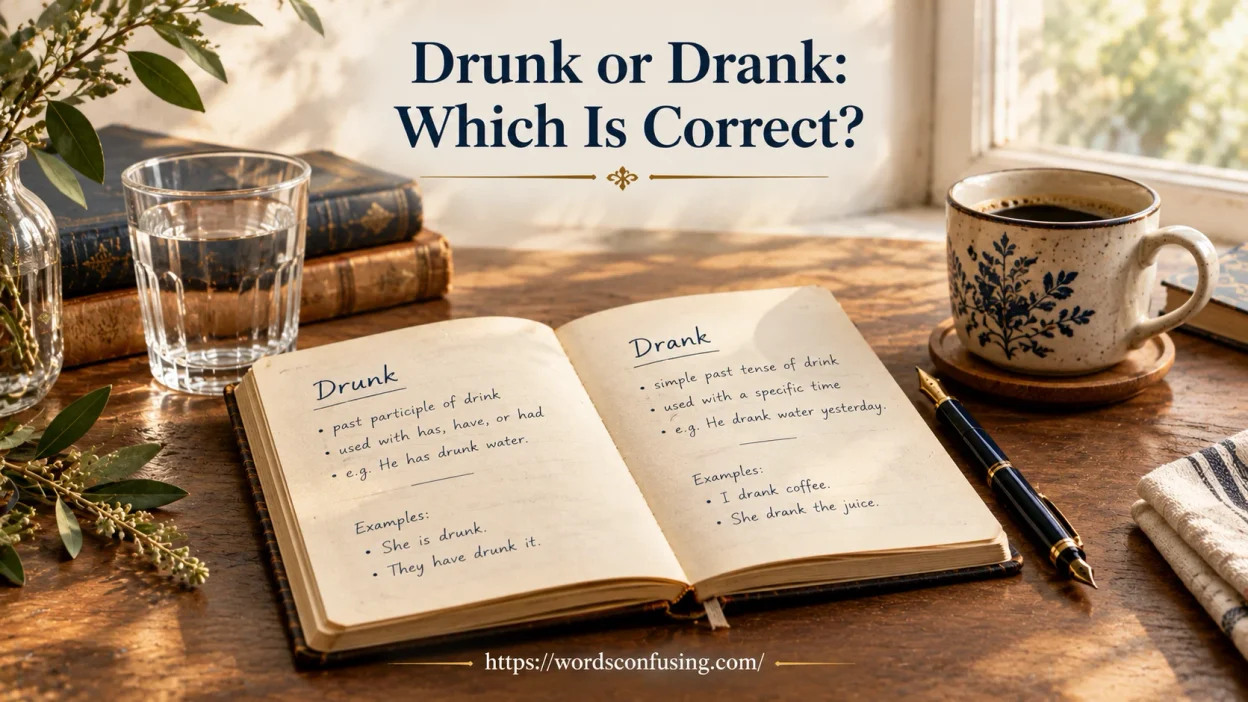
Drunk or Drank: Which Is Correct? Learn how to use each verb form correctly with simple grammar rules and clear everyday English examples.
Drank and drunk come from the irregular verb drink, but they follow different grammar rules. Use drank for a finished action, such as “I drank coffee yesterday” or “I drank tea this morning.” These examples describe completed actions, past actions, and past events. Use drunk with helping verbs such as have, has, and had.
For example, “I have drunk enough coffee” and “I have drunk tea already” demonstrate the present perfect tense. The past perfect tense follows the same pattern with had. These verb forms explain the difference between drunk and drank, helping students, writers, native speakers, and English learners choose the correct word in spoken English and written English.
Understanding sentence structure and time clues helps you avoid common grammar mistakes in standard English. Phrases such as “I drunk too much coffee” and “I have drank” are incorrect in standard usage. Instead, write “I drank too much coffee” and “I have drunk enough coffee.”
These real-life examples demonstrate correct usage, verb tense differences, and the grammar distinction between the simple past tense and past participle. The meaning of drank refers to a past drinking action, while drunk can also function as an adjective meaning intoxicated. These spelling differences and word meanings apply in both British English and American English.
Learning these language rules improves grammar understanding, English writing skills, English speaking skills, and grammar accuracy. Practice English verb conjugation, action verbs, and similar verbs to develop confident writing, confident speaking, and stronger everyday English usage.

Drunk vs. Drank: What’s the Difference?
The main difference between drunk and drank involves verb tense and grammatical function. Although both words come from drink, you cannot freely substitute one for the other.
Drank is the simple past tense of drink. You use it when talking about an action that happened in the past.
Drunk is the past participle of drink. It usually appears with helping verbs such as have, has, and had to form perfect tenses.
Here’s a quick comparison:
| Word | Grammatical form | When to use it | Example |
| Drink | Base form | Present tense, infinitives, and commands | I drink water every morning. |
| Drank | Simple past tense | An action completed in the past | I drank water yesterday. |
| Drunk | Past participle | Perfect tenses with helping verbs | I have drunk enough water. |
| Drunk | Adjective | Describing someone affected by alcohol | He was drunk after the party. |
Think of these forms as three steps in the same grammatical pattern. Each has a specific role, so recognizing the sentence structure makes the correct choice much easier.
For most standard American English writing, remember this simple rule:
Drink → Drank → Drunk
What Does Drank Mean?
The word drank is the simple past tense of drink. It describes an action that took place and finished in the past.
You don’t usually need a helping verb when using drank in an ordinary affirmative sentence. The word already expresses the past tense.
For example:
- I drank coffee before leaving for work.
- Sarah drank a glass of milk with breakfast.
- We drank lemonade during the picnic.
- They drank all the juice in the refrigerator.
- He drank a cup of tea before bed.
Each sentence describes a drinking action that happened in the past.
Notice that drank doesn’t change according to the subject. Whether you’re talking about yourself, a friend, or a group, the past-tense form remains the same.
When to Use Drank
Use drank when describing a completed drinking action in the past. The sentence may include a specific time, but it doesn’t have to.
Here are common situations where drank works naturally.
When mentioning a specific past time
Use drank when you know when the action happened.
- I drank orange juice yesterday.
- She drank coffee at 8 a.m.
- We drank hot chocolate last winter.
When telling a story
The simple past helps describe events in chronological order.
- Daniel arrived at the restaurant, ordered tea, and drank it while reading the menu.
- After the match, the players drank water and rested for a few minutes.
When asking questions about past actions
Use did with the base form drink, not drank.
- Did you drink the milk?
- Did she drink enough water?
- What did they drink at dinner?
This distinction is important. Although drank expresses the past in affirmative sentences, did already marks the past tense in questions.
Therefore, “Did you drink?” is correct, while “Did you drank?” is incorrect in standard English.
Drank in Sentences
The following examples show how drank works in everyday situations.
| Sentence | Explanation |
| I drank two cups of coffee this morning. | Describes a completed past action. |
| She drank water after exercising. | Identifies an action that followed exercise. |
| We drank tea during the meeting. | Describes something that happened during a past event. |
| My brother drank the last glass of milk. | Reports a completed action. |
| They drank lemonade at the beach yesterday. | Uses a specific past-time expression. |
| He drank very little water during the trip. | Describes the amount consumed in the past. |
| The children drank hot chocolate before bed. | Reports a completed action involving multiple people. |
These examples share the same pattern: drank functions as the main verb in the simple past tense.
What Does Drunk Mean?
The word drunk has two common grammatical uses. It serves as the past participle of drink and as an adjective describing intoxication.
As a past participle, drunk usually works with a helping verb. This construction allows you to describe experiences, completed actions connected to the present, or actions completed before another past event.
Consider these examples:
- I have drunk enough water today.
- She has drunk her coffee already.
- They had drunk all the juice before lunch.
- Have you ever drunk coconut water?
In each sentence, drunk appears with a form of have.
However, the word has a different function in a sentence such as, “He was drunk at the party.” Here, drunk describes his condition rather than forming a perfect tense.
When to Use Drunk
The easiest way to recognize the past participle is to look for the helping verb.
Use Drunk With Have
The present perfect tense uses have or has followed by a past participle.
Examples:
- I have drunk two glasses of water.
- She has drunk her tea.
- We have drunk this brand of coffee before.
- Have you drunk anything today?
These sentences describe experiences or actions connected to the present. The exact meaning depends on the surrounding context.
For example, “I have drunk enough water today” emphasizes your intake up to now. By contrast, “I drank enough water yesterday” refers to a completed period in the past.
Use Drunk With Had
The past perfect tense uses had followed by a past participle. It describes an action completed before another past event or reference point.
Examples:
- I had drunk my coffee before the meeting started.
- She had drunk all the water before we reached the station.
- They had drunk their tea by the time the guests arrived.
The word had already establishes the past-perfect construction. Therefore, you need drunk, not drank, in standard American English.
Use Drunk in Questions
Questions also follow the same pattern when they use perfect tenses.
- Have you drunk enough water?
- Has he drunk his medicine?
- Had they drunk anything before the journey?
These examples demonstrate why recognizing helping verbs is such a useful grammar trick.
Drunk in Sentences
Here are additional examples showing the past participle in different contexts.
| Sentence | Why Drunk Is Correct |
| I have drunk three cups of tea today. | Have forms the present perfect tense. |
| She has drunk all her juice. | Has introduces the past participle. |
| We had drunk our coffee before the guests arrived. | Had forms the past perfect tense. |
| Have you ever drunk fresh coconut water? | The question uses the present perfect. |
| They have drunk from this spring before. | The sentence describes a previous experience. |
| He had already drunk a glass of water when I arrived. | The drinking happened before another past event. |
Remember that the past participle doesn’t normally stand alone as the main verb in a standard affirmative sentence.
For example, write “I have drunk the water,” not “I drunk the water,” when using the present perfect. If you’re describing a simple past action, write “I drank the water.”
Read more: When Was the Letter “J” Invented? And Was It Before Jesus?
Drunk vs. Drank vs. Drink: Understanding All Three Forms
Learning all three forms together is more effective than memorizing drunk and drank separately. Once you understand how drink changes, you can apply the pattern to many sentences.
English contains numerous irregular verbs that don’t form their past tense by adding -ed. The verb drink is one of them.
Compare its three forms:
| Base Form | Simple Past | Past Participle |
| Drink | Drank | Drunk |
Unlike regular verbs such as walk, walked, walked, the verb drink changes its form twice.
Drink: The Present Tense
Use drink to describe habits, routines, general facts, or actions in the base form.
Examples:
- I drink water throughout the day.
- You drink coffee every morning.
- We drink tea after dinner.
- They drink juice with breakfast.
With he, she, or it in the simple present tense, add -s to form drinks.
- She drinks green tea every morning.
- He drinks a glass of milk before bed.
- My father drinks coffee without sugar.
The base form also appears after to, after modal verbs, and in commands.
- I want to drink some water.
- You should drink more water during hot weather.
- Drink your milk before leaving.
Notice that modal verbs such as should and can take the base form. Therefore, write “You should drink water,” not “You should drank water.”
Drank: The Simple Past Tense
Use drank when reporting a completed action in the past.
Examples:
- I drank coffee before class.
- She drank a bottle of water after running.
- They drank tea while discussing their plans.
The simple past can stand on its own without have, has, or had.
For example, “I drank coffee this morning” is a complete sentence. It identifies the action and places it in the past.
Drunk: The Past Participle
Use drunk with the appropriate helping verb when forming perfect tenses.
Examples:
- I have drunk enough water.
- She has drunk her coffee.
- They had drunk the juice before dinner.
This form also appears in some participial constructions, although the exact sentence structure determines its role.
For instance, “The water was drunk by the thirsty traveler” uses drunk in a passive construction. The sentence is grammatically possible, although “The thirsty traveler drank the water” sounds more natural in many everyday contexts.
The key is to recognize the difference between the simple past and the past participle.
Drunk or Drank: Which One Is Grammatically Correct?
Both drunk and drank are correct English words. However, they aren’t interchangeable in standard American English.
The correct choice depends on how the sentence is constructed and what you want to express.
Use drank for a simple past action:
- I drank water after lunch.
- She drank coffee before work.
- We drank lemonade yesterday.
Use drunk with have, has, or had in perfect-tense constructions:
- I have drunk enough water.
- She has drunk her coffee.
- We had drunk the juice before dinner.
This distinction answers many common grammar questions. Let’s examine the sentences that often cause confusion.
Should You Say “I Drank” or “I Have Drunk”?
Both expressions are grammatically correct, but they emphasize different things.
“I drank” uses the simple past tense. It typically describes an action that happened during a finished period in the past.
Examples:
- I drank coffee yesterday.
- I drank a glass of water an hour ago.
- I drank tea during the meeting.
“I have drunk” uses the present perfect tense. It connects a past action or experience to the present without necessarily naming a finished past time.
Examples:
- I have drunk enough water today.
- I have drunk this type of tea before.
- I have drunk three glasses of water so far.
Compare these two sentences:
- I drank three glasses of water yesterday. The sentence refers to a completed day in the past.
- I have drunk three glasses of water today. The sentence reports your intake up to the present.
The distinction isn’t simply about whether an action has finished. Both actions may be complete. Instead, the difference involves how the speaker relates the event to the time of speaking.
In standard American English, the present perfect generally doesn’t combine with finished-time expressions such as yesterday or last week when those expressions identify when the action occurred.
Therefore, say “I drank coffee yesterday,” rather than “I have drunk coffee yesterday.”
Is It “I Drank Water” or “I Drunk Water”?
The standard American English expression is “I drank water.”
Here, drank is the simple past tense of drink. The sentence doesn’t require a helping verb.
The expression “I drunk water” is nonstandard in standard American English when intended as the simple past. Although you might encounter it in some dialects or informal speech, drank is the appropriate choice for standard writing.
Compare these examples:
| Incorrect in Standard American English | Correct Standard Form |
| I drunk water yesterday. | I drank water yesterday. |
| She drunk coffee this morning. | She drank coffee this morning. |
| They drunk juice after lunch. | They drank juice after lunch. |
| He drunk the whole bottle. | He drank the whole bottle. |
However, you can use drunk when the sentence requires a past participle.
- Correct: I have drunk water today.
- Correct: She has drunk her coffee.
- Correct: They had drunk the juice already.
A simple question can help you choose: Does the sentence describe a simple past action, or does it require a past participle?
If it’s a simple past action, use drank. If it requires a past participle, use drunk.
Is It “Have Drank” or “Have Drunk”?
In standard American English, “have drunk” is the correct form.
The verb have acts as a helping verb in the present perfect tense. It must be followed by the past participle of the main verb.
For drink, that past participle is drunk.
Examples:
- Correct: I have drunk two cups of coffee.
- Incorrect in standard American English: I have drank two cups of coffee.
- Correct: She has drunk all her water.
- Incorrect in standard American English: She has drank all her water.
The same rule applies to has.
Write:
- He has drunk enough water.
- My sister has drunk her tea.
- The dog has drunk from its bowl.
Avoid has drank in standard writing.
The reason is grammatical rather than stylistic. In perfect-tense constructions, the helping verb carries the tense information while the main verb takes its past participle form.
Is It “Had Drank” or “Had Drunk”?
The standard American English construction is “had drunk.”
Use it when one action happened before another past event. The word had establishes the past perfect tense, so the main verb needs its past participle.
Examples:
- Correct: I had drunk my coffee before the meeting.
- Incorrect in standard American English: I had drank my coffee before the meeting.
- Correct: She had drunk all the water before we arrived.
- Incorrect in standard American English: She had drank all the water before we arrived.
Here’s a short example that makes the timing clear:
“Mark had drunk his coffee before his manager called.”
Two events happened in the past. First, Mark finished his coffee. Later, his manager called.
The past perfect construction emphasizes that the drinking happened before the phone call.
You can often use the simple past for events in chronological order. However, had drunk makes the earlier timing explicit.
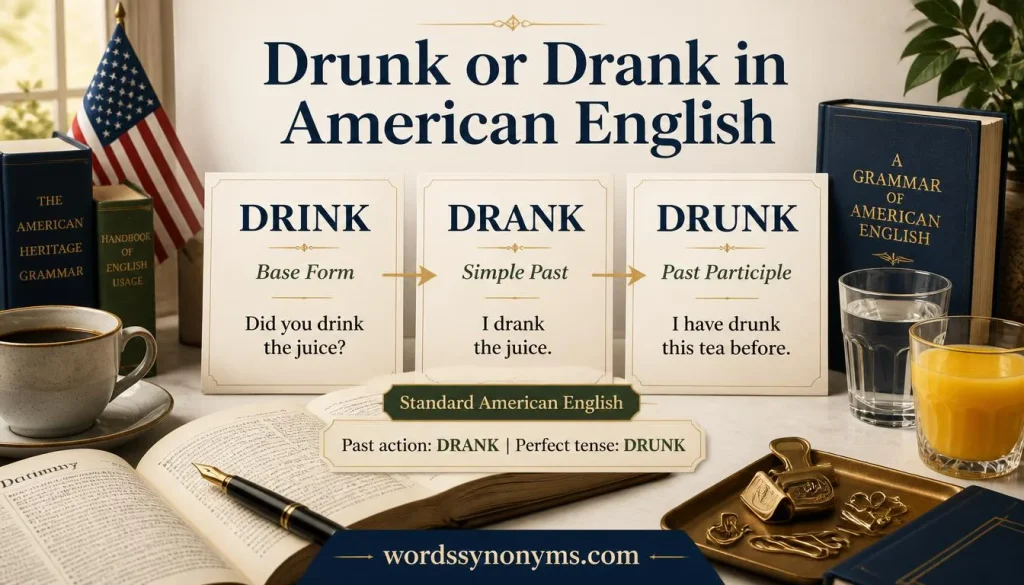
Drunk or Drank in American English
Standard American English follows a consistent pattern for this irregular verb:
- Drink: Base form and present-tense form, depending on the subject.
- Drank: Simple past tense.
- Drunk: Past participle.
You may occasionally hear people use drunk as the simple past in regional speech or informal conversation. Language varies across communities, and speakers don’t always follow the same patterns in everyday conversation.
Nevertheless, if you’re writing a school assignment, professional email, article, or formal document, stick to the standard forms.
For example:
| Situation | Standard American English |
| Describing a past action | I drank the juice. |
| Reporting an experience | I have drunk this tea before. |
| Describing an earlier past action | I had drunk the water before leaving. |
| Asking about a past action | Did you drink the juice? |
| Describing intoxication | He was drunk. |
Following these patterns makes your writing clear and grammatically consistent.
Read more: Yep vs. Yup: Which One Should You Use?
What Does Drunk Mean as an Adjective?
Besides functioning as a past participle, drunk can describe someone affected by alcohol.
In this context, drunk is an adjective rather than a verb form.
For example:
- He was drunk after the party.
- She seemed drunk when she arrived.
- The driver looked drunk, so someone called for help.
The adjective usually describes a person’s condition. It often follows linking verbs such as be, seem, look, or become.
Consider these examples:
“He was drunk.”
Here, was is the linking verb and drunk describes the person’s condition.
“He had drunk two glasses of water.”
Here, had is a helping verb and drunk is the past participle of drink.
The spelling is identical, but the grammatical function differs.
Context tells you which meaning applies.
Drunk as an Adjective vs. Drunk as a Past Participle
| Sentence | Function of Drunk |
| He was drunk after the celebration. | Adjective describing intoxication. |
| She seemed drunk during the conversation. | Adjective following a linking verb. |
| I have drunk enough water. | Past participle in the present perfect tense. |
| They had drunk the coffee before leaving. | Past participle in the past perfect tense. |
| The water was drunk by the traveler. | Past participle in a passive construction. |
This distinction is useful because a sentence can contain drunk without referring to alcohol.
For example, “I have drunk two glasses of water” has nothing to do with intoxication. The word simply completes the verb phrase.
Common Mistakes to Avoid When Using Drunk and Drank
Even fluent English speakers sometimes mix up irregular verb forms. Fortunately, a few simple corrections can prevent most mistakes.
Using Drunk for the Simple Past
Incorrect in standard American English: “I drunk coffee yesterday.”
Correct: “I drank coffee yesterday.”
Use drank when reporting a completed action in the simple past tense.
Using Drank After Have, Has, or Had
Incorrect in standard American English: “She has drank all the milk.”
Correct: “She has drunk all the milk.”
The helping verb requires the past participle drunk in this construction.
Writing “Did You Drank?”
Incorrect: “Did you drank the juice?”
Correct: “Did you drink the juice?”
The auxiliary did already marks the past tense. Therefore, the main verb must return to its base form, drink.
The same rule applies to negative sentences:
- Correct: I didn’t drink coffee this morning.
- Incorrect: I didn’t drank coffee this morning.
Assuming Every Past Action Requires Drank
Not every sentence about a past action uses the simple past tense.
For example:
- I drank the water before dinner.
- I have drunk the water already.
- I had drunk the water before dinner started.
All three sentences refer to drinking that occurred in the past. However, their grammatical structures differ.
Choose the verb form based on the tense and construction, not merely because the action happened earlier.
Confusing the Adjective With the Verb Form
The word drunk doesn’t always function as part of a verb phrase.
Compare:
- The man was drunk.
- The man had drunk some water.
In the first sentence, drunk describes a condition. In the second, it forms part of the past perfect verb phrase.
Understanding this distinction helps you interpret sentences correctly.

Easy Ways to Remember Drunk vs. Drank
You don’t need to memorize complicated grammar terminology to use these words correctly. A short phrase can help you remember the difference.
Yesterday, I drank. I have drunk.
The first sentence uses the simple past. The second uses the past participle with have.
Repeat this pattern whenever you’re unsure which form to choose.
Compare Drunk and Drank With Other Irregular Verbs
English has many irregular verbs that follow a similar three-form pattern.
| Base Form | Simple Past | Past Participle |
| Drink | Drank | Drunk |
| Sing | Sang | Sung |
| Ring | Rang | Rung |
| Begin | Began | Begun |
| Swim | Swam | Swum |
These verbs aren’t identical in every detail, but their patterns provide a helpful comparison.
For example:
- I sang a song yesterday.
- I have sung that song before.
Now apply the same pattern to drink:
- I drank water yesterday.
- I have drunk water today.
This comparison makes the difference easier to remember because you can connect drank and drunk with familiar forms such as sang and sung.
A Quick Reference for Choosing the Correct Word
Use this table whenever you need a quick reminder.
| If You Want to Say… | Use… | Example |
| You drink something regularly. | Drink | I drink tea every morning. |
| You finished drinking in the past. | Drank | I drank tea yesterday. |
| You have consumed something by now. | Have drunk | I have drunk two cups of tea. |
| Someone finished drinking before another past event. | Had drunk | I had drunk my tea before lunch. |
| Someone is affected by alcohol. | Drunk | He was drunk at the party. |
| You ask about a past drinking action. | Drink after did | Did you drink the tea? |
When in doubt, look for the helping verb first. It often reveals which form the sentence needs.
Drunk vs. Drank: Practice Quiz
Now it’s time to put the rules into practice. Choose the correct word for each sentence.
Fill in each blank with drink, drank, drunk, or drinks.
- I _____ a glass of water yesterday.
- She has _____ three cups of coffee today.
- They _____ tea every evening.
- Did you _____ all the juice?
- He had _____ his milk before school started.
- We _____ lemonade at the picnic last weekend.
- My brother _____ water after exercising every day.
- Have you ever _____ coconut water?
- I didn’t _____ coffee this morning.
- He was _____ after the party.
Answer Key With Explanations
| No. | Answer | Explanation |
| 1 | Drank | The sentence describes a completed action yesterday. |
| 2 | Drunk | The present perfect uses has plus the past participle. |
| 3 | Drink | The simple present describes a regular habit with they. |
| 4 | Drink | The auxiliary did takes the base form. |
| 5 | Drunk | The past perfect uses had plus the past participle. |
| 6 | Drank | The sentence describes a past event. |
| 7 | Drinks | The simple present takes -s with my brother. |
| 8 | Drunk | The present perfect uses have plus the past participle. |
| 9 | Drink | The negative auxiliary didn’t takes the base form. |
| 10 | Drunk | The adjective describes the person’s condition. |
If you answered all ten correctly, you’ve grasped the main distinction. If a few answers surprised you, review the helping-verb examples before trying again.
FAQs
1. Is it drunk or drank?
Both words are correct, but they serve different purposes. Drank is the simple past tense of drink, while drunk is the past participle. For example, “I drank water yesterday” is correct, as is “I have drunk enough water.”
2. Should I say “I have drunk” or “I have drank”?
The correct phrase is “I have drunk.” The verb have requires the past participle drunk in this sentence. For example, “I have drunk two glasses of water today” follows standard English grammar.
3. Is “I drank coffee” grammatically correct?
Yes, “I drank coffee” is grammatically correct. Use drank when describing a completed action in the past. For example, “I drank coffee before work” tells the reader what happened earlier.
4. Can “drunk” describe a person?
Yes, drunk can function as an adjective meaning intoxicated by alcohol. For example, “He was drunk at the party.” In this sentence, drunk describes the person’s condition rather than serving as the main verb for a past drinking action.
5. What is the past participle of “drink”?
The past participle of drink is drunk. The three principal forms are drink, drank, and drunk. For example, “I drink tea every morning,” “I drank tea yesterday,” and “I have drunk tea today” show how each form works.
6. Is “I drunk too much water” correct?
No, “I drunk too much water” is incorrect in standard English. The correct sentence is “I drank too much water.” Use drank for a simple past action. Use drunk with a helping verb, as in “I have drunk too much water.”
Conclusion
Understanding drunk or drank doesn’t have to be confusing once you learn how each word works. Both words come from the verb drink, but they serve different grammatical purposes. Use drank to describe a completed action in the past, such as “I drank coffee before work.” Use drunk with helping verbs like have, has, and had, as in “I have drunk enough water today.” You can also use drunk as an adjective when describing someone affected by alcohol.
The easiest way to remember the difference is to look at the other words in your sentence. If you’re talking about a past event without a helping verb, drank is usually the right choice. If your sentence includes have, has, or had, you’ll generally need drunk. Avoid common mistakes such as “I have drank” or “I drunk coffee yesterday.” Instead, practice using both forms in everyday conversations, emails, and written sentences. With regular practice, you’ll recognize the correct verb form more naturally and improve your overall English grammar, speaking, and writing skills.