


Others or Other’s or Others’: The Correct Usage Explained Learn the difference between singular and plural possessives, apostrophe placement, and correct usage with simple examples.
The words other, others, other’s, and others’ often cause grammar confusion because they have different meanings. In English grammar, other can work as a determiner or pronoun, while others refers to multiple people or things. The main grammatical difference appears in their singular form, plural form, and possessive form.
The other’s form usually shows singular ownership, whereas others’ indicates plural ownership. Understanding apostrophe rules and apostrophe placement helps you choose the correct spelling and avoid common writing mistakes.
The easiest way to remember these forms is to check who owns something. For example, “The others’ trips were longer than ours” shows possession by multiple people. In contrast, “The other’s trips were longer than mine” refers to one other person’s trips in a suitable context. The apostrophe before s appears in other’s, while the apostrophe after s appears in others’.
During editing and proofreading, check your sentence structure and punctuation carefully. These simple grammar rules improve writing accuracy in emails, reports, proposals, and other forms of professional writing.
Quick Answer
Others refers to additional people or things, other’s shows possession by one other person, and others’ shows possession by multiple people. For example, others agreed, the other’s opinion, and the others’ opinions. The easiest way to choose correctly is to check whether the sentence expresses possession and how many owners it refers to.
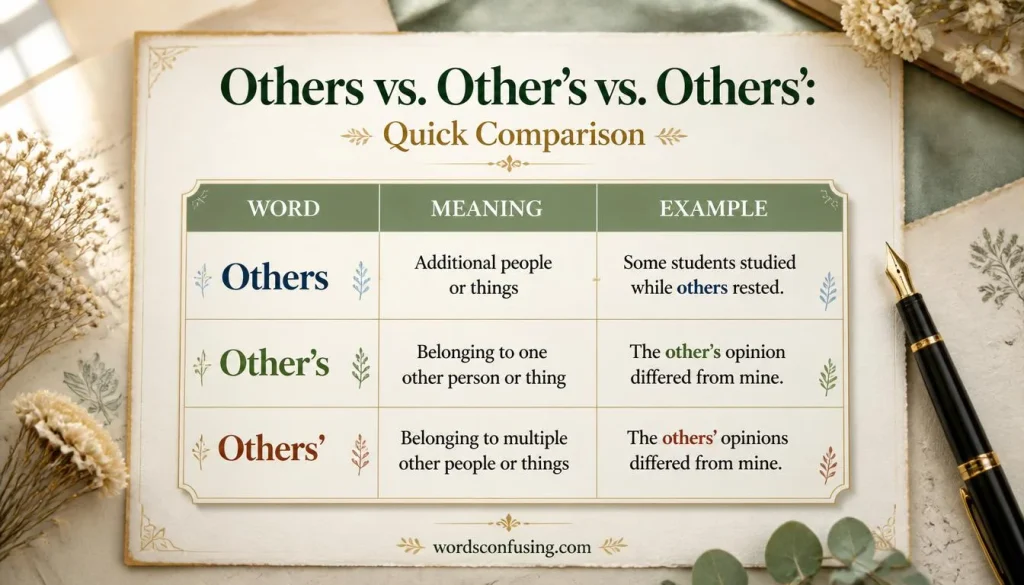
Others vs. Other’s vs. Others’: Quick Comparison
The easiest way to distinguish these forms is to examine their grammatical roles. Although they share the same base word, they don’t serve the same purpose in a sentence.
| Word | Grammatical function | Meaning | Example |
| Others | Plural pronoun | Additional or different people or things | Some students studied while others rested. |
| Other’s | Singular possessive form | Belonging to one other person or thing | The other’s opinion differed from mine. |
| Others’ | Plural possessive form | Belonging to multiple other people or things | The others’ opinions differed from mine. |
Notice the placement of the apostrophe. The word others has no apostrophe because it doesn’t express possession. In other’s, the apostrophe comes before the final s, while in others’, it comes after the s.
Here’s a simple way to remember the difference:
- Others: Additional people or things.
- Other’s: Possession associated with one other.
- Others’: Possession associated with multiple others.
However, the correct spelling also depends on how the sentence is constructed. Other’s is a valid grammatical form, but it can sound awkward when the writer hasn’t clearly established which person or thing other refers to.
What Does Others Mean?
Others is the plural form of the pronoun other. It refers to additional or different people or things without repeating their names.
For example, imagine a teacher asks ten students to complete an assignment. Five students finish early, while the remaining five need more time. You could write:
Some students finished early, while others needed more time.
The word others replaces a longer phrase such as the other students. It keeps the sentence concise and prevents unnecessary repetition.
Unlike possessive forms, others doesn’t indicate ownership. It simply identifies people or things that differ from, or remain separate from, those already mentioned.
When to Use Others
Use others when you want to refer to additional people or things that the reader can identify from the context.
Common situations include:
- Comparing preferences: Some people enjoy working alone, while others prefer teamwork.
- Describing different choices: A few customers ordered coffee, while others chose tea.
- Discussing opinions: Some readers agreed with the proposal, but others disagreed.
- Identifying remaining items: These books are mine, and the others belong to the library.
- Explaining different approaches: Some employees work remotely, while others commute to the office.
In each example, others refers to more than one person or thing. No apostrophe is necessary because the sentence doesn’t express possession.
Consider this sentence:
Some children brought their lunches, while others bought food at school.
Here, others means other children. Adding an apostrophe would incorrectly suggest possession rather than a simple plural reference.
Examples of Others in Sentences
The following examples show how others works in different situations.
| Example sentence | Meaning of others |
| Some people enjoy rainy weather, while others prefer sunshine. | Different people have different preferences. |
| I completed three exercises, but others remain unfinished. | Additional exercises still need attention. |
| Some employees arrived early, while others arrived later. | Different employees arrived at different times. |
| These shoes are expensive, but others are affordable. | Other shoes are available at lower prices. |
| She helped several students and encouraged others to participate. | Additional students were encouraged to participate. |
| Some ideas work immediately, while others require further testing. | Different ideas produce different results. |
A useful pattern appears in these examples. The word others often follows a reference to some people or things, identifying a separate group without naming every member.
Others vs. Other vs. The Others
Although these expressions look similar, they have different grammatical functions.
Other commonly appears before a noun or in singular constructions. Others stands alone as a plural pronoun. The others refers to a specific remaining group.
| Form | Usage | Example |
| Other | Modifies a noun or appears in a singular construction | I need another day to finish the project. |
| Other | Modifies a plural noun | Other students arrived later. |
| Others | Refers to additional people or things | Others arrived later. |
| The others | Refers to a specific remaining group | Three students left, but the others stayed. |
Consider the difference between other students and others.
In other students, the word other describes the noun students. In others, the pronoun replaces the noun phrase entirely.
Likewise, the others usually identifies a definite group already established by the context. If you tell someone that three guests have arrived and the others are still traveling, the phrase the others refers to the remaining guests.
This distinction matters because others is not simply a plural adjective. In standard English, it functions as a pronoun.
What Does Other’s Mean?
Other’s is a singular possessive form used when other functions as a noun or pronoun referring to one additional person or thing.
The apostrophe followed by s indicates possession or association. However, this construction needs a clear context because other more commonly appears alongside a noun or in phrases such as the other one.
For example:
The other’s opinion was different from mine.
In this sentence, the other refers to one person already understood from the conversation. The possessive form other’s indicates that the opinion belongs to that person.
Another example is:
I respected the other’s decision even though I disagreed.
Here, the speaker respects a decision made by one other person. The apostrophe helps express the relationship between the person and the decision.
However, compare the following sentence:
I respected the opinions of others.
This sentence doesn’t express possession through others’. Instead, the preposition of establishes the relationship between the opinions and the people who hold them.
Both constructions can be grammatical, but their structures differ.
When to Use Other’s
Use other’s when the sentence refers to one other person or thing and expresses possession or association.
For example:
- The other’s answer was more detailed. One other person gave the answer.
- I listened carefully to the other’s explanation. One other person provided the explanation.
- The other’s choice surprised the entire group. One other person made the choice.
- We considered the other’s perspective before deciding. One other person held that perspective.
In these sentences, the other identifies a singular person. The possessive form other’s connects that person with an answer, explanation, choice, or perspective.
Still, other’s is relatively uncommon when used without a clear antecedent. An antecedent is the word or phrase that establishes what a pronoun refers to.
For example, if a conversation mentions two business partners, the other’s proposal can refer to the proposal submitted by the second partner. Without that context, readers may wonder who the other refers to.
You can often improve clarity by using a more specific noun or pronoun.
Instead of writing:
The other’s opinion mattered.
You could write:
The second partner’s opinion mattered.
The revised sentence identifies the person more clearly. Both versions can be correct when their context supports the intended meaning.
Examples of Other’s in Sentences
Here are several examples of singular possession using other’s.
| Example sentence | Explanation |
| The other’s argument changed our discussion. | One other person made the argument. |
| I borrowed the other’s notebook for a moment. | One other person owns the notebook. |
| The other’s decision affected the entire team. | One other person made the decision. |
| We compared my answer with the other’s response. | One other person provided the response. |
| She understood the other’s concerns after their conversation. | One other person had the concerns. |
The key is to identify the singular owner. If the sentence refers to one other person and the apostrophe expresses possession, other’s may be appropriate.
However, don’t add an apostrophe simply because the sentence mentions one additional person. The apostrophe must serve a possessive function.
For example, the other student doesn’t need an apostrophe. It identifies a student rather than showing ownership.
Is Other’s a Contraction?
In ordinary modern English, other’s is generally used as a possessive form rather than a contraction.
A contraction combines words and usually replaces omitted letters with an apostrophe. Common examples include it’s for it is or it has, and they’re for they are.
The form other’s doesn’t normally represent a standard contraction in everyday writing.
However, don’t confuse it with one’s, which can express possession or function as a contraction in appropriate contexts.
For example:
- One’s reputation can take years to build. Here, one’s is possessive.
- One’s already finished the assignment. In some contexts, one’s can represent one has, although the construction is less common and may sound unnatural without suitable context.
The practical lesson is straightforward: when you encounter other’s, look first for a possessive meaning. Don’t assume the apostrophe automatically indicates a contraction.
Read more: Can an Opinion Be Right or Wrong? Real Examples
What Does Others’ Mean?
Others’ is the plural possessive form of others. It indicates that something belongs to, relates to, or is associated with multiple other people or things.
The apostrophe appears after the final s because others already ends in s. This follows the usual pattern for forming possessives from plural nouns or pronouns that end in s.
For example:
The others’ opinions influenced the final decision.
Here, others’ indicates that multiple other people have opinions that influenced the decision.
Compare that sentence with:
Others influenced the final decision.
The second sentence says that other people influenced the decision. It doesn’t identify anything they own or possess.
This difference is small but important. Others identifies a group, while others’ expresses possession or association involving that group.
When to Use Others’
Use others’ when the sentence refers to multiple other people or things and expresses a possessive relationship.
Here are some common situations:
- Opinions: The others’ opinions helped us evaluate the proposal.
- Belongings: The others’ bags were stored near the entrance.
- Responsibilities: The others’ responsibilities changed after the promotion.
- Decisions: The others’ decisions affected the final outcome.
- Achievements: The others’ achievements inspired the entire team.
In each sentence, the possessive form connects something with multiple people. The apostrophe comes after the s because the plural form already ends with that letter.
Consider this example:
The students discussed others’ achievements.
The sentence refers to achievements associated with multiple other people. Depending on the context, others’ may refer to people outside the students’ group or other people previously mentioned.
You could also write:
The students discussed the achievements of others.
Both versions can communicate a similar idea. The first uses a possessive form, while the second uses an of phrase.
However, context matters. If the sentence doesn’t clearly establish who others refers to, readers may need additional information.
Examples of Others’ in Sentences
These examples show how plural possession works in everyday writing.
| Example sentence | What others’ indicates |
| The others’ suggestions improved our plan. | Multiple people made the suggestions. |
| We respected the others’ decisions. | Multiple people made the decisions. |
| The others’ belongings remained in the classroom. | Multiple people owned the belongings. |
| Their success depended partly on others’ cooperation. | Multiple people provided cooperation. |
| The manager acknowledged the others’ contributions. | Multiple people contributed to the project. |
| The others’ expectations were different from ours. | Multiple people held those expectations. |
Notice that the possessive relationship doesn’t always involve physical ownership. People can possess opinions, responsibilities, expectations, and rights in a grammatical sense.
For instance, the others’ concerns means the concerns held by the other people. Nobody physically owns a concern, but the possessive construction expresses a relationship.
Others’ vs. Others
The difference between these forms becomes clearer when you compare them in similar sentences.
| Without an apostrophe | With an apostrophe |
| Others agreed with the decision. | Others’ agreement helped settle the dispute. |
| Others supported the proposal. | Others’ support strengthened the proposal. |
| Others questioned the results. | Others’ questions revealed a problem. |
| Others attended the meeting. | Others’ attendance was required. |
In the left column, others refers to people performing an action. In the right column, others’ identifies a relationship between people and something associated with them.
Consider these two sentences:
- Others contributed to the project.
- Others’ contributions improved the project.
The first sentence uses others as the subject of the verb contributed. The second uses others’ to modify the noun contributions.
That grammatical difference determines whether the apostrophe belongs in the sentence.
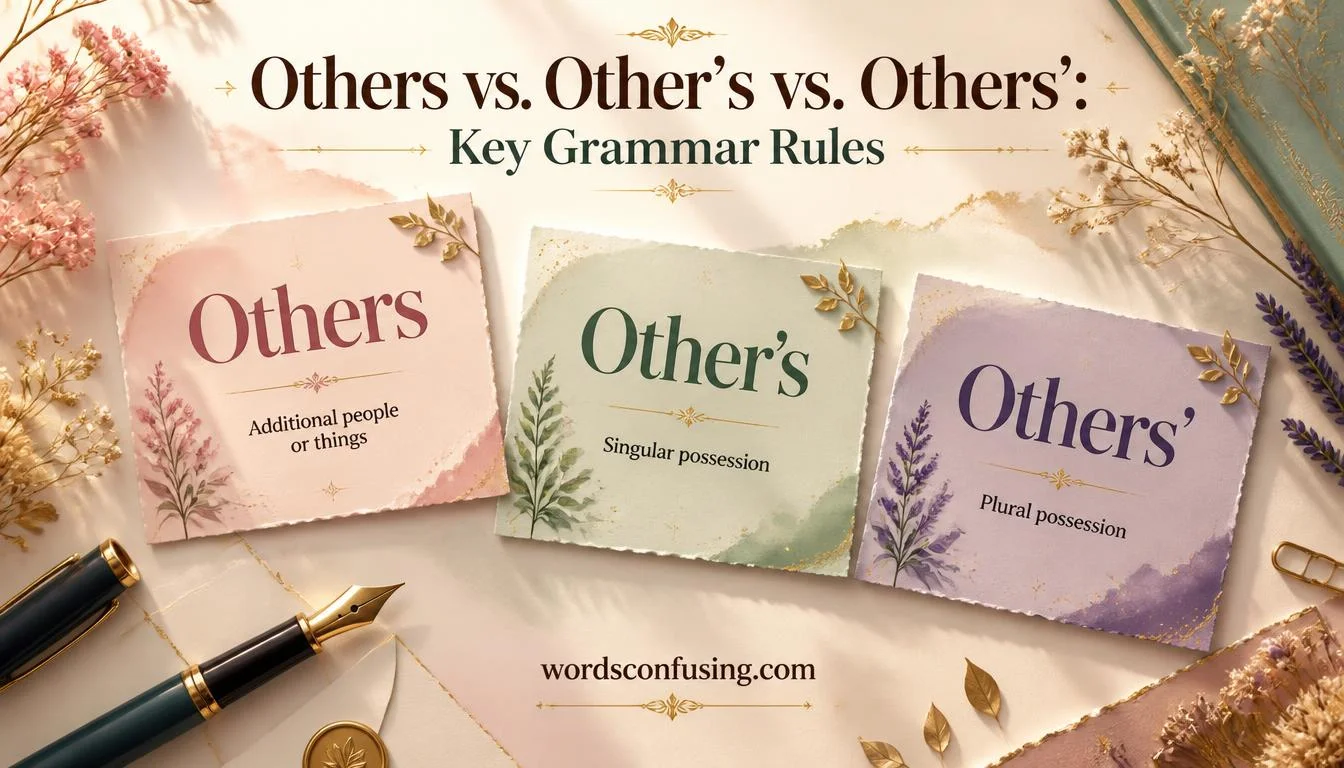
Others vs. Other’s vs. Others’: Key Grammar Rules
Once you understand the three meanings, choosing the correct form becomes much easier. You can usually solve the problem by checking whether the sentence expresses possession and identifying the number of owners.
Rule: Use Others for Additional People or Things
Use others when referring to additional or different people or things without expressing possession.
For example:
Some employees prefer working remotely, while others enjoy the office environment.
The word others refers to employees who prefer a different arrangement. It doesn’t indicate ownership, so no apostrophe is necessary.
Here are more examples:
- Some books are expensive, while others cost less.
- A few guests arrived early, but others arrived later.
- Some people enjoy public speaking, while others find it uncomfortable.
- Several proposals were rejected, although others received approval.
Remember: A plural reference doesn’t automatically require an apostrophe. The apostrophe belongs only when the grammatical construction calls for possession or another recognized apostrophe use.
Rule: Use Other’s for Singular Possession
Use other’s when referring to possession by one other person or thing described as other.
For example:
The other’s response was more convincing.
Here, the other identifies one person from an established group. The response belongs to that person, so the singular possessive form is appropriate.
Other examples include:
- The other’s explanation clarified the problem.
- I preferred the other’s approach to the assignment.
- The other’s decision surprised everyone.
- We compared my solution with the other’s.
The context must establish the identity of the other. If readers cannot determine who or what the phrase refers to, a specific noun may be clearer.
For example, the other employee’s response identifies the owner more precisely than the other’s response.
Rule: Use Others’ for Plural Possession
Use others’ when multiple other people or things possess or are associated with something.
For example:
The others’ recommendations helped us choose a supplier.
The sentence refers to recommendations made by multiple people. The apostrophe follows the final s in others.
Additional examples include:
- The others’ schedules conflicted with the meeting time.
- We considered the others’ suggestions before making changes.
- The others’ achievements deserved recognition.
- The others’ responsibilities increased during the busy season.
This rule follows a common English possessive pattern: when a plural form already ends in s, place the apostrophe after that letter.
Compare:
- One employee’s schedule — one employee.
- Two employees’ schedules — multiple employees.
- One other’s opinion — one other person.
- Others’ opinions — multiple other people.
The exact construction may vary with context, but the apostrophe placement reflects the grammatical form.
Rule: Check Whether You Mean Ownership
The quickest way to choose among these forms is to ask one question: Does the sentence express possession or association?
If the answer is no, others may be correct when you mean additional people or things.
If the answer is yes, identify whether the possessive construction refers to one other person or multiple others.
Follow this simple process:
- Identify the meaning. Are you referring to people or things, or to something associated with them?
- Check for possession. Does the sentence connect a person or group with an opinion, decision, belonging, responsibility, or another noun?
- Identify the number. Does the context refer to one other person or multiple other people?
- Choose the form. Use others for a plural reference, other’s for singular possession, or others’ for plural possession.
- Read the sentence again. Make sure the apostrophe matches the intended meaning.
For example, suppose you want to describe feedback from colleagues.
- Others provided feedback. This describes who provided it.
- The other’s feedback was helpful. This describes feedback from one other person.
- The others’ feedback was helpful. This describes feedback from multiple other people.
Each sentence is grammatical in an appropriate context. The difference lies in what you want to communicate.
Common Mistakes to Avoid With Others, Other’s, and Others’
Apostrophe mistakes often happen because writers focus on how a word looks rather than what it means. Fortunately, a few common errors are easy to recognize and correct.
Using Other’s When You Mean Others
One frequent mistake is adding an apostrophe to a plural pronoun that doesn’t express possession.
Incorrect: Some people enjoy hiking, while other’s prefer swimming.
Correct: Some people enjoy hiking, while others prefer swimming.
The second clause refers to additional people. It doesn’t indicate ownership, so others is correct.
More examples:
- Incorrect: Some customers complained, while other’s accepted the changes.
- Correct: Some customers complained, while others accepted the changes.
- Incorrect: Several students finished early, but other’s needed more time.
- Correct: Several students finished early, but others needed more time.
The apostrophe has no grammatical purpose in these examples. Removing it restores the correct plural form.
Using Others’ Without Expressing Possession
Another mistake occurs when writers use others’ simply because they refer to several people.
Incorrect: Others’ arrived before the meeting started.
Correct: Others arrived before the meeting started.
In the incorrect version, the possessive form appears without a suitable grammatical role. The sentence simply needs a plural pronoun as its subject.
Compare these examples:
| Incorrect sentence | Correct sentence |
| Others’ agreed with the plan. | Others agreed with the plan. |
| Others’ joined the discussion. | Others joined the discussion. |
| Others’ completed the assignment. | Others completed the assignment. |
However, others’ is correct when it modifies a noun or otherwise expresses possession.
For example, Others’ suggestions improved the plan is correct because the apostrophe connects the suggestions with multiple people.
Confusing Other’s and Others’
These forms differ by only one apostrophe position, but they express different possessive relationships.
Consider the following examples:
- The other’s suggestion was helpful. One other person made the suggestion.
- The others’ suggestions were helpful. Multiple other people made the suggestions.
The first sentence uses singular possession. The second uses plural possession.
Another pair illustrates the same distinction:
- The other’s belongings were missing. One other person owned the belongings.
- The others’ belongings were missing. Multiple other people owned the belongings.
The noun following the possessive form can be plural even when the owner is singular. In the first sentence, one person may own several belongings.
Don’t determine the number of owners by looking only at the noun that follows the apostrophe. Identify the person or group that possesses the item.
Adding Apostrophes to Ordinary Plurals
English apostrophes don’t normally create plurals. They primarily indicate possession or mark certain contractions and omissions.
For example:
- Correct: The others arrived before noon.
- Incorrect: The other’s arrived before noon.
- Correct: The others’ belongings were in the hallway.
- Incorrect: The others’s belongings were in the hallway.
The last incorrect example adds an extra s after the apostrophe. The plural form others already ends in s, so the standard plural possessive is others’.
This rule also applies to many ordinary plural nouns:
| Plural | Plural possessive |
| Students | Students’ books |
| Teachers | Teachers’ meeting |
| Customers | Customers’ requests |
| Employees | Employees’ benefits |
| Others | Others’ opinions |
There are exceptions to general possessive patterns, especially with irregular plurals. For instance, children’s and people’s use apostrophe-plus-s because those plural forms don’t end in s.
Nevertheless, others’ follows the regular pattern for a plural form ending in s.
How to Choose Between Others, Other’s, and Others’
When you’re unsure which spelling to use, focus on the meaning instead of the punctuation. The following examples show how a small change can affect the sentence.
A Simple Decision Guide
Use this quick guide whenever you need to choose the correct form.
Does the sentence simply refer to additional people or things?
Yes → Others
Example: Some stayed inside, while others went outside.
Does the sentence express possession by one other person or thing?
Yes → Other’s
Example: The other’s answer was correct.
Does the sentence express possession by multiple other people or things?
Yes → Others’
Example: The others’ answers were correct.
This guide works for most everyday situations. However, remember that other’s needs a clear singular reference, while others’ needs a plural possessive reference.
A Practical Case Study: Choosing the Correct Form
Imagine you’re writing a short report about a group project involving five students.
You want to explain that two students presented their findings, while three students listened.
You could write:
Two students presented their findings while others listened.
Here, others is correct because the sentence refers to additional students without expressing possession.
Next, you want to describe feedback from one student in the group.
The other’s feedback helped improve the presentation.
In a context where the other clearly identifies one student, other’s expresses singular possession. Depending on the group’s structure, however, naming the student or writing one student’s feedback may be clearer.
Finally, you want to describe feedback from several students.
The others’ feedback helped improve the presentation.
Here, others’ indicates that multiple students provided the feedback.
This example shows why context matters. The apostrophe isn’t a decorative mark. It communicates a grammatical relationship between the people and the information being discussed.
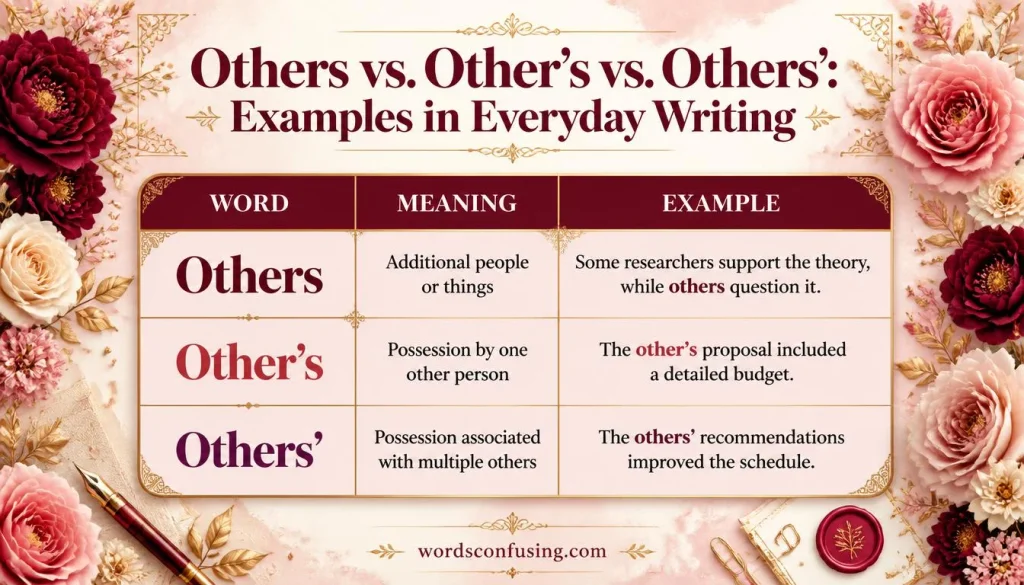
Others vs. Other’s vs. Others’: Examples in Everyday Writing
The three forms become easier to recognize when you see them in realistic situations. Their meanings remain the same across different types of writing, including academic assignments, workplace communication, and casual conversations.
Examples in Academic Writing
Students often use these forms when comparing ideas, discussing research, or describing classmates’ contributions.
| Example | Why the form is correct |
| Some researchers support the theory, while others question it. | Others refers to additional researchers. |
| The other’s interpretation differed from mine. | Other’s indicates one other person’s interpretation. |
| The others’ findings supported the original hypothesis. | Others’ indicates findings associated with multiple other researchers. |
| Some students submitted their work early, while others requested an extension. | Others identifies the remaining students. |
When writing an academic paper, clarity matters more than forcing a possessive construction into every sentence. If the other’s interpretation sounds vague, identify the person or use a clearer phrase.
For instance, the second researcher’s interpretation may be more precise when comparing two specific researchers.
Examples in Workplace Communication
Professional writing frequently refers to colleagues, responsibilities, decisions, and feedback. Choosing the correct form helps readers understand who did what and whose work you’re discussing.
- Others: Some employees attended the training, while others completed their regular duties.
- Other’s: The other’s proposal included a more detailed budget.
- Others’: The others’ recommendations helped the manager revise the schedule.
- Others: Others requested additional time to finish the assignment.
- Others’: The others’ responsibilities were clearly outlined in the report.
Notice that others can refer to colleagues who aren’t named individually. The possessive forms become useful when you need to connect those colleagues with a specific contribution or responsibility.
Still, workplace documents often benefit from precise wording. If a report discusses three departments, naming the department may be clearer than repeatedly using the others.
Examples in Everyday Conversations
You don’t need formal writing to encounter these forms. They can appear in ordinary discussions about friends, family, belongings, and personal preferences.
| Example sentence | Meaning |
| Some of my friends like football, while others prefer cricket. | Different friends have different preferences. |
| The other’s phone was ringing throughout dinner. | One other person owned the phone. |
| The others’ bags were left in the car. | Multiple other people owned the bags. |
| Some neighbors planted trees, while others planted flowers. | Different neighbors chose different plants. |
| I listened to the other’s explanation before responding. | One other person provided the explanation. |
| The others’ opinions changed after the discussion. | Multiple people changed their opinions. |
These examples highlight a simple principle: choose the form that matches the relationship expressed in your sentence. Don’t add an apostrophe just because a word ends in s or refers to multiple people.
Read more: The Smiths or The Smiths’ or The Smiths’s: Which Is Correct?
Practice Quiz: Others or Other’s or Others’?
Ready to test your understanding? Choose the correct form for each sentence. Pay attention to whether the sentence expresses possession.
Grammar practice
0 of 8 answered
1. Some students prefer studying alone, while ___ enjoy group work.
others
other’s
others’
2. The ___ explanation helped us understand the problem.
others
other’s
others’
3. The ___ suggestions improved our final report.
others
other’s
others’
4. Some guests arrived early, while ___ arrived later.
others
other’s
others’
5. We considered the ___ opinions before making our decision.
others
other’s
others’
6. I compared my answer with the ___.
others
other’s
others’
7. Some customers paid online, while ___ paid in cash.
others
other’s
others’
8. The ___ belongings were returned after the event.
others
other’s
others’
Check answers
The key to improving your score is understanding why each form works. Memorizing the spellings alone won’t help when a sentence changes its structure.
FAQs
1. What is the difference between others, other’s, and others’?
Others refers to additional people or things. Other’s shows possession by one person or thing described as “other,” while others’ shows possession by multiple people or things.
2. Is others’ grammatically correct?
Yes, others’ is grammatically correct when you want to show that something belongs to multiple people or things. For example, “We respected others’ opinions.”
3. When should I use other’s?
Use other’s to show possession by one other person or thing when the context makes the meaning clear. For example, “The other’s answer was correct.”
4. Why does others’ have an apostrophe after the s?
Others is already plural. To show possession, you add an apostrophe after the existing s, creating others’. For example, “The others’ bags were outside.”
5. Is others’ or other’s correct in formal writing?
Both forms can be correct, depending on the meaning. Use other’s for singular possession and others’ for plural possession. Choosing the right form makes your reports, emails, and professional documents clearer.
6. What is a simple trick to remember others’ and other’s?
Check how many owners you mean. If one other person owns something, use other’s. If multiple people own something, use others’. Remember that others is already plural, so you only need to add the apostrophe to show possession.
Conclusion
Understanding the difference between others, other’s, and others’ becomes easier when you focus on meaning and ownership. Use others when referring to additional people or things, other’s for singular possession, and others’ for plural possession. The apostrophe may seem like a small detail, but it can change the meaning of your sentence.
Whether you’re writing an email, completing an assignment, or preparing a professional report, checking apostrophe placement helps you avoid common grammar mistakes. With a little practice, you can choose the correct form confidently and make your writing clearer and more accurate.