

This guide to 7 Words for Doing Something Without Thinking explores how habit, impulse, and instinct shape your everyday actions.
Finding a decent word to describe somebody doing something without thinking depends on the situation and its implications. Sometimes, you respond automatically through instinctive behavior or an instinctive response. Other times, impulsive behavior leads to an impulsive action, spontaneous action, or unconscious action. These reactions can happen before you consider the consequences.
Understanding the subtle differences in meaning helps you select suitable adjectives and descriptive words. For example, a quick reaction or immediate response might reveal a lack of thought or lack of consideration.
Choosing suitable vocabulary choices also strengthens your English usage and grammar. Clear definitions and practical examples make these expressions easier to understand and apply. You might use them in formal writing, casual speech, professional communication, or business communication.
They also fit daily conversations, workplace interactions, and discussions during meetings. Even when writing an email, creating content, or managing tasks, people sometimes make decisions without conscious thought. The same applies to scheduling, calendar planning, project management, online booking, and broadcasting.
Recognizing when someone has acted instantly helps you describe their actions and behavior accurately. Ultimately, precise expressions improve your communication skills, clarity, and consistency.
Quick Answer
The word impulsive is commonly used for doing something without thinking about the consequences. Other words include spontaneous, instinctive, rash, hasty, reckless, and thoughtless. Each describes a different kind of unplanned or poorly considered action.
7 Words for Doing Something Without Thinking
Doing something without thinking can describe anything from a harmless surprise to a seriously dangerous decision. The circumstances behind an action determine which word fits best.
Here are seven common words that describe different types of thoughtless, unplanned, or automatic behavior.
Impulsive
Impulsive describes someone who acts suddenly without thinking carefully about the possible consequences. An impulsive person often follows an immediate feeling, desire, or urge instead of considering what might happen afterward.
For example, imagine walking through a shopping mall and seeing an expensive jacket. You love its appearance, so you immediately purchase it without checking your budget. Later, you realize that you didn’t really need it and cannot comfortably afford it.
That purchase was impulsive.
Impulsive behavior often comes from strong emotions such as excitement, anger, frustration, or curiosity. People sometimes act impulsively because they want immediate satisfaction rather than waiting or weighing their options.
However, impulsive actions aren’t necessarily harmful. Sometimes they lead to enjoyable experiences or unexpected opportunities.
Examples of impulsive behavior:
- Buying something expensive without considering your budget.
- Sending an angry message without thinking about its effect.
- Accepting an invitation before checking your schedule.
- Quitting a job during an emotional disagreement.
- Making an important decision because something feels exciting.
Example sentences:
- She made an impulsive decision to travel abroad without planning her expenses.
- His impulsive reaction turned a small disagreement into an argument.
- I bought the shoes impulsively because they looked beautiful in the store.
Common expressions with impulsive:
- Impulsive decision
- Impulsive purchase
- Impulsive behavior
- Impulsive reaction
- Impulsive spending
- Impulsive response
When should you use impulsive?
Use impulsive when someone acts on an immediate urge without considering the results. It works particularly well when emotions or desires influence a decision.
For instance, if someone suddenly sends a message they later regret, you can describe that behavior as impulsive. The word focuses on acting before thinking rather than intentionally causing harm.
Read more: “Hundred Thousands” or “Hundreds of Thousands”
Spontaneous
Spontaneous describes something that happens naturally, suddenly, or without prior planning. A spontaneous action usually occurs without preparation or a fixed arrangement.
Imagine your friends finish dinner and suggest taking a late-night drive. Nobody planned the trip earlier, but everyone agrees and enjoys the unexpected adventure.
That’s a spontaneous decision.
Unlike impulsive, spontaneous doesn’t automatically suggest poor judgment. It often carries a positive or neutral meaning because the action happens naturally without advance planning.
You can use this word for enjoyable experiences, friendly gestures, creative ideas, and unexpected decisions.
However, spontaneity doesn’t mean someone completely ignores consequences. A person can make a spontaneous choice while still considering basic safety and practical details.
Examples of spontaneous behavior:
- Taking an unplanned weekend trip.
- Singing along when your favorite song plays.
- Surprising a friend with an unexpected visit.
- Suggesting an impromptu dinner with coworkers.
- Starting a conversation with someone you meet.
Example sentences:
- We made a spontaneous decision to visit the beach after lunch.
- Her spontaneous invitation turned an ordinary evening into something memorable.
- He gave a spontaneous speech without preparing any notes.
Common expressions with spontaneous:
- Spontaneous decision
- Spontaneous reaction
- Spontaneous trip
- Spontaneous gesture
- Spontaneous conversation
- Spontaneous laughter
When should you use spontaneous?
Use spontaneous when someone does something without planning it beforehand. The word works especially well for natural, enjoyable, or unexpected actions.
For example, if your friend suddenly suggests visiting a nearby town, you can call the idea spontaneous. You don’t necessarily mean your friend acted carelessly.
The important distinction is that spontaneity concerns the lack of planning. It doesn’t necessarily involve a lack of judgment.
Instinctive
Instinctive describes an action or reaction that happens naturally without conscious reasoning. It often comes from an automatic response, an ingrained tendency, or an immediate sense of what to do.
Think about touching a hot surface. Your hand quickly pulls away before you have time to think through the situation.
That reaction is instinctive.
Instinctive behavior often appears in situations involving surprise, danger, emotions, or familiar patterns. Your body or mind responds quickly because the situation triggers an automatic reaction.
Not every instinctive response comes from a physical reflex. You might instinctively comfort someone who starts crying, protect a child from danger, or step backward when something approaches unexpectedly.
Examples of instinctive behavior:
- Pulling your hand away from something hot.
- Ducking when an object suddenly flies toward you.
- Reaching out to catch a falling glass.
- Protecting someone during an unexpected accident.
- Smiling naturally when you see someone you love.
Example sentences:
- She made an instinctive movement to protect her younger brother.
- My instinctive reaction was to step away from the approaching dog.
- He instinctively reached out when he noticed the child falling.
Common expressions with instinctive:
- Instinctive reaction
- Instinctive response
- Instinctive movement
- Instinctive behavior
- Instinctive decision
- Instinctive feeling
When should you use instinctive?
Use instinctive when someone responds naturally without consciously analyzing the situation. It works particularly well for immediate reactions and behaviors that feel automatic.
For example, if you catch a falling object before realizing what’s happening, your movement was instinctive.
Remember that instinctive behavior differs from impulsive behavior. An impulsive action often follows an immediate desire or emotion. An instinctive reaction happens naturally in response to a particular situation.
Rash
Rash describes an action or decision made too quickly without considering the possible consequences. It usually suggests poor judgment and unnecessary haste.
Imagine having a disagreement with your manager. You’re frustrated, so you immediately resign without considering your financial responsibilities or future employment opportunities.
That decision was rash.
Rash behavior often develops when emotions overpower careful judgment. Anger, fear, impatience, and frustration can make someone overlook important details.
Unlike spontaneous behavior, rash actions usually carry a negative meaning. They suggest that someone should have paused and considered the situation more carefully.
Examples of rash behavior:
- Resigning from a job during an argument.
- Ending a friendship after one misunderstanding.
- Making a financial commitment without reviewing the terms.
- Accusing someone without checking the facts.
- Taking unnecessary risks during an emotional moment.
Example sentences:
- He made a rash decision to sell his car without comparing other options.
- Don’t make a rash judgment before hearing the complete story.
- Her rash response damaged an otherwise healthy friendship.
Common expressions with rash:
- Rash decision
- Rash judgment
- Rash action
- Rash statement
- Rash behavior
- Rash response
When should you use rash?
Use rash when someone makes a poorly considered decision or takes action without examining the possible consequences.
The word is especially useful when an action could have been avoided through patience or better judgment.
For example, if someone quits a stable job because of one frustrating conversation, describing the decision as rash communicates more than simply saying it was sudden.
It suggests that the person acted too quickly and failed to consider the bigger picture.
Hasty
Hasty describes something done too quickly, often without enough thought, preparation, or attention to detail. It emphasizes speed and insufficient care rather than a particular emotional reaction.
Suppose you’re writing an important email. You rush through it because you want to finish quickly. Unfortunately, you overlook several mistakes and send incomplete information.
You made a hasty effort.
Hasty actions frequently occur when someone feels pressured by deadlines, impatience, or a desire to finish something immediately. Although working quickly isn’t always a problem, rushing can reduce accuracy and lead to avoidable mistakes.
A hasty decision might involve insufficient research. A hasty response might come from answering before understanding the question.
Examples of hasty behavior:
- Submitting an assignment without proofreading it.
- Signing a contract without reading every section.
- Making a decision before gathering enough information.
- Giving an answer without listening to the complete question.
- Preparing a report too quickly and overlooking important details.
Example sentences:
- She made a hasty decision without reviewing the available information.
- His hasty response created confusion during the meeting.
- Don’t draw a hasty conclusion based on one person’s opinion.
Common expressions with hasty:
- Hasty decision
- Hasty conclusion
- Hasty judgment
- Hasty response
- Hasty action
- Hasty preparation
When should you use hasty?
Use hasty when someone rushes through an action without giving it enough attention. It works especially well when speed causes mistakes or incomplete work.
For instance, if someone signs an agreement without reading its conditions, you can describe the decision as hasty.
The main focus is insufficient time or care. Unlike reckless, hasty doesn’t necessarily suggest that someone knowingly ignored danger.
Reckless
Reckless describes behavior that ignores possible danger, damage, or serious consequences. A reckless person takes unnecessary risks without giving proper consideration to what could go wrong.
Consider someone driving at an extremely high speed through a crowded neighborhood. They know that pedestrians and other drivers could get hurt, yet they continue driving dangerously.
That behavior is reckless.
Recklessness goes beyond simply acting without thinking. It involves a disregard for safety, responsibility, or potential harm.
Sometimes people behave recklessly because they feel overconfident, want excitement, or underestimate the risks involved. Others act recklessly because they don’t care enough about the possible consequences.
Examples of reckless behavior:
- Driving dangerously in heavy traffic.
- Spending money needed for essential expenses on unnecessary purchases.
- Ignoring important safety instructions at work.
- Sharing private information without considering the consequences.
- Taking unnecessary physical risks to impress others.
Example sentences:
- His reckless driving endangered everyone on the busy road.
- She made a reckless financial decision without considering her responsibilities.
- Their reckless behavior created serious problems for the entire team.
Common expressions with reckless:
- Reckless behavior
- Reckless driving
- Reckless decision
- Reckless spending
- Reckless action
- Reckless disregard
When should you use reckless?
Use reckless when someone ignores significant risks or behaves without proper concern for safety and consequences.
The word carries a strong negative meaning. It often describes actions that could seriously harm the person involved or other people.
For example, driving through a crowded street at dangerous speeds is reckless. The problem isn’t simply that the driver acted quickly. The behavior creates an unnecessary risk of injury.
Thoughtless
Thoughtless describes behavior that shows little consideration for other people’s feelings, needs, or circumstances. Someone who acts thoughtlessly may fail to recognize how their words or actions affect others.
Imagine a friend sharing an exciting personal achievement. Instead of congratulating them, you immediately make a dismissive comment about their success.
Your response might be considered thoughtless.
Thoughtless behavior doesn’t always come from bad intentions. Sometimes people simply overlook other people’s feelings or fail to consider how their actions might appear.
However, the impact can still hurt.
This word often describes insensitive remarks, inconsiderate gestures, and actions that show a lack of attention toward others.
Examples of thoughtless behavior:
- Interrupting someone repeatedly during an important conversation.
- Making jokes about another person’s insecurities.
- Canceling plans without informing the other person.
- Sharing someone’s private information without permission.
- Ignoring another person’s needs during a difficult situation.
Example sentences:
- His thoughtless comment hurt her feelings during an important conversation.
- Leaving without saying goodbye was a thoughtless thing to do.
- She apologized for her thoughtless response to his personal problem.
Common expressions with thoughtless:
- Thoughtless comment
- Thoughtless remark
- Thoughtless action
- Thoughtless behavior
- Thoughtless gesture
- Thoughtless response
When should you use thoughtless?
Use thoughtless when someone fails to consider how their behavior affects other people.
Unlike reckless, which focuses on ignoring risks, thoughtless often focuses on a lack of consideration or sensitivity.
For example, forgetting to acknowledge someone’s important achievement might be thoughtless. It doesn’t necessarily mean you intended to hurt them.
The word describes the lack of consideration behind the behavior.
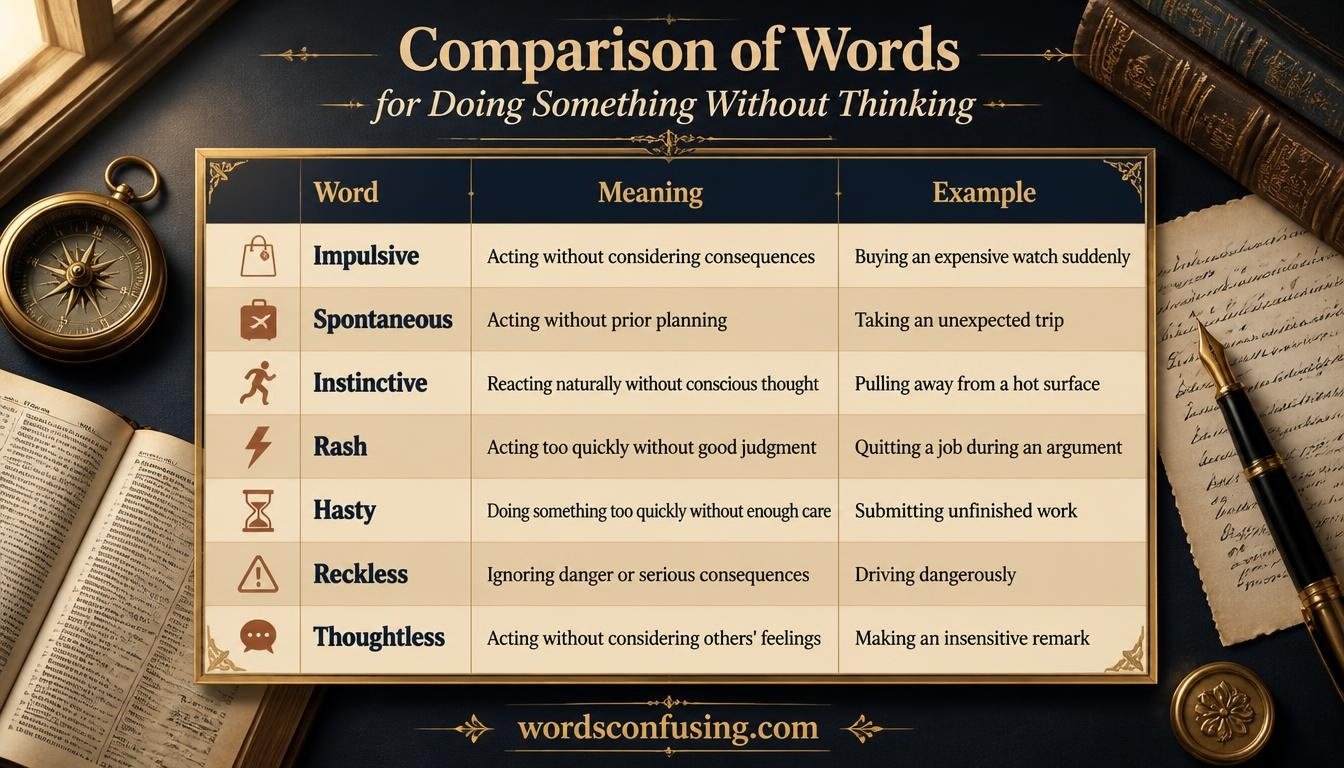
Comparison of Words for Doing Something Without Thinking
Although these seven words share similar meanings, each emphasizes a different reason or quality behind an action.
Some describe emotional decisions. Others focus on natural reactions, unnecessary risks, or a lack of consideration.
The following table makes their differences easier to understand.
| Word | Meaning | Connotation | Main Reason | Example |
| Impulsive | Acting without considering consequences | Usually negative or neutral | Immediate urge or emotion | Buying an expensive watch suddenly |
| Spontaneous | Acting without prior planning | Usually positive or neutral | Lack of preparation | Taking an unexpected trip |
| Instinctive | Reacting naturally without conscious thought | Usually neutral or positive | Natural response | Pulling away from a hot surface |
| Rash | Acting too quickly without good judgment | Negative | Poor consideration | Quitting a job during an argument |
| Hasty | Doing something too quickly without enough care | Negative or neutral | Rushing or impatience | Submitting unfinished work |
| Reckless | Ignoring danger or serious consequences | Strongly negative | Disregard for risk | Driving dangerously |
| Thoughtless | Acting without considering others’ feelings | Negative | Lack of consideration | Making an insensitive remark |
Which Word Should You Choose?
Choosing the right word becomes easier when you identify what caused the behavior.
Use these quick distinctions:
- Impulsive: Someone acts on an immediate desire without thinking about the outcome.
- Spontaneous: Someone does something unexpectedly without planning ahead.
- Instinctive: Someone responds naturally without consciously analyzing the situation.
- Rash: Someone makes a poorly considered decision.
- Hasty: Someone rushes and doesn’t give an action enough attention.
- Reckless: Someone ignores serious risks or possible harm.
- Thoughtless: Someone fails to consider other people’s feelings.
For example, imagine someone sends an angry message during a disagreement.
You might call the message impulsive because the person acted on emotion. You might call it rash if the message could seriously damage an important relationship. If the message contains an insensitive remark, thoughtless might describe it better.
The same situation can sometimes involve more than one word. Your choice depends on the specific behavior you want to emphasize.
Difference Between Acting Impulsively, Spontaneously, and Instinctively
These three words often cause confusion because they describe actions that happen without much deliberate planning. However, their meanings aren’t interchangeable.
Understanding their differences helps you describe behavior more accurately.
Impulsive vs. Spontaneous
The difference between impulsive and spontaneous comes down to consideration and consequences.
An impulsive action usually happens because someone follows an immediate urge. A spontaneous action happens without prior planning.
Consider these examples:
Impulsive: You see an expensive phone and purchase it immediately despite having limited money.
Spontaneous: You decide to visit your cousin after discovering that you’re both free that afternoon.
Both actions happen suddenly. However, the first involves an immediate desire that may override sensible judgment. The second simply involves an unplanned decision.
Here’s another useful comparison:
| Impulsive | Spontaneous |
| Often driven by emotions or urges | Often driven by opportunity or natural enthusiasm |
| May involve poor judgment | Doesn’t necessarily involve poor judgment |
| Can lead to regret | Often describes enjoyable experiences |
| Focuses on immediate action | Focuses on lack of planning |
Remember: Spontaneous doesn’t mean irresponsible. Impulsive often suggests that someone acted before considering the results.
Impulsive vs. Instinctive
Although both words describe actions that happen quickly, they refer to different processes.
An impulsive action usually follows an immediate desire, emotion, or temptation. An instinctive action happens naturally without conscious reasoning.
For example, buying something expensive because you suddenly want it is impulsive. Pulling your hand away from a hot pan is instinctive.
The first involves an urge. The second involves an automatic response.
| Impulsive | Instinctive |
| Often follows an immediate desire | Often follows a natural response |
| May involve emotional decisions | Often involves automatic reactions |
| Can happen during shopping or arguments | Can happen during surprise or danger |
| May lead to regret | Often helps someone respond quickly |
Remember: Impulsive behavior involves acting on an urge. Instinctive behavior involves responding naturally.
Spontaneous vs. Instinctive
These words also differ in an important way.
A spontaneous action happens without advance planning. An instinctive action happens without conscious reasoning.
For example, suggesting an unexpected dinner with friends is spontaneous. Reaching out to catch a falling glass is instinctive.
The first involves an unplanned choice. The second involves an automatic reaction.
| Spontaneous | Instinctive |
| Happens without prior planning | Happens without conscious reasoning |
| Often involves personal choices | Often involves automatic responses |
| Can be social or recreational | Often involves physical or emotional reactions |
| Doesn’t require an immediate trigger | Often responds to a particular situation |
Remember: Something spontaneous is unplanned. Something instinctive feels automatic.
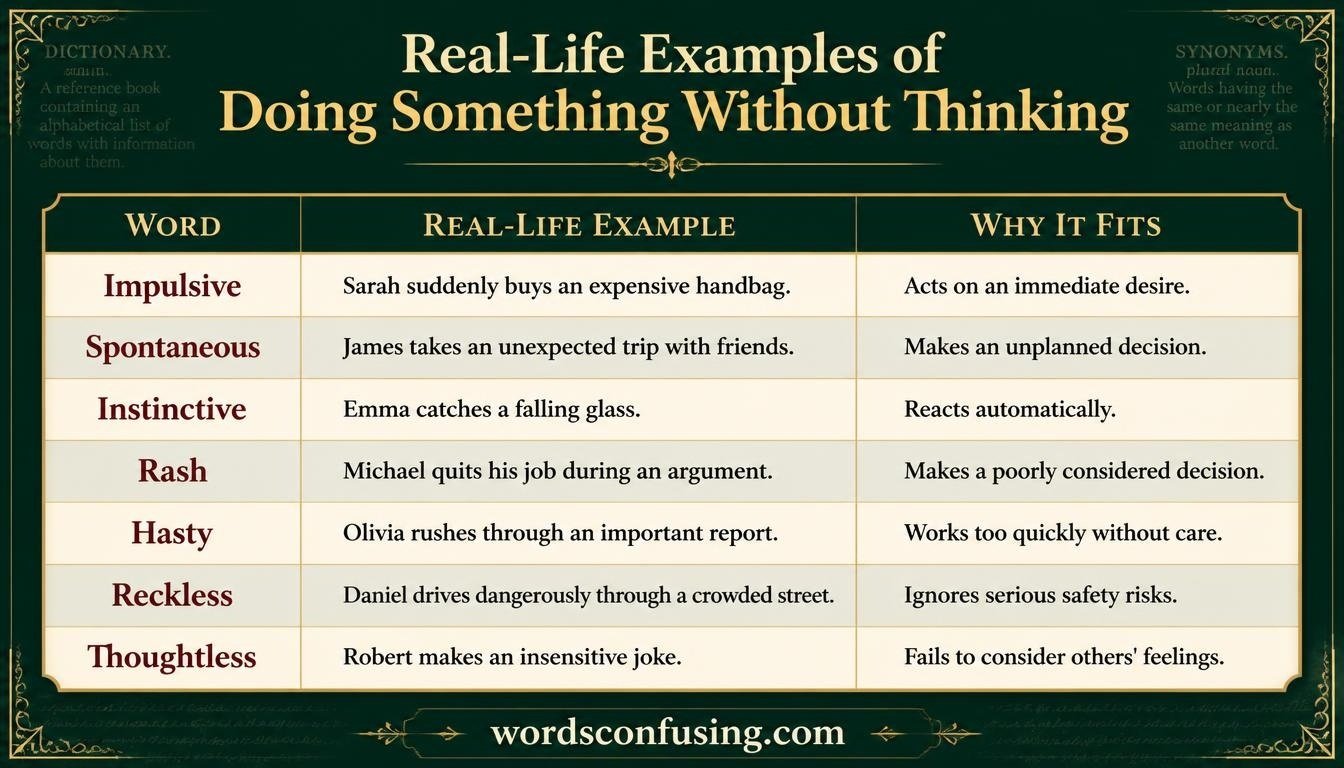
Real-Life Examples of Doing Something Without Thinking
Sometimes, examples make vocabulary differences easier to understand than definitions alone. Consider these everyday situations and how the seven words apply.
Case Study: Making a Sudden Purchase
Sarah visits a shopping center to buy groceries. While walking through a store, she notices an expensive handbag.
She immediately purchases it because she loves its design. Later, she checks her bank account and realizes she spent more than planned.
Best word: Impulsive
Sarah acted on an immediate desire without considering her budget. Her purchase was impulsive because she prioritized instant satisfaction over careful decision-making.
Case Study: Planning an Unexpected Trip
James and his friends finish their weekend lunch. Someone suggests visiting a nearby lake before sunset.
Nobody planned the outing, but everyone agrees. They spend the afternoon together and return home happily.
Best word: Spontaneous
The group made an unplanned decision. However, nothing suggests that they ignored important responsibilities or took unnecessary risks.
Case Study: Reacting to an Unexpected Accident
Emma notices a glass slipping from the kitchen counter. Without thinking consciously, she reaches forward and catches it.
Best word: Instinctive
Emma responds automatically to something happening in front of her. Her action doesn’t involve a carefully planned decision.
Case Study: Quitting During an Argument
Michael disagrees with his supervisor during a stressful meeting. Feeling angry, he immediately announces that he’s leaving his job.
Later, he regrets his decision because he hasn’t arranged another position.
Best word: Rash
Michael made a major decision without considering its consequences. His emotional response affected his judgment.
Case Study: Rushing Through Important Work
Olivia needs to submit a report before the end of the day. She rushes through the final sections without reviewing the figures.
Her manager discovers several mistakes during the presentation.
Best word: Hasty
Olivia worked too quickly and failed to give the report enough attention. Her mistake resulted from rushing rather than necessarily acting on an emotional urge.
Case Study: Ignoring an Obvious Safety Risk
Daniel drives dangerously fast through a crowded residential street. Several pedestrians have to move out of his way.
Best word: Reckless
Daniel disregards the potential danger to himself and others. His behavior creates an unnecessary safety risk.
Case Study: Making an Insensitive Comment
A colleague shares personal news about a difficult experience. Instead of listening, Robert makes a joke about the situation.
The colleague feels embarrassed and hurt.
Best word: Thoughtless
Robert fails to consider the emotional impact of his words. His comment shows a lack of sensitivity toward another person.
These examples demonstrate an important point: the reason behind an action matters as much as the action itself. Someone might act suddenly without being careless, dangerous, or insensitive.
What Is the Best Word for Someone Who Acts Without Thinking?
The best word depends on the person’s behavior, intentions, and circumstances. Although impulsive works as a general description, several alternatives communicate more specific meanings.
Here are the most suitable choices for different situations.
Use Impulsive for Someone Who Acts on Immediate Urges
An impulsive person often makes decisions without considering what might happen afterward.
For example:
- He buys things without checking his budget.
- She sends messages whenever she feels angry.
- They accept invitations without considering their schedules.
You can describe someone as impulsive when immediate emotions or desires influence their actions.
Use Rash for Someone Who Makes Poor Decisions
A rash person tends to make decisions too quickly without examining the consequences.
For example:
- He resigns whenever he disagrees with management.
- She ends friendships after minor misunderstandings.
- They make important choices without gathering enough information.
Use rash when you want to emphasize poor judgment rather than simply sudden behavior.
Use Reckless for Someone Who Ignores Danger
A reckless person disregards possible harm or serious risks.
For example:
- He drives dangerously despite knowing the risks.
- She ignores important safety instructions.
- They take unnecessary risks that could hurt others.
Use reckless when someone’s behavior shows little concern for safety or consequences.
Use Thoughtless for Someone Who Ignores Other People’s Feelings
A thoughtless person may say or do things without considering how others feel.
For example:
- He makes insensitive jokes about personal problems.
- She interrupts people during important conversations.
- They cancel plans without informing anyone.
Use thoughtless when the main problem involves a lack of consideration.
Use Spontaneous for Someone Who Acts Without Planning
A spontaneous person often enjoys making unexpected decisions.
For example:
- She suggests unplanned weekend adventures.
- He surprises his friends with unexpected visits.
- They organize last-minute celebrations.
Use spontaneous when the action happens naturally without advance arrangements.

Other Useful Synonyms for Acting Without Thinking
The seven main words cover several common situations. However, English offers additional vocabulary for describing specific kinds of unconsidered behavior.
These alternatives can help you express subtle differences more precisely.
| Word | Meaning | Example |
| Impetuous | Acting suddenly without considering consequences | His impetuous decision surprised everyone. |
| Careless | Failing to give something enough attention | She made a careless mistake while checking the figures. |
| Unthinking | Acting without conscious consideration | His unthinking response offended his colleague. |
| Automatic | Happening without conscious control | She gave an automatic response to the familiar question. |
| Knee-jerk | An immediate reaction without careful thought | His knee-jerk reaction was to reject the suggestion. |
| Inconsiderate | Showing little regard for other people | It was inconsiderate to cancel without warning. |
| Unpremeditated | Not planned or considered beforehand | The remark was unpremeditated and unexpected. |
Impetuous
Impetuous describes someone who acts suddenly and forcefully without thinking carefully about the results.
It’s particularly useful for describing bold decisions driven by emotion or excitement.
Example: His impetuous decision to move abroad surprised his entire family.
Careless
Careless describes someone who fails to pay enough attention to a task or responsibility.
It doesn’t necessarily mean the person acted suddenly. Instead, it highlights insufficient attention.
Example: A careless mistake caused the team to submit an incorrect report.
Unthinking
Unthinking describes an action performed without careful consideration or conscious reflection.
It can describe automatic behavior or an action that someone performs without considering its meaning.
Example: Her unthinking comment hurt someone she genuinely cared about.
Automatic
Automatic describes something that happens without conscious effort or deliberate control.
It often applies to familiar habits, routine actions, and physical responses.
Example: Saying hello became an automatic response whenever he entered the office.
Knee-Jerk
Knee-jerk describes an immediate reaction that happens without careful thought.
The expression comes from the automatic leg movement associated with the knee-jerk reflex test.
Example: His knee-jerk reaction was to disagree before hearing the complete proposal.
Inconsiderate
Inconsiderate describes behavior that shows little regard for other people’s needs or feelings.
It overlaps with thoughtless, although it often emphasizes a failure to consider someone else’s convenience or situation.
Example: It was inconsiderate to play loud music while everyone else was sleeping.
Unpremeditated
Unpremeditated describes something that wasn’t planned or deliberately considered beforehand.
It’s more formal than spontaneous and often appears in discussions of unexpected actions or remarks.
Example: His unpremeditated remark revealed what he genuinely thought.
Read more: Fair vs. Just: How to Use Each Correctly?
FAQs
1. What does doing something without thinking mean?
Doing something without thinking means acting before considering your choices or possible consequences. It often happens because of habit, impulse, or instinct. For example, you might answer a question immediately without thinking about your words.
2. What is a word for acting without thinking?
Several words describe actions performed without careful thought. Impulsive, instinctive, spontaneous, automatic, unconscious, and rash are common choices. Each word carries a slightly different meaning depending on the situation.
3. What is the difference between impulsive and instinctive behavior?
Impulsive behavior happens when you act on a sudden urge without considering the consequences. Instinctive behavior comes naturally without deliberate reasoning. For example, buying something suddenly is impulsive, while pulling your hand away from something hot is instinctive.
4. Is acting without thinking always a bad thing?
No, acting without thinking isn’t always negative. Some quick reactions help you avoid danger or handle familiar situations efficiently. However, impulsive decisions can create problems when they involve money, relationships, or important responsibilities.
5. What is another way to say someone acted without thinking?
You can say someone acted on impulse, reacted instinctively, or did something automatically. Other expressions include acting rashly, responding spontaneously, and behaving thoughtlessly. Choose the phrase that best describes the person’s actual behavior.
6. How can I describe someone who speaks without thinking?
You can describe such a person as impulsive, outspoken, thoughtless, or rash, depending on their behavior. Someone who speaks impulsively may say whatever comes to mind without considering how their words affect others. A thoughtless speaker may also overlook other people’s feelings.
Conclusion
Doing something without thinking is a common part of everyday life. Sometimes, habit and instinct guide your actions, while other moments involve sudden impulses or spontaneous reactions. Words like impulsive, instinctive, automatic, and thoughtless help you describe these behaviors more accurately. However, each word carries a slightly different meaning. Understanding those differences helps you choose expressions that match the situation instead of using the same description repeatedly.
Whether you’re writing an email, talking with friends, or communicating at work, the right vocabulary makes your message clearer. Pay attention to why someone acted a certain way before choosing a descriptive word. A quick reaction doesn’t always mean someone behaved carelessly. Sometimes, it simply reflects a natural response to a familiar situation.