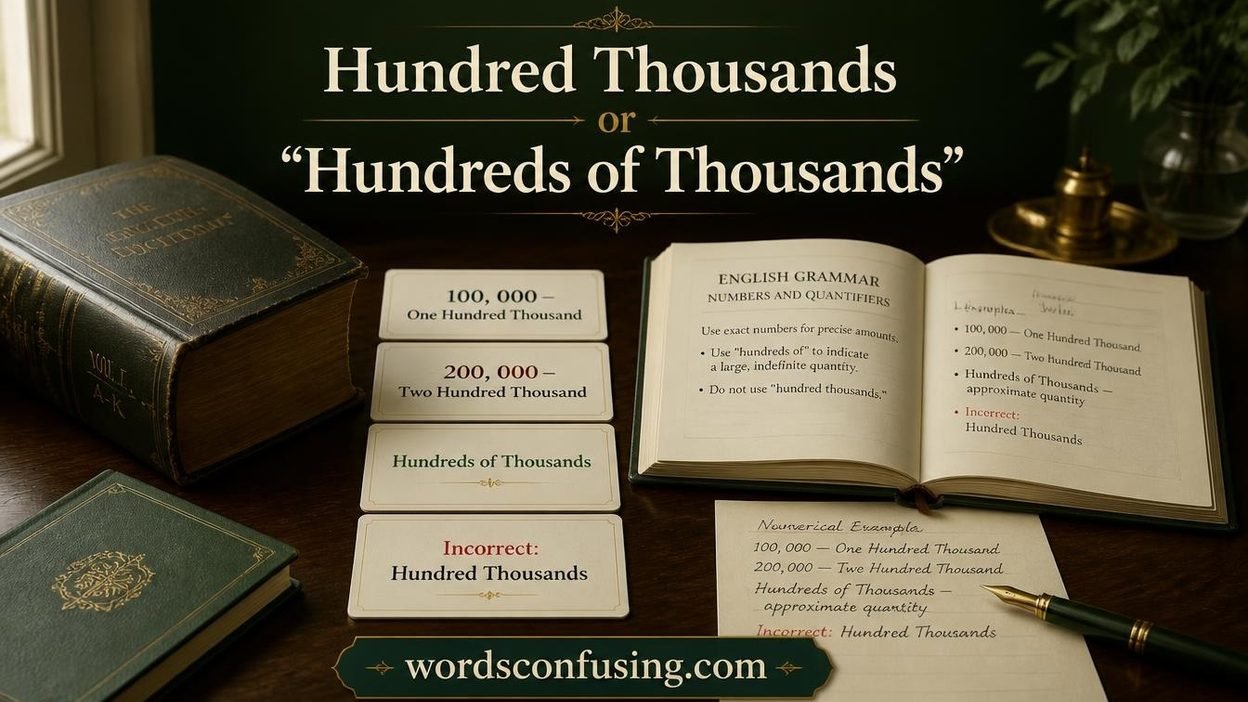
The guide “Hundred Thousands” or “Hundreds of Thousands”explains how to express large, approximate quantities clearly in English.
When describing an awful lot of things, you need the correct expression to avoid confusion. Although Hundred Thousands and Hundreds Of Thousands look similar, they follow different grammar rules. The distinction depends on how hundred, hundreds, and thousands describe a quantity. Hundreds of thousands refers to a large, approximate number, not an exact number.
For example, writers and speakers can use this expression to describe a large group without specifying its precise size. Understanding these key differences improves grammar accuracy, English usage, and knowledge of common English expressions. It also helps prevent common mistakes when using numerical phrases in spoken English, written English, and casual conversations.
Correct number usage matters in everyday communication, formal writing, and business communication. Whether you’re discussing meetings, schedules, calendar tools, project management documents, or online booking, accurate numerical expressions improve clarity and consistency. The same principle applies to broadcasting and professional content, where precise information builds trust.
With simple explanations and practical examples, you can understand English grammar and its practical application more easily. Remember that approximate quantities and large numbers often require this expression, while exact numerical values need precise wording. This approach makes your communication clearer and improves your understanding of number expressions and numerical quantities.
Quick Answer
“Hundreds of thousands” is the correct expression when describing a large, unspecified quantity. For example, “Hundreds of thousands of people attended the event.” However, use “hundred thousand” after a specific number, such as “Two hundred thousand people attended.” Simply put, use “hundreds of thousands” for approximate amounts and “hundred thousand” for exact numbers.
Is It “Hundred Thousands” or “Hundreds of Thousands”?
When describing a large but unspecified quantity, “hundreds of thousands” is the grammatically correct expression. The phrase follows a standard English number construction that uses a plural quantity noun followed by of.
For example:
- Correct: Hundreds of thousands of people watched the championship.
- Incorrect: Hundred thousands of people watched the championship.
- Correct: The organization received hundreds of thousands of dollars in donations.
- Incorrect: The organization received hundred thousands of dollars in donations.
The difference comes down to how English handles large numerical quantities. When you use hundred after a specific number, it normally stays singular. However, when you use it to describe an indefinite quantity, it becomes hundreds.
The preposition “of” also plays an important grammatical role. It connects the approximate quantity to the people, objects, or things being counted.
Consider these examples:
| Expression | Correct or incorrect? | Explanation |
| Hundred thousands of visitors | Incorrect | Missing the standard plural quantity construction and of relationship. |
| Hundreds of thousands of visitors | Correct | Describes an unspecified large number. |
| One hundred thousand visitors | Correct | Identifies exactly 100,000 visitors. |
| Two hundred thousand visitors | Correct | Identifies exactly 200,000 visitors. |
| Five hundreds thousand visitors | Incorrect | Adds an unnecessary plural ending. |
One useful rule makes this distinction easier to remember:
Use “hundreds of thousands” for an approximate quantity and “hundred thousand” after a specific number.
Although both expressions describe large amounts, they don’t communicate precisely the same thing.
What Does “Hundreds of Thousands” Mean?
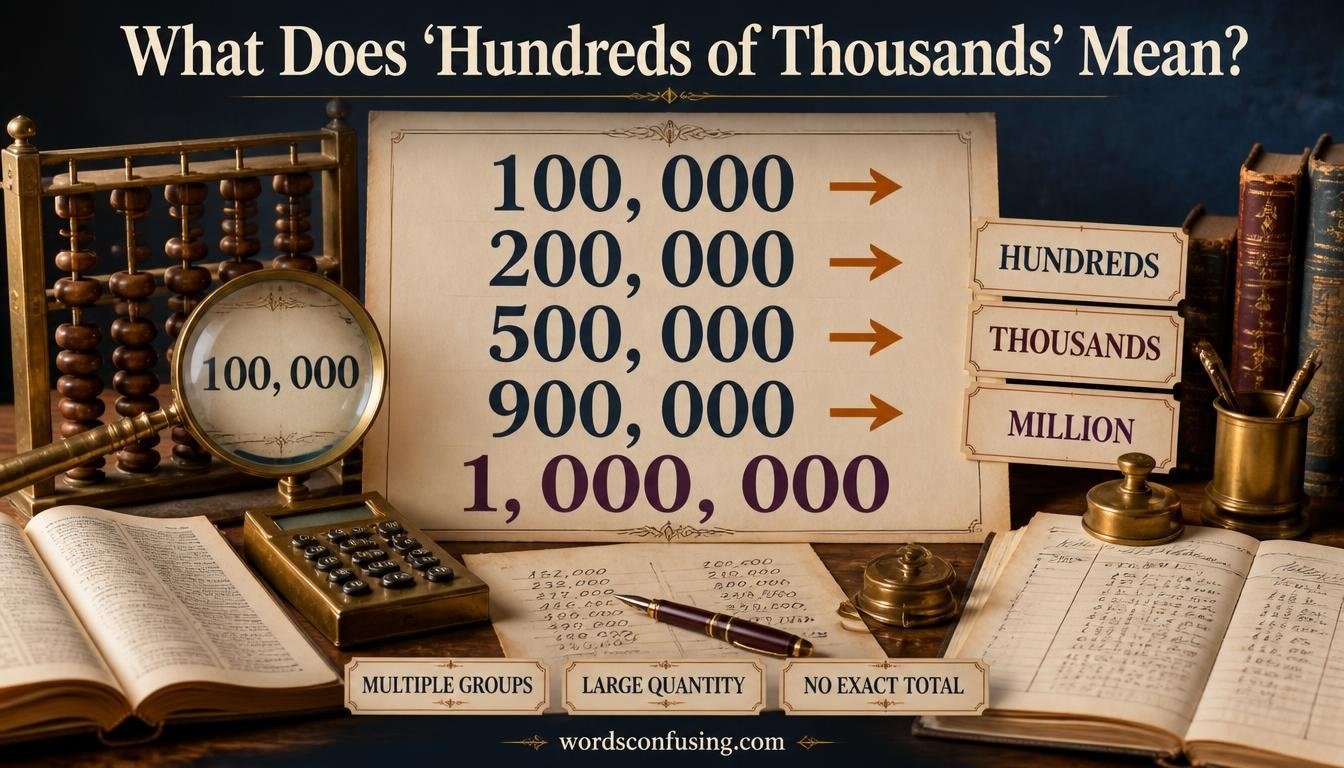
The expression “hundreds of thousands” refers to a large quantity that generally falls within the hundreds-of-thousands range. It describes multiple groups of 100,000 without identifying an exact total.
For example, imagine a charity collects donations from thousands of supporters. Its fundraising report might say that hundreds of thousands of dollars came from individual contributions.
That statement communicates a substantial amount without specifying whether the organization collected $200,000, $450,000, or $800,000.
The expression contains three important parts:
- Hundreds: The plural form of hundred, indicating multiple groups.
- Of: A preposition connecting the quantity to the noun that follows.
- Thousands: The plural form of thousand, representing groups of 1,000.
Together, these words create an expression for a substantial but unspecified quantity.
Understanding the Numerical Meaning of “Hundreds of Thousands”
To understand the expression, consider how individual groups of 100,000 work.
| Number | Written form |
| 100,000 | One hundred thousand |
| 200,000 | Two hundred thousand |
| 300,000 | Three hundred thousand |
| 400,000 | Four hundred thousand |
| 500,000 | Five hundred thousand |
| 600,000 | Six hundred thousand |
| 700,000 | Seven hundred thousand |
| 800,000 | Eight hundred thousand |
| 900,000 | Nine hundred thousand |
| 1,000,000 | One million |
When someone says “hundreds of thousands,” the listener generally understands that the quantity reaches multiple hundred-thousand units. The expression doesn’t identify a particular figure.
In ordinary usage, it often suggests a quantity somewhere between 200,000 and 999,999. However, context matters, and the phrase isn’t a precise mathematical boundary.
For instance, a news report might say:
- Hundreds of thousands of residents lost electricity during the storm.
- The museum welcomes hundreds of thousands of visitors annually.
- Hundreds of thousands of applications arrive each year.
- The campaign raised hundreds of thousands of dollars.
Each sentence communicates scale without providing an exact statistic.
Examples of “Hundreds of Thousands” in Sentences
Seeing the expression in different situations helps you understand how naturally it fits into everyday English.
Everyday situations:
- Hundreds of thousands of people attended the music festival.
- The online store received hundreds of thousands of orders.
- Hundreds of thousands of students applied for scholarships.
- The new application attracted hundreds of thousands of users.
- Hundreds of thousands of books were distributed nationwide.
Business and finance:
- The company invested hundreds of thousands of dollars in new equipment.
- Hundreds of thousands of customers purchased the product.
- The construction project required hundreds of thousands of dollars.
- The business generated hundreds of thousands of dollars in annual revenue.
Education and technology:
- Hundreds of thousands of students use digital learning platforms.
- The educational website receives hundreds of thousands of monthly visits.
- Researchers analyzed hundreds of thousands of digital records.
- The software processed hundreds of thousands of transactions.
Notice how the expression remains unchanged across different subjects. You can use it with people, dollars, applications, books, visitors, and other countable quantities.
Why Is “Hundred Thousands” Incorrect?
The expression “hundred thousands” is generally incorrect in standard English when you intend to describe an unspecified large quantity.
The problem involves two related grammatical rules: number words and plural nouns.
In English, hundred and thousand normally remain singular when a specific number comes before them. For example, you write three hundred rather than three hundreds. You also write five thousand rather than five thousands.
However, when these words function as ordinary plural nouns, they can take an -s ending. That’s why English speakers say hundreds of people and thousands of visitors.
The distinction becomes clearer through examples:
| Incorrect construction | Correct construction |
| Hundred thousands of people | Hundreds of thousands of people |
| Two hundreds of visitors | Two hundred visitors |
| Five thousands of dollars | Five thousand dollars |
| Three hundreds thousand people | Three hundred thousand people |
| Thousand of applications | Thousands of applications |
The expression hundred thousands combines number-word patterns in a way that doesn’t follow standard English usage.
Why Does “Hundreds” Need “Of”?
The word “hundreds” functions as a plural noun when you use it to describe an unspecified quantity. The preposition of connects this quantity to the noun being counted.
For example:
- Hundreds of people attended the ceremony.
- Hundreds of thousands of people attended the ceremony.
In the first sentence, hundreds describes an unspecified number of people. In the second, hundreds of thousands describes a much larger quantity.
Without of, the relationship between the quantity and the following noun becomes grammatically incomplete in these constructions.
Compare:
- Correct: Thousands of visitors entered the building.
- Incorrect: Thousands visitors entered the building.
- Correct: Hundreds of thousands of dollars were spent.
- Incorrect: Hundreds thousands dollars were spent.
The word of isn’t decorative. It performs an essential grammatical function.
Why Doesn’t “Hundred” Take an S After a Specific Number?
English treats hundred as part of a compound numerical expression when a specific number precedes it.
For example:
- One hundred people.
- Two hundred students.
- Three hundred dollars.
- Four hundred houses.
- Five hundred applications.
The number before hundred already identifies how many groups of one hundred you’re discussing. Adding an -s would be unnecessary.
However, compare these expressions:
- Two hundred people attended the meeting.
- Hundreds of people attended the meeting.
The first gives a specific number. The second describes an approximate quantity.
This difference explains why hundred and hundreds aren’t interchangeable in every sentence.
Read more: Driver License or Driver’s License or Drivers License: Which Is Correct?
When Should You Use “Hundred,” “Hundreds,” and “Hundred Thousand”?
Choosing the right expression becomes easier when you understand the role each form plays. Although these words share the same numerical roots, their grammatical functions differ.
Let’s examine when to use each construction.
When to Use “Hundred”
Use “hundred” when a specific number appears directly before it. This construction identifies an exact numerical quantity rather than an indefinite group.
Common examples include:
- One hundred people.
- Two hundred dollars.
- Three hundred students.
- Four hundred pages.
- Five hundred visitors.
- Nine hundred houses.
The same rule applies when another number appears before hundred.
For instance:
- Twenty-three hundred tickets.
- Forty-five hundred dollars.
- Seventy-two hundred participants.
These constructions represent 2,300 tickets, $4,500, and 7,200 participants, respectively.
You can also use a hundred to mean exactly 100 in ordinary numerical contexts.
Examples:
- A hundred people attended the celebration.
- She saved a hundred dollars.
- The library contains a hundred reference books.
In each example, hundred remains singular because a specific quantity determines its numerical value.
Remember: Don’t add an s to hundred immediately after a specific number.
When to Use “Hundreds”
Use “hundreds” when you want to describe an unspecified number of groups containing one hundred units each.
Unlike two hundred or five hundred, this construction doesn’t provide an exact total.
Examples include:
- Hundreds of people visited the exhibition.
- Hundreds of books arrived at the library.
- The company received hundreds of complaints.
- Hundreds of birds gathered near the lake.
- Hundreds of students participated in the competition.
You can also use hundreds without of in certain constructions.
For example:
- The museum displayed hundreds.
- Hundreds attended the public meeting.
- The company sold hundreds during its first week.
Here, the noun being counted is understood from the surrounding context.
However, when you introduce the noun being counted directly, the usual construction is “hundreds of + noun.”
When to Use “Hundred Thousand”
Use “hundred thousand” when expressing an exact numerical amount or a number within a specific numerical construction.
For example:
- One hundred thousand people registered for the event.
- Two hundred thousand dollars were allocated to the project.
- Three hundred thousand copies were distributed.
- Five hundred thousand residents live in the region.
- Nine hundred thousand applications were submitted.
Each expression identifies a specific number.
The same principle applies when you use larger numbers before hundred thousand.
Examples:
- One million two hundred thousand people.
- Two million five hundred thousand dollars.
- Three million four hundred thousand visitors.
Notice that hundred thousand doesn’t take plural endings in these constructions.
A common mistake is writing two hundred thousands when the intended number is 200,000. The correct form is “two hundred thousand.”
When to Use “Hundreds of Thousands”
Use “hundreds of thousands” when you know the quantity is very large but don’t want to provide an exact figure.
This expression works particularly well in journalism, business writing, research summaries, and everyday conversations.
Examples:
- Hundreds of thousands of people watched the live broadcast.
- The organization distributed hundreds of thousands of meals.
- Hundreds of thousands of dollars supported local charities.
- The website receives hundreds of thousands of visits.
- Hundreds of thousands of trees were planted across the region.
You might choose this construction when an exact statistic isn’t available or isn’t necessary for your point.
For example, compare these sentences:
- The company sold 350,000 products last year.
- The company sold hundreds of thousands of products last year.
Both sentences communicate a large quantity. However, the first provides an exact figure while the second offers an approximate description.
Use an exact number when precision matters. Use “hundreds of thousands” when the general scale matters more.

“Hundreds of Thousands” vs. “Hundred Thousand”: What’s the Difference?
Although these expressions look similar, they serve different purposes in numerical communication.
“Hundred thousand” belongs to exact-number constructions. “Hundreds of thousands” describes an indefinite quantity that generally falls within the hundreds-of-thousands range.
Consider this comparison:
| Expression | Meaning | Example |
| One hundred thousand | Exactly 100,000 | One hundred thousand people registered. |
| Two hundred thousand | Exactly 200,000 | Two hundred thousand dollars were raised. |
| Five hundred thousand | Exactly 500,000 | Five hundred thousand copies were printed. |
| Hundreds of thousands | An unspecified large quantity | Hundreds of thousands of people participated. |
| Hundreds of people | An unspecified quantity in the hundreds | Hundreds of people attended. |
| Thousands of people | An unspecified quantity in the thousands | Thousands of people attended. |
The main difference involves precision.
When you write three hundred thousand, readers understand that you mean exactly 300,000. When you write hundreds of thousands, readers understand that you’re describing a substantial quantity without specifying the precise total.
Practical Examples of the Difference
Imagine a company reports its annual customer numbers.
Example one: Exact quantity
The company served 250,000 customers during the previous year.
This statement provides a definite figure. Readers know exactly how many customers the company served.
Example two: Approximate quantity
The company served hundreds of thousands of customers during the previous year.
This statement communicates a similar scale without identifying the exact number.
The same distinction applies to money:
- Exact: The organization raised four hundred thousand dollars.
- Approximate: The organization raised hundreds of thousands of dollars.
It also applies to population:
- Exact: The city has three hundred thousand residents.
- Approximate: The city has hundreds of thousands of residents.
These examples demonstrate why choosing the right expression matters. Your wording tells readers whether you’re presenting a specific figure or a general estimate.
“Hundreds of Thousands” vs. “Thousands”: What’s the Difference?
Both expressions describe large quantities, but they suggest different numerical scales.
“Thousands” generally refers to multiple groups of 1,000. Meanwhile, “hundreds of thousands” refers to multiple groups of 100,000.
For example:
- Thousands of people attended the concert.
- Hundreds of thousands of people attended the concert.
The second sentence describes a considerably larger crowd.
Here’s a simple numerical comparison:
| Expression | General numerical scale |
| Hundreds | 200–999 approximately |
| Thousands | 2,000–9,999 approximately |
| Tens of thousands | 10,000–99,999 approximately |
| Hundreds of thousands | 200,000–999,999 approximately |
| Millions | 1,000,000 or more |
These ranges provide useful illustrations rather than strict grammatical limits. Context and ordinary usage determine the intended meaning.
For example, a business might describe its monthly website traffic as thousands of visitors. A major international platform might attract hundreds of thousands instead.
Using the appropriate expression helps readers understand the scale without forcing them to interpret an unclear figure.
Common Mistakes to Avoid When Using “Hundreds of Thousands”
Even experienced English writers sometimes confuse large numerical expressions. Most mistakes happen when people mix exact-number rules with approximate-quantity constructions.
Here are several common errors and their corrections.
Using “Hundred Thousands” Instead of “Hundreds of Thousands”
This is the central mistake to avoid.
Incorrect: Hundred thousands of people attended the celebration.
Correct: Hundreds of thousands of people attended the celebration.
The correct version uses the plural noun hundreds followed by of thousands. This construction expresses an unspecified large quantity.
Adding an S After a Specific Number
Don’t pluralize hundred or thousand when a specific number directly precedes it.
Incorrect: Three hundreds people entered the building.
Correct: Three hundred people entered the building.
Incorrect: Five thousands dollars were donated.
Correct: Five thousand dollars were donated.
The specific number already establishes the quantity. An additional plural ending isn’t necessary.
Forgetting the Word “Of”
When hundreds introduces the noun being counted, it normally needs of.
Incorrect: Hundreds people attended the event.
Correct: Hundreds of people attended the event.
Incorrect: Hundreds thousands of applications arrived.
Correct: Hundreds of thousands of applications arrived.
The preposition creates the proper relationship between the quantity and the noun.
Confusing “Hundred Thousand” With “Hundreds of Thousands”
These expressions don’t communicate the same degree of precision.
Incorrect: The charity collected hundreds of thousand dollars.
Correct: The charity collected hundreds of thousands of dollars.
However, if the charity collected exactly $300,000, you could write:
The charity collected three hundred thousand dollars.
Choose your expression according to the information you’re trying to communicate.
Using Inconsistent Numerical Expressions
A sentence can become confusing when it combines incompatible number constructions.
Incorrect: The company received two hundreds of thousands applications.
Correct: The company received hundreds of thousands of applications.
Alternatively:
The company received two hundred thousand applications.
The first corrected sentence gives an approximate quantity. The second provides an exact number.

Real-World Usage: How to Choose the Correct Expression
Understanding grammar rules is useful, but practical examples make them easier to apply. Large numerical expressions appear in news reports, financial statements, business discussions, and educational writing.
The following situations illustrate how to choose between exact and approximate quantities.
Case Study: Reporting a Company’s Sales
Imagine an online retailer sells 425,000 products during one financial year.
A financial report might state:
“The retailer sold 425,000 products during the year.”
This version provides a precise figure that readers can compare against previous years.
However, a general company overview might say:
“The retailer sells hundreds of thousands of products annually.”
The second sentence communicates the business’s approximate sales scale. It doesn’t claim that the company sells exactly 425,000 products every year.
Case Study: Describing a Charity’s Fundraising Campaign
Suppose a nonprofit organization collects $375,000 through public donations.
You have two possible ways to describe the result:
- Exact statement: The campaign raised three hundred seventy-five thousand dollars.
- Approximate statement: The campaign raised hundreds of thousands of dollars.
Both constructions are grammatically correct. The first highlights the precise fundraising result. The second emphasizes the campaign’s overall scale.
For financial reporting, the exact amount usually provides more useful information.
For a short promotional summary, the approximate expression might be sufficient.
Case Study: Discussing Population
Imagine a town has 275,000 residents.
You could write:
“The town has two hundred seventy-five thousand residents.”
This sentence identifies the exact population figure.
Alternatively:
“The town has hundreds of thousands of residents.”
This version provides a broad description without identifying the precise population.
However, population statistics can change. When accuracy matters, use a dated official figure rather than an approximate expression.
Case Study: Describing Website Traffic
Suppose a website receives 650,000 visits every month.
A detailed analytics report might say:
“The website recorded 650,000 visits in October.”
A general marketing description might say:
“The website attracts hundreds of thousands of monthly visits.”
The exact version works better for performance analysis. The approximate version works well when describing the website’s overall reach.
These situations reveal an important principle: grammatical correctness and numerical precision work together, but they serve different purposes.
Quick Tips for Remembering the Correct Usage
If you frequently confuse these expressions, a few simple rules can help.
- Use hundred after a specific number: three hundred, five hundred, or nine hundred.
- Use hundreds of for an unspecified quantity: hundreds of people or hundreds of books.
- Use hundred thousand for exact numerical constructions: two hundred thousand dollars.
- Use hundreds of thousands for an unspecified large quantity.
- Don’t add an unnecessary s after a specific number.
- Include of when using the plural quantity construction before another noun.
A quick substitution test can also help.
If you can replace the expression with an exact number, use a singular number construction:
- Three hundred thousand visitors.
- Five hundred thousand dollars.
- Seven hundred thousand applications.
If you want to describe an approximate quantity, use the plural construction:
- Hundreds of thousands of visitors.
- Hundreds of thousands of dollars.
- Hundreds of thousands of applications.
This simple distinction prevents most common errors.
Read more: 6 Words for Someone Who Won’t Admit They Are Wrong
FAQs
1. Is “Hundred Thousands” grammatically correct?
No, “hundred thousands” is generally incorrect when describing a large, approximate quantity. The correct expression is “hundreds of thousands.” For example, you can say, “Hundreds of thousands of people watched the concert.”
2. Why Do We Say “Hundreds of Thousands” Instead of “Hundred Thousands”?
English grammar uses “hundreds of” to describe an unspecified, large quantity. The word “of” connects the approximate number to the things being counted. Therefore, “hundreds of thousands” sounds natural and follows standard English usage.
3. What Does “Hundreds of Thousands” Mean?
“Hundreds of thousands” means a very large number, usually somewhere between 100,000 and 999,999. It doesn’t identify an exact figure. For instance, “Hundreds of thousands of visitors explored the city last year.”
4. Can I Use “Hundred Thousand” Without Adding an S?
Yes! “Hundred thousand” works when you describe an exact number with a preceding number or another suitable expression. For example, “Three hundred thousand people attended the festival.” You can also write “One hundred thousand dollars.”
5. What Is the Difference Between “Hundred Thousand” and “Hundreds of Thousands”?
The difference comes down to precision. “Hundred thousand” appears in exact numerical expressions, such as “Five hundred thousand dollars.” Meanwhile, “hundreds of thousands” describes an approximate quantity, such as “Hundreds of thousands of dollars were spent.”
6. Should I Use “Hundreds of Thousands” in Formal Writing?
Yes, “hundreds of thousands” is perfectly acceptable in formal writing. You can use it in reports, research papers, business documents, and professional communication. However, when exact figures matter, provide the specific number instead.
Conclusion
Choosing between “Hundred Thousands” or “Hundreds of Thousands” becomes easier once you understand the grammar behind these expressions. When describing a large, unspecified quantity, “hundreds of thousands” is the natural and grammatically correct choice. The word “hundreds” takes the plural form, while “of” connects it to the larger group being counted. Although the phrases may look similar, their usage isn’t interchangeable. A simple example can help you remember the difference: “Hundreds of thousands of people attended the festival.”
Whether you’re writing a business report, sharing information, or having an everyday conversation, correct number expressions make your message clearer. Use exact figures when you know the precise amount, and choose “hundreds of thousands” when an approximate quantity is enough. Once you recognize this pattern, you’ll find it easier to discuss large numbers without second-guessing your grammar.

Franklin Hayes is a writer and editor at WordsConfusing.com, focused on making English vocabulary, grammar, and commonly confused words easy to understand. He writes clear, practical articles with simple explanations and useful examples to help readers improve their English with confidence.
His goal is simple: Making Confusing Words Simple.