This guide to 9 Words to Use Instead of “However” With Examples and Usage shows how alternatives make your writing clearer and more natural.
However is a great word to counter a previous point in your writing, but excessive use of this common transition word can make your prose sound repetitive, stiff, and unpolished. Although it works in many situations, exploring tested synonyms and practical alternatives gives you more choices. Different expressions suit academic writing, professional writing, casual writing, essays, and professional documents.
For example, but, yet, and nevertheless are useful transition words, transitional words, linking words, connecting words, and connectors. Depending on their use, they can also function as discourse markers, conjunctions, or a conjunctive adverb. These transitions help maintain flow when introducing contrasting ideas, opposing ideas, comparisons, exceptions, and contradictions.
Good word choice, rich vocabulary, accurate grammar, and clear language make effective communication easier.
From my experience with different writing styles, choosing suitable alternatives depends on your sentence structure, sentence flow, readability, coherence, clarity, fluency, style, and context. These elements improve your message and strengthen its overall impact.
Experienced professional writers craft compelling content instead of forgettable text by varying their synonyms for different audiences and contexts. This guide offers practical advice, strategic application, pronunciation guides, and helpful usage examples to improve your communication.
As you master these techniques, you can develop strong writing, produce meaningful content, increase reader engagement, and connect with readers and listeners. These habits support lasting writing improvement and stronger writing skills. They also help prevent overdone expressions and encourage you to explore the best alternatives.
Quick Answer
You can use nevertheless, nonetheless, yet, still, although, conversely, on the other hand, even so, and that said instead of “however.” Each expression introduces contrast differently, so choose one that fits your sentence, tone, and intended meaning.

9 Words to Use Instead of “However”
Not every alternative to “however” works in the same way. Some connect contrasting clauses, while others introduce concessions or opposing viewpoints. Understanding these differences helps you choose expressions that fit your sentences naturally.
Here are nine useful alternatives, along with their meanings and practical examples.
Nevertheless
Nevertheless introduces a statement that remains true despite something mentioned earlier. It signals that the previous information doesn’t change the conclusion or outcome.
This word works particularly well when you want to acknowledge an obstacle without allowing it to weaken your main point. It has a formal tone and frequently appears in academic writing, business reports, and professional discussions.
For example, imagine someone completes a difficult project despite facing several unexpected problems. You could use “nevertheless” to emphasize their achievement.
Example sentences:
- The weather was extremely cold. Nevertheless, the hikers continued their journey.
- The proposal faced several objections. Nevertheless, the committee approved it.
- She had little experience. Nevertheless, she performed exceptionally well.
- The project required additional funding. Nevertheless, the team completed it successfully.
When to use “nevertheless”:
- When acknowledging difficulties before presenting a positive outcome.
- When emphasizing that something remains true despite an obstacle.
- When writing formal reports, academic papers, or professional correspondence.
- When you want a slightly more formal alternative to “however.”
Nevertheless vs. however: Both expressions introduce contrast, but they can emphasize different relationships. “However” generally signals a contrast between statements. “Nevertheless” more strongly suggests that the second statement holds despite the first.
Compare these examples:
- The restaurant was expensive. However, the food was delicious.
- The restaurant was expensive. Nevertheless, we decided to celebrate there.
The first sentence contrasts two observations. The second emphasizes a decision made despite the expense.
Nonetheless
Nonetheless means “despite that” or “in spite of what was just mentioned.” It introduces an idea that remains valid despite an earlier fact or difficulty.
Like “nevertheless,” this expression works well in formal and semi-formal writing. It helps you acknowledge limitations while maintaining the importance of your main statement.
For instance, a business might experience lower sales during one quarter but still maintain strong customer loyalty. “Nonetheless” connects those contrasting details smoothly.
Example sentences:
- The assignment was challenging. Nonetheless, every student completed it.
- His explanation wasn’t particularly convincing. Nonetheless, we considered his suggestions.
- The company experienced financial difficulties. Nonetheless, it continued serving its customers.
- The journey was exhausting. Nonetheless, the experience was worthwhile.
When to use “nonetheless”:
- When discussing challenges or unfavorable circumstances.
- When emphasizing that an earlier fact doesn’t change the outcome.
- When writing academic essays or professional documents.
- When you want to maintain a composed and measured tone.
Nonetheless vs. nevertheless: These expressions are extremely close in meaning. In most situations, you can use either without changing the essential message.
However, both can sound more formal than ordinary conversational alternatives. If you’re writing a casual message, “still” or “even so” might feel more natural.
Yet
Yet introduces a contrast between ideas that seem unexpected or inconsistent. It can also connect two independent clauses as a coordinating conjunction.
This expression is especially useful when you want to keep your writing concise. Instead of adding a longer transitional phrase, you can introduce the opposing idea with one simple word.
Consider a person who has considerable experience but continues learning new skills. “Yet” highlights the contrast between experience and continued curiosity.
Example sentences:
- She is young, yet she has considerable professional experience.
- The instructions looked complicated, yet the process was surprisingly simple.
- He rarely speaks in meetings, yet his observations are always valuable.
- The product is affordable, yet it offers excellent performance.
When to use “yet”:
- When presenting two contrasting qualities or situations.
- When expressing an unexpected result.
- When connecting closely related opposing ideas.
- When you want a short and natural alternative to “however.”
Yet vs. however: Although both expressions communicate contrast, their grammatical roles differ.
“Yet” can function as a coordinating conjunction that connects independent clauses. “However” usually functions as a conjunctive adverb.
For example:
- The exam was difficult, yet she passed.
- The exam was difficult. However, she passed.
Notice the punctuation. A comma generally appears before “yet” when it joins two independent clauses. “However” can begin a new sentence or connect independent clauses with a semicolon and comma.
Still
Still introduces an idea that remains true despite an earlier statement or circumstance. It often communicates persistence, determination, or an unexpected outcome.
Unlike “nevertheless,” this alternative sounds more conversational. You can use it in everyday conversations, informal writing, professional messages, and storytelling.
Imagine that someone receives disappointing feedback but continues improving their work. “Still” helps emphasize their determination without making the sentence sound overly formal.
Example sentences:
- The instructions were confusing. Still, we managed to finish the task.
- He doesn’t have much experience. Still, he’s eager to learn.
- The apartment is small. Still, it feels comfortable and welcoming.
- The decision wasn’t easy. Still, everyone respected the final outcome.
When to use “still”:
- When describing persistence despite difficulties.
- When acknowledging an obstacle before presenting another thought.
- When writing conversational articles or everyday messages.
- When you want a simple alternative that doesn’t sound overly formal.
Still vs. however: “Still” often emphasizes that something continues or remains true. “However” generally highlights a contrast without necessarily suggesting persistence.
For example:
- The weather was unpleasant. Still, we enjoyed our picnic.
- The weather was unpleasant. However, the forecast predicted sunshine tomorrow.
Both sentences contain contrast, but their emphasis differs.
Although
Although introduces a concession or contrasting circumstance. It acknowledges one fact while presenting another idea that might seem surprising.
Unlike “however,” although is a subordinating conjunction. It connects a dependent clause with an independent clause, so you must pay attention to sentence structure.
This expression works in academic writing, professional communication, and everyday conversations. It also helps you combine related ideas without creating several short sentences.
Example sentences:
- Although the weather was cold, we enjoyed the outdoor concert.
- She completed the assignment although she had limited time.
- Although the restaurant was crowded, the service remained excellent.
- He accepted the position although the salary was lower than expected.
When to use “although”:
- When acknowledging a fact before presenting a contrasting result.
- When combining two related ideas into one sentence.
- When writing essays, reports, and professional correspondence.
- When you want to express contrast without starting another sentence.
Although vs. however: These expressions aren’t grammatically interchangeable.
Consider these examples:
- The restaurant was expensive. However, the food was excellent.
- Although the restaurant was expensive, the food was excellent.
Both communicate a similar relationship. However, the second sentence uses a dependent clause introduced by “although.”
Important grammar tip: Don’t normally use “although” and “but” together to connect the same contrasting clauses.
Incorrect: Although the restaurant was expensive, but the food was excellent.
Correct: Although the restaurant was expensive, the food was excellent.
Also correct: The restaurant was expensive, but the food was excellent.
Conversely
Conversely introduces an opposing situation, viewpoint, or relationship. It works particularly well when comparing two things that differ in meaningful ways.
This expression has a formal and analytical tone. You’ll often encounter it in academic papers, research discussions, business reports, and comparative explanations.
For example, one marketing strategy might attract younger customers, while another appeals to older audiences. “Conversely” helps introduce the contrasting situation.
Example sentences:
- Some employees prefer working independently. Conversely, others enjoy collaborative projects.
- Urban areas often have extensive public transportation. Conversely, rural communities may have limited options.
- The first approach reduces expenses. Conversely, the second prioritizes long-term investment.
- Some people learn through visual examples. Conversely, others prefer detailed written explanations.
When to use “conversely”:
- When comparing two opposing situations.
- When introducing a contrasting viewpoint.
- When discussing differences between methods, results, or approaches.
- When writing analytical or academic content.
Conversely vs. however: “However” introduces general contrast. “Conversely” suggests a more direct opposition or reversal between two ideas.
For example:
- The first product is lightweight. However, it costs more.
- The first product is designed for beginners. Conversely, the second targets experienced professionals.
The second example presents two opposing product categories. That’s where “conversely” becomes particularly useful.
Read more: Is Equal To vs. Equals: What’s the Difference?
On the Other Hand
On the other hand introduces another perspective, especially when discussing two sides of an issue. It helps readers understand that a situation has advantages, disadvantages, or competing considerations.
This expression works well in essays, presentations, discussions, and professional communication. It’s especially useful when you want to examine an issue fairly instead of presenting only one side.
For instance, working remotely saves commuting time. On the other hand, it may reduce opportunities for face-to-face interaction.
Example sentences:
- Online courses offer flexibility. On the other hand, traditional classes provide direct interaction.
- Living in a large city offers more job opportunities. On the other hand, housing often costs more.
- The position provides excellent benefits. On the other hand, it requires frequent travel.
- Buying a new car offers reliability. On the other hand, purchasing a used vehicle may cost less.
When to use “on the other hand”:
- When comparing advantages and disadvantages.
- When presenting an alternative viewpoint.
- When discussing two sides of a decision.
- When writing persuasive essays or balanced arguments.
On the other hand vs. however: “However” introduces contrast more generally. “On the other hand” specifically signals another perspective or side of an issue.
Use it when your discussion genuinely contains two related viewpoints. Otherwise, “however” or “still” might express your meaning more accurately.
Even So
Even so acknowledges an earlier statement while emphasizing that another fact remains true. It expresses concession and often introduces an unexpected outcome.
This phrase sounds natural in conversations and informal writing. It also fits semi-formal articles, personal essays, and professional messages.
Suppose someone receives criticism but remains confident in their abilities. “Even so” connects the criticism with their continued confidence.
Example sentences:
- The road was slippery. Even so, the driver maintained control.
- She knew the task would be difficult. Even so, she accepted the challenge.
- The apartment needs repairs. Even so, its location makes it attractive.
- He missed several training sessions. Even so, he performed well during the competition.
When to use “even so”:
- When acknowledging a problem before presenting an outcome.
- When emphasizing determination despite difficulties.
- When writing conversational or semi-formal content.
- When you want a natural alternative to “nevertheless.”
Even so vs. nevertheless: Both expressions communicate concession. However, “even so” often sounds more conversational, while “nevertheless” generally feels more formal.
For everyday writing, “even so” can make your sentences sound less stiff.
That Said
That said introduces a qualification, exception, or contrasting observation. It acknowledges the previous statement while adding another point that deserves consideration.
This expression appears frequently in professional conversations, business communication, articles, and informal discussions. It creates a smooth transition when you want to recognize something positive or negative without presenting it as the complete picture.
For example, a product might offer excellent features but still have a few limitations. “That said” introduces those limitations without dismissing the product’s benefits.
Example sentences:
- The restaurant offers excellent service. That said, its prices are relatively high.
- The proposal has several advantages. That said, we should examine its potential risks.
- The course covers essential topics. That said, additional practice would improve your results.
- He has limited experience. That said, his enthusiasm makes him a promising candidate.
When to use “that said”:
- When adding a qualification to an earlier statement.
- When acknowledging advantages before discussing limitations.
- When writing professional emails or business discussions.
- When introducing a different perspective without sounding confrontational.
That said vs. however: “That said” often connects a qualification to an earlier observation. “However” introduces contrast more broadly.
For example:
- The software is easy to use. However, it requires regular updates.
- The software is easy to use. That said, it requires regular updates.
Both sentences work. The second sounds slightly more conversational and acknowledges the earlier praise before mentioning a limitation.
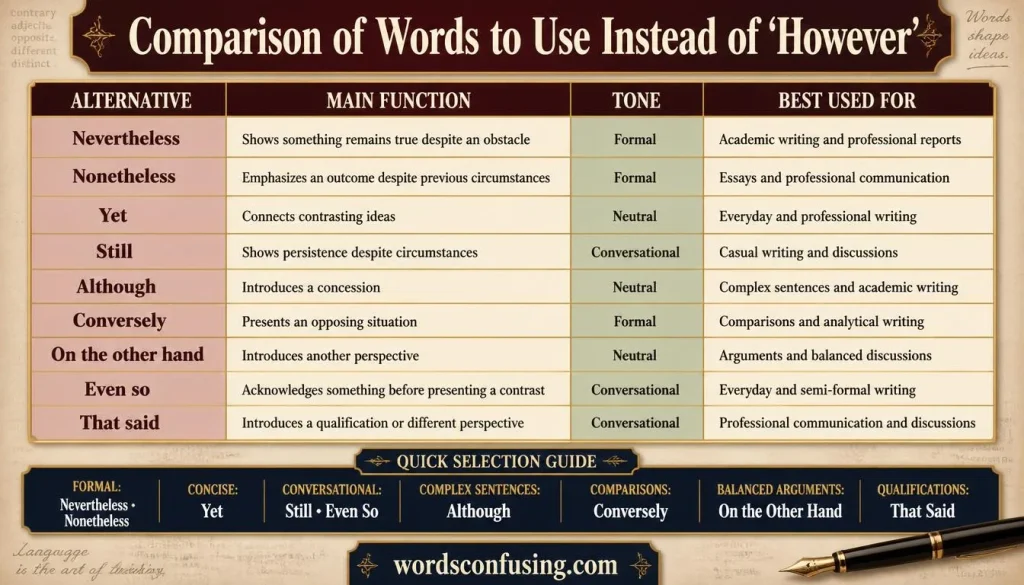
Comparison of Words to Use Instead of “However”
Choosing an alternative becomes easier when you understand what each expression communicates. Although these nine options introduce contrast, they don’t all serve identical purposes.
The following table compares their meanings, tones, and most suitable uses.
| Alternative | Main Function | Tone | Best Used For |
| Nevertheless | Shows something remains true despite an obstacle | Formal | Academic writing and professional reports |
| Nonetheless | Emphasizes an outcome despite previous circumstances | Formal | Essays and professional communication |
| Yet | Connects contrasting ideas | Neutral | Everyday and professional writing |
| Still | Shows persistence despite circumstances | Conversational | Casual writing and discussions |
| Although | Introduces a concession | Neutral | Complex sentences and academic writing |
| Conversely | Presents an opposing situation | Formal | Comparisons and analytical writing |
| On the other hand | Introduces another perspective | Neutral | Arguments and balanced discussions |
| Even so | Acknowledges something before presenting a contrast | Conversational | Everyday and semi-formal writing |
| That said | Introduces a qualification or different perspective | Conversational | Professional communication and discussions |
Which Alternative Should You Choose?
Your intended meaning matters more than finding a word that simply resembles “however.”
Use these quick guidelines when choosing an expression:
- For formal writing: Choose nevertheless or nonetheless.
- For concise sentences: Choose yet.
- For everyday conversations: Choose still or even so.
- For complex sentences: Choose although.
- For direct comparisons: Choose conversely.
- For balanced arguments: Choose on the other hand.
- For qualifications: Choose that said.
Remember that a good transition should clarify the relationship between ideas. It shouldn’t simply decorate your sentences.

How to Choose the Right Alternative to “However”
The best alternative depends on your audience, writing style, and intended meaning. A word that works beautifully in an academic essay might sound unnatural in a friendly email.
Before replacing “however,” consider these important factors.
Consider Your Writing Tone
Every writing situation has its own expectations. Formal documents require different language from casual conversations.
Choosing an appropriate transition helps your message sound natural and professional.
Formal and Academic Writing
Academic writing often requires precise language and clear connections between arguments. Expressions such as “nevertheless,” “nonetheless,” and “conversely” can help establish those relationships.
For example:
- The research sample was relatively small. Nevertheless, the findings provide useful insights.
- The first experiment produced inconsistent results. Nonetheless, the researchers continued their investigation.
- Some studies support the proposed theory. Conversely, others challenge its underlying assumptions.
These expressions suit research papers, university assignments, analytical essays, and professional reports.
Professional Emails and Workplace Communication
Workplace communication benefits from clear language that sounds respectful without becoming unnecessarily complicated.
Expressions such as “that said,” “still,” and “however” work well in many professional situations.
For example:
- Your proposal contains several strong ideas. That said, we should review the projected expenses.
- The deadline is approaching. Still, we have enough time to complete the remaining tasks.
- The presentation looks excellent. However, the financial section needs additional information.
Choose a transition that matches your relationship with the recipient. A friendly workplace email rarely needs excessively formal language.
Casual Conversations and Everyday Writing
Everyday conversations usually favor short, familiar expressions. Words such as “yet” and “still” communicate contrast without making your message sound stiff.
For example:
- I was tired, yet I stayed for the entire movie.
- The restaurant was crowded. Still, we found a comfortable table.
- It started raining. Even so, we continued walking.
These expressions work naturally in text messages, personal blogs, informal discussions, and social media posts.
Understand the Type of Contrast
Not every contrasting sentence communicates the same relationship. Sometimes you want to show opposition, while other situations require concession or qualification.
Identifying that relationship helps you select the right expression.
Direct Opposition
Direct opposition occurs when two statements present noticeably different ideas or situations.
For example:
- Some people prefer working alone. Conversely, others perform better in teams.
- The northern region receives heavy rainfall. Conversely, the southern region experiences drier conditions.
Use “conversely” when the second statement presents a meaningful opposite or alternative.
Unexpected Outcomes
An unexpected outcome occurs when something happens despite circumstances that suggest otherwise.
For example:
- The weather was terrible. Nevertheless, the outdoor event continued.
- He had little preparation time. Even so, he delivered an excellent presentation.
Use “nevertheless,” “nonetheless,” or “even so” when emphasizing this relationship.
Concessions
A concession acknowledges one fact while presenting another that remains important.
For example:
- Although the apartment is small, its location is convenient.
- The apartment is small. Nevertheless, its location is convenient.
Use “although” when combining ideas into one sentence. Choose “nevertheless” when separating them.
Alternative Viewpoints
Sometimes a discussion requires examining more than one perspective. You might recognize an advantage before explaining a disadvantage.
For example:
- Working from home saves commuting time. On the other hand, it can reduce personal interaction.
- The new policy improves efficiency. That said, employees may need additional training.
Use “on the other hand” for another side of an issue. Choose “that said” when introducing a qualification.
Qualifications and Exceptions
A qualification adds information that changes or limits an earlier statement. It helps you avoid making an overly broad claim.
For example:
- The course provides excellent instruction. That said, students must practice independently.
- The equipment is expensive. Still, it offers long-term reliability.
Use “that said” when refining an earlier point. Choose “still” when emphasizing that something remains true.
Check the Sentence Structure
One of the most common problems with replacing “however” involves incorrect punctuation. Several alternatives perform different grammatical jobs.
Understanding their functions prevents awkward or incomplete sentences.
Transitional Adverbs
“However,” “nevertheless,” “nonetheless,” “conversely,” and “still” can function as transitional adverbs.
They connect ideas while maintaining the grammatical independence of their surrounding clauses.
For example:
- The proposal looked promising. However, the budget needed revision.
- The proposal looked promising; however, the budget needed revision.
- The proposal looked promising. Nevertheless, the team requested additional research.
When joining two independent clauses with a conjunctive adverb, use a semicolon before the adverb and a comma afterward.
Coordinating Conjunctions
“Yet” can function as a coordinating conjunction. It connects two independent clauses that express contrasting ideas.
For example:
- The journey was long, yet everyone remained cheerful.
- The instructions seemed complicated, yet the process was straightforward.
When “yet” joins two independent clauses, place a comma before it.
Subordinating Conjunctions
“Although” introduces a dependent clause. That clause cannot normally stand alone as a complete sentence.
For example:
- Although the room was small, it felt comfortable.
- The room felt comfortable although it was small.
Place a comma after an introductory dependent clause. A comma usually isn’t necessary when the dependent clause follows the independent clause.
Transitional Phrases
“On the other hand,” “even so,” and “that said” function as transitional expressions.
For example:
- The first option is affordable. On the other hand, the second offers better durability.
- The assignment was demanding. Even so, the students completed it.
- The design looks attractive. That said, the colors need adjustment.
These expressions often appear at the beginning of a sentence. A comma generally follows them.
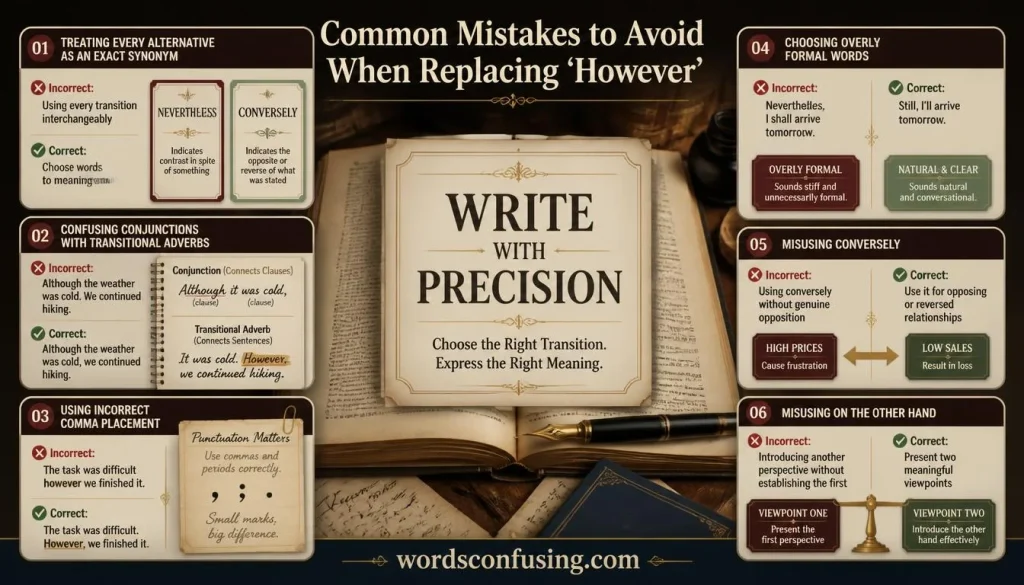
Common Mistakes to Avoid When Replacing “However”
Finding another word for “however” isn’t difficult. Using that alternative correctly requires more attention.
Even experienced writers sometimes choose transitions that don’t accurately express their intended meaning. Here are common mistakes worth avoiding.
Treating Every Alternative as an Exact Synonym
Although these expressions share a general connection to contrast, their meanings differ.
For example, “conversely” suggests an opposing relationship. “Nevertheless” emphasizes persistence despite an earlier circumstance.
Consider these sentences:
- She prefers working independently. Conversely, her colleague enjoys teamwork.
- She dislikes public speaking. Nevertheless, she delivered an excellent presentation.
Replacing “nevertheless” with “conversely” in the second example would change the intended relationship.
The solution: Identify the relationship between your ideas before selecting a transition.
Confusing Conjunctions With Transitional Adverbs
Not every alternative connects sentences in the same grammatical way.
For example, “although” introduces a dependent clause. Meanwhile, “nevertheless” can introduce an independent sentence.
Incorrect: Although the weather was cold. We continued hiking.
Correct: Although the weather was cold, we continued hiking.
Also correct: The weather was cold. Nevertheless, we continued hiking.
The distinction matters because grammatical errors can make otherwise strong writing difficult to understand.
Using Incorrect Comma Placement
Punctuation helps readers recognize how ideas connect. Incorrect comma placement can create run-on sentences or unnecessary sentence fragments.
Compare these examples:
| Incorrect | Correct |
| The task was difficult however we finished it. | The task was difficult. However, we finished it. |
| Although she was tired. She continued working. | Although she was tired, she continued working. |
| The room was small yet, it felt comfortable. | The room was small, yet it felt comfortable. |
| The product was expensive. Nevertheless we purchased it. | The product was expensive. Nevertheless, we purchased it. |
Remember: When “however” joins two independent clauses within one sentence, use a semicolon before it and a comma afterward.
Correct: The product was expensive; however, we purchased it.
Choosing Overly Formal Words for Casual Situations
A formal expression can make an ordinary message sound unnecessarily complicated.
Imagine texting a friend about a delayed meeting:
- Unnatural: The appointment was postponed. Nevertheless, I shall arrive tomorrow.
- Natural: The appointment was postponed. Still, I’ll arrive tomorrow.
Both communicate contrast, but the second sounds more appropriate for everyday conversation.
The solution: Match your vocabulary to your audience and situation.
Using “Conversely” Without a Genuine Opposition
“Conversely” works when two situations present opposing or reversed relationships. It doesn’t simply mean that another statement follows.
For example:
– Some customers prefer digital payments. Conversely, others prefer cash.
This sentence establishes a clear difference between payment preferences.
However, consider this example:
– The company introduced a new product. Conversely, its advertising budget increased.
These statements don’t necessarily oppose each other. The second describes another development rather than a contrasting situation.
The solution: Use “conversely” only when the ideas establish a meaningful opposing relationship.
Using “On the Other Hand” Without Another Perspective
“On the other hand” usually works best when a discussion establishes one viewpoint before introducing another.
For example:
– Public transportation reduces commuting expenses. On the other hand, private vehicles offer greater flexibility.
The two statements present different advantages.
However, using this expression without a meaningful comparison can confuse readers.
The solution: Establish the first perspective before introducing the second.
Read more: 6 Words for Someone Who Won’t Admit They Are Wrong
FAQs
1. Why should you use alternatives to “however”?
Using alternatives to however makes your writing sound more natural and less repetitive. It also helps you express contrasting ideas without relying on the same word repeatedly.
2. What is the closest synonym for “however”?
Nevertheless is one of the closest synonyms for however. Both words introduce a contrasting point while maintaining a clear connection with the previous statement.
3. Can you use “but” instead of “however”?
Yes, you can use but instead of however in many sentences. However, but usually connects two clauses directly, while however often introduces a separate sentence or interrupts one.
4. Is “nevertheless” more formal than “however”?
Both words work well in formal writing. Nevertheless can sound slightly more emphatic because it highlights that something remains true despite an earlier point.
5. What can I use instead of “however” in academic writing?
You can use nevertheless, nonetheless, although, even so, and on the other hand. Choose an expression that matches your sentence structure and the relationship between your ideas.
6. How can I avoid repeating “however” in an essay?
Try varying your transition words according to the context. Use but for direct contrasts, yet for unexpected results, and nevertheless to emphasize a point despite an earlier statement. This keeps your essay clear and engaging.
Conclusion
Choosing the right alternative to “however” can make a noticeable difference in your writing. Although this word works well for showing contrast, repeating it too often can make your sentences sound predictable. Alternatives such as nevertheless, nonetheless, yet, but, and even so help you express opposing ideas more naturally. Each option has its own purpose, so consider your sentence meaning, tone, and audience before making a choice.
Good writing isn’t about using complicated words or showing off your vocabulary. It’s about making every sentence clear, meaningful, and easy to follow. Experiment with different transitions in your essays, emails, and everyday conversations. With regular practice, you’ll develop stronger writing habits and communicate your ideas with greater confidence.