

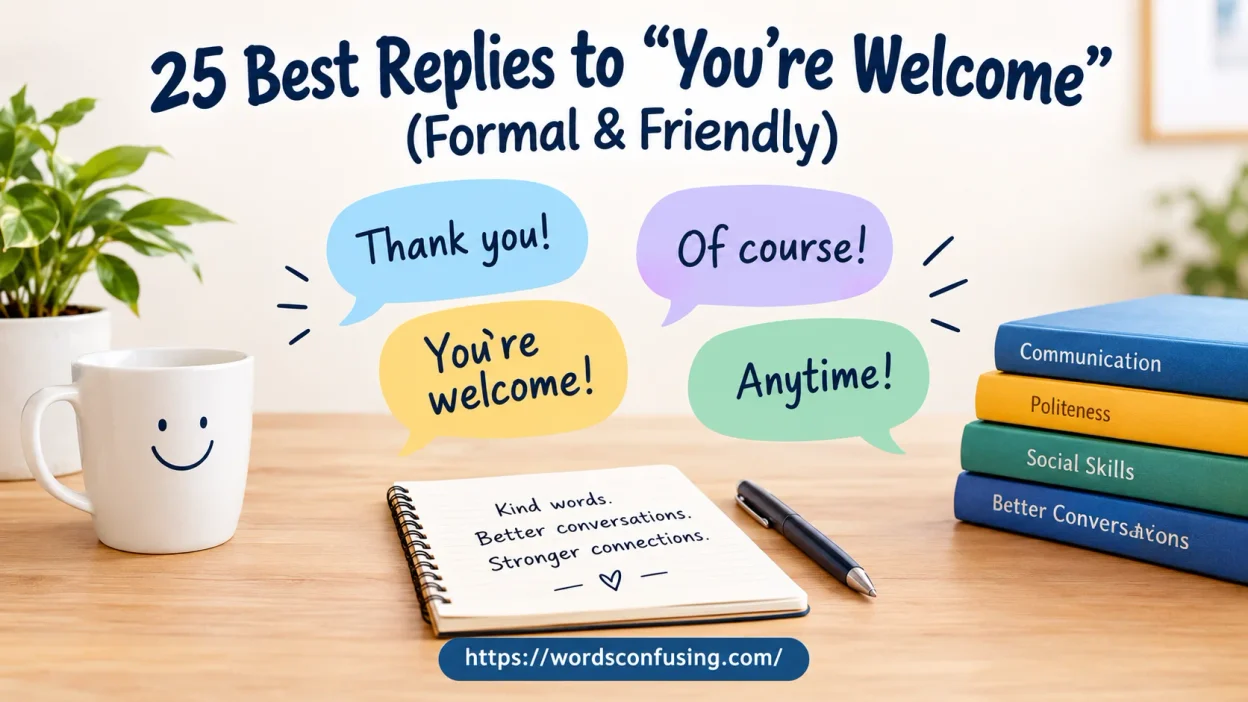
25 Best Replies to “You’re Welcome” Formal and Friendly gives you natural ways to respond when “you’re welcome” starts feeling repetitive.
In my experience, I’ve noticed that the same reply doesn’t always work in every situation. When I’ve used “My pleasure” in professional conversations, it has sounded more polished with clients and colleagues.
For quick workplace exchanges, “Happy to help” has felt more natural and relaxed. Even a simple “Of course” can keep a friendly conversation moving without sounding too formal. These small changes in words, tone, and expression can make your reply feel more genuine after someone says thanks.
I’ve also found that choosing the right alternative depends on the relationship and situation. A formal response can fit professional communication, while a warmer phrase works better with a friend or familiar coworker.
Learning other ways to say you’re welcome has helped me communicate with more confidence and avoid repeating the same typical response. Whether you’re responding after a big favor, a small task, or everyday assistance, the right phrase can show kindness, sincerity, and appreciation while making conversations feel more natural.
Quick Answer
The best reply to “you’re welcome” depends on the mood and situation. In casual conversations, “Of course,” “Anytime,” “No worries,” and “You got it” sound warm and effortless. For work or formal settings, choose “My pleasure,” “Happy to help,” “Certainly,” or “It was my pleasure.” You don’t always need another response, either. If the conversation has naturally reached its end, a smile or simple acknowledgment is perfectly fine. The key is to match your words to the relationship, setting, and level of formality.
What Does “You’re Welcome” Mean?
“You’re welcome” is the standard English response to “thank you” or “thanks.” It tells the other person that their gratitude is accepted and that you don’t consider their appreciation necessary.
For example:
“Thank you for helping me with the report.”
“You’re welcome.”
The phrase can sound warm, neutral, professional, or slightly formal depending on your voice and the surrounding conversation.
It also has an interesting grammatical point. “You’re” is the contraction of “you are,” while “your” shows possession. Therefore, “you’re welcome” is the correct expression when responding to thanks. “Your welcome” has a different grammatical meaning.
Why Do People Look for Alternatives to “You’re Welcome”?
There’s nothing wrong with saying “you’re welcome.” In fact, it’s one of the safest responses available.
Still, repetition can make everyday conversations sound mechanical. If someone says:
“Thanks for grabbing my coffee.”
You could answer:
“You’re welcome.”
That works. Yet “Of course!” or “Anytime!” might sound more relaxed between close friends.
Context makes the difference.
A phrase that feels natural with your best friend may sound too casual in an email to your manager. Likewise, an elaborate response can feel stiff when someone simply thanks you for holding a door.
How to Choose the Right Reply to “You’re Welcome”
Before choosing a response, consider three simple factors: who you’re talking to, what they thanked you for, and how formal the situation feels.
Match the Relationship
Friends usually need relaxed language. Coworkers often fall somewhere between casual and professional. Clients, customers, supervisors, and formal contacts may require more polished wording.
Match the Effort
The size of the favor matters too.
If you held a door open, “No problem!” makes sense. If you spent hours helping someone prepare for an important presentation, “I’m glad I could help” may better acknowledge the effort.
Match the Setting
Text messages encourage short responses. Workplace conversations can handle slightly more polished expressions. Customer service interactions often benefit from warmth without excessive familiarity.
Think of tone like clothing. You wouldn’t wear a tuxedo to buy groceries. Similarly, you don’t need an elaborate phrase for every tiny favor.
25 Best Replies to “You’re Welcome”
The following replies to “you’re welcome” work across different situations. Each one carries its own shade of meaning, so choose according to the conversation rather than using the same phrase every time.
“Of Course!”
“Of course!” sounds warm, confident, and natural. It suggests that helping the person felt completely reasonable.
This response works especially well with friends, family members, classmates, and familiar coworkers.
Example:
“Thanks for sending me those notes.”
“Of course!”
It doesn’t create distance. Instead, it makes the exchange feel effortless.
“Anytime!”
“Anytime!” tells someone you’re willing to help again. It works particularly well when you genuinely want to keep the door open for future favors.
Example:
“Thanks for helping me move those boxes.”
“Anytime!”
The expression feels friendly without becoming overly sentimental.
“No Problem!”
“No problem!” is common in casual American English. It communicates that the favor didn’t cause significant trouble.
For example:
“Thanks for picking me up.”
“No problem!”
The phrase can sound especially natural when someone worries that they inconvenienced you.
However, consider the scale of the favor. If someone thanks you for a significant sacrifice, “It was my pleasure” may acknowledge the situation more gracefully.
Discussions about this distinction often point out that “no problem” emphasizes the lack of inconvenience, while “you’re welcome” directly acknowledges the person’s thanks.
“My Pleasure!”
“My pleasure!” sounds polished, warm, and courteous.
It works particularly well in professional environments, customer service, hospitality, and situations where you want to show genuine willingness.
Example:
“Thank you for walking me through the process.”
“My pleasure!”
Unlike “no problem,” this phrase emphasizes that helping was enjoyable or satisfying.
“Absolutely!”
“Absolutely!” adds energy to the conversation. It works when you want to show that helping wasn’t merely acceptable.
Example:
“Thanks for helping me with the presentation.”
“Absolutely!”
This response fits friendly workplace conversations particularly well.
“Sure!”
“Sure!” is short, casual, and flexible.
You can use it when someone thanks you for a small favor.
“Thanks for grabbing that for me.”
“Sure!”
Because it’s brief, your tone matters. A cheerful delivery sounds friendly. A flat delivery can sound dismissive.
“You Got It!”
“You got it!” has an upbeat, conversational feel. It works best in informal settings.
You might use it with a friend or familiar coworker:
“Thanks for sending that file.”
“You got it!”
It’s more relaxed than “certainly” and more energetic than “you’re welcome.”
“Happy to Help!”
“Happy to help!” combines professionalism with warmth.
It works especially well when someone thanks you for solving a problem or completing a task.
“Thanks for helping me figure this out.”
“Happy to help!”
This phrase also fits customer-facing communication because it doesn’t sound overly intimate or casual.
“Glad I Could Help!”
“Glad I could help!” shifts attention toward the positive result.
Instead of simply acknowledging the thanks, you emphasize that you’re pleased your assistance mattered.
Example:
“Thank you for explaining everything so clearly.”
“Glad I could help!”
This response works well with coworkers, friends, classmates, and professional contacts.
“Don’t Mention It.”
“Don’t mention it” is a polite way to suggest that thanks aren’t necessary.
For example:
“Thanks for carrying my bag.”
“Don’t mention it.”
Dictionary.com lists “don’t mention it” among polite formulas used in response to thanks.
The expression sounds modest and can work particularly well when the favor was small.
“It Was Nothing.”
“It was nothing” minimizes the effort involved.
Someone might say:
“Thanks for helping me find the address.”
“It was nothing.”
This phrase feels casual and modest. However, be mindful of context. If someone deeply appreciates a major favor, minimizing the effort may unintentionally make their gratitude seem less important.
“Not at All.”
“Not at all” sounds polished and courteous. It works especially well in formal or traditional conversations.
For example:
“Thank you for taking the time to meet with me.”
“Not at all.”
It carries a calm, respectful tone without sounding excessively elaborate.
“It’s My Pleasure.”
“It’s my pleasure” is a polished alternative to “my pleasure.”
It fits professional conversations, formal correspondence, customer service, and situations where you want to sound particularly courteous.
Example:
“Thank you for assisting me today.”
“It’s my pleasure.”
The phrase communicates more than simple acceptance. It suggests that helping the person was genuinely welcome.
“I’m Happy to Help.”
“I’m happy to help” feels professional while remaining approachable.
It works beautifully in workplace communication:
“Thank you for reviewing the document.”
“I’m happy to help.”
It avoids the stiffness that can sometimes come with highly formal expressions.
“Always Happy to Help.”
“Always happy to help” adds a stronger sense of continued support.
It works well with teammates, coworkers, recurring clients, and people you regularly assist.
“Thanks for helping me again.”
“Always happy to help.”
The word “always” makes the response feel more generous without becoming dramatic.
“You’re Very Welcome.”
“You’re very welcome” strengthens the standard response.
It can sound warm, respectful, and slightly more formal than simply saying “you’re welcome.”
For example:
“Thank you so much for your assistance.”
“You’re very welcome.”
This option works well when someone expresses especially strong gratitude.
“Certainly!”
“Certainly!” sounds concise and professional.
It works best when the conversation already has a formal tone.
“Thank you for taking care of that.”
“Certainly!”
It may feel too formal among close friends, so reserve it for situations where polished language fits naturally.
“It Was My Pleasure.”
Use “It was my pleasure” when you want to acknowledge a meaningful favor or express genuine appreciation.
For example:
“Thank you for helping me prepare for the interview.”
“It was my pleasure.”
This phrase can sound more thoughtful than “no problem” because it doesn’t minimize the effort.
“Glad to Be of Help.”
“Glad to be of help” has a professional and courteous tone.
It’s particularly suitable for customer service, workplace communication, and formal interactions.
Example:
“Thank you for resolving the issue so quickly.”
“Glad to be of help.”
The wording emphasizes usefulness while maintaining professional distance.
“Anytime You Need Help.”
“Anytime you need help” goes beyond acknowledging gratitude. It offers reassurance about future assistance.
“Thanks for helping me today.”
“Anytime you need help.”
This response feels especially natural between friends and supportive coworkers.
“Of Course, Happy to Help.”
“Of course, happy to help” combines reassurance with warmth.
It’s useful when you want a response that feels friendly without becoming too casual.
“Thanks for getting that done so quickly.”
“Of course, happy to help.”
The phrase works well in workplace chats and informal professional conversations.
“No Worries!”
“No worries!” is relaxed and conversational.
It’s ideal for texts, casual conversations, friends, classmates, and familiar coworkers.
“Thanks for waiting for me.”
“No worries!”
The expression reassures the other person that their request didn’t cause trouble.
“It Was Nothing.”
“It was nothing” is another modest response for a small favor.
For example:
“Thanks for showing me where the room is.”
“It was nothing.”
Because the phrase downplays the effort, it works best when the action truly required little trouble.
“Glad I Could Do It.”
“Glad I could do it” sounds friendly and sincere.
It works after completing a specific task:
“Thank you for fixing that problem.”
“Glad I could do it.”
This phrase can feel more personal than a generic “you’re welcome.”
“You’re Welcome. Have a Great Day!”
Sometimes the best response adds a pleasant closing.
“Thank you for your help.”
“You’re welcome. Have a great day!”
This works especially well in customer service, workplace interactions, shops, reception desks, and other brief encounters.
It acknowledges the thanks while naturally signaling that the conversation can end.
Best Replies to “You’re Welcome” in Different Situations
Not every phrase belongs everywhere. The table below makes the choice easier.
| Situation | Natural Reply | Tone |
| Close friend | “Anytime!” | Friendly |
| Family member | “Of course!” | Warm |
| Casual coworker | “No problem!” | Casual |
| Close teammate | “You got it!” | Relaxed |
| Professional email | “My pleasure.” | Polished |
| Client interaction | “Happy to help!” | Professional |
| Customer service | “You’re very welcome.” | Courteous |
| Supervisor | “Certainly.” | Formal |
| Teacher or formal contact | “It was my pleasure.” | Respectful |
| Small favor | “Don’t mention it.” | Modest |
| Significant help | “Glad I could help.” | Appreciative |
| Text message | “No worries!” | Casual |
| Workplace chat | “Of course, happy to help.” | Friendly-professional |
| Service interaction | “Glad to be of help.” | Professional |
Formal Replies to “You’re Welcome”
When the situation calls for professional language, choose expressions that sound courteous without becoming stiff.
Good options include:
- My pleasure.
- It’s my pleasure.
- It was my pleasure.
- Certainly.
- Not at all.
- You’re very welcome.
- Glad to be of help.
- I’m happy to help.
For example, imagine a manager thanks an employee for preparing an urgent report.
“Thank you for getting this ready so quickly.”
A response such as “My pleasure” or “I’m happy to help” fits the workplace better than “You got it!”
The goal isn’t to sound impressive. It’s to sound appropriate.
Friendly Replies to “You’re Welcome”
Friendly conversations give you more freedom.
Try:
- Of course!
- Anytime!
- No worries!
- No problem!
- You got it!
- Sure!
- Absolutely!
- Glad I could help!
These phrases keep the conversation loose and natural.
Suppose your friend says:
“Thanks for saving me a seat.”
You could respond:
“Anytime!”
There’s no need to turn a tiny favor into a formal ceremony.
Replies to “You’re Welcome” in Professional Emails
Email requires a slightly different approach.
Written communication lacks facial expressions, vocal tone, and gestures. As a result, extremely casual phrases can sometimes sound different on screen.
For professional emails, consider:
“My pleasure.”
“Happy to help.”
“I’m glad I could assist.”
“It was my pleasure.”
“You’re very welcome.”
A concise response often works better than a long paragraph.
For example:
“Thank you for your quick assistance with the report.”
“You’re very welcome. I’m glad I could help.”
That’s warm, professional, and complete.
At the same time, not every email requires a reply to “thank you.” Etiquette discussions have noted that a separate “you’re welcome” email can sometimes be unnecessary when the conversation has already reached a natural stopping point.
Read more: 26 Best Replies to “Mind Your Own Business” Witty Comebacks
Replies to “You’re Welcome” With Customers or Clients
Customer-facing conversations require warmth without excessive familiarity.
Strong choices include:
- My pleasure!
- Happy to help!
- You’re very welcome!
- It was my pleasure.
- Glad to be of help.
- Have a great day!
Avoid slang when the setting is formal or unfamiliar.
For example:
Customer: “Thank you for helping me find the right product.”
Employee: “My pleasure! Have a great day.”
That exchange sounds courteous without feeling robotic.
What Should You Say After “You’re Welcome”?
Here’s an important point: you don’t always need to respond.
If someone says:
“Thank you!”
And you answer:
“You’re welcome.”
The exchange can end there.
Adding another sentence isn’t necessary unless the situation naturally continues.
However, you might respond if the other person continues the conversation.
Example
“Thanks again for helping me.”
“You’re welcome!”
“I really appreciate it.”
“Of course. I’m glad it worked out.”
The second response adds warmth because the other person continued expressing gratitude.
A simple conversation doesn’t need verbal decoration. Sometimes the cleanest response is the most natural one.
What If Someone Says “You’re Welcome” Before You Thank Them?
Occasionally, someone may say “you’re welcome” before you actually say “thank you.”
That can create an awkward moment.
For example:
“Here’s the file you asked for.”
“You’re welcome.”
You hadn’t thanked them yet.
In this situation, a simple response such as “Oh, thank you!” can acknowledge the help without creating unnecessary tension.
Etiquette writer Miss Manners has discussed this exact kind of preemptive “you’re welcome,” noting that it can sometimes feel like an indirect reminder to express gratitude.
The easiest solution is usually to stay gracious and move forward.
Common Mistakes When Replying to “You’re Welcome”
Choosing the right phrase isn’t difficult. Most mistakes happen when the tone doesn’t fit.
Using Formal Language With Close Friends
Imagine your friend says:
“Thanks for bringing me coffee.”
Responding with:
“Certainly. It was my pleasure.”
That’s grammatically fine. It just sounds unusually formal.
“Anytime!” would probably feel more natural.
Using Slang in a Formal Setting
On the other hand, saying “You got it!” to a senior executive or formal client may sound too casual depending on the workplace culture.
A safer choice would be:
“Happy to help.”
Saying “No Problem” After a Major Favor
If you spent an entire weekend helping someone move, “No problem” might undersell the effort.
A warmer response could be:
“Of course. I’m glad I could help.”
The distinction is subtle but meaningful.
Overexplaining a Simple Exchange
Someone says:
“Thanks!”
You don’t need a speech.
A short:
“Anytime!”
can be far more natural.
Good communication isn’t about using more words. It’s about choosing the right ones.
Repeating the Same Phrase Every Time
If every interaction ends with “you’re welcome,” your conversations may start sounding automatic.
You don’t need to force variety. Still, having several natural alternatives gives you more flexibility.
A Simple Guide to Choosing Your Reply
When you’re unsure, use this quick framework.
1. For friends:
Keep it relaxed with “Anytime!”, “Of course!”, or “No worries!”
2. For casual coworkers:
“Happy to help!”, “Absolutely!”, and “No problem!” all sound friendly and natural.
3. For professional communication:
Go with “My pleasure,” “I’m happy to help,” or “It was my pleasure.”
4. For formal situations:
“Certainly,” “Not at all,” and “You’re very welcome” offer a more polished tone.
5. For customers:
A warm response such as “My pleasure!”, “Happy to help!”, or “Have a great day!” works well.
6. For a small favor:
You can simply say “Don’t mention it” or “It was nothing.”For meaningful assistance:
“Glad I could help” or “It was my pleasure” acknowledges the effort more thoughtfully.
Quick Comparison of Replies to “You’re Welcome”
| Reply | Formality | Best Use | Main Feeling |
| Of course! | Casual | Friends and family | Warm |
| Anytime! | Casual | Friends | Generous |
| No problem! | Casual | Small favors | Reassuring |
| My pleasure! | Professional | Work and service | Courteous |
| Absolutely! | Casual-professional | Coworkers | Enthusiastic |
| Sure! | Casual | Everyday conversation | Relaxed |
| You got it! | Casual | Friends and teammates | Upbeat |
| Happy to help! | Professional | Workplace | Helpful |
| Glad I could help! | Friendly-professional | Work and favors | Sincere |
| Don’t mention it. | Neutral | Small favors | Modest |
| It was nothing. | Casual | Minor favors | Humble |
| Not at all. | Formal | Polite settings | Respectful |
| It’s my pleasure. | Formal | Professional settings | Courteous |
| I’m happy to help. | Professional | Workplace | Warm |
| Always happy to help. | Professional | Regular contacts | Supportive |
| You’re very welcome. | Neutral-formal | General use | Warm |
| Certainly! | Formal | Professional settings | Polished |
| It was my pleasure. | Formal | Meaningful help | Respectful |
| Glad to be of help. | Professional | Customer service | Courteous |
| Anytime you need help. | Friendly | Friends and coworkers | Supportive |
| Of course, happy to help. | Professional-friendly | Workplace chats | Warm |
| No worries! | Casual | Texts and friends | Relaxed |
| It was nothing. | Casual | Small favors | Modest |
| Glad I could do it. | Friendly | Completed tasks | Sincere |
| You’re welcome. Have a great day! | Professional-friendly | Service settings | Positive |
FAQs
What can I say instead of “You’re welcome” in a professional conversation?
You can say “My pleasure,” “Happy to help,” “Of course,” or “Glad I could help.” These phrases sound polite without making your response feel overly formal.
Is “My pleasure” a good response at work?
Yes. “My pleasure” works well when you want to sound warm, respectful, and professional. It’s especially suitable when responding to clients, customers, managers, or coworkers.
What is a friendly response after someone says “Thank you”?
Try “No problem,” “Of course,” “Anytime,” or “Happy to help.” Your relationship with the person and the situation can help you choose the most natural option.
How do I respond when someone says “You’re welcome”?
You can simply say “Thank you,” “I appreciate it,” “That means a lot,” or “I’m glad you could help.” A short response often works best when the conversation is casual.
Can I say “Anytime” in a professional setting?
You can, but context matters. “Anytime” sounds friendly and approachable, so it usually fits casual workplace conversations better than formal business communication.
What is the most natural reply to “You’re welcome”?
There isn’t one universal answer. “Thanks,” “I appreciate it,” “Of course,” and “Glad to hear it” can all sound natural depending on the conversation. The best choice matches your relationship, tone, and situation.
Conclusion
A simple “you’re welcome” works, but you don’t have to use it every time. The right response can make a short exchange feel warmer, more professional, or more personal. From “My pleasure” in a formal setting to “Anytime” with a friend, each phrase carries a slightly different tone. I’ve found that paying attention to the person and situation makes these small conversations feel much more natural.
You don’t need an elaborate sentence, either. Sometimes “Of course,” “Happy to help,” or “Glad I could help” says everything you need. Keep your relationship with the other person, the setting, and your intended tone in mind. With these 25 replies to “You’re welcome,” you can move beyond repetitive responses and choose words that sound genuinely like you.

Shafiq Ur Rehman is a writer and content contributor at WordsConfusing.com. He enjoys exploring the English language, common word confusions, vocabulary, and practical writing tips. His goal is to make English easier to understand through clear, simple, and useful articles.