


This guide to 6 Words That Describe a Blind Follower: Meanings and Examples shows how word choice can explain unquestioning loyalty in different situations.
Finding the correct word to describe someone who blindly follows an authoritative figure requires a good understanding of vocabulary. Although several commonly used words and synonyms describe a blind follower, their meanings have subtle differences. These terms can describe individuals who accept ideas, trends, instructions, opinions, behaviors, and decisions without questioning their source.
Exploring these six useful expressions and their practical examples makes it easier to find synonyms and choose the best synonyms for different contexts. The right attention to word choice also improves English usage, grammar, accuracy, and everyday writing.
These distinctions become important in everyday conversations, personal communication, professional communication, and formal writing. The same expression may have a different impact in business communication, professional discussions, or casual conversations.
You might notice blind-following behavior during meetings, project management, and workplace collaboration, especially when leadership influences decision-making. Such behavior can limit independent thinking and affect workplace outcomes.
Similar challenges can arise in broadcasting, scheduling, time management, calendar planning, and online booking systems when people follow directions without understanding them. Choosing suitable expressions helps reduce confusion and improves clarity, consistency, and the way your language helps you communicate your intended meaning.
Quick Answer
The six words and expressions that describe a blind follower are uncritical, subservient, gullible, conformist, unquestioning, and sheeplike.
Each term describes a different aspect of following others without independent judgment.
| Word | Meaning |
| Uncritical | Accepting ideas without examining or questioning them |
| Subservient | Excessively obedient or submissive toward someone |
| Gullible | Easily persuaded to believe something, even without evidence |
| Conformist | Following group beliefs, customs, or expectations |
| Unquestioning | Accepting instructions or beliefs without doubt |
| Sheeplike | Following others or the crowd without independent thought |

What Does Blind Follower Mean?
A blind follower is someone who supports, obeys, or imitates another person without questioning their actions, decisions, or beliefs. Instead of evaluating information independently, this person accepts someone else’s opinions as correct.
Blind following can happen in almost any environment. You might encounter it in workplaces, friendships, families, religious communities, social groups, or online communities.
For example, imagine a manager makes a questionable decision. Instead of examining its consequences, an employee agrees simply because the manager suggested it. The employee might recognize potential problems but chooses not to speak up.
That behavior demonstrates blind following.
However, blindly following someone doesn’t always involve deliberate dishonesty or a lack of intelligence. Sometimes, people follow others because they fear rejection, desire approval, or lack confidence in their own judgment.
Common Characteristics of a Blind Follower
Someone who follows others without independent thought might display several recognizable behaviors:
- Avoids questioning authority: Accepts instructions without asking whether they’re reasonable.
- Copies popular opinions: Adopts beliefs simply because other people support them.
- Ignores contradictory evidence: Rejects information that challenges an admired person’s statements.
- Seeks constant approval: Depends on another person’s opinions before making decisions.
- Fears disagreement: Avoids expressing different views to maintain acceptance.
- Defends questionable behavior: Justifies someone’s actions regardless of the available evidence.
It’s important to distinguish blind following from healthy loyalty. You can respect someone’s experience without agreeing with every decision they make.
Six Words That Describe a Blind Follower
Different words describe different reasons people follow others without questioning them. Some emphasize obedience, while others highlight poor judgment or social influence.
Here are six useful words and expressions with their meanings, characteristics, and practical examples.
Uncritical: Someone Who Accepts Ideas Without Questioning Them
Uncritical describes someone who accepts information, opinions, or arguments without examining their accuracy or considering alternative viewpoints.
An uncritical person rarely evaluates the reasoning behind another person’s statements. Instead, they accept information without asking whether it makes sense.
This word particularly suits someone who follows another person’s beliefs without applying independent judgment.
For example, imagine a student admires a popular teacher. The teacher makes a claim that contradicts established evidence. Rather than researching the subject, the student immediately accepts the statement as true.
The student’s response demonstrates uncritical thinking.
Characteristics of an Uncritical Follower
An uncritical follower typically:
- Accepts opinions without examining supporting evidence.
- Trusts familiar voices more than reliable information.
- Rarely considers alternative explanations.
- Defends someone’s statements without checking their accuracy.
- Confuses personal admiration with factual correctness.
Uncritical behavior can also appear in professional environments. An employee might accept every proposal from a senior colleague without considering potential risks.
Although experience deserves respect, even experienced people can make mistakes.
Uncritical vs. Critical Thinking
The distinction becomes clearer when you compare these two approaches.
| Uncritical Thinking | Critical Thinking |
| Accepts information immediately | Examines information carefully |
| Rarely questions authority | Questions claims when necessary |
| Relies heavily on personal trust | Evaluates available evidence |
| Avoids alternative viewpoints | Considers different perspectives |
| Accepts conclusions without analysis | Examines the reasoning behind conclusions |
Example Sentences
- His uncritical support for the manager prevented the team from discussing serious problems.
- She became an uncritical follower of the speaker and accepted every argument.
- An uncritical audience might believe convincing claims without checking their accuracy.
- Blind admiration can turn an intelligent person into an uncritical supporter.
When to use it: Choose uncritical when someone accepts another person’s opinions or arguments without examining their validity.
Subservient: Someone Who Obeys Another Person Excessively
Subservient describes someone who behaves as though another person has greater authority or importance. A subservient individual often puts another person’s wishes above their own opinions and interests.
This word emphasizes excessive obedience and submission. It can describe someone who follows a powerful individual without expressing disagreement.
For instance, an employee might agree with every decision their supervisor makes because they fear losing their position. Even when the supervisor makes an unreasonable request, the employee refuses to object.
Such behavior can appear subservient.
However, being respectful or cooperative doesn’t automatically make someone subservient. Healthy professional relationships allow people to disagree respectfully.
Characteristics of a Subservient Follower
A subservient person might:
- Obey another person without expressing personal preferences.
- Avoid disagreement with someone in authority.
- Prioritize another person’s approval over personal judgment.
- Accept unreasonable demands to avoid conflict.
- Struggle to establish personal boundaries.
- Treat another person’s wishes as more important than their own.
Subservience often develops in relationships where one person holds considerably more power or influence.
For example, an employee might depend on a supervisor for promotions. This dependence can discourage honest communication and encourage excessive agreement.
Subservient vs. Obedient
These words share similarities, but their meanings aren’t identical.
| Word | Meaning | Connotation |
| Subservient | Excessively submissive toward another person | Usually negative |
| Obedient | Willing to follow instructions or rules | Neutral or positive |
| Cooperative | Willing to work with others | Positive |
| Compliant | Willing to follow rules or requirements | Neutral, depending on context |
An obedient child might follow reasonable household rules. A subservient employee might suppress personal opinions to satisfy a demanding supervisor.
The difference lies in the degree of submission and the surrounding circumstances.
Example Sentences
- His subservient attitude made it difficult for him to challenge unreasonable instructions.
- She became increasingly subservient to the influential leader.
- A subservient follower rarely expresses disagreement with someone they admire.
- Their relationship became unhealthy because one partner expected constant subservience.
When to use it: Choose subservient when someone shows excessive obedience or submission toward another person.
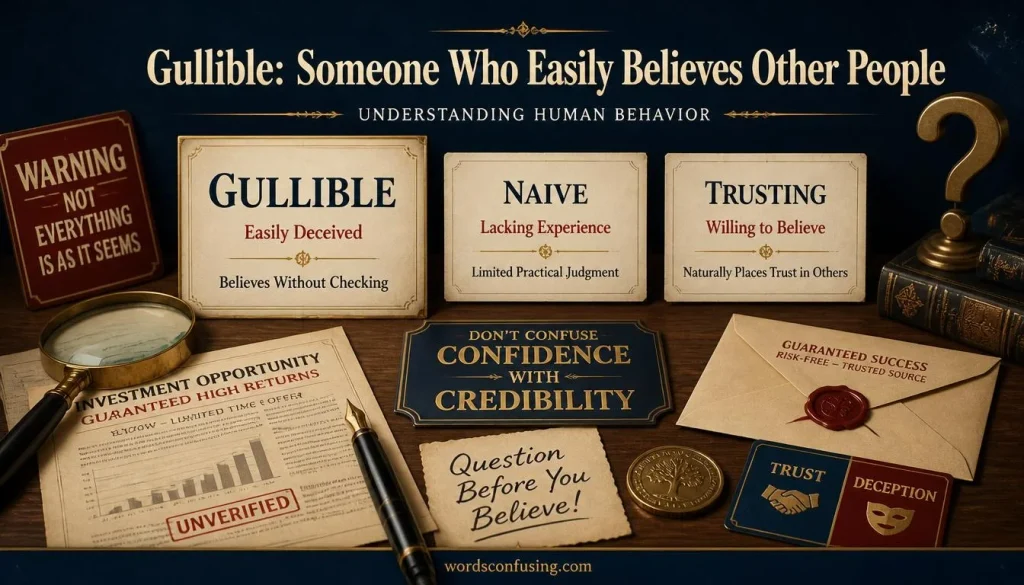
Gullible: Someone Who Easily Believes Other People
Gullible describes someone who is easily persuaded to believe something, especially when the information lacks reliable evidence.
A gullible person might accept exaggerated promises, misleading statements, or fabricated stories without checking their authenticity.
This word fits a particular type of blind follower: someone who follows another person because they believe whatever that person tells them.
Imagine an online personality promoting an unrealistic investment opportunity. They promise extraordinary returns and discourage followers from researching the risks.
A gullible follower might invest immediately because they trust the personality’s confident presentation.
The problem isn’t simply admiration. It’s accepting claims without sufficient evidence.
Characteristics of a Gullible Follower
Gullible individuals may:
- Believe persuasive claims without checking their sources.
- Trust strangers who present themselves as experts.
- Fall for exaggerated promises and unrealistic guarantees.
- Accept rumors without confirming their accuracy.
- Overlook warning signs when someone offers something attractive.
- Confuse confidence with honesty or expertise.
Gullibility doesn’t necessarily mean someone lacks intelligence. Even educated and experienced people can believe misleading information, especially when emotions or personal interests influence their judgment.
For example, someone might believe a false story because it confirms something they already want to believe.
Gullible vs. Naive vs. Trusting
These three words describe related qualities, but they emphasize different characteristics.
| Word | Meaning | Main Difference |
| Gullible | Easily deceived or persuaded | Emphasizes vulnerability to false claims |
| Naive | Lacking experience or practical judgment | Emphasizes limited experience |
| Trusting | Inclined to believe other people | Can describe a positive personality trait |
| Credulous | Too willing to believe things without sufficient evidence | Emphasizes excessive readiness to believe |
For example, a trusting person might believe a friend’s promise because they have a strong relationship.
A gullible person might believe an unfamiliar person’s unrealistic claims without checking the facts.
A naive person might trust someone simply because they haven’t encountered similar deception before.
Example Sentences
- His gullible followers believed every promise made by the online personality.
- Don’t be so gullible that you accept every rumor you hear.
- She became a gullible supporter of someone who repeatedly misled her.
- Gullible people sometimes mistake persuasive language for reliable evidence.
When to use it: Choose gullible when someone follows another person because they easily believe misleading or unsupported claims.
Read more: 7 Words for Doing Something Without Thinking
Conformist: Someone Who Follows the Crowd
Conformist describes someone who follows established beliefs, social expectations, or group behavior rather than expressing independent opinions.
Conformists often adjust their behavior to fit into a particular community. They might agree with popular opinions simply because most people around them share those views.
Unlike subservience, conformity doesn’t necessarily involve one powerful individual giving instructions. Instead, social pressure and the desire for acceptance often influence the person’s decisions.
Consider a workplace where everyone supports a particular proposal. One employee privately recognizes several weaknesses but agrees because they don’t want to become the only person expressing disagreement.
This employee demonstrates conformist behavior.
Why Do People Become Conformists?
Several social and psychological factors can encourage conformity.
Social acceptance: People naturally want to feel accepted by their communities. Agreeing with others can make social relationships easier.
Fear of rejection: Some individuals avoid expressing unpopular opinions because they fear criticism or exclusion.
Group pressure: When everyone supports one position, disagreeing can feel uncomfortable or intimidating.
Uncertainty: People sometimes assume a group’s judgment must be correct, especially when they lack enough information.
Habit: Repeated exposure to the same opinions can make those beliefs feel normal or unquestionable.
Conformity isn’t always harmful. Following shared rules can support cooperation and maintain social order.
Problems arise when people abandon independent judgment simply to avoid standing apart.
Conformist vs. Follower vs. Sheep
These expressions describe related behaviors, but their meanings differ.
| Term | Meaning |
| Conformist | Someone who follows group standards or expectations |
| Follower | Someone who supports or follows another person or group |
| Sheep | An informal, often insulting description of someone who follows others without thinking independently |
| Independent thinker | Someone who forms opinions through personal judgment and reasoning |
A conformist might follow popular fashion trends or workplace customs. A blind follower might support a particular leader without questioning their decisions.
The two behaviors can overlap, but they aren’t identical.
Example Sentences
- He became a conformist because he feared expressing unpopular opinions.
- Conformist employees sometimes agree with decisions they privately question.
- She refused to become a conformist and continued expressing independent ideas.
- The group encouraged conformist behavior by discouraging disagreement.
When to use it: Choose conformist when someone follows group opinions, social expectations, or established practices instead of thinking independently.
Unquestioning: Someone Who Accepts Authority Without Doubt
Unquestioning describes someone who accepts instructions, beliefs, or authority without asking questions or expressing doubts.
This word is particularly useful when describing blind loyalty or obedience.
An unquestioning follower doesn’t necessarily believe every statement because they’re gullible. They might simply refuse to challenge someone they admire or consider an authority.
For example, imagine a team member who follows every instruction from a department head. Even when a decision creates unnecessary problems, the employee continues complying without raising concerns.
That behavior reflects unquestioning obedience.
The word can also describe loyalty, trust, acceptance, and devotion.
Common Forms of Unquestioning Behavior
- Unquestioning obedience: Following instructions without challenging authority.
- Unquestioning loyalty: Supporting someone regardless of their actions.
- Unquestioning trust: Believing someone without considering possible mistakes.
- Unquestioning acceptance: Accepting beliefs or information without examination.
- Unquestioning devotion: Showing dedication without evaluating the person’s behavior.
These expressions help identify exactly what someone accepts without doubt.
Unquestioning vs. Uncritical
Although these words are similar, they emphasize slightly different aspects of blind following.
| Unquestioning | Uncritical |
| Accepts something without expressing doubt | Accepts something without evaluating its validity |
| Emphasizes the absence of questioning | Emphasizes the absence of careful examination |
| Often describes obedience or loyalty | Often describes judgment or reasoning |
| Can describe unquestioning devotion | Can describe uncritical acceptance |
For example:
- Unquestioning follower: He followed the leader’s instructions without hesitation.
- Uncritical follower: He accepted the leader’s arguments without examining the evidence.
The first example emphasizes obedience. The second emphasizes a lack of critical evaluation.
Example Sentences
- His unquestioning loyalty prevented him from recognizing the leader’s mistakes.
- She followed the instructions with unquestioning obedience.
- An unquestioning supporter rarely challenges the decisions of someone they admire.
- Their unquestioning acceptance of the proposal created unnecessary difficulties.
When to use it: Choose unquestioning when someone accepts another person’s authority, beliefs, or instructions without doubt or resistance.
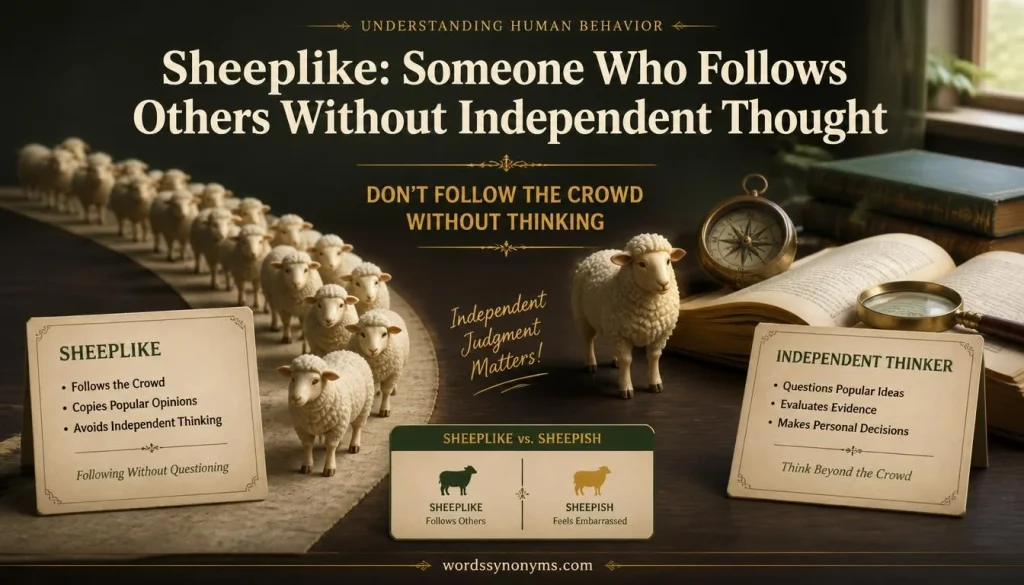
Sheeplike: Someone Who Follows Others Without Independent Thought
Sheeplike describes someone who follows a crowd, copies popular behavior, or accepts prevailing opinions without thinking independently.
The expression comes from the familiar image of sheep moving together as a flock. In everyday English, it can suggest that someone follows others automatically rather than making personal decisions.
For example, imagine a group of people sharing an unverified story online. One individual reposts it immediately because everyone else appears to believe it.
That person demonstrates sheeplike behavior.
The term usually carries a negative or critical tone. It suggests that someone lacks independent judgment or simply follows popular opinion.
Characteristics of Sheeplike Behavior
Someone displaying sheeplike behavior might:
- Follow popular opinions without examining their accuracy.
- Copy other people’s decisions without considering personal circumstances.
- Change viewpoints whenever the majority changes its position.
- Avoid independent thinking to maintain group acceptance.
- Support popular personalities simply because they have large audiences.
- Treat popularity as proof that something must be correct.
However, following a crowd doesn’t automatically mean someone lacks independent judgment. People can reach the same conclusion independently.
The term becomes appropriate when someone follows others without considering the reasons behind their decisions.
Sheeplike vs. Sheepish
These two words look similar, but they have very different meanings.
| Word | Meaning | Example |
| Sheeplike | Following others without independent judgment | His sheeplike behavior disappointed his colleagues. |
| Sheepish | Embarrassed, awkward, or self-conscious | He gave a sheepish smile after making a mistake. |
This distinction matters because sheepish isn’t a direct synonym for a blind follower.
For example, someone might look sheepish after forgetting an important appointment. That doesn’t mean they follow other people blindly.
Use sheeplike when describing someone who copies the crowd without independent thought.
Example Sentences
- His sheeplike behavior prevented him from developing independent opinions.
- She criticized the group’s sheeplike acceptance of popular ideas.
- The advertisement encouraged consumers to make sheeplike purchasing decisions.
- Independent thinkers examine evidence instead of displaying sheeplike obedience.
When to use it: Choose sheeplike when someone follows popular opinions or group behavior without applying independent judgment.
Understanding the Differences Between Six Words That Describe a Blind Follower
Although all six words relate to blind following, each highlights a different characteristic.
Choosing the right word depends on what you want to describe. Someone might follow others because they’re easily deceived, while another person might follow because they fear disagreement.
The following comparison makes those distinctions easier to understand.
| Word | Main Characteristic | Typical Situation | Tone |
| Uncritical | Lack of evaluation | Accepting someone’s claims without examining evidence | Negative |
| Subservient | Excessive submission | Obeying someone because of their authority | Negative |
| Gullible | Easily deceived | Believing misleading promises or stories | Negative |
| Conformist | Following group expectations | Agreeing with popular opinions | Neutral or negative |
| Unquestioning | Lack of doubt or challenge | Following instructions without resistance | Context-dependent |
| Sheeplike | Following the crowd | Copying others without independent thought | Negative |
Which Word Best Describes a Particular Type of Blind Follower?
Sometimes, one word communicates your meaning more accurately than several similar expressions.
Consider these situations:
- Someone accepts every statement from an admired person: Uncritical.
- Someone obeys a powerful individual excessively: Subservient.
- Someone believes misleading promises easily: Gullible.
- Someone agrees with the majority to fit in: Conformist.
- Someone follows instructions without expressing doubts: Unquestioning.
- Someone copies the crowd without thinking independently: Sheeplike.
The distinction is important because blind following doesn’t always come from the same motivation.
One person might follow because they trust someone too much. Another might follow because they fear rejection.
Real-Life Examples of Blind Following
Blind following isn’t limited to one relationship or social environment. It can appear anywhere people influence one another.
The following hypothetical case studies demonstrate how these six words apply in everyday situations.
Case Study: Blind Following in the Workplace
Imagine a company manager proposes a new strategy without reviewing its financial risks.
Several employees recognize potential problems. However, they agree with the manager because they believe challenging senior leadership could damage their careers.
Different words describe their behavior:
- Subservient: They prioritize the manager’s authority over their professional judgment.
- Unquestioning: They follow instructions without raising concerns.
- Uncritical: They accept the proposal without examining its weaknesses.
This example shows how workplace hierarchy can discourage independent thinking.
Case Study: Blind Following on Social Media
Consider someone who follows a popular online personality. The personality regularly shares questionable advice and makes exaggerated claims.
Instead of checking reliable information, the follower accepts every statement and recommends the advice to friends.
Several words might describe this behavior:
- Gullible: The follower believes unsupported claims easily.
- Uncritical: They don’t examine the information carefully.
- Sheeplike: They imitate the personality’s opinions without independent judgment.
A large audience doesn’t guarantee accurate information. Popularity and credibility are two different things.
Case Study: Blind Following Within a Social Group
Imagine a group of friends who share similar opinions about almost everything.
One member privately disagrees with their views but always agrees during conversations. They worry that expressing a different opinion could damage their friendships.
In this situation, conformist describes the person’s behavior.
Their agreement comes from social pressure rather than genuine belief.
This example also highlights an important distinction: people sometimes hide their opinions to maintain relationships, even when they recognize that the group might be wrong.
How to Choose the Right Word for a Blind Follower
Selecting the correct word requires understanding the person’s behavior and motivation.
Although these expressions overlap, using the wrong one can change the meaning of your sentence.
Here are some practical guidelines.
Use Uncritical for Poor Evaluation
Choose uncritical when someone accepts information without examining its accuracy.
Example: “His uncritical support for the proposal prevented meaningful discussion.”
Use Subservient for Excessive Obedience
Choose subservient when someone puts another person’s wishes above their own judgment.
Example: “She became subservient to a leader who discouraged disagreement.”
Use Gullible for Easily Deceived People
Choose gullible when someone believes misleading claims without checking the facts.
Example: “Gullible followers believed the unrealistic promises.”
Use Conformist for Following Group Opinions
Choose conformist when someone adopts popular beliefs to fit into a community.
Example: “He became a conformist because he feared social rejection.”
Use Unquestioning for Blind Obedience
Choose unquestioning when someone follows instructions or accepts beliefs without expressing doubts.
Example: “Their unquestioning loyalty prevented them from challenging the decision.”
Use Sheeplike for Following the Crowd
Choose sheeplike when someone copies other people’s opinions or behavior without independent judgment.
Example: “The group displayed sheeplike behavior by accepting every popular opinion.”
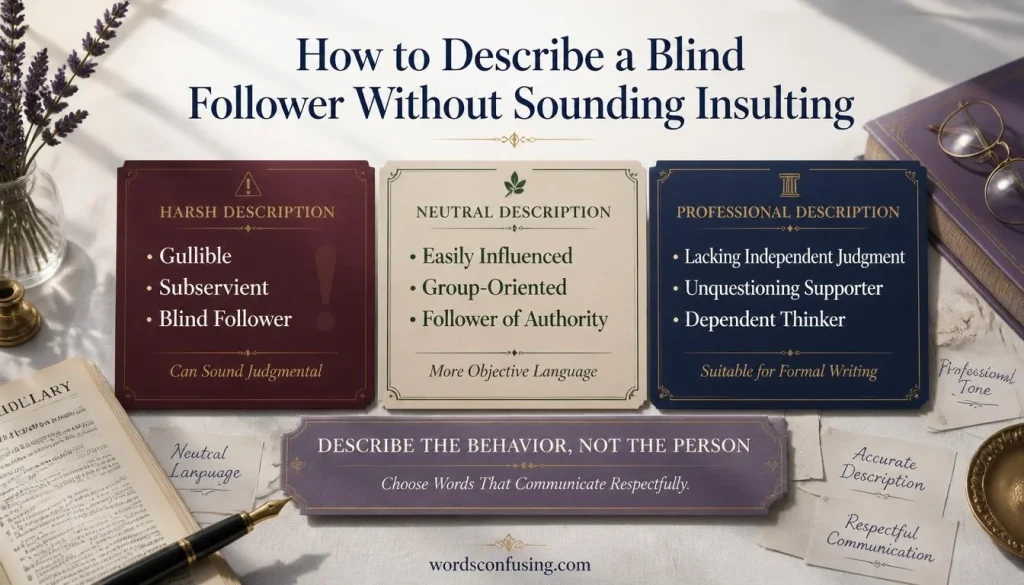
How to Describe a Blind Follower Without Sounding Insulting
Not every situation requires a harsh or judgmental word.
Sometimes, you want to describe someone’s behavior objectively rather than criticize their personality.
Choosing a neutral expression can make your writing more accurate and professional.
Consider these alternatives:
| Expression | Meaning | Best Context |
| Easily influenced | Someone whose opinions change through outside influence | Everyday conversations |
| Dependent thinker | Someone who relies heavily on others for opinions | Personal discussions |
| Follower of authority | Someone who regularly accepts authority figures’ decisions | Professional writing |
| Group-oriented | Someone who places importance on group agreement | Neutral descriptions |
| Lacking independent judgment | Someone who struggles to evaluate decisions independently | Formal discussions |
| Unquestioning supporter | Someone who supports another person without challenging them | General writing |
For example, calling an employee subservient might sound unnecessarily harsh.
Describing the employee as someone who struggles to challenge authority communicates the behavior more carefully.
Similarly, calling someone gullible can sound insulting. Saying they’re easily influenced may express the same concern more gently.
The best word depends on your purpose, audience, and the seriousness of the behavior.
Read more: Is Equal To vs. Equals: What’s the Difference?
FAQs
1. What is a blind follower?
A blind follower is someone who accepts another person’s ideas, decisions, or instructions without questioning them. Such a person often follows authority without considering whether the information is correct.
2. What is another word for someone who blindly follows others?
Words such as follower, conformist, disciple, yes-man, and imitator can describe someone who follows others. The best choice depends on the person’s behavior and the situation.
3. Why do some people become blind followers?
Some people follow others because they fear disagreement, seek approval, or trust authority too much. Others simply prefer letting someone else make decisions rather than thinking independently.
4. Is being a blind follower always a bad thing?
Not necessarily. Following experienced leaders can help you learn and work toward shared goals. However, accepting every instruction without thinking can lead to poor decisions and unnecessary mistakes.
5. What is the difference between a loyal follower and a blind follower?
A loyal follower supports someone because they trust their values and decisions. A blind follower agrees without considering other opinions or questioning questionable choices.
6. How can you describe someone who never questions authority?
You can use words such as yes-man, conformist, unquestioning follower, or obedient follower. Each expression has a slightly different meaning, so consider the person’s actions before choosing one.
Conclusion
Finding the right words to describe a blind follower helps you explain different types of behavior more accurately. Someone who follows an authoritative figure without questioning their decisions may be a conformist, yes-man, imitator, or unquestioning follower. However, these terms aren’t interchangeable in every situation. Each word carries a slightly different meaning, depending on the person’s attitude, actions, and willingness to think independently. Understanding these differences makes your vocabulary stronger and your communication more effective.
Remember, following someone doesn’t always mean giving up your own judgment. You can respect a leader, learn from experienced people, and still question decisions when necessary. Whether you’re writing an article, participating in professional discussions, or having an everyday conversation, choose the expression that best describes the behavior. The right word doesn’t just make your sentence clearer; it helps you communicate exactly what you mean.

Shafiq Ur Rehman is a writer and content contributor at WordsConfusing.com. He enjoys exploring the English language, common word confusions, vocabulary, and practical writing tips. His goal is to make English easier to understand through clear, simple, and useful articles.