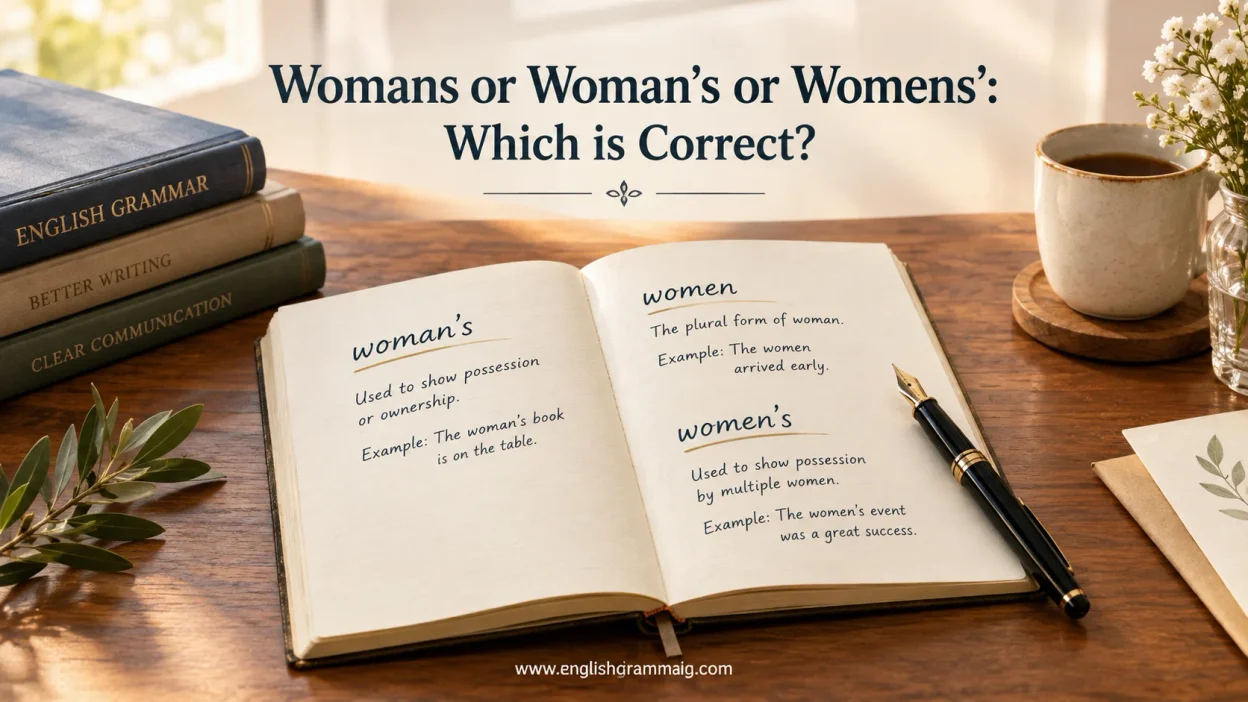
Choosing between these spellings can be tricky, but Womans or Woman’s or Womens’: Which is Correct? depends on grammar and ownership.
The “Woman” word follows different patterns from regular nouns. In English grammar, woman is a singular noun, while women is its plural form. A possessive noun shows ownership, and understanding these word forms helps you choose the correct possessive form when using “woman.” Knowing which is correct also means learning how grammar rules affect noun spelling according to its role in a sentence.
Woman’s is the singular possessive form, as in “The woman’s bag is on the table.” Women’s is the plural possessive form, as in “The women’s team won the match.” In standard English, womans and womens’ are generally incorrect. Recognizing the difference between a singular noun, a plural noun, and a possessive form makes choosing the correct spelling easier.
Quick Answer
Woman’s is the singular possessive form, meaning something belongs to one woman. Women is the plural of woman, while women’s is the plural possessive form. For example, write a woman’s bag for one woman and women’s bags for multiple women. Womans and womens’ are incorrect in standard English for these intended meanings.
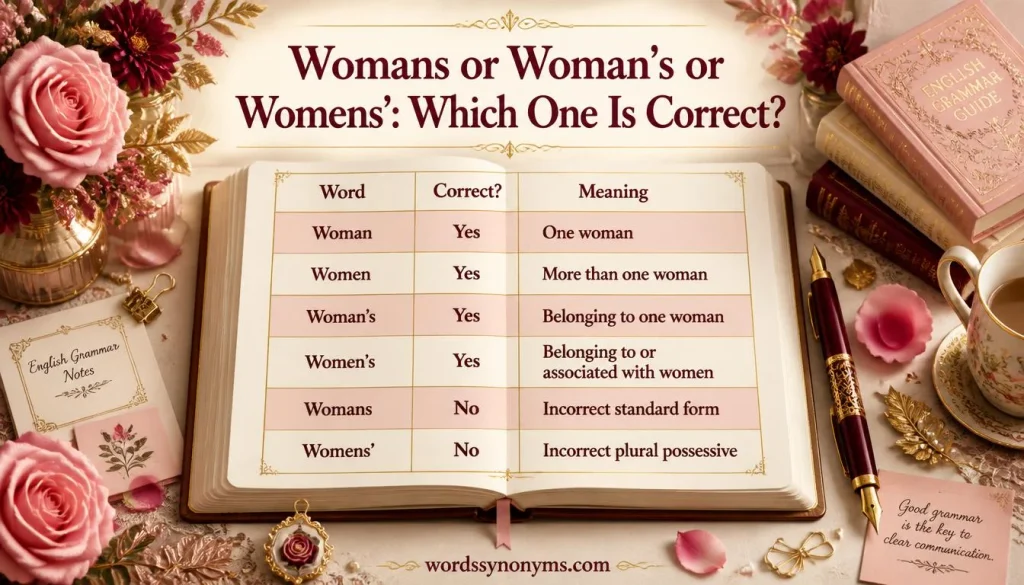
Womans or Woman’s or Womens’: Which One Is Correct?
The correct spelling depends on what you want to express. English uses different forms for singular nouns, irregular plurals, and possessives.
Although womans and womens’ may seem logical at first, neither is the standard spelling for the meanings people usually intend. The forms woman’s and women’s follow the accepted rules.
| Word | Correct? | Meaning | Example |
| Woman | Yes | One woman | The woman is reading. |
| Women | Yes | More than one woman | The women are reading. |
| Woman’s | Yes | Belonging to one woman | The woman’s book is missing. |
| Women’s | Yes | Belonging to or associated with women | The women’s books are missing. |
| Womans | Generally no | Incorrect as a standard plural or possessive form | Use women or woman’s, depending on the meaning. |
| Womens’ | No, in standard English | Incorrect plural possessive spelling | Use women’s instead. |
The key is to identify two things: how many women are involved and whether the sentence expresses possession.
For instance, if one woman owns a car, write the woman’s car. If several women own a car collectively, write the women’s car. The number of owners determines the noun form.
Woman’s: The Correct Singular Possessive Form
The word woman’s shows that something belongs to, relates to, or is associated with one woman. It is the singular possessive form of woman.
To create this form, start with the singular noun woman and add ’s.
The rule is simple:
Woman + ’s = Woman’s
For example:
- The woman’s handbag was beside the door.
- I appreciated the woman’s honesty.
- The woman’s appointment begins at noon.
- Her mother praised the woman’s patience.
- The woman’s jacket matched her shoes.
In each sentence, woman’s connects something to one woman. The relationship might involve ownership, a personal quality, an appointment, or another association.
Possession doesn’t always mean legal ownership. In the sentence the woman’s health matters, the word woman’s indicates whose health the sentence discusses.
You can also use woman’s in familiar expressions and everyday writing.
- A woman’s choice: a decision made by a woman.
- A woman’s voice: a voice belonging to or coming from a woman.
- A woman’s experience: an experience associated with one woman.
- A woman’s responsibility: a responsibility assigned to or undertaken by a woman.
Remember that woman’s refers to one woman, even when the noun following it describes something abstract rather than a physical object.
Womans: Why This Spelling Is Incorrect
The spelling womans often appears when writers try to apply the regular English plural rule to an irregular noun. However, woman doesn’t form its plural by simply adding an s.
The standard plural of woman is women.
Similarly, when you want to show possession, you cannot simply write womans. You need the apostrophe in woman’s.
Compare these examples:
| Incorrect | Correct | Explanation |
| Two womans entered the room. | Two women entered the room. | Women is the plural form. |
| The womans bag is missing. | The woman’s bag is missing. | One woman owns the bag. |
| The womans were talking. | The women were talking. | The plural noun doesn’t take an additional s. |
| Several womans attended. | Several women attended. | Use the irregular plural form. |
Why does this mistake happen? English has many nouns that form plurals by adding -s or -es. For example, book becomes books, and box becomes boxes.
However, some nouns change their spelling more significantly. Woman becomes women, just as man becomes men.
This irregular pattern requires memorization rather than the usual plural rule.
A useful reminder: If you’re talking about multiple women, use women. If you’re describing something belonging to one woman, use woman’s.
Womens’ or Women’s: Which Spelling Is Correct?
The correct plural possessive spelling is women’s, not womens’.
This mistake happens because writers often assume that every plural noun ending in s forms its possessive by adding an apostrophe after the final letter. That rule applies to many regular plural nouns, but women is different.
The word women is already an irregular plural. It doesn’t end with an s, so its possessive form takes ’s.
The pattern is:
- Singular: woman
- Singular possessive: woman’s
- Plural: women
- Plural possessive: women’s
Consider these examples:
- The women’s team practiced every morning.
- The women’s restroom is near the entrance.
- The women’s books were arranged on the shelf.
- The organization supports women’s education.
- The women’s meeting starts at ten.
In these sentences, women’s refers to something associated with multiple women.
Notice that the apostrophe appears before the final s in women’s. This placement reflects the word’s actual form rather than a rule for regular plurals.
For comparison, look at a regular plural noun:
- One student: student
- One student’s notebook: student’s notebook
- Several students: students
- Several students’ notebooks: students’ notebooks
Because students already ends in s, its plural possessive usually takes an apostrophe after that letter. The irregular plural women follows a different pattern.
The takeaway: Write women’s rights, women’s clothing, and women’s health. Don’t use womens’ for these expressions.
Woman vs. Women: Understanding the Singular and Plural Forms
Before choosing between woman’s and women’s, you need to understand the difference between woman and women. These words have related meanings, but they don’t serve the same grammatical purpose.
Woman: The Singular Form
Woman is a singular noun that refers to one adult female person. Use it when you’re talking about one individual.
Examples include:
- A woman is standing near the window.
- The woman works at a local hospital.
- Every woman deserves to be treated with respect.
- That woman helped me find the station.
- A woman entered the office a few minutes ago.
The noun remains singular even when you use words such as each, every, or a. These words commonly refer to one person at a time.
For example, Every woman has a different story uses the singular noun woman. It doesn’t require the plural form women.
The singular noun also provides the base for the possessive form woman’s.
- The woman’s coat is blue.
- A woman’s decision should be respected.
- The woman’s children attend the same school.
Each example refers to one woman, even when she owns several items or has multiple children.
Women: The Plural Form
Women is the plural form of woman. Use it when you’re referring to two or more women.
Unlike regular English nouns, woman doesn’t become plural by adding s. Instead, its internal spelling changes.
Examples:
- The women are waiting for their bus.
- Several women attended the conference.
- The women work in different departments.
- Three women volunteered for the project.
- Those women live in the same neighborhood.
The plural form also appears in expressions involving groups, organizations, and shared activities.
For example:
- Women in science
- Women in business
- Women athletes
- Women voters
- Women writers
In these phrases, women identifies the people being discussed. It doesn’t indicate possession.
This distinction matters because women and women’s aren’t interchangeable. The first is a plural noun, while the second is its possessive form.
Compare:
- Women need access to education. The sentence discusses women generally.
- Women’s education matters. The possessive form connects education with women.
Both sentences are grammatically correct, but they express their ideas differently.
Woman’s vs. Women’s: Singular and Plural Possessives
The difference between woman’s and women’s depends on the number of women associated with something.
Use woman’s when the noun refers to one woman. Use women’s when it refers to more than one woman.
| Singular possessive | Plural possessive |
| A woman’s opinion | Women’s opinions |
| The woman’s shoes | The women’s shoes |
| A woman’s career | Women’s careers |
| The woman’s rights | The women’s rights |
| A woman’s experience | Women’s experiences |
Consider a practical example. Imagine a teacher discussing the work of one student.
The teacher might say, “The woman’s presentation was excellent.” The possessive form identifies one woman’s presentation.
Now imagine a teacher discussing a group of students. The sentence could become, “The women’s presentations were excellent.”
The difference is small, but the meaning changes. One sentence refers to a single woman, while the other refers to multiple women.
However, the noun after the possessive doesn’t have to be plural. For example, the women’s team is correct even though team is singular. The word team refers to a group associated with women.
Read more: Jesus’ or Jesus’s: Rules and Examples
What Does Woman’s Mean Besides Possession?
Although woman’s often shows ownership, it can also be a contraction of woman is or woman has in certain sentence structures.
This is an important distinction because the apostrophe can serve different grammatical purposes.
For example:
- Possession: The woman’s coat is hanging by the door.
- Woman is: The woman’s waiting outside.
- Woman has: The woman’s already finished her work.
In the second sentence, woman’s means woman is. In the third, it means woman has, with has functioning as an auxiliary verb.
However, context determines the intended meaning. In formal writing, spelling out is or has can sometimes make a sentence clearer.
Remember that woman’s doesn’t always indicate ownership. Read the entire sentence before deciding what the apostrophe means.
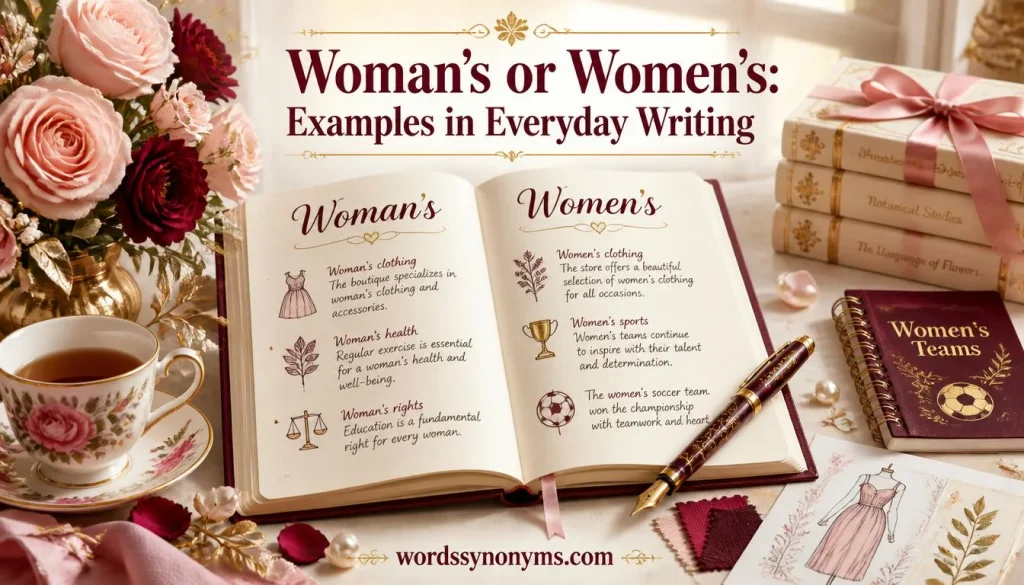
Woman’s or Women’s: Examples in Everyday Writing
The difference between these forms becomes easier to remember when you see them in common situations. From clothing labels to workplace documents, the correct spelling depends on the intended meaning.
Woman’s or Women’s Clothing
Clothing descriptions frequently use possessive forms, especially in stores and online catalogs.
Use women’s clothing when describing clothing intended for women as a category. Use a woman’s clothing when discussing one particular woman’s clothing.
Examples:
- The store has a large women’s clothing department.
- The woman’s clothing was packed in a suitcase.
- Women’s jackets are displayed on the second floor.
- The woman’s dress was made from silk.
The first and third examples describe clothing associated with women generally. The other examples refer to clothing connected with one specific woman.
For a retail category, women’s clothing is the standard form. Writing womens clothing leaves out the apostrophe required by standard grammar.
Woman’s or Women’s Health
Health-related writing also uses both forms, depending on the subject.
Women’s health commonly refers to health issues, research, services, and care related to women as a group. Meanwhile, a woman’s health refers to one woman’s health.
Examples:
- Women’s health services are available at the clinic.
- A woman’s health can change throughout her life.
- The research examines women’s health across different age groups.
- The doctor discussed the woman’s health with her.
These sentences illustrate the difference between a broad topic and an individual case.
If you’re writing an article about healthcare services for women generally, women’s health is appropriate. If you’re describing one patient’s circumstances, the woman’s health may be the better choice.
Woman’s or Women’s Rights
The same distinction applies to discussions of rights and opportunities.
- A woman’s rights: The rights of one woman.
- Women’s rights: Rights relating to women as a group.
For example:
- The organization protects a woman’s legal rights in the case.
- Women’s rights remain an important subject in public discussion.
- The report examines the woman’s rights under the applicable law.
- The campaign focuses on women’s access to education.
The plural possessive form is especially common in established expressions such as women’s rights, women’s education, and women’s representation.
These expressions refer to subjects concerning women collectively. They don’t require the incorrect spelling womens’.
Woman’s or Women’s Team
Sports provide another useful example because a team can consist of multiple women while remaining a singular collective noun.
For example:
- The women’s basketball team won the final.
- The women’s soccer team practiced yesterday.
- The woman’s team selection surprised her colleagues.
The first two examples use women’s because the teams are associated with women. The third refers to a team associated with one particular woman, though that meaning would need suitable context.
A team doesn’t become plural simply because its members are numerous. In the women’s team, the word team is singular, while women’s describes the group associated with it.
Common Mistakes When Using Woman’s and Women’s
Most errors happen when writers confuse plural formation with possessive formation. Understanding those two steps helps you avoid mistakes in emails, essays, reports, and website content.
Using Womans Instead of Woman’s
The first mistake is writing womans when you mean that something belongs to one woman.
Incorrect: The womans phone rang during the meeting.
Correct: The woman’s phone rang during the meeting.
The corrected sentence uses an apostrophe and s to show the relationship between the woman and her phone.
If you’re referring to more than one woman, however, use women.
Incorrect: The womans arrived early.
Correct: The women arrived early.
The correct form depends on whether the sentence needs a singular possessive or a plural noun.
Writing Womens’ Instead of Women’s
Another common mistake involves placing the apostrophe after the final s, as writers do with regular plural nouns such as students.
Incorrect: The womens’ locker room is downstairs.
Correct: The women’s locker room is downstairs.
The reason is straightforward: women is an irregular plural that doesn’t end in s. Its possessive form therefore takes ’s.
Compare these patterns:
| Singular | Regular plural | Irregular plural |
| Student | Students | Woman |
| Student’s | Students’ | Woman’s |
| — | — | Women |
| — | — | Women’s |
The comparison shows why women’s follows a different spelling pattern from students’.
Confusing Women’s With Womens
Some writers leave out the apostrophe entirely because they think womens is a plural form.
However, women already expresses the plural. Adding another s doesn’t make it more plural.
Incorrect: The company sells womens shoes.
Correct: The company sells women’s shoes.
The corrected version uses the plural possessive form to describe shoes intended for women.
You might see womens on an informal sign, product label, or website category. Such examples don’t make it the standard grammatical spelling.
When writing polished English, use women for the plural noun and women’s for the possessive form.
Choosing the Wrong Form Based on the Number of Owners
Sometimes the apostrophe is present, but the writer chooses the wrong noun form.
Consider this example:
Incorrect for multiple women: The woman’s committee submitted its report.
Correct, if the committee is associated with multiple women: The women’s committee submitted its report.
The first sentence may be correct if one woman leads, owns, or is otherwise associated with the committee. The second describes a committee associated with women collectively.
The intended meaning determines which form works.
A simple proofreading method is to replace the possessive phrase temporarily:
- The woman’s bag → the bag belonging to one woman.
- The women’s bags → the bags belonging to multiple women.
If the expanded meaning doesn’t match your sentence, reconsider the spelling.
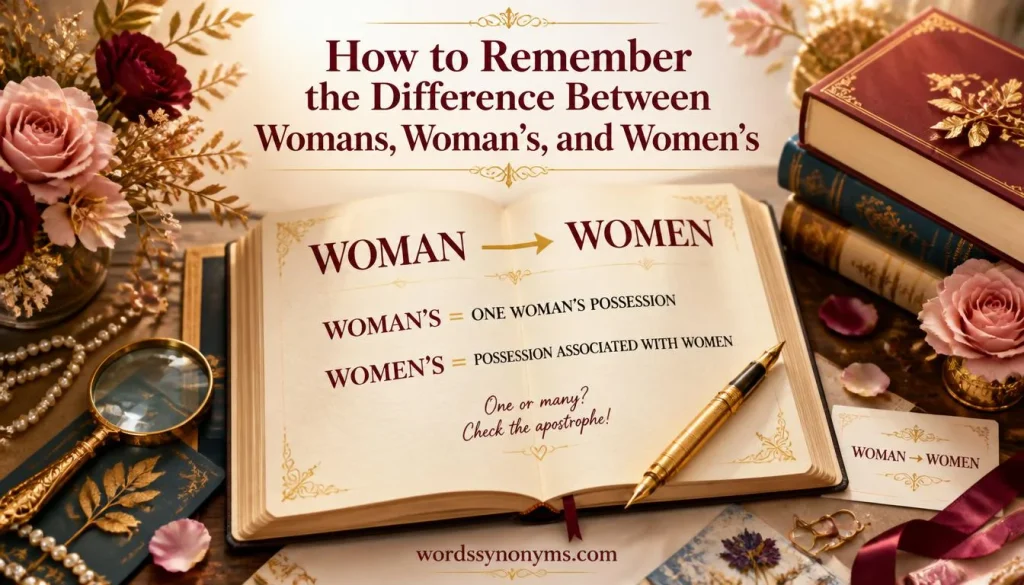
How to Remember the Difference Between Womans, Woman’s, and Women’s
You don’t need to memorize dozens of examples. A few simple rules can help you choose the correct spelling whenever the question comes up.
Remember That Woman Becomes Women in the Plural
The most important step is learning the irregular plural form.
Woman → Women
Don’t add an s to woman to make it plural. The spelling changes instead.
Compare the following sentences:
- One woman is waiting.
- Two women are waiting.
- The woman is waiting for her friend.
- The women are waiting for their friends.
Notice how the noun and verb change together. Woman pairs with is in these examples, while women pairs with are.
This agreement provides another clue when you’re checking your writing.
Add ’s to Form the Possessive
Once you know whether the noun is singular or plural, forming the possessive becomes straightforward.
- Singular: woman → woman’s
- Plural: women → women’s
Both forms take an apostrophe followed by s because women is an irregular plural that doesn’t end in s.
For comparison, regular plural nouns follow a different pattern:
- One girl: girl
- One girl’s bag: girl’s bag
- Several girls: girls
- Several girls’ bags: girls’ bags
This is why the apostrophe placement in women’s may seem unusual at first. The rule depends on the actual spelling of the plural noun.
Use a Simple Number Test
When you’re unsure which spelling to choose, ask yourself two questions.
- Am I talking about one woman or more than one woman?
- Am I showing possession or simply referring to people?
Use the answers to choose the correct form.
Quick grammar check
One woman
Use woman for the person and woman’s for possession.
Example: The woman’s notebook is blue.
Multiple women
Use women for the people and women’s for possession.
Example: The women’s notebooks are blue.
This test works in most everyday writing situations. It also helps you distinguish grammatical errors from sentences that simply express a different meaning.
Read more: Families or Family’s or Families’: What’s the Difference?
Woman’s or Women’s: Practice Exercises
The best way to remember these forms is to use them in sentences. Try the following questions before checking the answers.
Fill in each blank with woman, women, woman’s, or women’s.
- The ______ purse was left in the restaurant.
- Several ______ attended the training session.
- The ______ basketball team reached the final.
- Every ______ deserves respect.
- The ______ opinions were included in the report.
- Two ______ helped organize the event.
- The ______ appointment was scheduled for Monday.
- The organization supports ______ education.
Answers and Explanations
| No. | Answer | Explanation |
| 1 | Woman’s | The purse belongs to one woman. |
| 2 | Women | The sentence refers to multiple people. |
| 3 | Women’s | The team is associated with women. |
| 4 | Woman | Every takes a singular noun here. |
| 5 | Women’s | The opinions belong to or are associated with multiple women. |
| 6 | Women | The sentence refers to two people. |
| 7 | Woman’s | The appointment is associated with one woman. |
| 8 | Women’s | The sentence discusses education associated with women generally. |
The key is to identify the noun’s number before deciding whether it needs an apostrophe. Once you establish that distinction, the correct spelling becomes much easier to recognize.
FAQs
1. Is “womans” a correct English word?
No, womans is generally incorrect in standard English. The correct plural of woman is women. If you want to show that something belongs to one woman, use woman’s instead.
2. Should I write “woman’s” or “women’s”?
Use woman’s when talking about one woman’s belongings or actions. Use women’s when referring to something owned by or related to multiple women. For example, “the woman’s coat” refers to one woman, while “the women’s coats” refers to several women.
3. Why does “woman” become “women” in the plural?
Woman has an irregular plural form, so it changes to women instead of following the usual rule of adding -s or -es. This spelling change is part of standard English usage and must be learned as a separate word form.
4. Is “womens’” ever correct?
No, womens’ is not the standard possessive spelling. Because women is already the plural form of woman, you add an apostrophe and s to make women’s. For example, “The women’s locker room is upstairs.”
5. How do I know when to use “woman’s” in a sentence?
Use woman’s when one woman owns something or when the word represents a contraction of “woman is” or “woman has” in an appropriate sentence. For example, “The woman’s phone is ringing” shows ownership, while “The woman’s waiting outside” means “The woman is waiting outside.”
6. What is the easiest way to remember “woman’s” and “women’s”?
Remember the singular and plural forms first: woman means one, and women means more than one. Add ’s to either form to show possession. That gives you woman’s for one woman and women’s for multiple women.
Conclusion
Choosing between womans, woman’s, and womens’ becomes easier when you understand how singular, plural, and possessive forms work. Woman refers to one person, while women is its irregular plural form. When something belongs to one woman, write woman’s, as in “The woman’s handbag is beautiful.” When something belongs to or relates to multiple women, use women’s, as in “The women’s team practiced today.” Remember that womans and womens’ are generally incorrect in standard English.
The easiest way to avoid these mistakes is to check whether you mean one woman or several women before adding an apostrophe. If you’re describing ownership, place the apostrophe correctly and make sure the noun has the right form. With regular practice and simple examples, you’ll recognize these differences more quickly in everyday writing. Understanding these small grammar details can make your sentences clearer, more natural, and more accurate.

Franklin Hayes is a writer and editor at WordsConfusing.com, focused on making English vocabulary, grammar, and commonly confused words easy to understand. He writes clear, practical articles with simple explanations and useful examples to help readers improve their English with confidence.
His goal is simple: Making Confusing Words Simple.