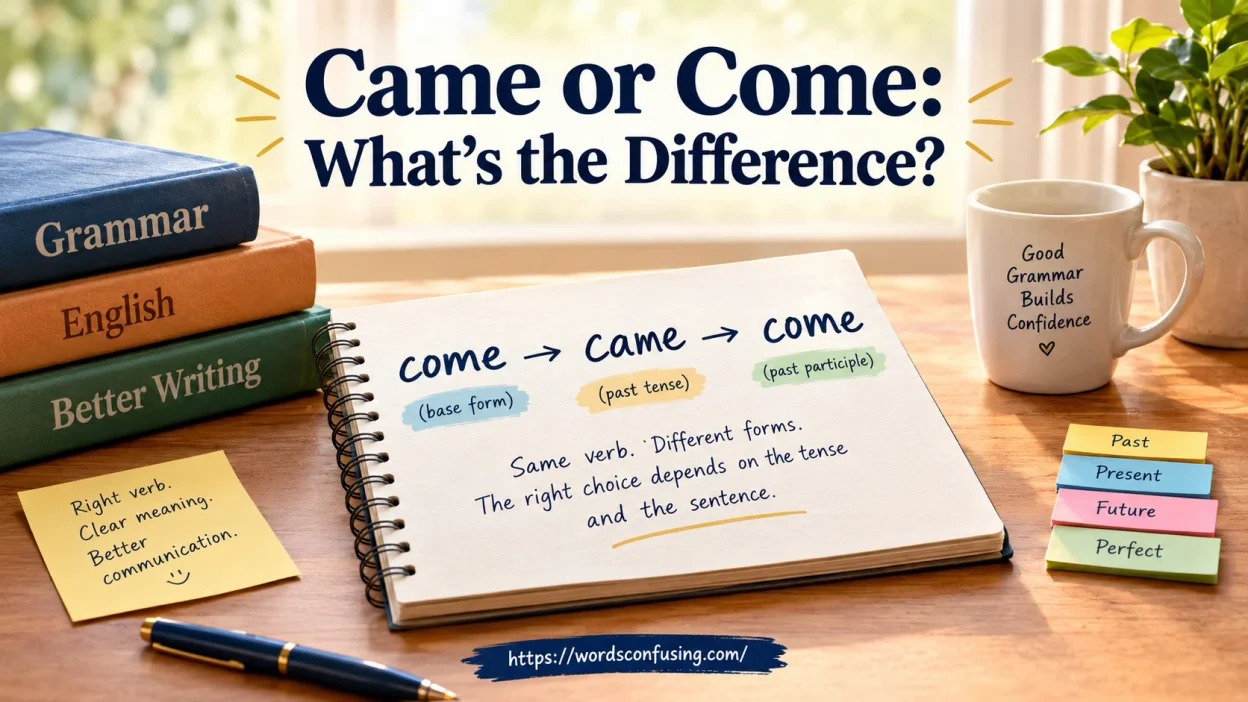
Came or Come: What’s the Difference? Learn how these similar words describe movement and fit different situations by understanding verb tense and word usage.
Come is the base form of an irregular verb used in the simple present for present actions, general actions, daily habits, and ongoing habits. For example, “I come here every day” describes a routine. In contrast, came is the past form and simple past tense of the verb come.
It describes completed actions, finished actions, and past events. “I came here yesterday” shows that an action happened in the past. These easy examples explain the grammatical distinction and meanings of both forms.
Understanding when to use came and come helps you follow grammar rules, strengthen your grammar understanding, and improve your writing skills and natural speech. In everyday English, spoken English, and daily English conversation, the right choice depends on time expressions, sentence structure, and grammatical situations.
For example, “She came home yesterday” describes past actions, while “I have come home” uses the past participle come with the helping verb have to form the present perfect tense. This tense distinction is important in the English language. Learning verb forms, verb conjugation, and contextual usage helps you choose the correct form in everyday conversations.
Practical examples, conversation examples, and memory tips can help you avoid common mistakes, recognize common English grammar mistakes, and improve your English vocabulary through language learning. These usage differences also help native speakers and English learners communicate clearly, write correctly, speak naturally, and use come vs came with confidence.
Quick Answer
Came and come are two forms of the same irregular verb, but they serve different grammatical purposes. Use came for a completed action in the simple past, as in “She came home yesterday.” Use come as the base form after helping verbs such as did, will, and can, or as the past participle after have, has, and had. For example, “Did you come to the party?” and “She has come home” are both correct. Remember the simple pattern come → came → come to choose the right form and avoid common mistakes such as “have came” or “did you came.”

Came or Come: What’s the Difference?
The main difference between came and come is their grammatical role. Came is the simple past tense of come, while come serves as the base form and past participle.
Here is the basic verb pattern:
| Verb form | Grammatical role | Example |
| Come | Base form | Please come inside. |
| Comes | Simple present with he, she, or it | He comes here every Sunday. |
| Came | Simple past tense | He came here yesterday. |
| Come | Past participle | He has come home. |
The verb come is irregular, which means it doesn’t form its past tense by simply adding -ed. You say came, not comed.
The past participle returns to come, even though the simple past form is came. This pattern also appears in many other irregular verbs, such as begin, began, begun and drink, drank, drunk.
Remember this pattern: come → came → come.
- Use came for a completed past action in a simple past sentence.
- Use come after have, has, or had when forming perfect tenses.
- Use come after did, will, can, and other constructions that require the base form.
The right choice depends on how the verb functions in your sentence, not merely on whether the action involves movement.
What Does Came Mean?
Came is the simple past tense of come. You use it when someone or something moved toward a place, arrived, or approached at a past time.
The action may have happened a few minutes ago or many years ago. What matters is that the sentence presents it as a past event.
Consider these examples:
- My brother came home late last night.
- Sarah came to the office before lunch.
- The guests came to our house on Saturday.
- A strange idea came to mind during the meeting.
- The bus came five minutes behind schedule.
- Spring came earlier than we expected.
In each sentence, came describes something that happened in the past. The word doesn’t change according to the subject.
You can say “I came,” “she came,” “they came,” or “we came.” Unlike regular present-tense verbs, came stays the same for every subject.
When to Use Came in the Simple Past Tense
Use came when describing a past event without a helping verb that requires the base form or past participle.
For example:
- Correct: He came to class yesterday.
- Incorrect: He come to class yesterday.
The first sentence uses the simple past tense correctly. The second sentence incorrectly uses the base form in a standard affirmative statement about a completed past event.
Time expressions often help you recognize when came is appropriate. Common examples include:
- Yesterday
- Last night
- Last week
- Two hours ago
- In 2022
- When I was younger
- Earlier this morning, when the event has already finished
For example, “They came to visit us last weekend” clearly places the visit in the past.
However, a past-time expression doesn’t automatically mean you should use came. Helping verbs and sentence structure still matter. “They didn’t come yesterday” is correct because didn’t requires the base form.
Can Came Describe More Than Physical Movement?
Yes. Although came often describes arriving somewhere, English also uses it in expressions about ideas, results, opportunities, and changes.
Examples include:
- The answer came to me while I was walking.
- A better opportunity came along unexpectedly.
- The decision came after several discussions.
- The truth came out during the interview.
- Her dream came true after years of effort.
These expressions show why learning the verb only as a word for physical movement isn’t enough. Its meaning depends on the surrounding phrase.
For instance, “the truth came out” means that information became known. Nobody necessarily moved from one place to another.
What Does Come Mean?
Come is the base form of the verb and the past participle. Its exact role depends on the words surrounding it.
You use come in several common constructions, including present-tense sentences, commands, infinitive phrases, and perfect tenses.
Here are a few examples:
- Please come to my office.
- I come here every Friday.
- They will come tomorrow.
- She wants to come with us.
- We have come a long way.
- He has come home safely.
Although all these sentences contain come, they don’t use the word in exactly the same way. Some express habits or future plans, while others describe completed actions through perfect-tense constructions.
Use Come in the Present Tense
The base form come appears with the subjects I, you, we, and they in the simple present tense. It can describe habits, repeated actions, and general situations.
Examples:
- I come here to study every evening.
- You come to work earlier than everyone else.
- We come to this restaurant whenever we visit town.
- They come from different parts of the country.
With he, she, and it, the simple present form changes to comes.
For example:
- She comes home at six every evening.
- He comes to the gym after work.
- The train comes through this station twice daily.
This distinction matters because come and comes aren’t interchangeable in ordinary affirmative present-tense statements. The subject determines which form you need.
Use Come With Helping Verbs
Several helping verbs require the base form come. These include will, can, could, may, might, should, and must.
Examples:
- She will come tomorrow.
- You can come with us.
- They might come later.
- He should come early.
- We must come prepared.
Notice that the main verb remains come, even when the sentence refers to the future or expresses possibility. The helping verb carries the grammatical information.
The same rule applies to do and does in questions and negative statements.
- Do you come here often?
- She doesn’t come here anymore.
- Did they come yesterday?
The final example refers to the past, yet it still uses come. That’s because did already marks the past tense.
Use Come as the Past Participle
The past participle come appears in perfect-tense constructions with have, has, and had.
Compare these sentences:
- I have come to understand the problem.
- She has come home.
- They had come before the meeting started.
The helping verb changes according to the tense and subject, but the participle stays the same.
A common mistake is writing has came or have came. In standard English, both forms are incorrect when used to create the perfect tense.
Remember that came is the simple past form, while come is the past participle. This distinction is the foundation for using the verb correctly.
Read more: Witnesses or Witness’s or Witness’: What’s the Difference?
When to Use Came vs. Come
Choosing between came and come becomes easier when you identify the sentence structure first. Instead of relying only on the meaning, look for helping verbs and determine which verb form the sentence requires.
Use Came for the Simple Past Tense
When you describe a completed event directly, use came in an affirmative simple past statement.
Examples:
- My cousin came to visit us yesterday.
- The manager came into the room.
- We came home after midnight.
- The package came earlier than expected.
Each sentence presents an event as something that happened in the past.
You don’t need to add have, has, or had to these statements. The word came already expresses the simple past tense.
However, if you add did to form a question or negative sentence, you must switch to come.
- Affirmative: She came to the party.
- Question: Did she come to the party?
- Negative: She didn’t come to the party.
This change may seem unusual at first, but the rule is straightforward: don’t mark the past tense twice in the same verb construction.
Use Come After Have, Has, and Had
When you form the present perfect or past perfect tense, use come rather than came.
| Helping verb | Correct construction | Example |
| Have | Have come | We have come to an agreement. |
| Has | Has come | She has come home. |
| Had | Had come | They had come before noon. |
The present perfect connects a past action or situation to the present. For example, “She has come home” reports an arrival with relevance to the current situation.
The past perfect places one past event before another past event. In “They had come before noon,” the arrival happened before the reference point at noon.
Don’t write she has came or they had came in these constructions. The correct forms are has come and had come.
Use Come After Did and Didn’t
One of the most common mistakes involves questions and negative statements in the simple past tense.
When you use did or didn’t, the main verb takes its base form. Therefore, did come is correct, while did came is incorrect in standard English.
Examples:
- Correct: Did you come to school yesterday?
- Incorrect: Did you came to school yesterday?
- Correct: I didn’t come to work on Monday.
- Incorrect: I didn’t came to work on Monday.
Why does this happen? The helping verb did already carries the past-tense marking. Adding came afterward would use two past-tense forms in the same construction.
The same principle applies to other verbs:
- Did you go? Not Did you went?
- Did she eat? Not Did she ate?
- Did they see it? Not Did they saw it?
This pattern makes English questions easier to build once you recognize it.
Use Come in Present and Future Sentences
Use come when the sentence structure requires the base form, even if the sentence refers to something that hasn’t happened yet.
Examples:
- I will come to your house tomorrow.
- They can come whenever they like.
- We may come after dinner.
- You should come early for registration.
- She wants to come along.
For ordinary affirmative present-tense statements, remember the subject agreement rule: I come, but he comes.
Future expressions work differently. After will, use the base form for every subject:
- I will come.
- He will come.
- They will come.
Never write he will comes or they will came. The helping verb determines the construction, so the main verb remains in its base form.
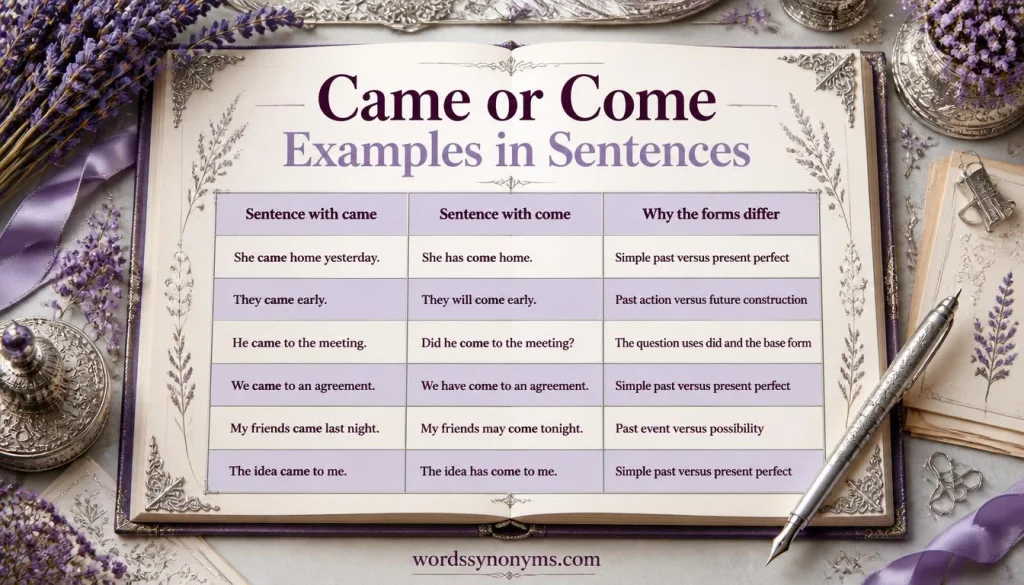
Came or Come Examples in Sentences
Comparing similar sentences helps you understand why one form works while another doesn’t. Pay attention to the tense and any helping verb.
| Sentence with came | Sentence with come | Why the forms differ |
| She came home yesterday. | She has come home. | Simple past versus present perfect |
| They came early. | They will come early. | Past action versus future construction |
| He came to the meeting. | Did he come to the meeting? | The question uses did and the base form |
| We came to an agreement. | We have come to an agreement. | Simple past versus present perfect |
| My friends came last night. | My friends may come tonight. | Past event versus possibility |
| The idea came to me. | The idea has come to me. | Simple past versus present perfect |
These pairs show that the correct choice depends on grammar, not just meaning.
Example: Talking About a Visit
Imagine that your friend visited your home yesterday. You might say:
– “My friend came over yesterday.”
The sentence uses came because it reports a completed past event.
Now imagine that you’re explaining why your friend isn’t outside anymore. You could say:
– “My friend has come inside.”
Here, has come uses the present perfect. The sentence connects the arrival to the current situation.
If you ask whether the friend visited yesterday, you’d say:
– “Did your friend come over yesterday?”
Even though the question refers to the past, did requires the base form come.
Example: Talking About Work
Consider three statements about an employee arriving at work:
- “The new employee came late yesterday.”
- “The new employee has come early all week.”
- “The new employee will come early tomorrow.”
The first sentence describes a past event. The second uses the present perfect to describe a period extending toward the present. The third describes a future plan or expectation.
The subject stays the same in all three examples. Only the sentence construction changes.
Example: Describing a Change
The verb come also appears in expressions that describe progress or change.
Consider these sentences:
- “She came to the same conclusion last year.”
- “She has come to a different conclusion.”
- “She may come to understand the decision later.”
The first describes a completed past event. The second uses the past participle with has. The third uses the base form after may.
These examples demonstrate why memorizing isolated definitions isn’t enough. Learning the verb patterns helps you choose the correct form in different situations.
Came vs. Come in Different Tenses
Understanding the main verb tenses makes the difference between came and come much easier to remember. The verb form changes according to the tense and the grammatical construction.
| Tense or construction | Correct form | Example |
| Simple present | Come / Comes | They come here often. |
| Simple past | Came | They came yesterday. |
| Present perfect | Have / Has come | They have come home. |
| Past perfect | Had come | They had come before noon. |
| Simple future | Will come | They will come tomorrow. |
| Modal construction | Can come | She can come later. |
| Infinitive | To come | I want to come with you. |
| Past-tense question | Did come | Did they come yesterday? |
The table highlights an important point: the past participle is come, not came. It also shows why the base form appears in questions and after modal verbs.
Simple Past vs. Present Perfect
The simple past and present perfect can both describe events that happened before now. However, they present those events differently.
Simple past:
- She came to the office yesterday.
- We came here last summer.
- He came to visit me two days ago.
Present perfect:
- She has come to the office.
- We have come here several times.
- He has come to visit me before.
The simple past often identifies a completed event at a specific past time. The present perfect connects a past event to the present or describes experience without specifying a finished past time.
For example, “I came here yesterday” identifies when the visit happened. “I have come here before” emphasizes previous experience rather than a specific date.
Past Perfect With Had Come
The past perfect describes an action that happened before another past event or reference point.
For example:
- The guests had come before we prepared dinner.
- She had come home when the phone rang.
- We had come to an agreement before the negotiations ended.
In each sentence, had combines with the past participle come. Writing had came would be incorrect in standard English.
Common Mistakes to Avoid With Came and Come
Most mistakes happen when writers confuse the simple past with the past participle or overlook a helping verb. These examples show how to correct the most common errors.
Have Came vs. Have Come
The correct expression is have come, not have came.
- Incorrect: We have came a long way.
- Correct: We have come a long way.
The word have requires the past participle in the present perfect tense. Since come is the past participle, it must follow have.
The same rule applies to has:
- Incorrect: She has came home.
- Correct: She has come home.
Remember that the past tense and past participle don’t always share the same form. In this case, came is the simple past, while come is the past participle.
Did You Came vs. Did You Come
The correct question is “Did you come?”
- Incorrect: Did you came to the party?
- Correct: Did you come to the party?
The helping verb did marks the past tense. Therefore, the main verb must remain in its base form.
This rule also applies to negative sentences:
- Incorrect: I didn’t came yesterday.
- Correct: I didn’t come yesterday.
When you see did or didn’t, use come rather than came.
She Come Yesterday vs. She Came Yesterday
For a standard affirmative sentence describing a completed past event, use came.
- Incorrect: She come yesterday.
- Correct: She came yesterday.
The word yesterday identifies a past time, and the sentence doesn’t contain a helping verb that requires the base form.
However, compare that statement with this question:
– Did she come yesterday?
The question is correct because did changes the grammatical structure. You can’t choose the verb form based on the time expression alone.
Has Came vs. Has Come
Use has come when forming the present perfect with he, she, or it.
Examples:
- Incorrect: The bus has came.
- Correct: The bus has come.
- Incorrect: He has came home.
- Correct: He has come home.
The helping verb has signals the present perfect construction. The past participle come completes it.
For comparison, use came without has in a simple past statement:
- The bus came ten minutes ago.
- He came home after work.
Came vs. Come With Time Expressions
Time expressions can help you identify the intended tense, but they don’t determine the verb form by themselves.
Consider these examples:
| Time expression | Correct sentence | Reason |
| Yesterday | She came yesterday. | Simple past |
| Last night | They came last night. | Simple past |
| Tomorrow | She will come tomorrow. | Future construction |
| Before noon | They had come before noon. | Past perfect |
| Every morning | He comes every morning. | Habitual present |
| Recently | She has come recently. | Present perfect |
Notice that come can appear in a sentence about the past when a helping verb requires the base form or past participle.
For example, “Did she come yesterday?” is correct even though yesterday refers to the past. Always check the entire sentence before deciding which verb form to use.
Came or Come: Quick Comparison Table
If you need a quick reference while writing, use this table to check the most common constructions.
| Expression | Correct or incorrect? | Explanation |
| I came home. | Correct | Simple past |
| I come home every day. | Correct | Simple present |
| She comes home daily. | Correct | Present tense with she |
| I have come home. | Correct | Present perfect |
| She has come home. | Correct | Present perfect |
| They had come home. | Correct | Past perfect |
| I will come home. | Correct | Future construction |
| Did you come home? | Correct | Did takes the base form |
| I didn’t come home. | Correct | Didn’t takes the base form |
| I have came home. | Incorrect | Use the past participle come |
| She has came home. | Incorrect | Use has come |
| Did you came home? | Incorrect | Use did you come |
| They had came home. | Incorrect | Use had come |
| He will came home. | Incorrect | Use will come |
These examples cover the patterns that cause the most confusion. If a sentence contains have, has, or had, check whether the past participle is required. If it contains did, will, or a modal verb, check whether the base form is needed.

How to Remember the Difference Between Came and Come
A simple memory trick can help you choose the right form without second-guessing every sentence.
Remember the three principal forms:
Come → Came → Come
- Come: Base form, as in “Please come inside.”
- Came: Simple past, as in “She came inside.”
- Come: Past participle, as in “She has come inside.”
Then ask yourself two questions.
First, am I describing a past event directly?
If the sentence is an affirmative simple past statement, came is usually the correct choice.
Example: “We came home late.”
Second, does the sentence contain a helping verb?
If it contains have, has, or had, use come as the past participle. If it contains did, will, can, or another modal verb, use the base form come.
Examples:
- We have come home.
- Did you come home?
- We will come home.
Think of did and will as grammatical signals. They tell you to keep the main verb in its base form.
Read more: Jones’ or Jones’s: Which Is Correct?
Practice Exercises: Came or Come?
Test your understanding with these sentences. Fill in each blank with came or come. Pay attention to the helping verbs and time expressions.
- My sister ______ home late last night.
- Have you ever ______ to this restaurant?
- Did your friends ______ to the school event?
- We will ______ back tomorrow.
- The manager ______ to the office an hour ago.
- They had already ______ when we arrived.
- She didn’t ______ to class yesterday.
- I have ______ to appreciate your advice.
- Can you ______ to my house this evening?
- He ______ to see us every weekend.
Answers and Explanations
- Came — Last night identifies a completed past event.
- Come — Have requires the past participle.
- Come — Did requires the base form.
- Come — Will takes the base form.
- Came — The sentence uses the simple past tense.
- Come — Had requires the past participle.
- Come — Didn’t takes the base form.
- Come — Have forms the present perfect.
- Come — Can requires the base form.
- Comes — The simple present uses comes with he.
The final question includes comes because the verb needs to agree with the third-person singular subject. Although comes isn’t one of the two choices in the exercise, it completes the verb pattern and reinforces an important grammar rule.
FAQs
1. What is the main difference between came and come?
Came is the simple past tense of come, while come is its base form and past participle. You use came for completed past actions and come in present-tense sentences or perfect tenses.
2. Should I say “I came home” or “I come home”?
Both are correct, but the meaning depends on the situation. Say “I came home” when describing a past event. Use “I come home” when talking about a habit, such as “I come home at 5 p.m. every day.”
3. Is come the past tense of came?
No, came is the past tense of come. For example, “She comes to class every day” describes a routine, while “She came to class yesterday” describes a past event.
4. Why do we say “I have come” instead of “I have came”?
The present perfect tense requires the past participle, which is come, not came. Therefore, “I have come home” is correct, while “I have came home” is grammatically incorrect.
5. How can I remember when to use came and come?
Connect came with a finished past event and come with the base form or perfect-tense structures. For example, remember “I came yesterday” and “I have come today.” Practicing these sentence patterns can make the difference easier to recall.
6. Can come and came both describe movement toward a place?
Yes, both words can describe movement toward a person or place. The difference is the time and grammatical structure. “They come here every weekend” describes a regular activity, while “They came here last weekend” refers to a completed event in the past.
Conclusion
Understanding the difference between came and come becomes easier when you focus on the time and structure of a sentence. Use came when describing a completed action in the past, such as “I came home yesterday.” Use come for the base form of the verb and in perfect-tense sentences, such as “I have come home.” Although both words describe movement toward a person or place, they serve different grammatical purposes. Choosing the correct form helps you express your ideas clearly and avoid common English grammar mistakes.
The best way to master came vs. come is to practice using both words in everyday situations. Pay attention to time expressions like yesterday, every day, and already, because they can help you identify the correct tense. Try writing a few sentences about your daily routine and past experiences to strengthen your understanding. With regular practice, you’ll find it easier to choose the right verb form, improve your writing, and speak more naturally in English.