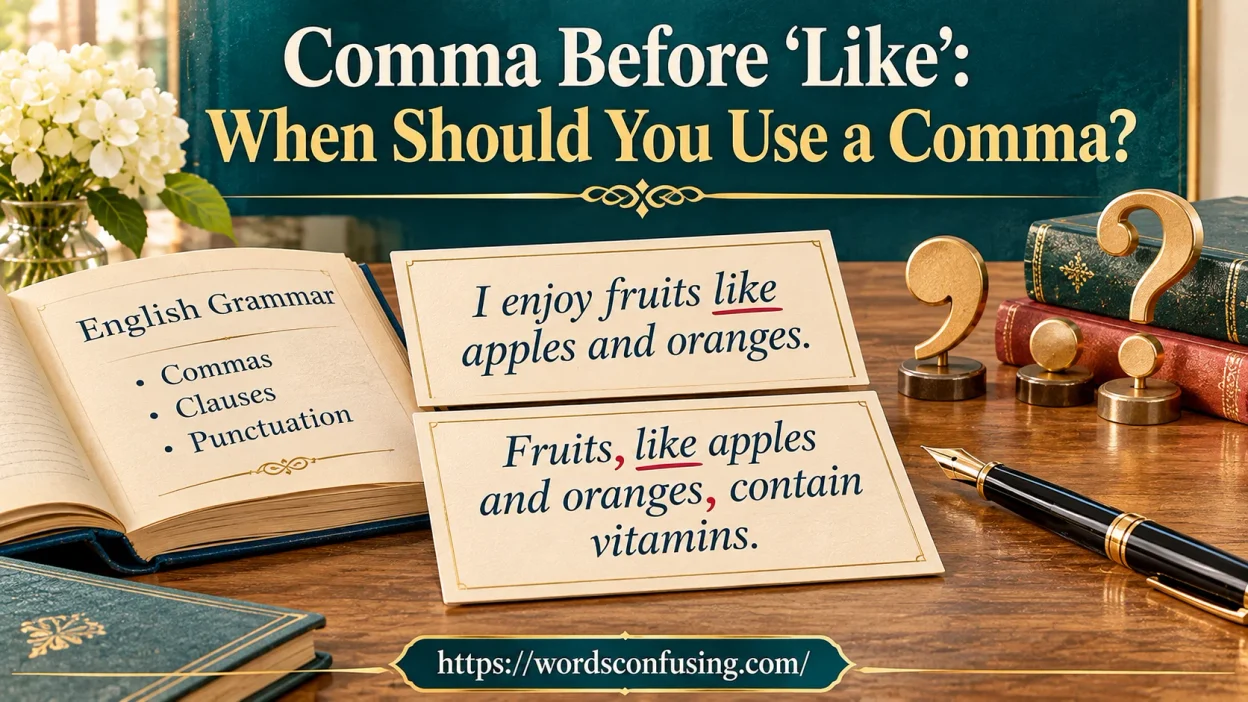
Comma Before “Like”: When Should You Use a Comma? is a common question when learning English punctuation.
Understanding punctuation rules starts with knowing how the word “like” works in sentences. It can introduce examples, comparisons, or additional information. In English grammar, the right place for a comma depends on sentence structure and meaning. For example, consider this sentence: “I enjoy outdoor activities, like hiking and cycling.”
Here, the comma separates the main idea from the examples. Understanding these grammar rules improves writing clarity and grammatical accuracy while helping you avoid common punctuation mistakes.
Knowing when to use a comma and when not to use a comma makes your writing clearer. When placing commas, consider whether the information adds extra detail or completes the main meaning.
These comma placement rules support proper punctuation, better sentence structure, and consistent comma usage. A helpful punctuation guide explains using commas with like through simple examples.
This tricky punctuation issue becomes easier when you understand punctuation basics and build stronger grammar knowledge. With regular practice, you can improve your English writing, avoid unnecessary commas, and use punctuation confidently throughout your article.
Quick Answer
You don’t always need a comma before like. Use one when like introduces nonessential information or an additional comparison. Skip it when like introduces an essential example or completes a direct comparison.
Examples:
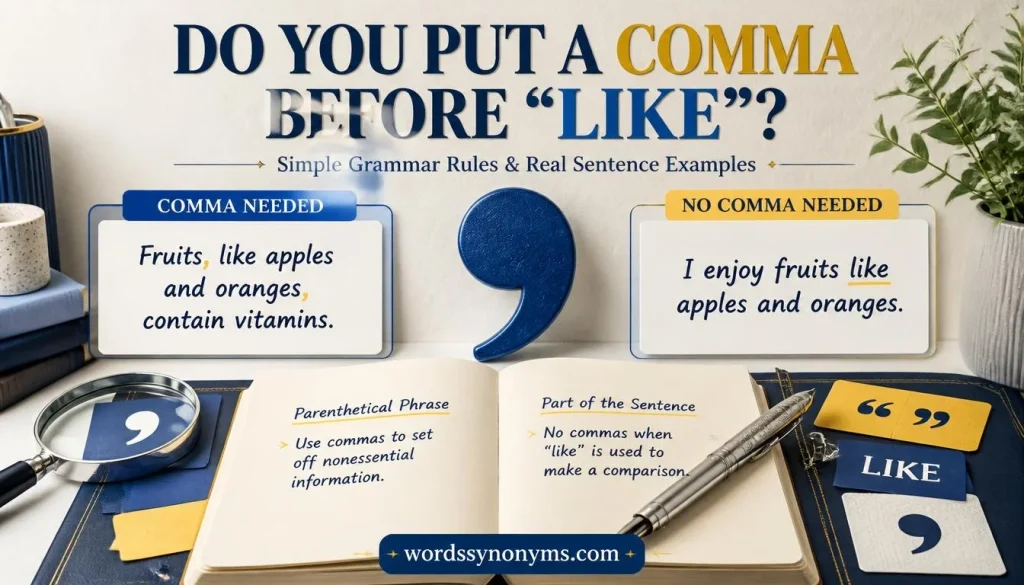
- No comma: I enjoy fruits like apples and oranges.
- Comma needed: Fruits, like apples and oranges, contain vitamins.
- No comma: She looks like her mother.
- Comma needed: My sister, like my mother, enjoys reading.
Easy Rule: If the phrase adds extra information, separate it with commas. If it completes the sentence’s meaning, leave the comma out.
Do You Put a Comma Before “Like”?
Sometimes you need a comma before like, but it’s not always necessary. The correct punctuation depends on the sentence’s structure and meaning.
When like introduces essential information, you generally don’t need a comma. However, when it introduces nonessential information, a comma can help separate that extra detail.
Compare these examples:
| Sentence | Comma Needed? | Explanation |
| I enjoy fruits like apples and oranges. | No | The examples identify the fruits being discussed. |
| Fruits, like apples and oranges, contain vitamins. | Yes | The phrase adds supplementary information. |
| She looks like her mother. | No | The comparison completes the sentence’s meaning. |
| Several activities, like hiking and cycling, improve fitness. | Yes | The phrase provides additional examples. |
| He enjoys sports like basketball and tennis. | No | The examples are integrated into the sentence. |
Notice that like doesn’t automatically require a comma. Instead, you must consider how the phrase contributes to the sentence.
Here are the main situations to remember:
- Nonessential information: Use commas to separate additional details.
- Essential information: Don’t separate necessary details with commas.
- Comparisons: Usually don’t place a comma before an integrated comparison.
- Examples: Decide whether the examples identify something or simply provide extra information.
- Parenthetical expressions: Use commas when a phrase interrupts the main sentence.
Understanding these differences will help you make better punctuation decisions.
When to Use a Comma Before “Like”
A comma before like usually appears when the word introduces additional information rather than an essential part of the sentence.
However, the distinction isn’t based on the word itself. It depends on the relationship between the phrase and the rest of the sentence.
Let’s examine the most common situations.
When “Like” Introduces a Nonessential Phrase
A nonessential phrase adds information without identifying something necessary to understand the sentence.
You can remove this information without changing the sentence’s basic meaning. Writers often separate these phrases with commas.
Consider this example:
My brother enjoys outdoor activities, like hiking and fishing, whenever he gets time.
The phrase like hiking and fishing provides additional examples of outdoor activities. Removing it still leaves a complete sentence:
My brother enjoys outdoor activities whenever he gets time.
The central message remains clear.
Here are more examples:
- My grandmother enjoys traditional foods, like homemade bread and vegetable soup.
- Several animals, like elephants and giraffes, live in the wildlife sanctuary.
- Our neighborhood has beautiful parks, like Riverside Park and Green Valley Park.
- Some hobbies, like painting and gardening, help people relax.
In each example, the comma separates supplementary information from the main statement.
Remember: Nonessential information often needs punctuation at both ends when it appears inside a sentence.
For example:
- Correct: My sister, like my mother, enjoys reading novels.
- Incorrect: My sister like my mother enjoys reading novels.
The paired commas make the additional comparison easier to recognize.
When “Like” Introduces Examples as an Afterthought
Sometimes writers mention a general category before adding a few examples. When those examples function as an afterthought, a comma can separate them from the main statement.
For example:
We need more outdoor activities, like hiking and cycling.
Here, the speaker presents outdoor activities as the main idea. The examples provide additional clarification.
However, punctuation can change when the examples identify the specific category being discussed.
Compare:
- I enjoy outdoor activities like hiking and cycling.
- Outdoor activities, like hiking and cycling, can improve physical fitness.
The first sentence integrates the examples into the meaning. The second presents them as supplementary information.
This distinction matters because a comma shouldn’t appear simply because a sentence contains examples.
Consider another pair:
| Without a Comma | With a Comma |
| I enjoy desserts like cakes and cookies. | Desserts, like cakes and cookies, often contain sugar. |
| She prefers flowers like roses and tulips. | Flowers, like roses and tulips, can brighten a room. |
| We study subjects like history and geography. | School subjects, like history and geography, develop different skills. |
The second column treats the example phrases as additional information about an already established category.
When “Like” Appears in an Introductory Expression
An introductory expression appears before the main clause and provides context for what follows.
When an introductory expression begins with like, a comma may follow the entire expression.
For example:
- Like many students, Sarah prefers studying in the morning.
- Like his older brother, Daniel enjoys playing basketball.
- Like most beginners, I struggled with the first lesson.
- Like her mother, Emily has a natural interest in painting.
Notice something important: The comma appears after the introductory phrase, not before the word like.
This distinction often confuses beginners.
You wouldn’t write:
Incorrect: ,Like many students Sarah prefers studying in the morning.
Correct: Like many students, Sarah prefers studying in the morning.
The comma separates the introductory comparison from the main clause.
When “Like” Appears in a Parenthetical Expression
A parenthetical expression interrupts a sentence to add a comment, comparison, or explanation.
Writers commonly place commas around these expressions because they aren’t essential to the sentence’s main structure.
For example:
The new teacher, like her predecessor, encourages classroom discussions.
The phrase like her predecessor adds a comparison. However, the main sentence remains complete without it.
More examples include:
- My father, like many experienced drivers, prefers long road trips.
- The restaurant, like its sister location, serves traditional Italian food.
- Emma, like her best friend, enjoys learning new languages.
- This method, like the previous approach, requires careful planning.
When the parenthetical expression appears in the middle, use a comma before and after it.
When it appears at the end, one comma may introduce it.
For example:
The entire team enjoyed the experience, like their coach.
However, always check whether the expression genuinely functions as additional information. Don’t add commas merely to create a pause.
Read more: 5 Good Synonyms for Willful Ignorance And What It Means
When NOT to Use a Comma Before “Like”
Just as important as knowing when to use commas is knowing when to leave them out.
Many writers insert unnecessary commas because they assume every occurrence of like needs separation. That assumption creates awkward sentences.
Here are the situations where a comma usually isn’t necessary.
When “Like” Introduces an Essential Comparison
An essential comparison connects two things directly. Removing the comparison may change the sentence’s intended meaning.
For example:
- She looks like her grandmother.
- This fabric feels like silk.
- He runs like a professional athlete.
- Your handwriting looks like mine.
- The baby sleeps like an angel.
In these sentences, like introduces an integrated comparison.
A comma would interrupt the natural connection between the words.
Incorrect: She looks, like her grandmother.
Correct: She looks like her grandmother.
The comparison belongs directly to the sentence’s structure.
When “Like” Introduces Examples Within a Sentence
When examples form an essential part of the sentence, you generally don’t need a preceding comma.
For example:
- I enjoy activities like swimming and cycling.
- She buys vegetables like carrots and spinach.
- We study languages like Spanish and French.
- They sell products like notebooks and pens.
- He prefers movies like action and adventure films.
The examples help explain which activities, vegetables, languages, products, or movies the writer means.
Removing the examples may make the statement less specific.
However, remember that the distinction depends on context. A phrase can be essential in one sentence and supplementary in another.
Compare:
Essential: I enjoy hobbies like photography and painting.
Nonessential: Creative hobbies, like photography and painting, can reduce stress.
Both sentences are grammatically possible. Their punctuation reflects how the examples function.
When “Like” Functions as a Preposition
The word like often functions as a preposition. It introduces a noun or pronoun that expresses similarity or comparison.
In ordinary sentences, these prepositional phrases don’t need commas.
Examples include:
- She dances like a professional.
- He talks like his father.
- The clouds look like cotton.
- This tastes like fresh lemonade.
- Your idea sounds like a practical solution.
A comma would unnecessarily separate connected sentence elements.
For example:
Incorrect: The clouds look, like cotton.
Correct: The clouds look like cotton.
The phrase like cotton completes the comparison naturally.
When “Like” Appears in Everyday Expressions
Many common expressions contain like. These expressions usually don’t require a comma before the word.
Consider the following examples:
| Expression | Example |
| Looks like | It looks like rain outside. |
| Sounds like | That sounds like a wonderful idea. |
| Feels like | This blanket feels like velvet. |
| Acts like | He acts like a responsible adult. |
| Smells like | The kitchen smells like fresh bread. |
| Tastes like | This drink tastes like orange juice. |
| Seems like | It seems like everyone enjoyed the party. |
| Something like | I need something like a notebook. |
These expressions connect ideas naturally. A comma would usually interrupt their grammatical relationship.
For example:
Incorrect: That sounds, like a great opportunity.
Correct: That sounds like a great opportunity.
The same principle applies to most everyday comparisons.
Comma Before “Like” vs. Comma After “Like”
A comma before like and a comma after like serve different purposes.
Understanding this difference can prevent several common punctuation mistakes.
A comma before like may separate an introductory or supplementary phrase from the main sentence.
A comma after like may appear when the word begins an introductory comparison or example phrase.
Consider these examples:
| Sentence | Comma Position | Explanation |
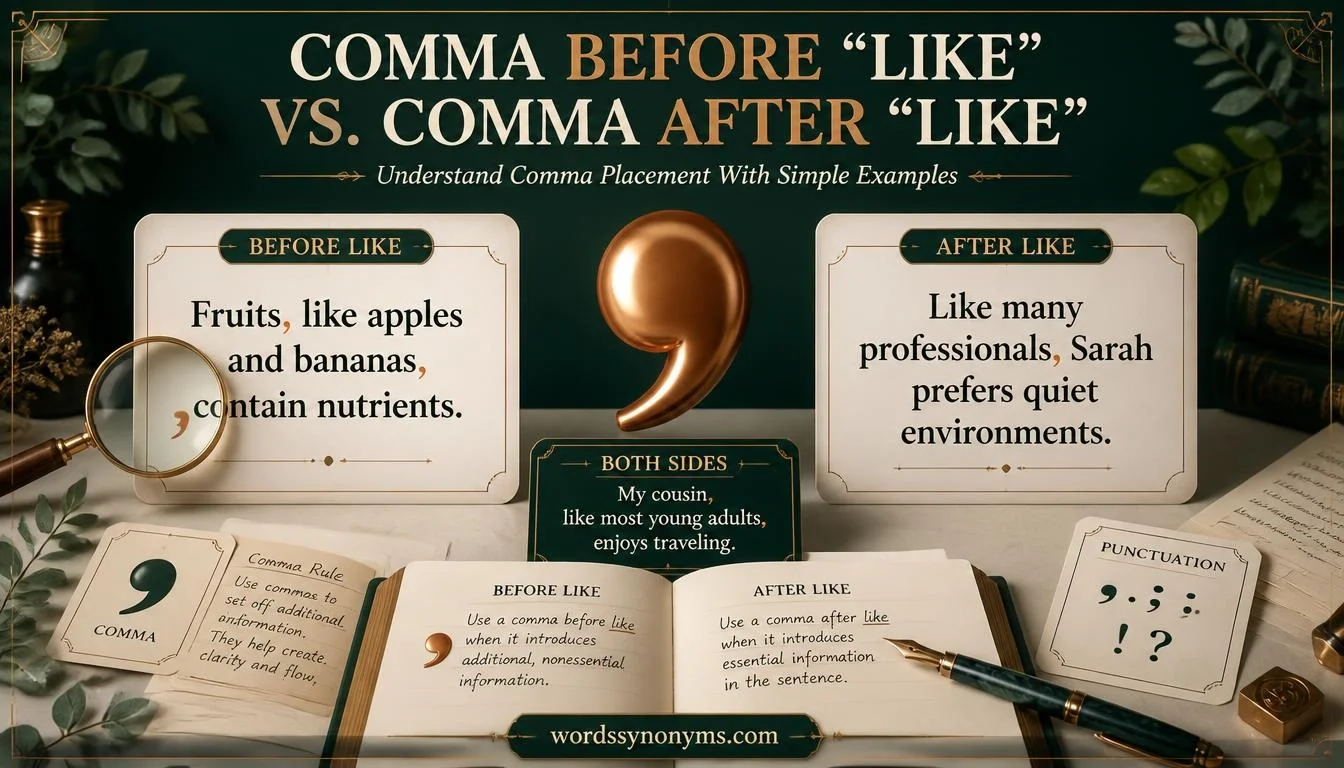
| Fruits, like apples and bananas, contain nutrients. | Before and after | The example phrase is supplementary. |
| Like most children, David enjoys playing outside. | After | The comparison introduces the sentence. |
| She enjoys activities like swimming and hiking. | Neither | The examples are integrated. |
| My brother, like my father, enjoys cooking. | Before and after | The comparison interrupts the sentence. |
When a Comma Appears Before “Like”
Use a comma before like when it introduces a nonessential phrase.
Example:
Several countries, like Canada and Australia, have large natural landscapes.
The phrase like Canada and Australia adds examples without identifying an otherwise unclear category.
When a Comma Appears After “Like”
Use a comma after an introductory expression when it separates that expression from the main clause.
Example:
Like many other professionals, Sarah prefers working in a quiet environment.
Here, the introductory comparison ends before the main clause begins.
When Both Commas Are Necessary
Sometimes like introduces additional information inside a sentence.
In that situation, you may need commas on both sides.
Example:
My cousin, like most young adults, enjoys traveling during holidays.
The main sentence remains complete without the comparison.
Quick tip: Don’t confuse the position of a comma with the grammatical function of like. Always examine the complete phrase.
Comma Before “Like” When Giving Examples
One of the most common questions concerns using like to introduce examples.
Should you write a comma before it?
The answer depends on whether the examples provide necessary identification or additional information.
For instance:
I enjoy outdoor activities like camping and fishing.
No comma is necessary because the examples identify the activities being discussed.
Now consider:
Outdoor activities, like camping and fishing, can help people relax.
The examples provide supplementary information about outdoor activities in general.
Both sentences work. Their different structures explain the punctuation.
Comma Before “Like” in a List
Lists often contain several examples introduced by like.
However, the comma before like doesn’t follow the same rule as commas separating individual list items.
Consider:
- I purchased supplies like pencils, notebooks, and markers.
- Many fruits, like apples, bananas, and oranges, contain fiber.
- Outdoor hobbies, like hiking, fishing, and camping, attract many enthusiasts.
In the first example, like pencils, notebooks, and markers identifies the supplies.
In the remaining examples, the phrases provide supplementary information.
Notice that commas between list items serve a separate grammatical purpose.
For example, in this sentence:
Many fruits, like apples, bananas, and oranges, contain fiber.
There are three different punctuation functions:
- The first comma opens the supplementary phrase.
- The middle commas separate individual examples.
- The final comma closes the supplementary phrase.
This distinction makes longer sentences easier to punctuate correctly.
Comma Before “Like” in Formal Writing
Formal writing follows the same basic principles as everyday writing. However, clarity and consistency become especially important.
In academic papers, professional reports, and business documents, unnecessary commas can interrupt sentence flow.
Consider these examples:
Informal: We enjoy activities like hiking and cycling.
Formal: Several recreational activities, like hiking and cycling, promote physical fitness.
Both sentences can be correct. The punctuation depends on the role of the example phrase.
You may also choose such as when introducing specific examples in formal writing.
For example:
- The company offers services such as consulting and training.
- Several nutrients, such as calcium and iron, support normal body functions.
However, such as doesn’t automatically require a comma either.
The same essential-versus-nonessential distinction applies.
Comma Before “Like” in Different Sentence Positions
The position of like can affect where commas appear. However, sentence structure remains the deciding factor.
Let’s look at its common positions.
Comma Before “Like” at the Beginning of a Sentence
When like begins a sentence, it usually introduces a comparison or introductory phrase.
A comma generally follows the complete introductory expression when it separates that expression from the main clause.
Examples:
- Like many teenagers, Alex enjoys playing video games.
- Like her sister, Maria loves reading mystery novels.
- Like most beginners, I found the instructions confusing.
- Like his father, James prefers working outdoors.
Notice that none of these examples needs a comma before like.
The comma comes after the introductory comparison.
Comma Before “Like” in the Middle of a Sentence
The middle position offers several possibilities.
If like introduces essential information, don’t add a comma automatically.
Examples:
- I enjoy activities like running and swimming.
- She prefers books like historical novels and biographies.
- He wears clothes like denim jackets and cotton shirts.
However, supplementary phrases need commas around them.
Examples:
- My sister, like my mother, enjoys gardening.
- Several animals, like lions and tigers, live in this region.
- Our teacher, like many experienced educators, encourages discussion.
The easiest way to recognize the difference is to remove the phrase mentally.
If the sentence remains complete and the removed information merely adds detail, the phrase may be nonessential.
Comma Before “Like” at the End of a Sentence
When like introduces an integrated comparison at the end, a comma usually isn’t necessary.
Examples:
- She sings like a professional.
- He looks like his father.
- This fabric feels like cotton.
- The sky looks like a painting.
However, a comma can introduce a supplementary phrase at the end.
For example:
- Several people attended the event, like my cousins and neighbors.
- I enjoy outdoor activities, like hiking and camping.
The second example presents the activities as additional examples.
Still, don’t rely on sentence position alone. The intended meaning matters more than the location of like.
“Like” vs. “Such As”: Do They Need Commas?
The words like and such as often introduce examples. However, they don’t always communicate exactly the same idea.
Like commonly expresses similarity or introduces examples.
Such as more directly introduces specific examples from a broader category.
For example:
- I enjoy fruits like apples and oranges.
- I enjoy fruits such as apples and oranges.
Both sentences communicate that apples and oranges are examples of fruits.
However, like can also emphasize resemblance.
For example:
Her voice sounds like a famous singer’s voice.
Here, like introduces a comparison rather than a list of examples.
Comparison of “Like” and “Such As”
| Feature | Like | Such As |
| Introduces examples | Yes | Yes |
| Shows similarity | Yes | Not usually |
| Works in comparisons | Yes | Not usually |
| Requires a comma automatically | No | No |
| Can introduce essential information | Yes | Yes |
| Can introduce supplementary information | Yes | Yes |
Examples Without Commas
- I enjoy sports like tennis and basketball.
- She studies subjects such as biology and chemistry.
- We need supplies like paper and pencils.
- They sell products such as notebooks and folders.
In these sentences, the examples integrate naturally into the statements.
Examples With Commas
- Popular sports, like tennis and basketball, attract large audiences.
- Several subjects, such as biology and chemistry, require regular practice.
- Office supplies, like paper and pencils, are available here.
- Many household items, such as lamps and chairs, come in different styles.
The phrases provide additional examples rather than essential identification.
Important: Neither expression automatically needs a comma. Sentence structure determines the correct punctuation.
Common Mistakes When Using a Comma Before “Like”
Even experienced writers sometimes misuse commas around like. Most mistakes happen when writers follow punctuation habits instead of examining sentence meaning.
Here are the errors worth avoiding.
Adding a Comma Before Every “Like”
This is one of the most common mistakes.
Incorrect: I enjoy, like, swimming and cycling.
Correct: I enjoy activities like swimming and cycling.
The word like doesn’t require a comma simply because it introduces examples.
Using Commas Around Essential Information
Essential information helps identify exactly what the writer means.
Incorrect: Students, like those studying medicine, need regular practice.
This sentence isn’t necessarily incorrect. However, if the writer means only medical students, the phrase should remain integrated.
Clearer version: Students like those studying medicine need regular practice.
The intended meaning determines the punctuation.
Confusing Commas Before and After “Like”
Introductory expressions generally take a comma after the complete phrase.
Incorrect: ,Like most beginners, I struggled with grammar.
Correct: Like most beginners, I struggled with grammar.
A comma cannot appear before the first word of an ordinary sentence.
Adding Unnecessary Commas to Comparisons
Comparisons usually remain connected to the words they describe.
Incorrect: This cake tastes, like chocolate.
Correct: This cake tastes like chocolate.
The phrase like chocolate completes the comparison.
Treating Every Example as Parenthetical
Not every example phrase provides additional information.
Incorrect for the intended meaning: I enjoy hobbies, like painting and reading.
If the writer needs those examples to identify the hobbies being discussed, the comma may suggest the wrong relationship.
Clearer version: I enjoy hobbies like painting and reading.
Confusing “Like” With “Such As”
Both expressions can introduce examples, but their meanings aren’t always identical.
For example:
- She looks like her mother. (Similarity)
- She enjoys activities such as swimming. (Examples)
Replacing one expression with the other can change the sentence’s meaning.
Comma Before “Like”: Examples and Corrections
Practical examples make punctuation rules easier to understand. The following sentences show how small changes affect comma placement.
| Sentence | Correct or Incorrect? | Explanation |
| I enjoy fruits like apples and oranges. | Correct | The examples identify the fruits. |
| Fruits, like apples and oranges, contain vitamins. | Correct | The phrase adds supplementary examples. |
| He looks like his father. | Correct | The comparison is integrated. |
| She sings, like a professional. | Usually incorrect | The comparison doesn’t need separation. |
| My brother, like my father, enjoys cooking. | Correct | The comparison is nonessential. |
| I purchased supplies like pens and notebooks. | Correct | The examples identify the supplies. |
| Several animals, like lions and tigers, live here. | Correct | The phrase adds examples. |
| Like most students, Anna enjoys weekends. | Correct | The introductory phrase takes a following comma. |
| This feels, like silk. | Incorrect | The comma interrupts the comparison. |
| Many hobbies, like painting and gardening, reduce stress. | Correct | The phrase provides additional information. |
| She likes books such as novels and biographies. | Correct | The examples are integrated. |
| Books, such as novels and biographies, can entertain readers. | Correct | The phrase provides supplementary examples. |
Case Study: Understanding Two Similar Sentences
Consider these two sentences:
Sentence A: I enjoy movies like action films and comedies.
Sentence B: Movies, like action films and comedies, entertain millions of viewers.
At first glance, they appear almost identical. Both mention movies, action films, and comedies.
However, their structures differ.
In Sentence A, the examples identify the types of movies the speaker enjoys. The phrase belongs directly to the sentence’s meaning.
In Sentence B, the writer discusses movies generally. The examples simply illustrate the broader category.
Therefore:
- Sentence A doesn’t need a comma before like.
- Sentence B uses commas to separate supplementary information.
This example demonstrates why punctuation depends on meaning rather than individual words.
More Real-World Examples
Here are additional examples from everyday writing.
School and education
- I enjoy subjects like English and history.
- School subjects, like mathematics and science, require regular practice.
- Like many students, Daniel prefers interactive lessons.
Food and cooking
- She enjoys desserts like brownies and cheesecake.
- Desserts, like brownies and cheesecake, often contain sugar.
- This tastes like homemade chocolate pudding.
Work and business
- We offer services like editing and proofreading.
- Several services, like editing and proofreading, improve content quality.
- Like many business owners, Sarah values customer feedback.
Travel and hobbies
- I enjoy destinations like Paris and Rome.
- European destinations, like Paris and Rome, attract millions of visitors.
- Like most travelers, James enjoys exploring new places.
These examples demonstrate how the same punctuation principles work across different subjects.
Quick Rules for Using a Comma Before “Like”
If you need a quick reminder, keep these practical rules nearby.
| Situation | Comma Before “Like”? |
| Essential examples | Usually no |
| Nonessential examples | Yes |
| Essential comparison | Usually no |
| Nonessential comparison | Yes |
| Introductory phrase beginning with like | No comma before; usually one after |
| Integrated prepositional phrase | Usually no |
| Parenthetical expression | Yes, when separating the additional information |
A Simple Test to Check Your Sentence
When you’re unsure, try this three-step method.
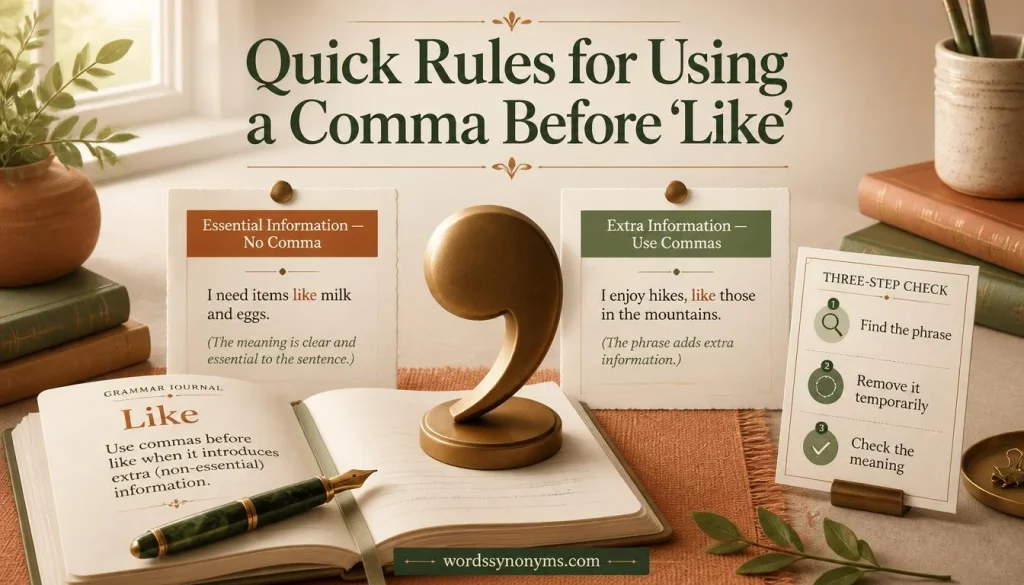
Step 1: Find the phrase beginning with like.
Identify the words that follow like and determine what they contribute.
Example: Some activities, like swimming and cycling, improve fitness.
Step 2: Remove the phrase temporarily.
Read the sentence without the additional information.
Some activities improve fitness.
The sentence remains complete.
Step 3: Decide whether the information is supplementary.
If the phrase adds an extra explanation rather than identifying something necessary, commas may be appropriate.
Remember that removing a phrase isn’t a perfect test by itself. Meaning and context still matter.
Read more: No Need to Apologize: Meaning and 11 Better Alternatives
FAQs
1. Should you always put a comma before “like”?
No, a comma isn’t always necessary before “like.” It depends on how the word functions in your sentence. When it introduces a nonessential example or additional information, a comma may be appropriate. Otherwise, you can often leave it out.
2. When should I use a comma before “like”?
Use a comma when “like” introduces examples or extra information that you want to separate from the main sentence. For example: “I enjoy outdoor activities, like hiking and swimming.”
3. Do you need a comma before “like” when giving examples?
Not always. A comma often appears before “like” when introducing examples, especially when the examples provide additional information. However, short and essential phrases don’t always need one.
4. Is a comma necessary before “like” in formal writing?
It depends on the sentence structure, not simply the level of formality. Formal writing follows the same basic punctuation principles. Use a comma when the sentence requires a pause or separation.
5. What happens if you use an unnecessary comma before “like”?
An unnecessary comma can interrupt the natural flow of your sentence. It may also separate closely connected words or ideas, making your writing less clear.
6. How can I remember the comma rule for “like”?
Focus on the meaning rather than memorizing a fixed rule. Ask yourself whether the information after “like” adds extra details or completes the sentence’s main idea. This simple check can help you make better punctuation choices.
Conclusion
Using a comma before “like” doesn’t have to feel confusing. The trick is to understand what the word does in your sentence. When it introduces examples or additional information, a comma may help separate those details from the main idea. However, when “like” forms an essential part of the sentence, adding a comma can interrupt the natural flow. Instead of memorizing one fixed rule, pay attention to the meaning and structure of your sentences.
Good punctuation comes from understanding how words connect, not simply following patterns. Whenever you’re unsure about comma placement, read your sentence aloud and check whether the information after “like” needs separation. A little practice can help you recognize the difference between necessary and unnecessary commas. Once you understand these simple distinctions, you’ll write clearer sentences and feel more confident using “like” in everyday English writing.