

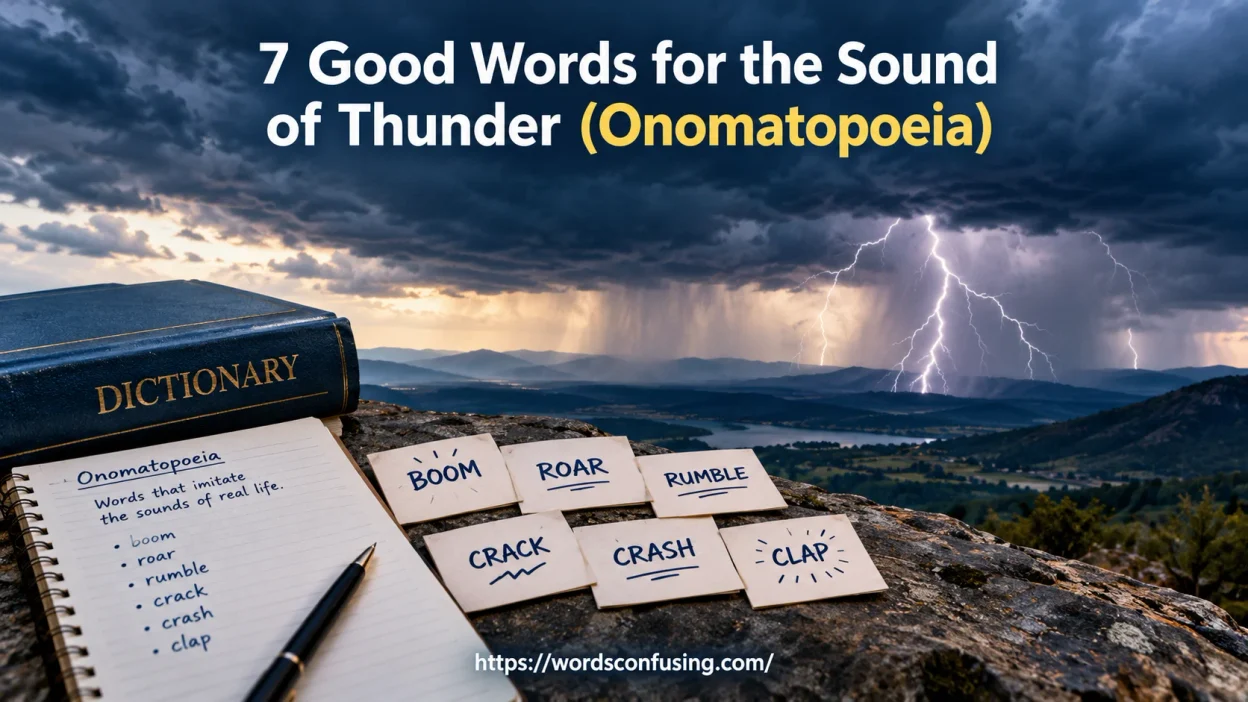
When you describe the sound of thunder, the right word can make the scene feel more vivid and immediate. The 7 Good Words for the Sound of Thunder article can help you find a good, descriptive choice that matches the moment.
A distant rumble may feel calm, while a sudden crack can seem powerful and dramatic. The intensity of the noise also matters because thunder can range from a soft roll to an immense burst that shakes the air.
To achieve a natural description, understand what you want your reader to hear and feel. A carefully selected term gives your writing energy without making it sound forced or exaggerated.
In this article, you can explore the best options and learn when each descriptive expression fits the scene, mood, and strength of the storm around you for your intended audience everywhere.
One useful technique is onomatopoeia, which uses words that imitate or suggest real sounds. This approach can make descriptions of thunder more lively because readers can almost hear the noise as they read. Strong descriptive sounds may suggest a deep rumble, a sharp crack, or a long rolling boom.
From my experience with descriptive writing, the most effective word depends on the kind of storm you want to present. If the sky suddenly erupts, a forceful expression can show its intensity. If the storm stays far away, softer wording may work better. You can also combine sensory details with the sound itself to create a fuller picture.
The goal isn’t simply to describe thunder as loud. Instead, choose a good term that helps readers understand its character, movement, and emotional effect clearly throughout the entire passage for clarity and impact.
Quick Answer
| Word | What It Suggests | Best Use |
| Boom | Deep, powerful, resonant sound | Loud, forceful thunder |
| Roar | Sustained, loud, powerful sound | Long or intense storms |
| Rumble | Low, deep, rolling sound | Distant or prolonged thunder |
| Crash | Sudden, loud, violent sound | Dramatic thunderclaps |
| Crack | Sharp, abrupt sound | Nearby or sudden thunder |
| Clap | Short, distinct burst | A clear thunderclap |
| Thunder | General storm sound | Neutral descriptions |
Among these choices, rumble works particularly well for distant thunder, while crack captures the sharp quality of nearby thunder. Boom emphasizes depth and force. Roar suggests something larger and more sustained.
What Is Onomatopoeia?
Onomatopoeia refers to words that imitate, resemble, or strongly evoke the sounds associated with what they describe.
Common examples include:
- Buzz — the sound associated with bees
- Hiss — a sharp, breathy sound
- Bang — a sudden loud impact
- Pop — a short explosive sound
- Splash — the sound of liquid being disturbed
- Click — a short, sharp mechanical sound
Words such as boom, crack, rumble, and clap can function as sound words when they describe thunder. They don’t reproduce the entire acoustic event perfectly. Instead, they give readers a recognizable impression of what the sound feels like.
That’s important because real thunder is complicated.
A lightning flash can stretch for miles through the atmosphere. Different portions of that channel produce sound that reaches you at different times. NOAA’s National Severe Storms Laboratory notes that thunder may begin with a sharper sound from nearby portions of the lightning channel and then transition into lower-frequency rumbling from more distant portions.
In other words, thunder isn’t just one giant BOOM.
Sometimes it really is a boom. Other times, it sounds like a long, rolling rumble. A nearby strike can produce a startling crack or even a tearing, explosive sound.
Why Does Thunder Sound Like a Boom, Crack, or Rumble?
The reason comes down to lightning and rapidly heated air.
When lightning travels through the atmosphere, it heats the air around its channel almost instantaneously. That sudden heating causes the air to expand violently. The expansion generates a shock wave that eventually reaches your ears as thunder.
The sound can change as it travels.
A nearby lightning channel may produce a sharp, high-frequency sound. Farther away, atmospheric absorption reduces some of those higher frequencies, leaving more low-frequency sound. That’s one reason distant thunder often sounds like a deep rumble rather than a sharp crack.
The shape and length of the lightning channel matter, too. A single flash can involve many portions of a channel, each contributing sound. Your ears receive those sounds at slightly different times, creating thunder’s characteristic rolling quality.
That scientific detail explains why English has so many useful thunder words.
1. Boom
Boom is one of the strongest words for describing powerful thunder.
The word suggests a deep, loud, resonant burst. It works especially well when thunder feels physically forceful, such as when windows rattle or the sound seems to shake a building.
For example:
A tremendous boom of thunder shook the windows.
The word immediately gives the sentence weight. You can almost hear the low-frequency impact.
When to use “boom” for thunder
Use boom when you want to emphasize:
- Loudness
- Depth
- Power
- Sudden impact
- A strong burst of sound
It works especially well in dramatic writing.
Examples:
- Thunder boomed across the darkened valley.
- A deep boom echoed through the house.
- Another boom of thunder rolled over the rooftops.
- The sudden boom startled everyone inside.
There’s also a useful distinction between boom and rumble.
A boom usually feels more concentrated. A rumble feels more extended.
Think of boom as a heavy drumbeat. Think of rumble as the sound continuing beneath it.
2. Roar
Roar describes a loud, powerful sound that continues rather than ending immediately.
When thunder seems to fill the entire sky, roar can capture its intensity beautifully.
Thunder roared above the mountains as rain swept across the valley.
That sentence creates a much larger soundscape than simply saying that thunder was loud.
When to use “roar” for thunder
Choose roar when thunder feels:
- Sustained
- Powerful
- Overwhelming
- Continuous
- Vast or dramatic
It works particularly well when the storm itself becomes the dominant feature of a scene.
Examples:
- Thunder roared throughout the night.
- The storm roared beyond the hills.
- A furious roar of thunder followed the lightning.
- Thunder roared overhead while the rain hammered the roof.
The word can also personify the storm. A storm that roars feels almost alive.
That makes roar particularly effective in fiction and descriptive prose.
3. Rumble
If you need a word for low, deep, rolling thunder, choose rumble.
This is often the most natural choice for thunder that sounds distant or continues for several seconds.
A low rumble of thunder drifted across the hills.
Notice the mood. The sentence doesn’t sound explosive. Instead, it feels distant and slightly ominous.
That’s exactly where rumble shines.
When to use “rumble” for thunder
Use rumble when the thunder is:
- Low-pitched
- Distant
- Prolonged
- Rolling
- Subtle but noticeable
NOAA notes that thunder often sounds like a low-frequency rumble when you’re several miles from the lightning source. The sound can continue because different portions of the lightning channel reach the listener at different times.
Examples:
- A distant rumble of thunder warned of the approaching storm.
- Thunder rumbled beyond the mountains.
- The low rumble grew louder as the storm moved closer.
- She heard thunder rumbling in the distance.
Why “rumble” creates suspense
Interestingly, rumble doesn’t need to be extremely loud to feel threatening.
A faint rumble in the distance can signal that something bigger is coming. In storytelling, that makes it useful for building anticipation before the storm arrives.
It’s the literary equivalent of hearing footsteps before seeing the person.
4. Crash
Crash suggests a sudden, loud, forceful sound.
When thunder arrives abruptly and seems to explode across the sky, crash can capture that moment.
A violent crash of thunder shattered the quiet afternoon.
Compared with rumble, crash feels much more immediate.
When to use “crash” for thunder
Use crash when you want to emphasize:
- Suddenness
- Loudness
- Violence
- Shock
- Dramatic impact
Examples:
- A crash of thunder shook the house.
- Thunder crashed over the city.
- A deafening crash followed the lightning.
- The sudden thunder crash startled the sleeping dog.
The word is particularly effective when the storm interrupts something peaceful.
A quiet bedroom. A calm conversation. An empty road.
Then—crash.
That contrast makes the sound more powerful.
5. Crack
Crack is ideal for a sharp, sudden burst of thunder.
Unlike rumble, which feels low and continuous, crack feels quick and piercing.
A sharp crack of thunder split the silence.
This is one of the most vivid ways to describe thunder that seems very close.
NOAA explains that thunder from nearby portions of a lightning channel can produce a sharp crack or click. More distant portions can contribute lower-frequency rumbling afterward.
When to use “crack” for thunder
Choose crack when the sound feels:
- Sharp
- Sudden
- Close
- Abrupt
- Startling
Examples:
- A crack of thunder broke the silence.
- Lightning flashed, followed by a sharp crack.
- The nearby thunder cracked like a giant whip.
- A sudden crack sent everyone rushing toward the windows.
The word also works because crack has a naturally abrupt rhythm. It feels short and explosive on the page.
6. Clap
Clap appears most naturally in the familiar phrase “clap of thunder” or “thunderclap.”
A thunderclap usually refers to a distinct burst of thunder rather than the entire prolonged sound of a storm.
A sudden clap of thunder startled the children.
The phrase has been part of English descriptive language for centuries. It remains useful because clap gives the sound a clear beginning and end.
When to use “clap” for thunder
Use clap when describing:
- A distinct burst
- A sudden thunder sound
- A dramatic interruption
- A single noticeable event
Examples:
- A loud clap of thunder echoed across the valley.
- One enormous clap of thunder woke the baby.
- The first clap of thunder sent birds scattering from the trees.
- A sudden thunderclap interrupted the conversation.
“Clap of thunder” vs. “thunderclap”
Both expressions work, but they have slightly different structures.
Clap of thunder is a descriptive phrase:
A powerful clap of thunder shook the windows.
Thunderclap is a compound noun:
The thunderclap startled everyone.
If you’re writing creatively, either can work. Choose the one that fits the rhythm of your sentence.
7. Thunder
Sometimes the simplest word remains the best.
Thunder is the general term for the sound created by lightning. Unlike boom, crack, or rumble, it doesn’t specify one particular quality.
That makes it useful when you don’t need to tell the reader exactly how the sound behaved.
The thunder grew louder as the storm approached.
The sentence is clear and natural.
When to use “thunder”
Use the general word when:
- The exact sound isn’t important.
- You’re describing the storm as a whole.
- You want neutral wording.
- You don’t want dramatic language.
- You’re writing factual or straightforward prose.
Examples:
- Thunder echoed through the night.
- The thunder became louder after sunset.
- Heavy rain arrived shortly after the thunder.
- The sound of thunder filled the valley.
There’s no rule saying every storm description needs a colorful onomatopoeia. Sometimes thunder is exactly the right word.
Thunder Sound Words Compared
Choosing the right word becomes easier when you compare their emotional and acoustic qualities.
| Word | Intensity | Duration | Sound Quality | Typical Impression |
| Boom | High | Short to moderate | Deep and resonant | Powerful |
| Roar | High | Long | Loud and sustained | Overwhelming |
| Rumble | Low to moderate | Long | Deep and rolling | Distant or ominous |
| Crash | Very high | Short | Sudden and forceful | Startling |
| Crack | High | Very short | Sharp and abrupt | Nearby |
| Clap | High | Short | Distinct burst | Sudden |
| Thunder | Varies | Varies | General | Neutral |
This isn’t a strict scientific classification. It’s a practical writing guide.
Real thunder can contain several of these qualities at once.
For example, one storm might begin with a sharp crack, followed by a deep boom, and then fade into a long rumble.
That’s not contradictory. It’s actually closer to how thunder behaves.
Boom vs. Rumble: What’s the Difference?
The easiest distinction is duration and character.
Boom usually emphasizes a strong, resonant burst.
Rumble emphasizes a low, prolonged, rolling sound.
Compare these sentences:
A boom of thunder shook the windows.
A rumble of thunder lingered beyond the hills.
The first feels immediate.
The second feels distant.
If your character jumps because of the sound, boom may fit better. If your character notices an approaching storm from far away, rumble is usually stronger.
Roar vs. Rumble: What’s the Difference?
Both words can describe prolonged thunder, but their intensity differs.
Rumble tends to sound lower, softer, and more distant.
Roar sounds louder, broader, and more forceful.
Compare:
Thunder rumbled in the distance.
Thunder roared overhead.
The first sentence creates anticipation. The second creates immersion.
Use rumble when the storm hasn’t fully arrived. Use roar when the storm dominates the scene.
Read more: 5 Words for the Sound of Glass Breaking
Crack vs. Clap: What’s the Difference?
These two words overlap, but their emphasis differs.
Crack highlights sharpness and abruptness.
Clap highlights a distinct burst or thunderclap.
For example:
A sharp crack of thunder split the sky.
The word crack makes the sound feel sudden and piercing.
Now compare:
A loud clap of thunder echoed across the valley.
Here, clap feels like a recognizable burst of thunder.
Both work. The choice depends on the mood you want.
What Makes Thunder Sound Different?
Thunder doesn’t sound identical from every location.
Several physical factors influence what you hear.
Distance
Distance has a major effect on thunder’s character.
Nearby thunder often sounds sharper and more intense. As the sound travels farther, higher frequencies become increasingly absorbed by the atmosphere. Lower-frequency components can remain audible as a rolling rumble.
That’s why a nearby strike can produce a startling crack, while a distant storm may sound like a prolonged rumble.
Lightning Channel Length
Lightning isn’t necessarily a short vertical line.
A lightning channel can extend horizontally and branch through a storm cloud. Sound from different sections of that channel reaches you at different times.
NOAA explains that this accumulation of sound waves contributes to thunder’s characteristic rolling quality.
So when you hear thunder continue for several seconds, you’re not necessarily hearing one sound simply echoing.
You’re hearing sound produced by different parts of the lightning channel.
Surrounding Terrain
Mountains, buildings, valleys, and other surfaces can affect how sound reaches you.
A valley can make thunder seem particularly resonant because surrounding terrain may reflect or channel sound. Urban environments can also produce reflections from buildings.
That means two people can experience the same storm differently.
One person might hear a crisp crack. Another might hear a longer rumble.
Weather Conditions
Rain and wind can also affect how clearly you perceive thunder. The National Weather Service notes that thunder can generally be heard around 10 miles from a lightning strike, although conditions can make the audible range shorter or longer.
That gives writers an important detail: sound descriptions don’t exist in isolation.
The environment matters.
How to Describe Thunder in Fiction
Strong storm writing doesn’t depend on stuffing every sentence with dramatic sound effects.
Instead, match the word to the scene.
Use “boom” for impact
A deep boom rattled the glass.
This works when the sound physically affects the surroundings.
Use “rumble” for suspense
A distant rumble rolled beyond the dark hills.
This creates anticipation without making the storm feel immediately dangerous.
Use “crack” for sudden fear
A crack of thunder split the room’s fragile silence.
The sharp word makes the interruption feel immediate.
Use “roar” for overwhelming storms
Thunder roared as sheets of rain swallowed the road.
Here, the sound becomes part of the larger storm.
Use “crash” for dramatic interruption
Thunder crashed just as he reached for the door.
The timing makes the sound feel cinematic.
How to Describe Thunder in Poetry
Poetry benefits from words that carry sound, rhythm, and imagery simultaneously.
Short words such as boom and crack can create punchy lines. Longer descriptions such as rolling rumble can slow the rhythm and create a heavier mood.
For example:
A distant rumble rolls across the sleeping hills.
The repeated rolling sounds in the sentence reinforce the subject.
You can also combine sound words with sensory details:
- Deep rumble of thunder
- Sharp crack of lightning
- Distant boom across the hills
- Violent roar overhead
- Sudden clap of thunder
- Heavy crash above the rooftops
The trick is restraint.
If every sentence contains boom, crash, or roar, the effect quickly becomes predictable. One carefully chosen sound word can do more work than five repeated ones.
How to Describe Thunder in Everyday Writing
For ordinary communication, clarity usually beats drama.
If you’re describing weather in a message, report, journal entry, or social post, simple language works well.
Good examples include:
- We could hear thunder rumbling in the distance.
- A loud crack of thunder woke me up.
- The thunder became louder after the rain started.
- A huge boom shook the windows.
- Thunder roared throughout the evening.
You don’t need elaborate metaphors unless the context calls for them.
Specific doesn’t have to mean complicated.
Examples of Thunder Descriptions for Different Moods
| Mood | Example |
| Peaceful | A soft rumble drifted across the distant hills. |
| Ominous | A low rumble warned that the storm was getting closer. |
| Dramatic | A tremendous boom shook the windows. |
| Frightening | A sharp crack of thunder split the darkness. |
| Powerful | Thunder roared across the valley. |
| Sudden | A violent crash interrupted the quiet night. |
| Neutral | Thunder echoed through the clouds. |
Notice how the sound word changes the emotional temperature of each sentence.
That’s the real power of onomatopoeia.
Common Mistakes When Describing Thunder
Even strong sound words can fall flat when writers use them carelessly.
Using “rumble” for every thunder sound
Rumble is excellent, but it doesn’t describe every type of thunder.
A nearby strike may sound sharper and more abrupt. In that case, crack or clap may create a more accurate impression.
Calling every thunder sound a “boom”
Boom is popular because it’s vivid. However, repeated use can make descriptions feel generic.
Try matching the word to the sound instead.
If the thunder continues for several seconds, rumble or roar may work better.
Overloading one sentence with sound words
Avoid constructions such as:
The thunder boomed, crashed, cracked, roared, and rumbled across the sky.
That sounds more like a vocabulary exercise than natural prose.
Pick the strongest word.
Repeating the same sound word
If every paragraph contains roared, the word quickly loses its impact.
Instead, vary your vocabulary:
- A low rumble approached.
- Then came a sharp crack.
- Moments later, another boom shook the windows.
Now the storm feels dynamic.
Choosing drama over accuracy
Not every thunderstorm sounds terrifying.
If the storm sits several miles away, distant rumble may fit better than deafening crash.
Good descriptive writing respects the scene.
How Far Away Is Thunder?
Thunder also provides a useful way to estimate the distance of a lightning strike.
You see lightning almost immediately because light travels vastly faster than sound. Thunder takes longer to reach you.
A practical rule from NOAA is:
Count the seconds between seeing the lightning and hearing thunder, then divide by 5 to estimate the distance in miles.
For example:
| Time Between Flash and Thunder | Approximate Distance |
| 5 seconds | 1 mile |
| 10 seconds | 2 miles |
| 15 seconds | 3 miles |
| 20 seconds | 4 miles |
| 30 seconds | 6 miles |
| 60 seconds | 12 miles |
This is an estimate rather than a precision measurement.
The basic reason is simple: sound travels through air at roughly one-fifth of a mile per second under typical conditions. NOAA gives the practical approximation of about 5 seconds per mile.
More importantly, hearing thunder means the storm isn’t merely a distant spectacle.
The National Weather Service advises that if you can hear thunder, you should move indoors because the storm is close enough to pose a lightning threat.
A Useful Thunder-Word Decision Guide
When you’re unsure which word to choose, start with the sound you want the reader to imagine.
- Deep and powerful? Choose boom.
- Low and distant? Choose rumble.
- Loud and sustained? Choose roar.
- Sudden and violent? Choose crash.
- Sharp and abrupt? Choose crack.
- A distinct burst? Choose clap.
- General storm sound? Choose thunder.
This approach works better than memorizing a list of synonyms.
You aren’t really choosing between seven identical words. You’re choosing between seven different impressions.
Are These Words All True Onomatopoeia?
Not necessarily in the strictest linguistic sense.
Onomatopoeia generally involves words that imitate or evoke sounds. However, not every word used to describe a sound directly imitates the acoustic signal itself.
For example, boom has a strong sound-symbolic quality. Rumble also evokes the character of a low continuous sound. Thunder, by contrast, is primarily the name of the phenomenon and the sound associated with it.
That distinction matters if you’re writing about language academically.
For everyday writing, however, grouping these words as thunder sound words or onomatopoeic descriptions of thunder is practical and understandable.
Best Thunder Sound Words at a Glance
If you only need the most useful options, keep this shortlist nearby:
Boom — deep and forceful.
Roar — loud and sustained.
Rumble — low and rolling.
Crash — sudden and violent.
Crack — sharp and abrupt.
Clap — distinct burst.
Thunder — general and neutral.
Each word gives the reader a slightly different auditory picture.
FAQs
What is a good word for the sound of thunder?
Words like rumble, boom, crash, roar, and crack can describe thunder effectively. The best choice depends on how the thunder sounds and how strong you want the description to feel.
What is the onomatopoeia for thunder?
Common thunder-related onomatopoeic words include boom, rumble, crash, and kaboom. These words either imitate the noise or create a strong impression of the sound.
How do you describe loud thunder in writing?
You can describe loud thunder as a deafening roar, powerful boom, or explosive crash. Choose words that match the storm’s intensity and the feeling you want your reader to experience.
What word describes deep thunder?
Rumble is one of the most natural choices for deep thunder. It suggests a low, rolling sound that continues for several seconds rather than ending with one sharp noise.
What is a word for sudden thunder?
Crack works well when thunder arrives suddenly. It suggests a sharp, quick sound that can make the storm feel dramatic and intense.
How can I make thunder sound more vivid in writing?
Use specific sound words instead of simply calling thunder “loud.” Words such as roar, boom, rumble, and crack help readers imagine the storm more clearly.
Conclusion
Thunder can sound completely different depending on the storm, distance, and intensity. That’s why choosing the right word matters when you want your writing to feel vivid and natural. From a deep rumble to a sudden crack, each expression can create a different image in the reader’s mind.
Onomatopoeia can make these descriptions even more engaging by giving the sound a sense of movement and energy. Instead of simply calling thunder loud, choose a word that captures its actual character.
With the right descriptive language, you can make a simple storm scene feel much more powerful and memorable. The next time thunder rolls across the sky, listen closely. You might discover the perfect word hiding inside that unforgettable sound.

Franklin Hayes is a writer and editor at WordsConfusing.com, focused on making English vocabulary, grammar, and commonly confused words easy to understand. He writes clear, practical articles with simple explanations and useful examples to help readers improve their English with confidence.
His goal is simple: Making Confusing Words Simple.