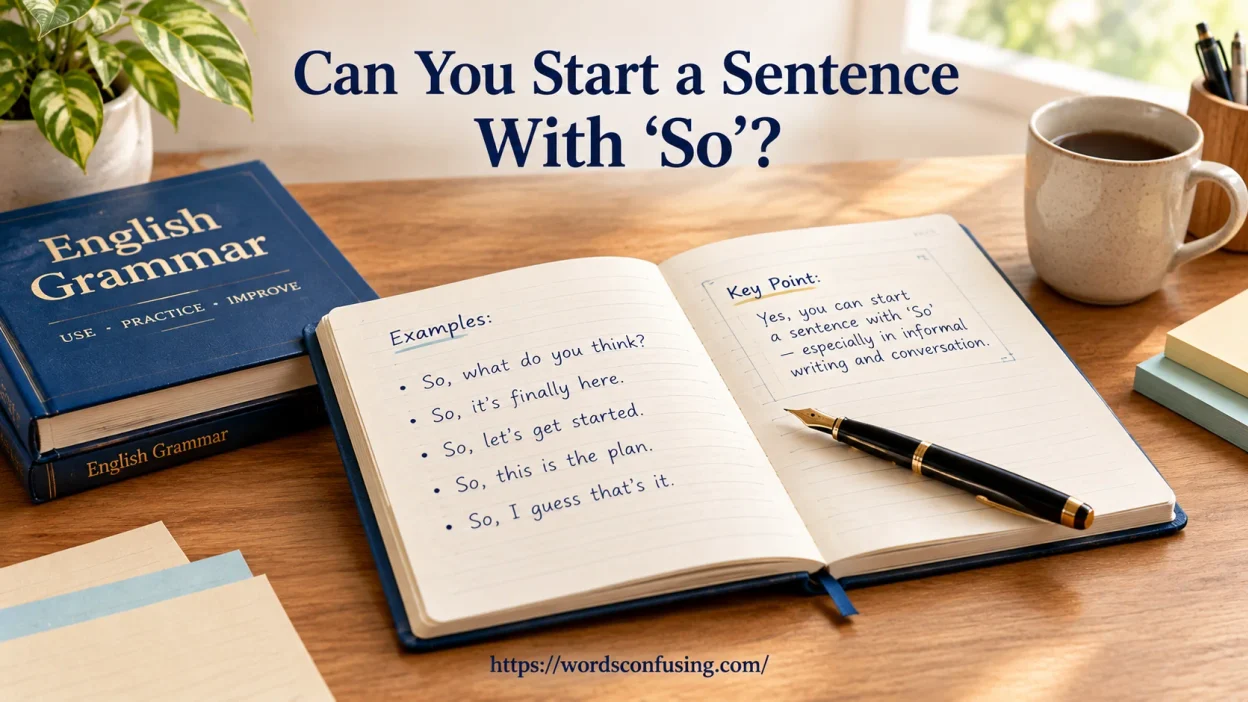
Can You Start a Sentence With “So”? Rules and Examples explains why this common sentence starter is acceptable in English.
No specific English grammar rules prohibit starting sentences with so or other certain words. Although some people believe this usage is incorrect, that idea is a myth and misconception. In written English and spoken English, so can introduce a result, connect ideas, and improve sentence flow when used in the right context.
Understanding sentence structure, grammatical rules, and writing conventions helps you choose the right writing style. For example, “It was raining, so we stayed home” uses so as a coordinating conjunction. However, “It was raining. So, we stayed home” starts a new sentence and explains the result.
Both examples demonstrate correct usage. In formal writing, academic writing, informal writing, and conversational writing, use sentence transitions naturally. Good English writing depends on clear word choice, proper punctuation, and readable sentence construction.
Quick Answer
Yes, you can start a sentence with “so.” It’s grammatically correct and commonly used to introduce a result, explain a conclusion, or begin a conversation. For example, “The weather looked terrible. So, we stayed home.” You don’t always need a comma after “so,” especially when it directly introduces a result.
Can You Start a Sentence With “So”?
Yes, you can start a sentence with “so.” English grammar doesn’t prohibit this construction. Writers and speakers regularly use “so” at the beginning of sentences to connect ideas, introduce consequences, and signal a response.
Consider these examples:
- So, we decided to leave before the storm arrived.
- So, what would you like to discuss first?
- So, the experiment produced different results than expected.
- So, how did your job interview go?
- So, everyone agreed to try another approach.
Each example uses “so” to serve a particular purpose. The first introduces a decision, the second opens a discussion, and the third presents a result.
The key is understanding the relationship between “so” and the surrounding sentences. When “so” helps readers follow your ideas, it can be a useful addition.
Is Starting a Sentence With “So” Grammatically Correct?
Yes. The belief that you should never begin a sentence with “so” is an overly broad writing rule rather than a universal principle of English grammar.
Some traditional writing advice discourages beginning sentences with conjunctions. However, English has long allowed coordinating conjunctions such as “and,” “but,” and “so” to begin sentences in appropriate contexts.
For example:
- The roads were icy. So, we postponed the trip.
- She practiced every day. So, she improved quickly.
- The store had already closed. So, we returned home.
These sentences are grammatically acceptable. Each opening “so” connects the second sentence to information established in the first.
Nevertheless, grammatical correctness doesn’t automatically make every sentence effective. If you begin several consecutive sentences with “so,” your writing may sound repetitive. The goal is to use the word when it adds meaning or improves the flow.
What Does “So” Mean at the Beginning of a Sentence?
The word “so” has several meanings in English. Its function depends on the sentence, the surrounding context, and the relationship between ideas.
Understanding these uses will help you choose the right sentence structure.
So to Introduce a Result or Consequence
One of the most common uses of “so” is to introduce the result of something that happened earlier.
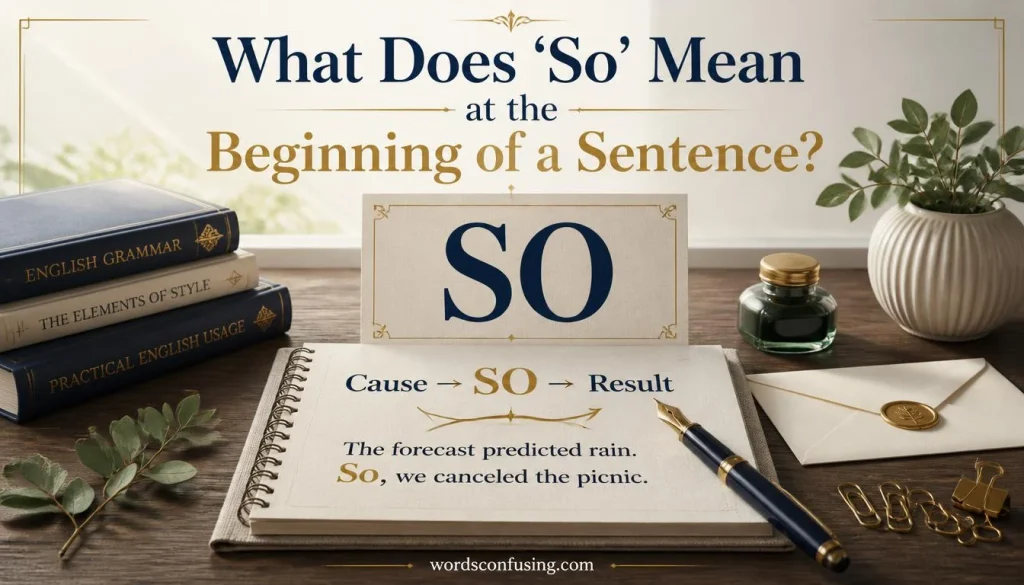
In this construction, “so” establishes a cause-and-effect relationship. The first sentence describes a situation, while the next explains its consequence.
Examples:
- The weather forecast predicted heavy rain. So, we canceled the picnic.
- Daniel missed the morning bus. So, he arrived late for class.
- The computer stopped working. So, I restarted it.
- The team needed more time. So, the manager extended the deadline.
In each example, the second sentence follows logically from the first.
You can also use “so” within a single sentence to connect a cause with its result:
The weather forecast predicted heavy rain, so we canceled the picnic.
Both constructions work. The choice depends on how you want to organize your writing.
Use a separate sentence when you want to emphasize the result or give it more weight. Keep the clauses together when you want a compact statement.
So to Introduce a Conclusion
“So” can also introduce a conclusion based on information, observations, or reasoning.
For example:
- We have reviewed all the applications. So, we can now select the most qualified candidate.
- The figures match the original estimates. So, the calculation appears correct.
- Everyone has submitted their assignments. So, the class is ready for the next lesson.
This use is especially common in conversations, presentations, and explanations.
However, formal writing may benefit from a more precise transition when you need to emphasize a logical conclusion. Words such as “therefore” and “thus” can communicate the relationship more explicitly.
For example:
The figures match the original estimates. Therefore, the calculation appears correct.
The meaning remains similar, but the tone becomes more formal.
So to Start a Conversation or Change Topics
In everyday conversation, “so” often introduces a question, begins a discussion, or shifts attention to a new subject.
Examples include:
- So, what are your plans for the weekend?
- So, how was your first day at work?
- So, let’s talk about the next project.
- So, what do you think about this proposal?
Here, “so” doesn’t necessarily express a direct consequence. Instead, it acts as a conversational marker that signals the start of a discussion or the next stage of an interaction.
This usage is common in spoken English, interviews, meetings, and informal writing.
For instance, a teacher might say, “So, let’s look at the next example.” The word signals a transition from one part of the lesson to another.
So to Emphasize a Point
Sometimes, writers use “so” to introduce an important statement or highlight what follows.
Examples:
- So, here’s what we need to remember: clear communication prevents confusion.
- So, the real question is this: does the solution address the problem?
- So, let’s focus on what we can change.
This construction can make a statement feel direct and engaging. It often appears in speeches, blog posts, presentations, and conversations.
Still, don’t use “so” simply to make every sentence sound important. The surrounding idea should justify the emphasis.
How to Punctuate a Sentence That Starts With “So”
Punctuation affects how readers interpret “so” at the beginning of a sentence. The most important distinction is whether “so” expresses a result or acts as a conversational introduction.
Should You Put a Comma After “So”?
No, you don’t always need a comma after “so.” Both punctuated and unpunctuated versions can be correct, depending on the intended meaning.
Compare these examples:
| Sentence | Explanation |
| So we changed our plans. | “So” introduces a result without a pause. |
| So, what happens next? | The comma creates a conversational pause. |
| So, here’s the problem. | The comma adds emphasis to the introduction. |
| So the answer is simple. | The sentence flows directly into the main statement. |
The Chicago Manual of Style also explains that the comma depends on how “so” functions in the sentence. A comma may emphasize the word, but it isn’t automatically necessary.
The simplest approach is to read the sentence aloud. If “so” connects a result directly to the previous statement, you can usually omit the comma. If it acts as an introductory interjection, a comma may better reflect the intended pause.
Should You Put a Comma Before “So”?
When “so” joins two independent clauses in the same sentence, place a comma before it.
An independent clause contains a subject and a verb and expresses a complete thought.
Correct: The restaurant was full, so we ordered takeout.
The sentence contains two independent clauses:
- The restaurant was full.
- We ordered takeout.
The comma separates the clauses before the coordinating conjunction “so.”
You can also separate the ideas into two sentences:
The restaurant was full. So we ordered takeout.
Both versions are grammatically acceptable. The first keeps the cause and result together, while the second gives the result more emphasis.
Should You Capitalize “So” at the Beginning of a Sentence?
Yes. Capitalize “so” whenever it begins a standard sentence.
Correct examples:
- So we decided to wait.
- So what should we do next?
- So far, everything has gone according to plan.
This follows the ordinary English capitalization rule. The word remains lowercase when it appears within a sentence unless another rule requires capitalization.
When Should You Start a Sentence With “So”?
The best time to start a sentence with “so” is when it helps readers understand the connection between ideas.
In Casual Conversations
“So” is especially natural in everyday conversation. It can introduce a question, explain a decision, or help you move from one subject to another.
Examples:
- So, are you coming to the party?
- So, what did you think of the movie?
- So, I finally finished the book.
- So, where should we meet tomorrow?
Imagine meeting a friend after a long week. You might say, “So, how did everything go?” The word creates a relaxed opening without making the question sound abrupt.
In this context, “so” often works as a discourse marker. It helps organize the conversation rather than contributing a separate factual meaning.
In Academic Writing
Starting with “so” is grammatically acceptable in academic writing. However, you should consider whether it matches your assignment’s tone and purpose.
For example:
The first experiment produced inconsistent results. So the researchers repeated the test.
The construction is understandable and grammatically sound. Still, a more formal revision may suit a research paper better:
The first experiment produced inconsistent results. Therefore, the researchers repeated the test.
Another option is to combine the ideas:
Because the first experiment produced inconsistent results, the researchers repeated the test.
Each version communicates the relationship between the ideas. The best choice depends on the emphasis you want.
For academic writing, remember these guidelines:
- Use “so” when the connection is clear and the tone permits it.
- Choose “therefore” when you want to emphasize a logical conclusion.
- Use “consequently” when you want to highlight an outcome.
- Use “as a result” when you want to explain a consequence directly.
- Follow any specific style requirements from your instructor or institution.
The objective isn’t to eliminate “so” from academic writing. Instead, choose wording that expresses your reasoning accurately.
In Professional and Business Writing
Professional writing benefits from clear transitions. “So” can introduce a decision, recommendation, or next step, especially in emails and internal discussions.
For example:
The client approved the revised proposal. So we can begin the next phase on Monday.
This wording works in a conversational workplace email.
For a more formal report, you might write:
The client approved the revised proposal. Therefore, the team can begin the next phase on Monday.
Consider these additional examples:
- So, let’s review the remaining tasks before Friday.
- So, we recommend moving the launch to next month.
- So, the next step is to confirm the final budget.
In business communication, “so” can sound confident and direct. However, avoid using it when a precise transition would better explain the relationship between your ideas.
In Creative Writing and Storytelling
Creative writers often begin sentences with “so” to establish a conversational voice or connect events.
For example:
I thought the interview had gone terribly. So imagine my surprise when the company offered me the job.
The opening creates a natural transition between the narrator’s expectation and the unexpected result.
Dialogue offers another useful example:
“So, what brings you here?”
“I’m looking for someone who can help me solve a problem.”
The opening makes the question sound natural rather than overly formal.
Writers can also use “so” to build suspense:
The house had been empty for twenty years. So why was a light glowing upstairs?
Here, “so” links the established situation to a question that encourages the reader to continue.
Use this technique thoughtfully. Repeated sentence openings can make even an interesting story feel monotonous.
When Should You Avoid Starting a Sentence With “So”?
Although starting with “so” is grammatically acceptable, some situations call for a different approach.
When “So” Adds No Meaning
Consider this example:
So, I went to the store and bought some bread.
The sentence is grammatically correct. However, if the previous sentence doesn’t establish a connection or transition, “so” may be unnecessary.
A simpler version may work better:
I went to the store and bought some bread.
Before using “so,” ask yourself whether the word explains a result, connects ideas, or helps establish the intended tone.
If it does none of these things, remove it.
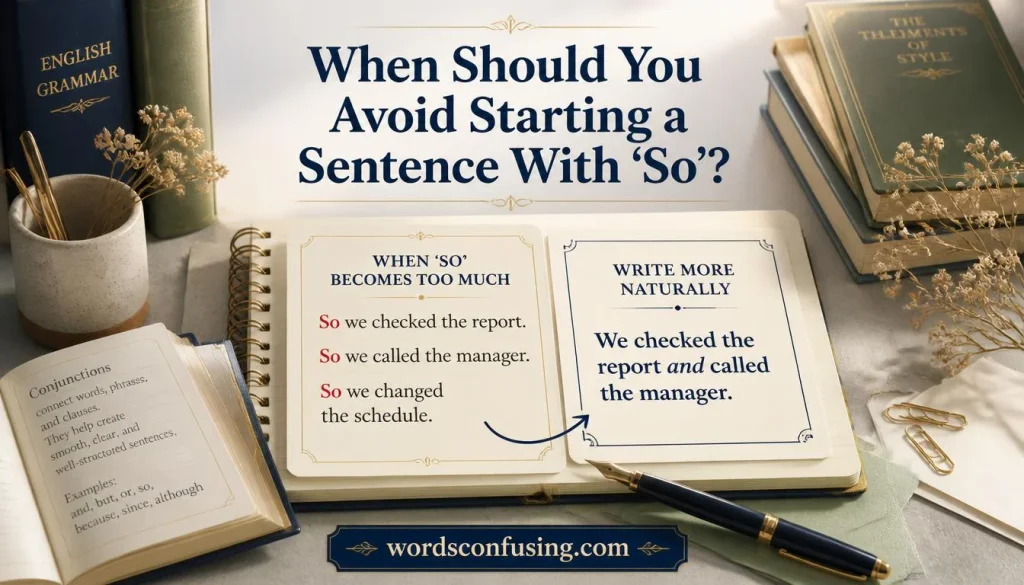
When You Repeat “So” Too Often
Repeated sentence openings can make your writing sound mechanical.
Weak example:
So we checked the report. So we called the manager. So we changed the schedule. So we sent another email.
A smoother version would be:
We checked the report and called the manager. After changing the schedule, we sent another email.
The revised version preserves the sequence without repeating the same opening.
Tip: Vary your sentence structures rather than replacing every instance of “so” with another transition. Sometimes the strongest revision simply removes the unnecessary word.
When the Connection Between Ideas Is Unclear
“So” usually signals some relationship between the current statement and earlier information. If that relationship is missing, readers may struggle to follow your reasoning.
Unclear example:
The office walls were painted blue. So the meeting started late.
The statements don’t establish an obvious cause-and-effect relationship.
A clearer version might be:
The meeting room wasn’t ready because the painters were still working. So the meeting started late.
Now the reader understands why the meeting began late.
When a More Precise Transition Would Help
“So” is flexible, but that flexibility can sometimes make your meaning less specific.
Compare these sentences:
- So the project failed.
- Consequently, the project failed.
- Because the team missed several critical deadlines, the project failed.
The first sentence may work well in conversation. The second explicitly emphasizes the consequence. The third explains the reason behind the failure.
Choose the version that gives readers the information they need.
Better Alternatives to Starting a Sentence With “So”
You don’t need to avoid “so” altogether. However, knowing several alternatives gives you more control over tone and meaning.
| Alternative | Best use | Example |
| Therefore | Introducing a logical conclusion | Therefore, we revised the proposal. |
| Consequently | Emphasizing a resulting outcome | Consequently, the launch was delayed. |
| As a result | Explaining a consequence | As a result, the company reduced its expenses. |
| Thus | Expressing a concise conclusion | Thus, the evidence supports the hypothesis. |
| Accordingly | Showing a response to information or circumstances | Accordingly, the team updated its schedule. |
| For this reason | Making the cause-and-effect relationship explicit | For this reason, we chose another supplier. |
| In that case | Responding to a particular situation | In that case, let’s meet tomorrow. |
| Meanwhile | Introducing something happening at the same time | Meanwhile, the other team prepared the presentation. |
| Well | Introducing a response or expressing hesitation | Well, we have another option. |
| Anyway | Returning to the main topic | Anyway, let’s finish the discussion. |
These expressions aren’t interchangeable in every situation.
For instance, “therefore” signals a conclusion, while “meanwhile” introduces a simultaneous event. Replacing “so” with the wrong transition can change the meaning.
Choose an alternative based on the relationship between your ideas, not simply to make your vocabulary look more advanced.
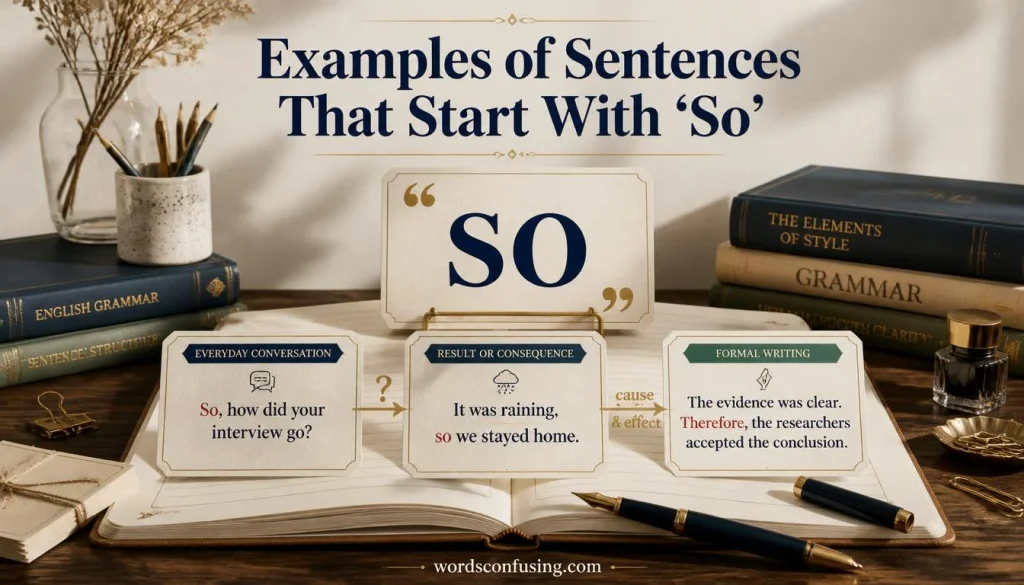
Examples of Sentences That Start With “So”
The following examples demonstrate how “so” works in different contexts.
Everyday Examples
- So, what are you doing tonight?
- So we decided to take the earlier train.
- So, how did your interview go?
- So the children stayed home because it was raining.
- So, are we still meeting at six?
- So I tried the recipe again and finally got it right.
These examples show how “so” can introduce questions, decisions, and results in ordinary conversation.
Formal Writing Examples
- So the committee approved the revised proposal after reviewing the changes.
- So the findings suggest that further testing may be necessary.
- So the organization introduced new procedures to address the problem.
- So the available evidence supports the original conclusion.
These sentences are grammatically possible, although some formal documents may benefit from transitions such as “therefore” or “consequently.”
For example:
The available evidence supports the original conclusion. Therefore, the researchers retained their initial hypothesis.
This version makes the logical relationship explicit.
Incorrect or Awkward Examples and Their Corrections
| Awkward or incorrect sentence | Better version | Why it works |
| So, the weather was cold, we stayed inside. | The weather was cold, so we stayed inside. | The original incorrectly joins two clauses with a comma. |
| So we were tired. So we were hungry. So we went home. | We were tired and hungry, so we went home. | The revision removes repetitive openings. |
| The deadline passed. So the sky was cloudy. | The deadline passed, so we submitted the report late. | The revised example establishes a logical relationship. |
| So, the report was submitted by the team yesterday. | So the team submitted the report yesterday. | The revision uses a more direct active construction. |
Notice that starting with “so” isn’t the problem in every example. Sometimes the real issue is punctuation, repetition, or an unclear relationship between ideas.
Common Mistakes When Starting a Sentence With “So”
A few common errors can weaken otherwise correct sentences. Understanding them will help you write with greater confidence.
- Adding a comma automatically: Don’t assume every sentence-initial “so” needs a comma. Punctuation depends on its function and the intended pause.
- Using “so” in every sentence: Repetition makes your writing predictable. Combine ideas or vary your sentence openings.
- Confusing cause and effect: Make sure the second statement logically follows from the first.
- Choosing an unsuitable tone: Conversational “so” may not fit every formal report or academic assignment.
- Creating a fragment: Starting with “so” doesn’t automatically create a complete sentence. Check that the sentence expresses a complete thought when it stands independently.
- Ignoring the reader’s expectations: A transition should help readers understand your point rather than make them guess how two ideas connect.
For example, “So because the office was closed” is incomplete when it stands alone without a main clause.
You could revise it as follows:
Because the office was closed, we returned the next morning.
Or:
The office was closed. So we returned the next morning.
Both revisions communicate a complete idea.
Read more: For the Good of the Order: Origin and Examples
A Quick Checklist for Using “So” at the Beginning of a Sentence
Before publishing or submitting your writing, review these questions:
- Does “so” introduce a result, conclusion, question, or transition?
- Does the sentence connect logically to the surrounding text?
- Is the sentence grammatically complete?
- Have you used the correct punctuation?
- Does the word fit the intended tone?
- Have you repeated the same opening too frequently?
- Would a more precise transition communicate your meaning better?
If your sentence passes these checks, starting with “so” is usually a reasonable choice.
FAQs
1. Can you start a sentence with “so” in English?
Yes, you can start a sentence with “so” in English. It often introduces a result, explains a reason, or connects your next thought to the previous sentence.
2. Is starting a sentence with “so” grammatically incorrect?
No, starting a sentence with “so” is grammatically acceptable. The idea that you should never begin a sentence with a conjunction is a common grammar myth.
3. Should you use “so” at the beginning of a formal sentence?
Yes, when it suits the context. In formal writing, use “so” to introduce a clear result or transition, but avoid repeating it unnecessarily.
4. What is an example of starting a sentence with “so”?
Here’s a simple example: “The store was closed. So, we went somewhere else.” The second sentence uses “so” to explain the result of the first.
5. Can you begin an academic essay with “so”?
You can, but consider your audience and purpose. In academic writing, “therefore,” “consequently,” or a direct opening may sound more precise when introducing an argument.
6. Does a comma come after “so” at the beginning of a sentence?
A comma is not always necessary after “so.” Use one when “so” acts as an introductory transition and the pause improves readability, as in “So, what happens next?”
Conclusion
Starting a sentence with “so” is perfectly acceptable in English when you use it correctly. Whether you’re writing a casual message, a formal email, or an academic paper, the key is to make your meaning clear and your sentences flow naturally. Don’t let outdated grammar myths limit your writing style. Instead, pay attention to context, punctuation, and the connection between your ideas. When “so” introduces a result or creates a smooth transition, it can make your writing sound natural and easy to follow.
Remember that good writing isn’t about following every traditional rule without question. It’s about choosing words that communicate your thoughts effectively. You can use “so” at the beginning of a sentence to explain a consequence, introduce a response, or move your discussion forward. However, avoid relying on it in every paragraph, especially when a more precise transition would work better. Review your sentences to ensure each one contributes something meaningful. With practice, you’ll learn when starting with “so” sounds natural and when another opening creates a stronger effect.

Franklin Hayes is a writer and editor at WordsConfusing.com, focused on making English vocabulary, grammar, and commonly confused words easy to understand. He writes clear, practical articles with simple explanations and useful examples to help readers improve their English with confidence.
His goal is simple: Making Confusing Words Simple.