

12 Best Replies to “Nice Meeting You” in an Email Business Context help you respond politely and confidently after a business meeting. The phrase “nice meeting you” often appears in an email exchanged with a client, colleague, or potential business partner. If you’re unsure about the right reply, choose an appropriate response that matches your professional tone and strengthens business relationships.
For example, “It was a pleasure meeting you, too” is a polite response that supports good business communication and business etiquette. Understanding the phrase meaning helps you write a suitable email response without making your formal email sound stiff.
When signing off, consider the recipient, your business email, and the purpose of the professional interaction. Clear professional language, natural email phrases, and a suitable email closing or closing phrase create a better impression than a complicated expression. Whether you’re networking, sending a follow-up email, or continuing a professional networking conversation, a thoughtful reply improves workplace communication, written communication, and effective communication.
This article explores 12 best replies, or twelve replies, for different situations, offering extra help with professional correspondence, business correspondence, and email etiquette. The right greeting, professional greeting, and email sign-off phrase also support workplace etiquette, professional relationships, and professional communication across business settings.
Use natural business English or workplace English to make your professional email reply respectful and clear. Proper professional email etiquette keeps every email exchange friendly, while a suitable email sign-off maintains the right formal tone for your professional setting.
Quick Answer
The best reply to “Nice meeting you” in a business email is, “It was great meeting you as well. I enjoyed our conversation and look forward to staying in touch.” You can also say “The pleasure was mine” for a formal tone or “I look forward to working with you” when you’ve agreed to collaborate. Choose a response that fits your relationship and keeps the conversation natural.
What Is the Best Reply to “Nice Meeting You” in an Email?
A safe, professional response is:
Thank you! It was great meeting you as well. I enjoyed our conversation and look forward to staying in touch.
This reply works in many business situations because it acknowledges the sender’s message, expresses genuine appreciation, and keeps future communication possible.
However, you can adjust the wording to fit your situation. If you met a potential client, mention the project you discussed. After a job interview, thank the interviewer for their time. When meeting someone at a networking event, express interest in maintaining the connection.
The goal is simple: acknowledge the meeting, match the sender’s tone, and add a relevant detail when appropriate.
Read more: Bosses or Boss’s or Boss’: What’s the Difference?
12 Best Replies to “Nice Meeting You” in an Email
Not every professional interaction calls for the same response. Some situations require a formal acknowledgment, while others benefit from a warmer, more personal message.
Here are 12 natural replies you can use in business emails, along with examples showing how each one works.
It Was Great Meeting You as Well
This is one of the easiest and most versatile ways to respond to “Nice meeting you” in a professional email. It sounds friendly without becoming too casual.
Use this reply when you’ve met a new colleague, client, business partner, or professional contact. It works particularly well when the original email simply expresses appreciation for meeting you.
Example email:
Hi Alex,
Thank you for your message. It was great meeting you as well, and I enjoyed learning more about your team’s work.
I hope we have the opportunity to connect again soon.
Best regards,
Jordan
Why it works: The response reciprocates the sender’s sentiment and adds a little warmth. It also leaves room for another conversation without making unnecessary promises.
The Pleasure Was Mine
When you want to sound polished and courteous, “The pleasure was mine” is a suitable choice. It communicates that you appreciated the opportunity to meet the other person.
This phrase fits formal business relationships, client introductions, and conversations with senior professionals. It’s especially useful when the sender has thanked you for meeting them.
Example email:
Dear Ms. Carter,
Thank you for your kind message. The pleasure was mine, and I appreciated the opportunity to discuss your team’s current priorities.
I look forward to staying in touch.
Kind regards,
Daniel
Why it works: The wording feels respectful and composed. However, if your workplace favors a casual communication style, “It was great meeting you too” may sound more natural.
I Enjoyed Our Conversation
Sometimes, the best reply does more than acknowledge the meeting. It shows that you paid attention and found the discussion worthwhile.
“I enjoyed our conversation” works well after interviews, networking events, consultations, and business meetings involving an exchange of ideas. You can make it more meaningful by mentioning a specific topic you discussed.
Example email:
Hi Michael,
It was great meeting you as well. I enjoyed our conversation about the upcoming project and appreciated hearing your perspective on the team’s goals.
I hope we can continue the discussion soon.
Best,
Chris
Why it works: Mentioning a real discussion point makes the response feel personal rather than copied from a template. Even one specific detail can help the recipient remember your conversation.
Thank You for Taking the Time to Meet
A person’s time is valuable, especially during a busy workday. Acknowledging that time is a thoughtful way to respond after an interview, client consultation, or meeting with a senior professional.
This reply is particularly useful when the other person arranged the meeting, explained a process, or helped you understand an opportunity.
Example email:
Dear Mr. Wilson,
Thank you for your message. I appreciated the opportunity to meet with you and learn more about the position.
Thank you for taking the time to discuss the role and answer my questions. I look forward to hearing from you.
Sincerely,
Taylor
Why it works: The message expresses appreciation without exaggerating your enthusiasm. It is especially appropriate after job interviews and meetings where the recipient shared valuable information.
I Look Forward to Working With You
If your meeting involved a confirmed project, new client relationship, or upcoming collaboration, this reply expresses enthusiasm about what comes next.
It works best when both parties have a clear reason to work together. If you’re only exploring a possible partnership, consider a less definite phrase, such as “I look forward to staying in touch.”
Example email:
Hi Priya,
It was great meeting you as well. I enjoyed discussing the project and learning more about your team’s approach.
I’m looking forward to working with you and helping move the project forward.
Best regards,
Sam
Why it works: The message connects the meeting to a shared goal. It communicates a positive attitude while keeping the focus on the work ahead.
I Look Forward to Staying in Touch
Not every meeting leads to an immediate project or business agreement. Sometimes, you simply meet someone interesting and want to maintain the connection.
“I look forward to staying in touch” works well after conferences, professional introductions, networking events, and informal business conversations. It expresses interest without putting pressure on the other person.
Example email:
Hi Emma,
It was a pleasure meeting you at the conference. I enjoyed hearing about your work in digital marketing.
I look forward to staying in touch and hope our paths cross again soon.
Best,
Olivia
Why it works: The phrase keeps the relationship open without suggesting that either person must take immediate action. It’s a useful choice when you want to build a professional network naturally.
It Was a Pleasure Learning More About Your Work
A specific acknowledgment often feels more genuine than a general compliment. This response shows that you valued the opportunity to learn about the other person’s role, experience, or professional interests.
Use it when meeting an industry specialist, consultant, business owner, or potential collaborator. Make sure the wording reflects something you actually discussed.
Example email:
Hello Rebecca,
It was great meeting you as well. It was a pleasure learning more about your work in product development and the challenges your team is addressing.
Thank you for sharing your experience. I hope we have another opportunity to connect.
Kind regards,
Morgan
Why it works: This response recognizes the other person’s expertise without resorting to exaggerated praise. It also gives the email a clear connection to your original conversation.
I Appreciated Your Insights
Did the other person share useful advice, explain a complicated topic, or offer a fresh perspective? This reply acknowledges the value of that contribution.
It’s particularly suitable after strategy sessions, consultations, professional interviews, and meetings where you learned something useful.
Example email:
Hi David,
It was great meeting you too. I appreciated your insights on improving the customer onboarding process.
Your suggestions gave me a clearer idea of the areas we should explore next. Thank you for sharing your experience.
Best regards,
Jamie
Why it works: The response recognizes a meaningful contribution instead of offering a generic compliment. It also gives the recipient a clearer understanding of what you found helpful.
I’m Glad We Had the Opportunity to Connect
This phrase strikes a balance between professional courtesy and genuine warmth. It works when you meet someone through a conference, business introduction, cross-department meeting, or professional event.
Use it when the meeting was valuable but you don’t necessarily have an immediate task or project to discuss.
Example email:
Hi Andrew,
Thank you for reaching out. I’m glad we had the opportunity to connect and learn more about each other’s work.
I enjoyed our discussion and hope we can keep in touch.
Best,
Casey
Why it works: The phrase emphasizes the value of making a connection. It’s flexible enough for formal business contacts while remaining natural and approachable.
I Hope We Can Continue the Conversation
Sometimes, a meeting raises questions that deserve more time. Perhaps you discussed a possible partnership, explored a business challenge, or identified an opportunity worth examining.
This response expresses interest in another discussion without assuming that the other person has already agreed to one.
Example email:
Hi Lauren,
It was great meeting you as well. I enjoyed discussing the upcoming initiative and exploring a few possible approaches.
I hope we can continue the conversation and look more closely at the next steps. Please let me know if you’d be available for a follow-up call.
Best regards,
Alex
Why it works: The reply creates a natural opening for further communication. It also offers a clear next step when another conversation would be useful.
Thank You for the Warm Introduction
When a mutual colleague or business contact introduces you to someone, acknowledging that introduction can make your reply more thoughtful.
This phrase is especially suitable when responding to an email that connects you with a potential client, new colleague, recruiter, or industry contact. If you’re replying to both people, address them appropriately.
Example email:
Hi Rachel,
Thank you for the introduction. It was great meeting you, and I appreciated learning more about your team’s work.
I’d be happy to stay in touch and explore opportunities to collaborate if a suitable opportunity arises.
Best regards,
Morgan
Why it works: The response acknowledges how the connection began and helps establish a positive professional relationship. If someone facilitated the introduction, remember to thank that person separately when appropriate.
Likewise, and I Look Forward to Our Next Meeting
When you already have another meeting scheduled, this response acknowledges the sender’s sentiment and expresses interest in reconnecting.
It works well for ongoing client relationships, recurring consultations, project discussions, and scheduled business reviews. Since the phrase refers to another meeting, use it only when another meeting is expected or planned.
Example email:
Hi Robert,
Likewise! It was a pleasure meeting with you and discussing the project’s current priorities.
I look forward to our next meeting and continuing our discussion about the upcoming milestones.
Best regards,
Jamie
Why it works: The message connects the first meeting with the next stage of the relationship. It sounds positive without repeating the original greeting word for word.

How to Choose the Best Reply to “Nice Meeting You” in an Email
Choosing the right response becomes easier when you consider the relationship and the reason you met. A phrase that sounds natural to a close colleague may feel too casual when you’re writing to a potential client.
Use the following table to find a response that fits your situation.
| Business situation | Recommended reply | Tone |
| Meeting a new colleague | It was great meeting you as well. | Friendly |
| Speaking with a senior professional | The pleasure was mine. | Polished |
| Attending a networking event | I look forward to staying in touch. | Approachable |
| Meeting a potential client | I enjoyed our conversation. | Professional |
| Completing a job interview | Thank you for taking the time to meet with me. | Respectful |
| Starting a confirmed project | I look forward to working with you. | Collaborative |
| Receiving helpful advice | I appreciated your insights. | Appreciative |
| Meeting through a mutual contact | Thank you for the warm introduction. | Courteous |
| Discussing a possible opportunity | I hope we can continue the conversation. | Interested |
| Preparing for another meeting | I look forward to our next meeting. | Forward-looking |
Match Your Reply to the Relationship
Your relationship with the recipient should guide your choice of words.
For a new client, a courteous and professional response helps establish trust. With a coworker, a simple and friendly message usually feels more natural. When contacting a senior executive, you can use a polished phrase without making the email unnecessarily formal.
Consider these examples:
- For a client: “It was great meeting you as well. I enjoyed learning more about your team’s goals.”
- For a coworker: “Likewise! It was great meeting you. Looking forward to working together.”
- For a recruiter: “Thank you for your time. I enjoyed learning more about the position and the team.”
- For a networking contact: “I enjoyed our conversation and hope we can stay in touch.”
The key is to sound like yourself while respecting the professional setting.
Consider What Should Happen Next
A meeting often leads to another conversation, a project, or a new professional connection. Your reply can acknowledge that next step without making the email longer than necessary.
For example, if you’ve agreed to collaborate, say you’re looking forward to working together. If the meeting was exploratory, express interest in staying in touch instead.
Avoid promising something that hasn’t been agreed upon. Saying “I look forward to working with you” may suggest an established collaboration. If you’re still discussing possibilities, “I hope we can explore opportunities to work together” leaves more room.
Keep the Email Short and Meaningful
A professional reply doesn’t need several paragraphs. In most cases, two or three sentences are enough to acknowledge the sender and keep the conversation moving.
A useful structure is:
- Thank the person or acknowledge their message.
- Reciprocate the sentiment about meeting.
- Add a relevant detail or next step if needed.
For example:
“Thank you for your message. It was great meeting you as well, and I enjoyed discussing the project with you. I look forward to our next conversation.”
This structure is clear, courteous, and easy to adapt.
Read more: 8 Words for Someone Who Doesn’t Care About Others’ Feelings
Complete Email Examples You Can Copy and Customize
Sometimes, a single phrase isn’t enough. You may need a complete email that fits a particular business situation.
These examples provide ready-to-use templates. Replace the names and details with information from your actual meeting.
A Short and Professional Reply
Use this template when someone sends a brief message after an ordinary business meeting.
Hi [Name],
Thank you for your message. It was great meeting you as well, and I enjoyed our conversation.
I look forward to staying in touch.
Best regards,
[Your Name]
When to use it: This is a reliable option for new colleagues, professional acquaintances, and business contacts when you don’t need to discuss a specific next step.
A Reply to a Potential Client
When you’ve met a potential client, your response can acknowledge the meeting and refer to the business needs you discussed.
Hi [Client’s Name],
It was great meeting you as well. I enjoyed learning more about your business and discussing your team’s current priorities.
Thank you for sharing your perspective. I look forward to continuing our conversation and exploring how we might work together.
Best regards,
[Your Name]
When to use it: Send this when the meeting helped you understand a potential client’s goals. If you’ve agreed on a specific follow-up, mention that instead of using a general closing.
A Reply After a Job Interview
A response after an interview should express appreciation and reinforce your interest without sounding overly eager.
Dear [Interviewer’s Name],
Thank you for your message. It was a pleasure meeting you and learning more about the role and the team.
I appreciated the opportunity to discuss my experience and understand the position’s priorities. I’m excited about the possibility of contributing to your organization.
Kind regards,
[Your Name]
When to use it: This template works when an interviewer follows up after your conversation. If you haven’t already sent a thank-you email, you can combine your appreciation with your response rather than sending repetitive messages.
A Reply After a Networking Event
Networking emails work best when they help the recipient remember the conversation. Mentioning a shared interest or a topic you discussed makes your message more personal.
Hi [Name],
It was great meeting you at [Event Name]. I enjoyed hearing about your work in [industry or field] and discussing [specific topic].
I’d love to stay in touch and continue exchanging ideas. I hope we have another opportunity to connect soon.
Best,
[Your Name]
When to use it: Use this after a conference, industry event, workshop, or professional gathering. A genuine detail from your conversation helps distinguish your message from a generic networking email.
A Reply to a New Colleague or Manager
Starting a new working relationship doesn’t require stiff language. A warm response can establish a friendly tone while remaining professional.
Hi [Name],
Likewise! It was great meeting you, and I’m looking forward to getting to know the team better.
I’m excited to work together. Please feel free to reach out if there’s anything I can help with as we get started.
Best,
[Your Name]
When to use it: This works when you’ve met a new teammate, supervisor, or colleague from another department. Adjust the final sentence if you don’t yet have an active working relationship.
A Reply After a Virtual Meeting
Online meetings can be just as valuable as in-person conversations. Your reply should acknowledge the discussion without forcing expressions such as “nice to e-meet you” when simpler wording works.
Hi [Name],
It was great meeting you as well. I enjoyed our virtual discussion about [topic] and appreciated hearing your thoughts.
I look forward to staying in touch and discussing the next steps when the time is right.
Best regards,
[Your Name]
When to use it: Choose this after a video call, virtual consultation, or remote project meeting. If you’ve agreed to a specific action, mention it directly.
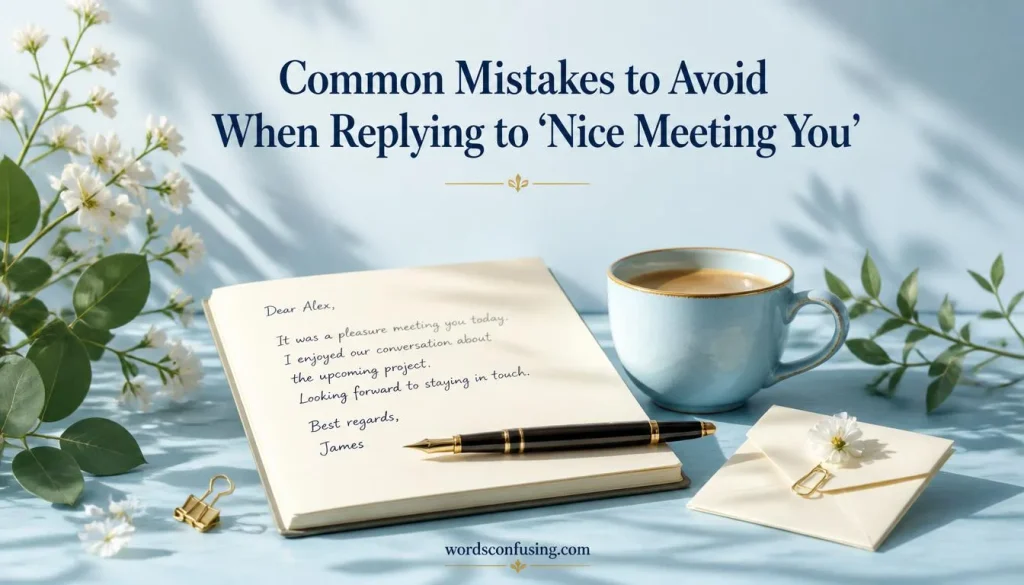
Common Mistakes to Avoid When Replying to “Nice Meeting You”
A good business email doesn’t need fancy language. However, a few common mistakes can make your reply sound less natural or create confusion.
Giving a Reply That Feels Too Brief
Replies such as “Same,” “You too,” or “Likewise” can work in casual conversations. In a business email, though, they may feel abrupt when the sender has written a thoughtful message.
You don’t need to write a long response. Simply add enough context to acknowledge the meeting.
Instead of:
“Same.”
Try:
“It was great meeting you as well. I enjoyed our conversation.”
The second version feels more complete without adding unnecessary detail.
Sounding Overly Formal
Professional communication doesn’t mean using complicated words. Phrases such as “I wish to convey my profound appreciation for our acquaintance” can make an ordinary exchange feel unnatural.
Choose straightforward language instead.
- Instead of “I am delighted to have made your acquaintance,” write “It was a pleasure meeting you.”
- Instead of “I anticipate further correspondence,” write “I look forward to staying in touch.”
- Instead of “I extend my gratitude for your valuable time,” write “Thank you for taking the time to meet.”
Clear language often sounds more confident than elaborate wording.
Promising Future Collaboration Too Soon
It’s tempting to write “I look forward to working with you” after a positive meeting. However, the phrase may imply that you’ve already agreed to collaborate.
If you only discussed a possible opportunity, use more flexible wording.
For example:
- Confirmed project: “I look forward to working with you on the project.”
- Possible partnership: “I look forward to exploring potential opportunities together.”
- General networking: “I hope we can stay in touch.”
These small differences help you communicate interest without creating unrealistic expectations.
Repeating the Same Phrase Without Adding Context
A reply such as “Nice meeting you too” is perfectly acceptable. Still, repeating the original message without adding anything can miss an opportunity to build rapport.
When appropriate, mention one real detail from the conversation.
For example:
“It was great meeting you as well. I enjoyed hearing about your team’s approach to customer research.”
This sounds more personal because it reflects the actual meeting. There’s no need to add a detail if you don’t have one worth mentioning.
Confusing “Nice to Meet You” With “Nice Meeting You”
These expressions are closely related, but they often appear in different situations.
- “Nice to meet you” commonly appears during an introduction or at the beginning of a first encounter.
- “It was nice meeting you” commonly refers to a meeting that has already happened.
Both expressions are natural English. The distinction is a matter of context rather than a strict grammatical rule.
For example, you might say “Nice to meet you” when greeting a new client on a video call. After the call, you could write, “It was nice meeting you. Thank you for your time.”
FAQs
1. How do you reply to “Nice meeting you” in a business email?
You can say, “It was a pleasure meeting you, too.” This reply sounds polite, professional, and friendly. It works well for clients, colleagues, and business partners.
2. Is “Nice meeting you, too” professional enough for an email?
Yes, “Nice meeting you, too” is appropriate for most professional emails. If you want a slightly more formal tone, write, “It was a pleasure meeting you as well.”
3. How do you respond to “Nice meeting you” after a business meeting?
Thank the person and acknowledge the meeting. For example, write, “It was great meeting you, too. I enjoyed learning more about your work.” This response keeps the conversation positive.
4. Should you reply to “Nice meeting you” in a follow-up email?
Yes, especially if the meeting involved networking, a potential client, or an important business discussion. A short reply helps maintain the connection and gives you an opportunity to discuss the next steps.
5. What is a formal alternative to “Nice meeting you, too”?
You can write, “It was a pleasure making your acquaintance” or “I appreciated the opportunity to meet with you.” Both options suit formal situations, although the second sounds more natural in many business emails.
6. How do you respond to “Nice meeting you” when you want to stay connected?
You can say, “It was a pleasure meeting you, too. I look forward to staying in touch.” This response shows genuine interest and encourages future communication without sounding pushy.
Conclusion
Replying to “Nice meeting you” in a business email doesn’t have to be complicated. A simple, thoughtful response can help you leave a positive impression and build lasting professional relationships. Whether you choose “It was a pleasure meeting you, too” or “I look forward to staying in touch,” make sure your words fit the situation and sound natural.
If you’re writing to a client, keep your reply professional and show interest in future collaboration. When responding to a colleague or someone you met through networking, a warmer message can make the conversation feel more personal. You can also mention something you discussed during the meeting to make your email more memorable.
The best response depends on your relationship with the recipient and what you hope to achieve next. You don’t need lengthy sentences or complicated expressions to sound professional. Focus on being genuine, respectful, and clear. With the right words, even a short email reply can strengthen a connection and open the door to future opportunities.

Shafiq Ur Rehman is a writer and content contributor at WordsConfusing.com. He enjoys exploring the English language, common word confusions, vocabulary, and practical writing tips. His goal is to make English easier to understand through clear, simple, and useful articles.


