
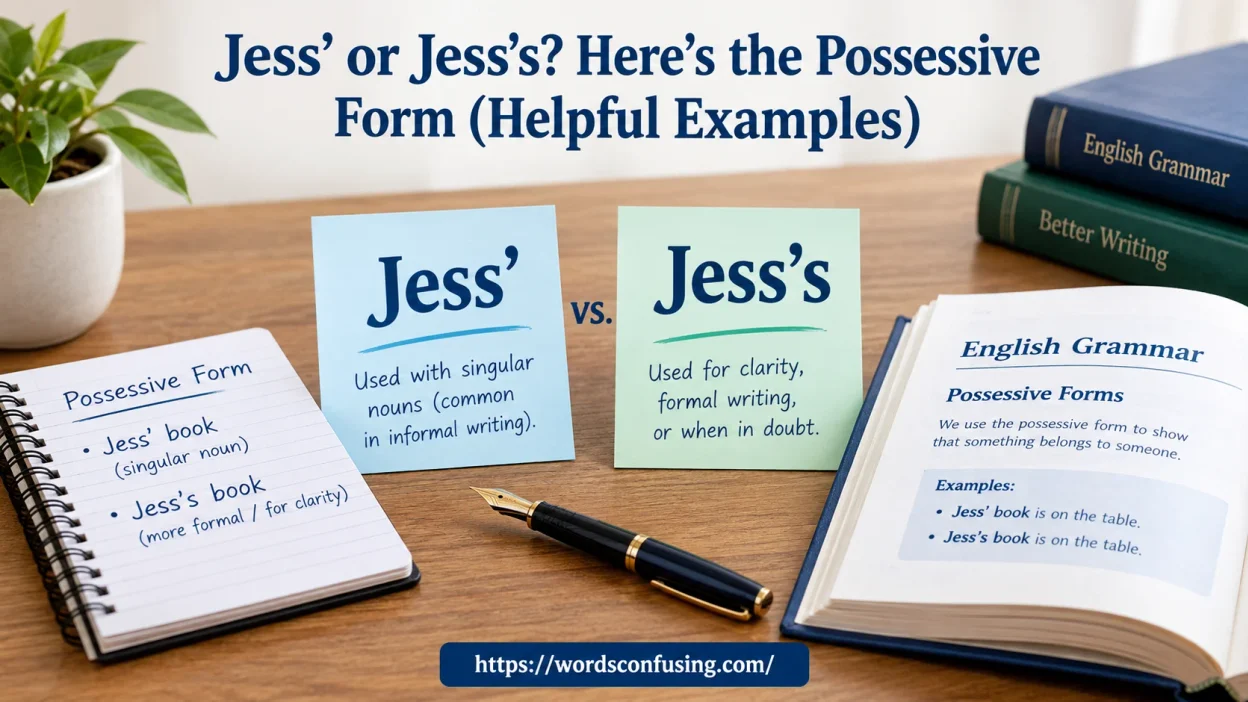
Jess’ or Jess’s can both show possession, but Jess’s is often the clearer possessive form for the singular name Jess.
Both are grammatical and grammatically acceptable, although style guides may prefer different forms. Some guides permit omitting the final s after the apostrophe, while others prefer Jess’s.
This choice often depends on stylistic preference and consistent English grammar. The possessive of Jess works like a possessive noun, while the apostrophe s can make the possessive construction easier to understand. In everyday writing, Jess’s remains a common and widely considered clear option.
The same grammatical form applies to other names ending in s, singular nouns, and singular names. A name ending in S can create tricky questions about spelling, punctuation, and English usage.
You can keep the S and add an apostrophe, or drop the extra s after the apostrophe, depending on your chosen style guides. These options become easy to grasp when you understand the correct usage. For plural form and possessive forms, check whether the word already ends in s.
This guide keeps the rule simple for everyone and helps you choose the right version for your writing.
Quick Answer
Jess’s is the usual possessive form when you’re talking about something belonging to one person named Jess. For example, “Jess’s phone is on the table” means the phone belongs to Jess. The spelling follows the common rule for singular possessives: add ’s even when a singular name already ends in s.
The style-guide exception explains why you may also see Jess’. Some editorial styles allow or prefer an apostrophe alone after a singular proper name ending in s. Under that convention, Jess’ phone is treated as correct. Other styles use Jess’s instead.
So the difference is mainly style, not meaning:
| Form | Meaning |
| Jess’s phone | The phone belongs to Jess |
| Jess’ phone | Same meaning under an apostrophe-only style |
| Jesses | More than one person named Jess |
| Jesses’ phones | Phones belonging to multiple Jesses |
If no particular style guide applies, Jess’s is a clear and widely accepted choice. If you’re writing for a publication, school, or organization with its own style rules, follow that system consistently.
Jess’ or Jess’s: Which Is Correct?
When Jess refers to one person, Jess’s is the usual possessive form.
The construction follows the standard rule for singular nouns. You generally form a singular possessive by adding ’s:
- the girl → the girl’s backpack
- the teacher → the teacher’s desk
- Jess → Jess’s backpack
The fact that Jess already ends with s doesn’t automatically remove the second s.
So, if you’re writing a sentence such as “I found Jess’s keys,” the form Jess’s is grammatically sound and widely understood.
Is Jess’ wrong?
Not necessarily.
Jess’ appears in some writing styles that treat singular names ending in s differently. Under those conventions, writers add only an apostrophe after the final s.
That creates two forms:
| Form | Use | Example |
| Jess’s | Singular possessive | Jess’s notebook |
| Jess’ | Alternative singular possessive style | Jess’ notebook |
| Jesses | Plural of Jess | Three Jesses arrived |
| Jesses’ | Plural possessive | The Jesses’ notebooks |
The distinction matters because Jess’s and Jesses don’t perform the same grammatical job.
If no particular style guide applies to your writing, Jess’s is the straightforward choice for a singular possessive.
How to Make the Possessive Form of Jess
Creating the possessive form of Jess doesn’t require a complicated formula.
Start with the singular name:
Jess
Then add an apostrophe and s:
Jess + ’s = Jess’s
That gives you the singular possessive form.
Examples of Jess’s as a possessive
- Jess’s car needs new tires.
- Jess’s house is around the corner.
- I found Jess’s wallet.
- Jess’s dog loves chasing tennis balls.
- We discussed Jess’s proposal.
- The teacher praised Jess’s essay.
- Jess’s birthday is next Friday.
- Everyone liked Jess’s suggestion.
In every example, one person named Jess has a connection to the following noun.
That connection doesn’t always mean literal ownership. Possessives can express relationships, authorship, origin, responsibility, association, or other kinds of connection.
For example, Jess’s mother doesn’t mean Jess owns a mother. It means the woman is Jess’s mother.
Likewise, Jess’s opinion identifies an opinion expressed or held by Jess.
Why Is Jess’s Written With an Apostrophe and an S?
The answer becomes easier when you ignore the spelling for a moment.
English usually forms the possessive of a singular noun by adding ’s. The rule applies even when the singular noun already ends in the letter s.
Consider these examples:
- Chris’s book
- James’s car
- Lucas’s room
- Jess’s phone
The final spelling may look unusual because the word contains two s letters around the apostrophe. Grammatically, though, the structure remains straightforward.
Jess’s = Jess + ’s
The first s belongs to the name Jess. The second s comes from the possessive ending.
Does the extra “s” mean Jess becomes plural?
No.
That’s a common misunderstanding.
Jess’s remains singular. It means that one Jess possesses or is associated with something.
For example:
Jess’s laptop is charging.
This sentence refers to one person named Jess and one laptop associated with that person.
By contrast:
Two Jesses brought their laptops.
Here, Jesses means more than one person named Jess.
The apostrophe isn’t what makes the name plural. The grammatical context determines that.
Jess’ or Jess’s: Why Do Both Forms Appear?
English spelling conventions aren’t completely uniform when singular proper names end in s.
That’s why you can encounter both Jess’s and Jess’ in real-world writing.
One approach treats a singular proper name like an ordinary singular noun and adds ’s.
Another approach adds only an apostrophe when a singular proper name already ends in s.
The result looks like this:
Jess → Jess’s
or, under an alternative convention:
Jess → Jess’
Neither form changes the person’s name. The difference lies in the possessive spelling convention.
A useful rule for everyday writing
When you aren’t following a specific editorial style, Jess’s is a clear and conventional choice.
For example:
Jess’s notebook was left in the classroom.
Readers immediately recognize the apostrophe-s construction as a singular possessive.
If a publication, school, employer, or other organization specifies a different style, follow that requirement consistently.
Consistency matters almost as much as the individual choice.
When Is Jess’ Used?
Jess’ can appear when a writing style treats a singular name ending in s as an exception to the usual ’s pattern.
For instance:
Jess’ car was parked outside.
The writer means that the car belongs to Jess.
This construction isn’t the same as a typographical mistake simply because it lacks the second s. In some editorial systems, the omission is intentional.
However, readers may encounter Jess’s more often in general writing because the ’s construction clearly signals the singular possessive.
Why writers sometimes prefer Jess’
There are several practical reasons a writer or publication may use Jess’:
- A house style may require it.
- An editorial system may prefer a shorter spelling.
- A publication may apply one rule to proper names ending in s.
- The writer may follow a particular style tradition.
- Consistency with nearby names may influence the choice.
The key is not to mix systems randomly.
If one paragraph says Jess’s car and another says Jess’ house without any stylistic reason, the inconsistency can distract careful readers.
Jess’s or Jess’ in Professional Writing
Professional writing rewards clarity.
When you’re writing an email, report, application, article, business document, or school assignment, Jess’s is generally an easy-to-understand singular possessive form.
Consider:
Please return Jess’s documents before Friday.
The construction is immediately recognizable.
Now compare:
Please return Jess’ documents before Friday.
The second version can also be understood. However, readers familiar with a style that uses ’s for singular names may wonder whether the missing s was intentional.
Neither sentence creates a serious comprehension problem. The difference is primarily one of grammatical convention and editorial style.
Follow the style rules that apply
If you’re writing for an organization, check its preferred style.
For academic work, follow the style required by your instructor or institution.
Professional publications may have their own established conventions, so check the relevant style guide.
In ordinary personal writing, Jess’s works well as a practical default.
The goal isn’t to turn a tiny apostrophe into a philosophical crisis. It’s simply to make your writing consistent and easy to read.
Examples of Jess’s in Sentences
The possessive form becomes much easier once you see it operating in different contexts.
Possession of an Object
Use Jess’s when an object belongs to Jess.
- Jess’s phone is ringing.
- I put Jess’s keys on the counter.
- Someone moved Jess’s chair.
- The mechanic repaired Jess’s car.
- We found Jess’s glasses under the sofa.
Here, the possessive relationship involves a physical object.
Family and Relationships
Possessives can also describe relationships.
- Jess’s sister called earlier.
- We met Jess’s parents yesterday.
- Jess’s uncle owns the store.
- I spoke with Jess’s teacher.
- Jess’s friend joined us for dinner.
The apostrophe doesn’t mean ownership in a literal sense. Instead, it identifies a relationship.
Places and Locations
You can also use Jess’s with places associated with someone.
- We met at Jess’s house.
- Jess’s office is on the second floor.
- They stopped by Jess’s apartment.
- The party took place at Jess’s place.
Again, the construction identifies association rather than strict ownership.
Ideas, Work, and Decisions
Possessives frequently identify the source of an idea or piece of work.
- Jess’s idea solved the problem.
- The manager approved Jess’s proposal.
- Everyone liked Jess’s presentation.
- Jess’s decision surprised the team.
- The teacher praised Jess’s writing.
These examples show why possessives matter beyond physical ownership.
How Do You Pronounce Jess’s?
Spelling and pronunciation don’t always march in perfect lockstep.
In many ordinary contexts, Jess’s is pronounced with an extra syllable. It commonly sounds approximately like:
JESS-iz
For example:
Jess’s phone
can sound like:
JESS-iz phone
The possessive ending has a voiced or unvoiced pronunciation depending on the sounds around it. English speakers often produce a small “iz” sound after names ending in a hissing sound such as s.
This is similar to what happens with other possessive forms ending in sounds that make a simple s awkward to pronounce.
Does Jess’ sound different?
Usually, Jess’ doesn’t add the same written s ending.
In speech, however, the actual pronunciation depends on the speaker and the surrounding sentence. English spelling conventions don’t always provide a perfect pronunciation guide.
The important point is simple:
Jess’s is a normal possessive spelling even though its pronunciation may contain an additional syllable.
Jess’ or Jess’s: Examples With Different Meanings
A few examples can reveal the difference better than a rule alone.
| Sentence | Meaning |
| Jess’s coat is wet. | The coat belongs to or is associated with Jess. |
| Jess’ coat is wet. | Same possessive meaning under an alternative style. |
| Jess called me. | Jess is the subject. No possessive needed. |
| I called Jess. | Jess is the object of the verb. No possessive needed. |
| Two Jesses called me. | More than one person is named Jess. |
| The Jesses’ coats were wet. | The coats belong to multiple people named Jess. |
This comparison highlights an important principle: apostrophes don’t simply mark names.
They mark particular grammatical relationships.
Jess’s vs. Jesses: Don’t Confuse Possessive and Plural Forms
One of the easiest mistakes involves confusing Jess’s with Jesses.
They look similar when spoken quickly. Grammatically, they’re worlds apart.
Jess’s
Jess’s is the singular possessive form of Jess, showing that something belongs to her.
For example, Jess’s backpack is blue.
One Jess has a backpack.
Jesses
Jesses is plural.
Three Jesses attended the event.
The sentence refers to three different people named Jess.
Jesses’
Jesses’ is plural possessive.
The Jesses’ backpacks were blue.
Here, multiple people named Jess share the possessive relationship.
Think of the forms as a three-step ladder:
Jess → Jess’s → Jesses → Jesses’
That sequence becomes easier to understand when you separate number from possession.
| Form | Grammatical role | Example |
| Jess | Singular name | Jess arrived. |
| Jess’s | Singular possessive | Jess’s bag arrived. |
| Jesses | Plural name | Two Jesses arrived. |
| Jesses’ | Plural possessive | The Jesses’ bags arrived. |
What Is the Plural of Jess?
When you need to refer to more than one person named Jess, the plural form is generally Jesses.
For example:
Two Jesses work in the same department.
The final es helps create the plural pronunciation and spelling.
This is different from the possessive:
Jess’s desk is near the window.
The first sentence discusses multiple people. The second describes something associated with one Jess.
What about the plural possessive?
If several people named Jess collectively possess or relate to something, use Jesses’.
For example:
The Jesses’ schedules conflicted.
Here, Jesses is already plural. The apostrophe indicates possession.
Another example:
The Jesses’ cars were parked outside.
The cars belong to multiple people named Jess.
This distinction is particularly useful when writing about a group that happens to contain people with the same name.
Jess’s or Jesse’s?
Don’t confuse Jess with Jesse.
They are different names, so their possessive forms follow their own spellings.
If the person’s name is Jess:
Jess’s notebook
If the person’s name is Jesse:
Jesse’s notebook
Both forms use ’s, but the underlying names differ.
That matters in names, records, school documents, workplace communications, and other contexts where spelling carries meaning.
Changing Jess to Jesse isn’t simply a grammatical adjustment. It changes the name itself.
Common Mistakes With Jess’ and Jess’s
Apostrophes create surprisingly small traps. Fortunately, most errors follow predictable patterns.
Mistake: Writing Jesss
Jesss phone is on the desk.
This form lacks the apostrophe.
Correct:
Jess’s phone is on the desk.
The apostrophe separates the possessive ending from the original name.
Mistake: Using Jesses for one person’s possession
Jesses car needs gas.
If one person’s car is meant, write:
Jess’s car needs gas.
Jesses normally indicates multiple people named Jess.
Mistake: Adding an apostrophe to create a plural
Three Jess’s attended the meeting.
If you’re simply referring to three people named Jess, the standard plural form is:
Three Jesses attended the meeting.
The apostrophe isn’t normally needed to make an ordinary plural.
Mistake: Switching between Jess’s and Jess’ randomly
Using both forms in the same document can create unnecessary inconsistency.
For example:
Jess’s report was excellent. Later, Jess’ manager praised the work.
Unless a deliberate style distinction exists, choose one convention and stick with it.
Mistake: Changing Jess into Jesse
Jesse’s phone rang.
This sentence is correct if the person’s name is Jesse.
It isn’t correct if the person’s actual name is Jess.
Names deserve the same spelling accuracy as any other important detail.
Jess’s or Jess’ in Academic Writing
Academic writing places extra value on consistency and adherence to a chosen style.
Suppose an assignment contains:
Jess’s research examines language change.
That form clearly marks the singular possessive.
Another paper might use:
Jess’ research examines language change.
The difference may reflect a style convention rather than a difference in meaning.
When an academic institution, instructor, department, or publication specifies a style manual, that requirement should take priority over a general preference.
A practical academic checklist
Before submitting your work, check:
- Is Jess singular?
- Are you showing possession or association?
- Does your required style guide use ’s or ’ for this type of name?
- Have you used the same convention throughout the document?
- Did you accidentally write Jesses when you meant Jess’s?
- Did you spell the person’s name correctly?
These checks take seconds. They can prevent needless editing later.
Read more: Drew or Drawn: Meaning and Correct Usage
Jess’s or Jess’ in Everyday Writing
For texts, emails, casual messages, and ordinary online writing, you don’t need to overcomplicate the issue.
If you’re referring to something associated with one Jess, Jess’s is a clear and natural option.
For example:
I left Jess’s book on your desk.
Or:
Jess’s meeting starts at three.
The reader understands the relationship instantly.
If you regularly write for a publication that follows a specific style, however, its rules may differ.
A Simple Way to Remember Jess’s
Think of the name as a small grammatical equation:
Jess + ’s = Jess’s
That’s the singular possessive pattern.
Now add the plural:
Jess → Jesses
Then add the plural possessive:
Jesses + ’ = Jesses’
This gives you three distinct constructions:
- Jess = one person
- Jess’s = something associated with one Jess
- Jesses = more than one person named Jess
- Jesses’ = something associated with multiple Jesses
Once those categories click, most apostrophe questions become much easier.
Jess’ or Jess’s: A Quick Comparison
| Question | Answer |
| What is the usual singular possessive form? | Jess’s |
| Can Jess’ appear in writing? | Yes, under some style conventions. |
| What is the plural of Jess? | Jesses |
| What is the plural possessive? | Jesses’ |
| Does Jess’s mean multiple Jesses? | No. |
| Does an apostrophe make Jess plural? | No. |
| Is Jess’s used for relationships? | Yes. |
| Is Jess’s used for ideas and work? | Yes. |
| Should you follow a required style guide? | Yes. |
| What should you use without a specific style requirement? | Jess’s is a clear default. |
Jess’ or Jess’s: Helpful Examples
Here are additional examples showing how the possessive form works naturally.
Example: Personal belongings
I found Jess’s wallet beneath the chair.
The wallet belongs to Jess.
Example: Family relationship
Jess’s father picked her up after work.
The possessive identifies a family relationship.
Example: Authorship
Jess’s article received several comments.
The article was written by Jess.
Example: Opinion
Jess’s opinion differed from everyone else’s.
The opinion belongs to or comes from Jess.
Example: Responsibility
The mistake wasn’t Jess’s fault.
The possessive identifies responsibility or attribution.
Example: Location
We met at Jess’s apartment.
The apartment is associated with Jess.
Example: Alternative style
Jess’ apartment was close to downtown.
This can represent the same possessive relationship when a style convention uses the apostrophe-only form.
A Note About Pronunciation and Style
Some writers choose Jess’ because they feel the extra s looks cumbersome.
Others prefer Jess’s because it follows the familiar singular possessive pattern.
That difference often reflects editorial taste rather than a difference in meaning.
Pronunciation can also influence perception. When people say Jess’s, the possessive ending can produce an extra syllable. On the page, though, the written form remains perfectly understandable.
English contains many situations where spelling conventions don’t perfectly mirror speech.
That’s nothing unusual.
FAQs
Is “Jess’s” grammatically correct?
Yes. Jess’s is a grammatically correct possessive form of the singular name Jess. For example, “That is Jess’s notebook.”
Is “Jess’” also correct?
Yes. Jess’ is also accepted by some style guides. It drops the extra s after the apostrophe, so you may see both forms in published writing.
Should I use “Jess’” or “Jess’s”?
Your choice usually depends on the style guide you follow. If you want a straightforward option, Jess’s clearly shows that the name is singular and possessive.
Does the pronunciation change between “Jess’” and “Jess’s”?
Usually, the written choice can affect how readers interpret the form, but both represent possession. Jess’s makes the possessive ending more visible.
What is the possessive form of the name Jess?
The two commonly accepted forms are Jess’s and Jess’. Both can indicate that something belongs to Jess, such as “Jess’s phone” or “Jess’ phone.”
What is the plural form of Jess?
If you mean more than one person named Jess, the plural is usually Jesses. The apostrophe should not be added simply to make the name plural.
Conclusion
Choosing between Jess’ and Jess’s doesn’t have to feel complicated. Both forms can show that something belongs to Jess, but Jess’s is often easier for readers to recognize at a glance. It clearly marks the name as singular and possessive, which makes your writing feel more natural and consistent.
If your preferred style guide allows both forms, pick one and stick with it throughout your writing. Consistency matters more than second-guessing every apostrophe. Once you understand the basic rule, names ending in s become much easier to handle.

Shafiq Ur Rehman is a writer and content contributor at WordsConfusing.com. He enjoys exploring the English language, common word confusions, vocabulary, and practical writing tips. His goal is to make English easier to understand through clear, simple, and useful articles.