
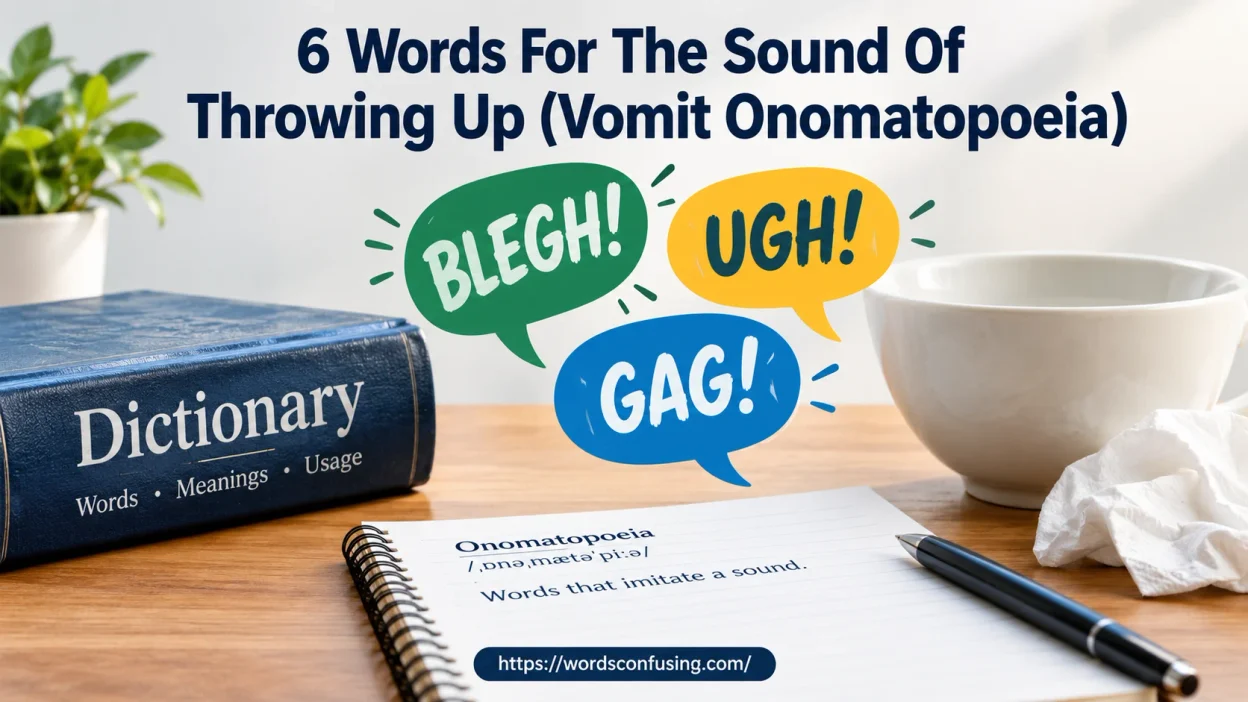
For 6 Words For The Sound Of Throwing Up and Vomit Onomatopoeia, onomatopoeia gives you vivid words for the sound of being sick in clear writing.
Onomatopoeia uses words that imitate or suggest a sound, helping descriptions feel more vivid. When describing throwing or throwing up, vomit onomatopoeia can help readers imagine the sound of throwing up and sound of vomit more clearly. Different sounds can suit situations involving someone who is sick or experiencing sickness.
From my experience with writing, choosing words that refer to sounds can make your writing style feel more natural. You can explore vomit sounds, vomit words, and sound words to find the best option for your scene. When talking about someone or someone being sick, the words you choose should match the sounds they make.
This approach can spice up your content without sounding forced, especially when discussing certain situations in an article. The goal is to refer to sounds naturally instead of adding unusual vocabulary just for effect.
These onomatopoeic words provide practical ways to describe being sick, make a scene clearer, and explain the sound in terms that readers can easily understand.
Quick Answer
If you need a written sound for vomiting, “blegh” and “bleurgh” are strong informal choices. They suggest disgust, nausea, or an unpleasant guttural reaction.
For realistic descriptive writing, “gag,” “retch,” and “heave” work better. These words connect directly with the physical process that happens before or during vomiting.
Here are six useful choices:
| Word | What It Suggests | Best Use |
| Blegh | Disgust, nausea, unpleasant reaction | Dialogue, casual writing |
| Bleurgh | Strong disgust or exaggerated nausea | Fiction, comics, humor |
| Ugh | Disgust or revulsion | Dialogue, reactions |
| Gag | A choking or pre-vomiting reaction | Narrative writing |
| Retch | Forceful vomiting-like sound and movement | Realistic prose |
| Heave | Strong stomach contraction before vomiting | Descriptive prose |
One important distinction matters here: not every word on this list is technically an onomatopoeia. Blegh and bleurgh imitate or represent expressive sounds in writing. Retch and heave, however, primarily describe physical actions associated with vomiting.
That distinction can make your writing much more accurate.
What Is the Sound of Throwing Up Called?
There isn’t a single standard English name for the sound someone makes while vomiting.
That might seem surprising, especially because English has plenty of familiar sound words. Words such as buzz, crash, bang, and hiss closely imitate recognizable noises. Vomiting doesn’t work quite the same way.
The process can produce several different sounds. A person might gag, retch, heave, cough, choke, or make a deep guttural noise. The exact sound also changes depending on whether the person feels nauseated, is dry-heaving, or is actually vomiting.
Cambridge defines retch as making the sound and action associated with vomiting, particularly when nothing comes up. Oxford similarly defines retch as making sounds and movements as if vomiting even when no vomit is produced.
That makes retch one of the most precise words for this subject.
By comparison, gag describes the unpleasant physical reaction that can happen when something triggers the urge to vomit. Oxford notes that gag can mean experiencing an unpleasant feeling in the mouth and stomach as if you are going to vomit.
So, if you’re writing a realistic scene, you don’t always need to invent a strange spelling. Sometimes the strongest word is simply the one that accurately describes what the character is doing.
6 Words for the Sound of Throwing Up
1. “Blegh”
“Blegh” is one of the most recognizable informal spellings for an unpleasant reaction.
It doesn’t exclusively mean vomiting. Instead, it conveys disgust, nausea, revulsion, or an unpleasant taste. That broad meaning makes it useful when a character reacts to something disgusting before actually getting sick.
Collins lists blegh as an alternative spelling of bleah.
The spelling itself has a useful visual quality. The combination of “gh” gives the word a rough, guttural finish. Readers can almost hear the speaker forcing the sound from the back of the throat.
For example:
“Blegh! What is that smell?”
You can also use it in a scene involving nausea:
“Blegh,” Marcus muttered as the sour smell reached him.
Notice that the word doesn’t claim that Marcus has already vomited. It communicates his reaction.
That distinction matters. Blegh works best as a reaction sound, not as a precise technical description of vomiting.
When should you use “blegh”?
Use blegh when you want the writing to feel:
- Informal
- Conversational
- Comic
- Expressive
- Slightly exaggerated
- Focused on disgust or nausea
It works especially well in dialogue, comics, text messages, captions, and humorous fiction.
For serious literary prose, however, retch or heave usually gives you greater precision.
2. “Bleurgh”
“Bleurgh” pushes the same idea further.
The longer spelling makes the sound look heavier and more exaggerated. It can suggest a prolonged guttural reaction rather than a quick expression of disgust.
Collins lists bleurgh as a proposed informal word used to express disappointment, disgust, or annoyance. The entry remains categorized as a word suggestion rather than an established standard dictionary headword.
That status is worth knowing. Bleurgh is usable in informal creative writing, but it isn’t a standard formal English term for vomiting.
Its greatest strength comes from its visual and comic effect.
For example:
“Bleurgh! That soup has definitely gone bad.”
Or:
“Bleurgh,” she groaned, turning away from the rotten food.
The extra letters make the reaction feel stretched out. A writer can therefore use bleurgh when a short ugh doesn’t seem disgusting enough.
Think of the difference this way:
- Ugh = quick disgust
- Blegh = disgust with a guttural flavor
- Bleurgh = exaggerated, prolonged disgust
That isn’t a strict linguistic rule. It’s a useful writing distinction based on how the spellings visually and phonetically behave.
3. “Ugh”
Few English interjections are as flexible as “ugh.”
Cambridge defines ugh as an exclamation used to express strong disgust toward something unpleasant. It also describes the written form as representing a sound people sometimes make when they feel disgust.
That makes ugh a legitimate sound-based expression, although it doesn’t specifically mean vomiting.
You might write:
“Ugh! I can’t even look at it.”
Or:
“Ugh,” Daniel said as another wave of nausea hit.
The second example connects ugh with vomiting without claiming that the word itself means “vomiting.”
That’s an important distinction for good writing.
Ugh represents the reaction. It doesn’t specifically reproduce the mechanics of vomiting.
The word works particularly well when your character sees something disgusting, smells something unpleasant, or feels suddenly nauseated.
It’s also more natural than an elaborate invented spelling in many situations.
If the scene is serious, ugh can keep the dialogue understated:
“Ugh. I feel sick.”
If the scene is comic, you can stretch it:
“Uuuugh!”
The repeated letters visually increase the duration and intensity.
4. “Gag”
“Gag” is much more precise when you want to describe the physical reaction that precedes vomiting.
Oxford defines the relevant intransitive use of gag as experiencing an unpleasant feeling in the mouth and stomach as if you are going to vomit.
That makes it particularly useful in narrative prose.
For example:
The rotten smell made him gag.
Or:
She gagged as soon as she opened the container.
Unlike blegh or ugh, gag describes an actual bodily response.
The word can also suggest a sudden interruption in breathing or swallowing. Because of that, it has a harsher physical quality than a simple expression of disgust.
Consider these two sentences:
“Ugh,” she said.
She gagged when she smelled the spoiled milk.
The first sentence tells you about her emotional reaction. The second tells you what her body actually did.
That makes gag especially valuable when you’re writing realistic scenes.
It also works in different forms:
- gag
- gagged
- gagging
- gag reflex
For example:
He started gagging before he could reach the sink.
Here, gagging clearly establishes the buildup toward vomiting without needing an artificial sound effect.
5. “Retch”
If you want the most precise word on this list, “retch” deserves serious consideration.
Cambridge defines retch as reacting as if vomiting. Its American Dictionary definition specifically describes it as making the sound and action of vomiting, especially when nothing is actually vomited.
Oxford gives a similar explanation, describing retch as making sounds and movements associated with vomiting even when vomiting doesn’t occur.
That makes retch particularly useful for describing dry heaving.
For example:
He retched over the sink but couldn’t bring anything up.
Or:
She retched twice before finally vomiting.
The word has a naturally harsh sound. The short vowel and ending consonants give it a clipped quality that fits the action.
It’s also useful because it doesn’t force you to invent a spelling.
Instead of writing:
“1 Hurk! 2 Hurk! 3 Hurk!”
you can write:
He retched repeatedly over the toilet.
The second version often sounds more mature and natural.
Why “retch” works so well
Retch can communicate several things at once:
- A physical reaction
- A vomiting-like movement
- A harsh throat sound
- Nausea
- Dry heaving
- An attempted vomit
It therefore has more descriptive precision than most informal sound effects.
For realistic fiction, journalism, narrative nonfiction, and serious prose, retch is usually a stronger choice than a cartoon-style spelling.
6. “Heave”
“Heave” is another strong option when the focus falls on the body’s movement.
Oxford lists a specific meaning of heave connected with the tight feeling in the stomach that occurs before vomiting.
That gives the word a slightly different role from retch.
Retch emphasizes the vomiting-like sound and action.
Heave emphasizes the powerful muscular movement associated with nausea and vomiting.
For example:
His stomach heaved as he leaned over the sink.
Or:
She heaved once, swallowed hard, and reached for a glass of water.
The word can create a vivid physical image without using graphic detail.
You can also combine it with retch:
He heaved and retched over the bucket.
That combination works because the two words aren’t exact duplicates. One highlights the body’s forceful movement. The other emphasizes the vomiting-like action and sound.
Vomiting Sounds vs. Gagging and Retching Sounds
A common mistake involves treating gagging, retching, heaving, and vomiting as identical actions.
They aren’t.
A person can gag without vomiting. Someone can retch without producing vomit. A person can heave before anything comes up. Actual vomiting involves bringing stomach contents back through the mouth.
Oxford defines vomit as food from the stomach brought back out through the mouth.
This difference helps you choose the right word.
| Term | Main Meaning | Does Vomit Have to Come Up? |
| Gag | A reaction that feels as though vomiting may occur | No |
| Retch | Vomiting-like sound and movement | No |
| Heave | Strong stomach movement associated with vomiting | No |
| Vomiting | Expelling stomach contents | Yes |
| Blegh | Expressive disgust or nausea | No |
| Ugh | Strong disgust | No |
| Bleurgh | Informal exaggerated disgust | No |
This is why saying “he retched” can be more accurate than saying “he vomited” when nothing actually came up.
Likewise, writing “ugh” doesn’t automatically mean the character vomited. It simply communicates disgust or discomfort.
How to Write the Sound of Vomiting in Fiction
When you’re writing a vomiting scene, the sound effect alone usually isn’t enough.
A single word such as “blegh” tells readers what the character sounds like. Physical description tells them what is happening.
For example:
“Blegh!” He stumbled toward the bathroom.
That’s understandable, but it remains fairly broad.
A more descriptive version could be:
“Blegh!” He covered his mouth and rushed toward the bathroom, swallowing hard as his stomach tightened.
The second sentence creates movement, anticipation, and physical tension.
You don’t need graphic descriptions to make the moment convincing. Small details often work better:
- A hand covering the mouth
- A sudden pause in conversation
- A sharp swallow
- Tightening stomach muscles
- A character rushing toward a sink
- Repeated gagging
- Dry heaving
- A strained breath afterward
These details give the sound a physical setting.
A useful writing formula
For realistic scenes, try this structure:
Sound or reaction + physical action + consequence
For example:
“Ugh!” She gagged and gripped the edge of the sink.
Or:
He retched over the bucket, then stayed there until the nausea passed.
Or:
“Bleurgh!” Marcus turned away from the spoiled food.
The sound creates immediacy. The action creates realism. The consequence completes the moment.
Read more: Universities or University’s or Universities’? Which Is Correct?
How to Spell Vomiting Sounds in Comics and Text
Comics give writers more freedom than conventional prose.
A comic can stretch a sound visually:
BLEEEGH!
Or:
URGH!
The typography itself becomes part of the sound.
You can manipulate spelling to suggest duration, intensity, or volume. Repeated vowels can make a sound feel longer. Capital letters can suggest shouting or dramatic emphasis. Exclamation points can increase energy.
However, more letters don’t automatically make a sound more realistic.
Compare:
“Ugh.”
“Uuuuuuuugh!”
The first sounds like a quick reaction. The second feels theatrical.
That can be perfect for a comedy panel. It may feel excessive in a restrained novel.
For that reason, choose the spelling according to the tone of your writing.
Informal dialogue
“Ugh, I feel sick.”
Comic-style reaction
BLEURGH!
Realistic narrative
She gagged and leaned over the sink.
More intense physical description
He heaved violently before retching into the bucket.
Each version communicates something different.
Examples of Vomit Onomatopoeia in Sentences
The best sound word depends heavily on the situation.
Mild nausea
“Ugh,” she whispered as the smell reached her.
Here, ugh communicates discomfort without implying that vomiting has already started.
Strong disgust
“Blegh! Get that thing away from me.”
Blegh works because the character reacts to something unpleasant.
Exaggerated comic reaction
“Bleurgh!” The detective staggered away from the overflowing trash can.
The spelling gives the scene a deliberately comic flavor.
Gagging
The smell hit him, and he gagged immediately.
This is more realistic than using a sound effect when the physical response matters.
Dry heaving
He retched over the sink, but nothing came up.
This is one of the clearest uses of retch.
Strong stomach movement
Her stomach heaved as she knelt beside the toilet.
Here, heave emphasizes the physical sensation.
Combined description
“Ugh!” She gagged, heaved once, and grabbed the sink.
This example combines an expressive interjection with physical verbs. The result feels more complete than a single sound effect.
Which Vomiting Sound Word Should You Use?
Choosing the right word becomes easier when you first decide what you want the reader to hear.
| If You Want To Show… | Best Choice |
| General disgust | Ugh |
| Nausea or disgust | Blegh |
| Exaggerated disgust | Bleurgh |
| A pre-vomiting reaction | Gag |
| Dry heaving or vomiting-like movement | Retch |
| Strong stomach contractions | Heave |
For casual dialogue, ugh is probably the safest option.
If you’re writing something comic, blegh and bleurgh can add more personality.
In serious fiction, gag, retch, and heave usually provide greater descriptive accuracy.
There’s also no rule saying you must choose only one.
A strong sentence can combine an interjection with an action:
“Blegh,” he muttered before gagging into his sleeve.
That approach often sounds more natural than forcing a made-up sound to carry the entire scene.
Is Vomit Onomatopoeia the Same as a Vomiting Sound?
Not exactly.
Onomatopoeia traditionally refers to words that imitate or closely suggest sounds. Some examples include buzz, hiss, bang, and clang.
Vomiting creates a complicated problem because its sound isn’t a single, stable noise.
The sound can change depending on:
- Whether the person is gagging
- Whether they are dry-heaving
- How forcefully they vomit
- Whether they are coughing
- Whether they are trying to suppress the reaction
- The surrounding environment
- The style of the writing
As a result, writers often use sound-symbolic expressions such as blegh alongside ordinary descriptive verbs such as retch.
That’s why calling every word on this list a “true onomatopoeia” would oversimplify the language.
A more accurate description is words and expressions used to represent or describe the sound and action of vomiting.
Why “Hurk” Isn’t the Best General Choice
Some lists online recommend unusual spellings such as “hurk” for vomiting.
It can work as an invented comic sound effect. However, it isn’t as established or broadly recognizable as gag, retch, or heave.
That distinction matters when you’re trying to write natural English.
If readers need to stop and wonder what hurk means, the sound effect has failed to do part of its job.
A creative writer can still use it. Fiction allows plenty of experimentation. But for general-purpose writing, the established vocabulary is usually safer.
For example:
Hurk!
can work in a cartoon.
Meanwhile:
He retched over the sink.
works in a much wider range of contexts.
The best word isn’t always the strangest one. Sometimes clarity wins.
A Simple Comparison of the Six Vomit Sound Words
Here’s a closer look at the six choices:
| Word | Type | Specific to Vomiting? | Tone | Naturalness |
| Blegh | Interjection | No | Informal | High in casual writing |
| Bleurgh | Informal sound expression | No | Comic/exaggerated | Moderate |
| Ugh | Interjection | No | Everyday | Very high |
| Gag | Verb | Closely related | Physical/realistic | Very high |
| Retch | Verb | Closely related | Strong/realistic | Very high |
| Heave | Verb | Closely related | Physical/descriptive | Very high |
The table reveals an important pattern. The most accurate vomiting vocabulary isn’t necessarily the most obvious onomatopoeia.
If you need a funny sound, blegh may be perfect. If you need a realistic description, retch usually does more work.
Case Study: Choosing the Right Word for Different Scenes
Imagine the same character encounters spoiled food in three different types of writing.
Scene A: A comedy
“Bleurgh!” Jake recoiled from the fridge. “Who left this science experiment in here?”
The exaggerated spelling fits the humorous tone.
Scene B: A realistic novel
Jake opened the container and immediately gagged. The smell was enough to turn his stomach.
The physical reaction feels more natural here.
Scene C: A comic panel
BLEGH!
A large visual sound effect works because the reader can see the character’s reaction.
The event hasn’t changed. The writing strategy has.
That’s the key lesson with vomiting sounds. Choose the word based on the scene rather than forcing every situation into the same spelling.
Common Mistakes When Writing Vomiting Sounds
A few mistakes can make a scene feel artificial.
Treating “ugh” as a synonym for vomiting
Ugh expresses disgust. It doesn’t specifically mean someone vomited.
Instead of:
He ugh-ed into the sink.
write:
He groaned, then retched into the sink.
Calling every sound an onomatopoeia
Not every related word technically imitates a sound.
Retch and heave primarily function as verbs describing physical actions. They can still communicate the sound vividly.
Overusing invented spellings
Writing:
“BLEGH! BLEURGH! URGH! GAG! HURK!”
may look dramatic, but it can quickly become cartoonish.
Use one strong expression and support it with physical detail.
Ignoring the scene’s tone
A playful bleurgh may fit a comedy. It can feel jarring in a serious scene.
Always consider the surrounding prose.
Describing too much
Vomiting is already an unpleasant subject. Graphic detail doesn’t automatically create better writing.
Often, one sharp verb and one physical detail can create a stronger effect than an entire paragraph of description.
FAQs
What is vomit onomatopoeia?
Vomit onomatopoeia refers to words that imitate or represent the sounds someone may make while throwing up. These words can make descriptions more vivid.
Why use onomatopoeia for the sound of throwing up?
It helps readers imagine the scene more easily. A suitable sound word can add realism without requiring a long explanation.
What are some words for the sound of throwing up?
Common choices include words that suggest gagging, retching, choking, heaving, or vomiting. The best choice depends on the exact sound you want to describe.
Can vomit onomatopoeia be used in creative writing?
Yes. Writers can use these sound words in stories, comics, scripts, and humorous scenes. They work especially well when a character’s reaction needs to feel immediate.
Is onomatopoeia always an exact representation of a sound?
Not necessarily. Onomatopoeic words usually suggest or imitate a sound rather than reproduce it perfectly. Different writers may spell the same sound differently.
How do I choose the right vomit sound word?
Think about what happens in the scene. A sudden, loud sound needs different wording from a quiet gag or repeated retching. Choose the term that best matches the action and tone.
Conclusion
Finding the right vomit onomatopoeia can make an awkward scene easier to picture without overexplaining it. Words that suggest gagging, retching, heaving, or vomiting each create a slightly different effect. Your choice should match the sound, action, and overall tone of your writing.
Whether you’re writing a story, comic, script, or humorous scene, the right sound word can add personality and realism. Try a few options and read the sentence aloud. If the wording feels natural and helps you hear the scene in your head, you’ve probably found the right fit.

Franklin Hayes is a writer and editor at WordsConfusing.com, focused on making English vocabulary, grammar, and commonly confused words easy to understand. He writes clear, practical articles with simple explanations and useful examples to help readers improve their English with confidence.
His goal is simple: Making Confusing Words Simple.