
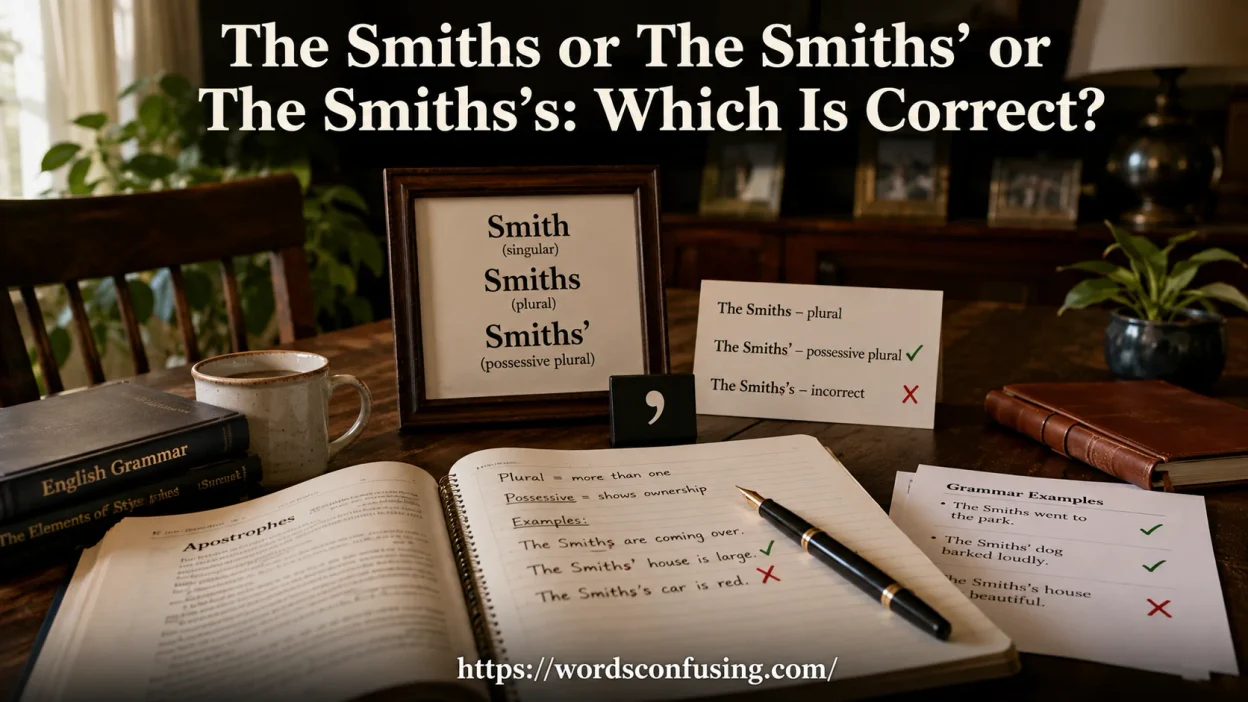
The Smiths or The Smiths’ or The Smiths’s: Which Is Correct? explains how grammar, plural names, and possessive forms work in everyday English usage.
Smiths is the plural of the last name or surname Smith, referring to two or more people, including the parents, children, or the whole family. The Smiths works as a plural noun, while Smith’s is the singular possessive of the name Smith.
You can pluralize names like regular nouns, which can help you understand why The Smiths is correct when addressing a Christmas Card.
For example, Johnny may be one of the Smiths living on Second Street, while the Smith family may have an address on that street. In normal usage, Smiths’ is the plural possessive form.
The clearest way to recognize possession and ownership is to look at what belongs to the family. Use Smiths’ for things such as house, cars, and attics. The apostrophe follows Smiths because the plural possessive shows that something belongs to more than one person.
The same pattern can appear in Jones’ cars. At a New Year’s Eve party, for example, Smiths’ cars and Jones’ cars collided in the driveway, causing a collision. A roofer who discovered raccoons living in the Smiths’ attics could have told the family about health and safety risks connected with removing the animals.
Their dog and cat might remain awake because of the noise at 2 a.m. This practical pattern makes the possessive form easier to use and recognize. Smiths’s isn’t the standard choice for this family name.
Quick Answer
Here’s the simplest way to see the difference:
| Form | Grammatical function | Meaning | Example |
| The Smiths | Plural | The Smith family or multiple Smiths | The Smiths are visiting. |
| The Smiths’ | Plural possessive | Something belongs to the Smiths | The Smiths’ car is outside. |
| The Smiths’s | Nonstandard in this context | Incorrect attempt at plural possession | Avoid the Smiths’s car. |
| The Smith’s | Singular possessive | Something belongs to one Smith | The Smith’s car is outside. |
The key distinction is this:
An apostrophe does not normally make a surname plural.
You make Smith plural by adding s:
Smith → Smiths
Then, if the plural family name needs to show possession, place the apostrophe after the s:
Smith → Smiths → Smiths’
That pattern works far beyond the Smith family. It applies to many surnames that form their plural by adding -s.
The easiest rule to remember
Plural first. Possessive second.
Think of the process as two steps:
Smith → Smiths → Smiths’
First, you identify the people. Then, you show ownership.
What Does “The Smiths” Mean?
The Smiths is the plural form of the surname Smith when you’re referring to two or more people.
It doesn’t contain an apostrophe because nothing is being shown as belonging to anyone.
For example:
- The Smiths are coming to dinner.
- The Smiths moved to Boston.
- We invited the Smiths to our wedding.
- The Smiths have three children.
- I saw the Smiths at the market.
In each sentence, Smiths simply identifies a group of people.
“The Smiths” is plural, not possessive
This distinction matters because writers sometimes insert an apostrophe automatically whenever they see a surname.
Consider these two sentences:
The Smiths are coming over.
The Smiths’ dog is coming over.
The first sentence identifies the people.
The second sentence identifies something associated with those people.
The first needs Smiths.
The second needs Smiths’.
Why “The Smith’s” changes the meaning
Now consider:
The Smith’s car is parked outside.
This normally means that one person named Smith owns or is associated with the car.
Compare it with:
The Smiths’ car is parked outside.
Now the car belongs to, or is associated with, the Smith family.
That single s before the apostrophe changes the number of people involved.
| Expression | What it means |
| Smith | One person with the surname Smith |
| Smith’s | Something belonging to one Smith |
| Smiths | More than one Smith |
| Smiths’ | Something belonging to multiple Smiths |
This is why apostrophe placement matters. It isn’t decorative punctuation.
What Does “The Smiths’” Mean?
The Smiths’ is the plural possessive form of the surname Smith.
Use it when something belongs to, is associated with, or is connected to the Smith family.
For example:
- The Smiths’ house
- The Smiths’ garden
- The Smiths’ children
- The Smiths’ car
- The Smiths’ business
- The Smiths’ vacation
- The Smiths’ wedding anniversary
Notice the structure:
The Smiths + apostrophe = The Smiths’
There’s no extra s after the apostrophe.
Why the apostrophe comes after the “s”
English normally forms the possessive of a regular plural noun ending in s by placing an apostrophe after that final s.
For example:
- students → students’
- teachers → teachers’
- parents → parents’
- neighbors → neighbors’
- players → players’
- Smiths → Smiths’
The surname behaves similarly.
So:
The Smiths’ house
follows the same basic possessive pattern as:
the students’ classroom
Both forms involve a plural noun ending in s, followed by an apostrophe.
Examples of “The Smiths’” in context
The Smiths’ house has a large backyard.
Here, the house belongs to or is associated with the Smith family.
We attended the Smiths’ anniversary party.
The party is connected to the Smiths.
The Smiths’ children attend the same school.
The children belong to the Smith family.
Everyone complimented the Smiths’ cooking.
The cooking is associated with the Smiths.
The possessive relationship can involve ownership, family connection, responsibility, authorship, or association. It doesn’t always mean literal legal ownership.
Is “The Smiths’s” Correct?
For the family name Smiths, the Smiths’s is generally not the standard possessive form.
The problem comes from treating Smiths as though it were a singular name ending in s.
That isn’t what’s happening.
The Smiths is already plural.
Therefore, its possessive form is:
The Smiths’
not:
The Smiths’s
Why writers make this mistake
English has several different apostrophe rules. That can make surnames ending in s feel slippery.
For example, some style guides allow or prefer different possessive treatments for singular names ending in s. You may encounter forms such as James’s or James’, depending on the style guide and context.
But that’s a different situation.
Compare:
James’s car
Here, James refers to one person.
Now compare:
The Jameses’ car
Here, Jameses refers to multiple members of a family named James.
The grammatical structures aren’t identical.
The crucial distinction
Singular name ending in s:
James → James’s
Plural family name ending in s:
Smith → Smiths → Smiths’
Don’t let the final s fool you. First determine whether the name is singular or plural.
The Difference Between “Smith’s” and “Smiths’”
This is one of the most important distinctions in the entire topic.
The forms look similar, but they refer to different numbers of people.
“Smith’s” means one Smith possesses something
Examples:
- Smith’s office
- Smith’s car
- Smith’s phone
- Smith’s opinion
- Smith’s house
For instance:
Smith’s car needs repairs.
This normally means one person named Smith owns or uses the car.
“Smiths’” means multiple Smiths possess something
For example:
The Smiths’ car needs repairs.
This refers to a car belonging to or associated with multiple Smiths.
The contrast becomes clearer in a table:
| Form | Number | Possessive? | Example |
| Smith | One | No | Smith arrived. |
| Smith’s | One | Yes | Smith’s coat is here. |
| Smiths | More than one | No | The Smiths arrived. |
| Smiths’ | More than one | Yes | The Smiths’ coat is here. |
The apostrophe itself doesn’t tell you whether the owner is singular or plural. The spelling before the apostrophe does.
That’s an excellent rule to keep in mind.
The Smiths vs. The Smith Family
Sometimes you’ll see the Smiths and the Smith family used almost interchangeably. Both can refer to the same group of people, but their grammatical structures differ.
Consider:
The Smiths are hosting dinner.
and:
The Smith family is hosting dinner.
Both can describe the same event.
However, the nouns work differently.
The Smiths is plural.
The Smith family is grammatically singular because the head noun is family.
Possessive forms
You can therefore write:
The Smiths’ house
or:
The Smith family’s house
Both can express possession by the family.
The construction is different:
The Smiths + apostrophe
versus:
The Smith family + ’s
This gives you another useful option when a surname’s plural form feels awkward.
Why “The Smiths family” is usually wrong
A common mistake is:
The Smiths family
That construction doesn’t normally work when Smiths is already the plural surname.
Use:
The Smith family
or:
The Smiths
depending on the sentence.
For example:
Correct:
The Smith family moved into the neighborhood.
Correct:
The Smiths moved into the neighborhood.
Incorrect in standard usage:
The Smiths family moved into the neighborhood.
The reason is straightforward. Smiths already functions as the plural family name. Adding family after it creates an unnecessary and grammatically awkward combination.
How to Use “The Smiths” in a Sentence
Once you know that the Smiths is plural, sentence construction becomes straightforward.
As the subject
Use the Smiths when the family performs the action.
Examples:
- The Smiths are traveling this weekend.
- The Smiths bought a new house.
- The Smiths invited their neighbors.
- The Smiths moved to California.
Because the Smiths refers to more than one person, plural verbs generally follow it.
The Smiths are here.
not:
The Smiths is here.
As the object
You can also use the Smiths as the object of a verb.
Examples:
- We invited the Smiths.
- I met the Smiths yesterday.
- They called the Smiths.
- The neighbors welcomed the Smiths.
Again, there is no apostrophe because you’re simply naming the people.
In everyday family references
The form sounds completely natural in ordinary conversation:
- We’re having dinner with the Smiths.
- Have you seen the Smiths lately?
- The Smiths are coming over tonight.
- We spent Thanksgiving with the Smiths.
The apostrophe only enters when you need to express possession or association.
How to Use “The Smiths’” in a Sentence
Use the Smiths’ when a noun follows it and belongs to or relates to the family.
Common combinations include:
- the Smiths’ house
- the Smiths’ children
- the Smiths’ car
- the Smiths’ garden
- the Smiths’ restaurant
- the Smiths’ vacation
- the Smiths’ decision
- the Smiths’ wedding
- the Smiths’ dog
Before a possessed noun
Examples:
The Smiths’ house is across the street.
We borrowed the Smiths’ car.
The Smiths’ garden looks beautiful.
Everyone admired the Smiths’ new kitchen.
In every example, the apostrophe comes after the final s in Smiths.
When the noun is implied
Sometimes the noun that follows the possessive is understood from context.
For example:
We had dinner at the Smiths’.
Here, the Smiths’ refers to the Smiths’ home.
Another example:
Our house is smaller than the Smiths’.
The missing noun is understood as house.
This construction can sound natural in context, although many writers prefer to include the noun when clarity matters.
A Simple Formula for Family Name Possessives
If apostrophes make your eyes cross, use this three-step formula.
Step One: Start with the surname
Smith
Step Two: Make the surname plural
Smiths
Step Three: Add possession if necessary
Smiths’
So the entire process looks like this:
Smith → Smiths → Smiths’
That small formula solves most questions involving The Smiths or The Smiths’ or The Smiths’s.
Think of it like adding labels
Imagine three name tags:
Smith
One person.
Smiths
More than one person.
Smiths’
Something belonging to those people.
The apostrophe acts like a grammatical signpost. It tells readers that a possessive relationship follows.
Common Mistakes With “The Smiths”
Family names attract several predictable apostrophe errors. Here are the ones worth watching.
| Common mistake | Better form | Reason |
| The Smith’s are here. | The Smiths are here. | The family name needs a plural s, not an apostrophe. |
| The Smith’s house | The Smiths’ house | The house belongs to the family. |
| The Smiths’s house | The Smiths’ house | The plural already ends in s. |
| The Smiths family | The Smith family | Use the singular surname before “family.” |
| The Smiths are coming. | The Smiths are coming. | No apostrophe is needed for a simple plural. |
| The Smiths’ are coming. | The Smiths are coming. | The possessive form doesn’t belong here. |
Mistake: Using an apostrophe to create a plural
One of the oldest and most persistent punctuation mistakes is using an apostrophe to make a word plural.
For family names, don’t write:
The Smith’s are here.
Write:
The Smiths are here.
The apostrophe would indicate possession rather than plurality.
Mistake: Putting the apostrophe before the plural “s”
Don’t write:
The Smith’s house
if the entire family owns or occupies the house.
Write:
The Smiths’ house
The difference is small visually, but significant grammatically.
The Smiths or The Smiths’ or The Smiths’s: A Meaning Test
When you’re unsure which form to choose, don’t memorize dozens of rules. Ask a couple of quick questions.
Are you talking about the people?
If yes, use:
The Smiths
Example:
The Smiths are visiting.
Does something belong to the people?
If yes, use:
The Smiths’
Example:
The Smiths’ house is nearby.
Are you talking about one person named Smith?
If yes, use:
Smith’s
Example:
Smith’s office is upstairs.
This gives you a compact decision tree:
Are you referring to one or more people?
↓
One Smith
→ Smith
Multiple Smiths
→ The Smiths
↓
Do they possess something?
↓ ↓
No Yes
↓ ↓
The Smiths The Smiths’
It’s simple because the grammar itself is simple once the number is clear.
Read more: Heroes or Hero’s or Heroes’: Which Is Correct?
How Other Family Names Follow the Same Rule
The Smith example isn’t an isolated case. Many family names follow the same basic pattern.
Names that simply add “s”
Examples include:
- Smith → Smiths → Smiths’
- Johnson → Johnsons → Johnsons’
- Miller → Millers → Millers’
- Taylor → Taylors → Taylors’
- Brown → Browns → Browns’
Consider Johnson:
The Johnsons are coming.
The Johnsons’ house is nearby.
Or Miller:
The Millers moved last year.
The Millers’ children attend college.
The same grammar keeps repeating.
Family names ending in “s”
Some surnames require a different plural spelling.
For example:
Jones → Joneses
The plural possessive becomes:
Joneses’
So you might write:
The Joneses are hosting dinner.
The Joneses’ house is beautiful.
This is important because the apostrophe still comes after the plural form.
The same basic logic applies to names such as Harris and Williams, although the exact plural spelling can depend on the surname and established usage.
| Singular surname | Family plural | Plural possessive |
| Smith | Smiths | Smiths’ |
| Johnson | Johnsons | Johnsons’ |
| Miller | Millers | Millers’ |
| Jones | Joneses | Joneses’ |
| Harris | Harrises | Harrises’ |
| Williams | Williamses | Williamses’ |
The safest approach is to determine the correct plural surname first. Then form its possessive.
Case Study: A Family Invitation
Imagine you’re designing a holiday invitation for the Smith family.
You want to write:
The Smiths invite you to dinner.
That’s correct because the Smiths refers to the family.
Now imagine you want to describe their home:
Dinner will be held at the Smiths’ home.
Again, correct.
Now suppose you accidentally write:
Dinner will be held at the Smith’s home.
The sentence now suggests that one Smith owns or is associated with the home.
Finally, imagine writing:
Dinner will be held at the Smiths’s home.
That creates an unnecessary possessive construction.
The correct version remains:
Dinner will be held at the Smiths’ home.
This tiny example shows why context matters. The right form depends on what the sentence actually means.
Case Study: A Family Business
Suppose the Smith family owns a bakery.
You could write:
The Smiths own a bakery.
Here, Smiths identifies the family.
Now write:
The Smiths’ bakery opened in 2024.
Here, Smiths’ shows the relationship between the family and the bakery.
You could also write:
The Smith family’s bakery opened in 2024.
Both possessive constructions work:
- The Smiths’ bakery
- The Smith family’s bakery
However, the grammatical structure differs.
This is a useful trick when you’re editing formal writing. If the plural surname starts to feel awkward, the Smith family’s can provide a clear alternative.
Why Apostrophes Matter in Family Names
An apostrophe may look tiny on the page, but it can change the entire grammatical relationship.
Compare:
The Smiths
with:
The Smiths’
The first identifies people.
The second connects those people to something else.
That distinction appears everywhere in real writing:
- invitations
- family histories
- business documents
- property descriptions
- holiday cards
- school records
- newspaper articles
- websites
- social media posts
- legal and professional correspondence
A misplaced apostrophe can make an otherwise polished sentence look careless.
A useful editing habit
When proofreading, temporarily ignore how the word looks.
Instead, ask:
“Am I naming the people, or am I showing what belongs to them?”
If you’re naming them:
The Smiths
If you’re showing possession:
The Smiths’
That meaning-first approach works better than simply memorizing punctuation rules.
The Smiths vs. The Smith Family: Which Sounds Better?
Both forms can be useful, depending on the sentence.
Use “the Smiths” for natural everyday writing
The Smiths are coming over.
We met the Smiths yesterday.
The Smiths bought a new house.
It’s concise and conversational.
Use “the Smith family” for emphasis or clarity
The Smith family has lived here for generations.
Their tradition began in the 1950s and has remained an important part of the community.
Today, the family business is still locally owned and operated.
The phrase can also make the family relationship clearer when the surrounding text contains several surnames.
Use the possessive form when ownership matters
The Smiths’ home
The Smith family’s home
Both are understandable and grammatical in the right context.
The best choice often depends on rhythm. Read the sentence naturally. If the Smith family’s feels clunky, the Smiths’ may be cleaner.
A Practical Cheat Sheet
Keep this reference nearby when editing.
| If you mean… | Use… | Example |
| One person named Smith | Smith | Smith arrived. |
| Something belonging to one Smith | Smith’s | Smith’s car is new. |
| The Smith family | The Smiths | The Smiths arrived. |
| Something belonging to the Smith family | The Smiths’ | The Smiths’ car is new. |
| The family described with “family” | The Smith family | The Smith family arrived. |
| Something belonging to that family | The Smith family’s | The Smith family’s car is new. |
The form The Smiths’s doesn’t fit the standard plural possessive pattern.
FAQs
1. Is The Smiths grammatically correct?
Yes. The Smiths is the correct plural form when you’re talking about two or more members of the Smith family.
2. Should I write The Smiths’ or The Smiths’s?
Use The Smiths’ for plural possession. The Smiths’s isn’t the standard form because the plural name already ends in s.
3. When should I use Smith’s?
Use Smith’s when one person named Smith owns something. For example, Smith’s car means the car belongs to one Smith.
4. What does The Smiths’ house mean?
The Smiths’ house means the house belongs to the Smith family or to more than one Smith.
5. Is The Smiths appropriate on a Christmas card?
Yes. If you’re addressing the entire Smith family, The Smiths is a natural and correct choice.
6. Why does the apostrophe come after the s in Smiths’?
Because Smiths is already plural. To show possession, you simply add an apostrophe after the final s, creating Smiths’.
Conclusion
Choosing between The Smiths, Smith’s, Smiths’, and Smiths’s becomes much easier when you focus on meaning rather than memorizing rules. If you’re talking about the family as a group, use The Smiths and If something belongs to one person named Smith, use Smith’s. If something belongs to the entire Smith family, use Smiths’.
In standard English, Smiths’s usually isn’t the form you need. The easiest trick is to ask yourself one question: Are you talking about the people, or something they own? If you mean the people, choose The Smiths. If you mean something owned by the family, choose Smiths’. Once you make that distinction, the apostrophe has a clear job—and The Smiths never has to be a guessing game again.

Franklin Hayes is a writer and editor at WordsConfusing.com, focused on making English vocabulary, grammar, and commonly confused words easy to understand. He writes clear, practical articles with simple explanations and useful examples to help readers improve their English with confidence.
His goal is simple: Making Confusing Words Simple.