With Abandon: Meaning, Synonyms and Examples in Sentences explains how this phrase describes acting freely, enthusiastically, and without holding back.
At first glance, you might find this confusing phrase difficult to work out. If you’re stumped by its exact word meaning, don’t worry. It describes doing something without restrictions and enjoying the moment.
This English phrase can have a positive interpretation or a negative interpretation, depending on the context and situation. Understanding its phrase meaning improves your comprehension, adds clarity, and expands your English vocabulary.
You can use this expression in everyday English and conversational English to describe excitement, freedom, and enthusiastic actions. Its synonyms include freely, wholeheartedly, recklessly, and without restraint. These alternatives explain its phrase usage and practical usage in different situations.
For correct usage, consider the surrounding words and intended meaning. Reading examples, sentence examples, and complete sentences makes phrase understanding easier during language learning.
This meaning explanation also introduces useful English expressions and supports vocabulary building through simple explanations. You can understand and use the phrase naturally in your writing and conversations.
Quick Answer
With abandon means doing something freely, enthusiastically, or without holding back. It describes actions performed without worrying about restrictions, embarrassment, or limitations.
Example: She danced with abandon at the wedding.
This means she danced freely and happily without worrying about how she looked. Depending on the context, the phrase can also suggest reckless or careless behavior, such as spending money with abandon.

What Does With Abandon Mean?
With abandon means doing something without restraint, hesitation, or concern about limitations. It describes an action performed freely and wholeheartedly, often with considerable energy or enthusiasm.
When someone does something with abandon, they don’t hold themselves back. They might express their feelings openly, enjoy an activity completely, or act without thinking carefully about the consequences.
For example:
- She danced with abandon at the wedding reception.
- The children played with abandon in the backyard.
- He laughed with abandon during the comedy show.
- They celebrated their team’s victory with abandon.
In each example, the expression emphasizes freedom and a lack of restraint. The person isn’t worried about behaving cautiously or maintaining strict control.
However, the phrase can communicate different ideas depending on its context. Dancing with abandon usually suggests happiness and excitement. Spending money with abandon often suggests irresponsible financial behavior.
The central idea remains the same: someone acts without holding back. The surrounding words help readers understand whether that behavior is admirable, excessive, or simply spontaneous.
With Abandon Definition in Simple English
In simple English, with abandon means doing something freely and without worrying about restrictions.
Here are a few easy ways to understand it:
- Doing something without holding back.
- Acting with complete freedom.
- Showing enthusiasm without embarrassment.
- Expressing emotions openly.
- Acting without much caution or control.
Consider this example:
The little boy ran with abandon across the playground.
This sentence suggests that the boy ran freely and energetically. He wasn’t concerned about slowing down or following a particular pattern.
Now consider another example:
She bought expensive clothes with abandon.
Here, the phrase suggests that she spent money freely without considering the cost.
Both sentences communicate unrestricted behavior. However, their emotional meanings differ.
What Does It Mean to Do Something With Abandon?
Doing something with abandon means giving yourself permission to act without unnecessary restraint.
Imagine attending a wedding where everyone is dancing. Some guests might feel shy and remain seated. Others might join the dance floor and enjoy themselves completely.
The second group could be described as dancing with abandon.
The expression can describe several kinds of behavior:
- Emotional freedom: Expressing happiness, excitement, or affection openly.
- Physical freedom: Dancing, running, playing, or moving energetically.
- Creative freedom: Painting, writing, or performing without worrying about perfection.
- Financial excess: Spending money without considering expenses.
- Reckless behavior: Taking unnecessary risks without thinking carefully.
The phrase doesn’t necessarily mean someone has lost control. Sometimes it simply highlights a willingness to enjoy life without unnecessary restrictions.
Origin and History of the Phrase With Abandon
The history of with abandon connects to the older meaning of the word abandon.
The English word abandon entered the language through Old French. Its historical development is associated with the idea of surrendering something or giving it over without reservation.
Over time, the noun abandon developed a particular meaning: freedom from restraint or inhibition.
This older noun meaning helps explain the modern expression with abandon.
When someone acts with abandon, they behave as though ordinary restrictions no longer hold them back. They might express themselves freely, enjoy an experience wholeheartedly, or act without considering the usual limitations.
The expression became especially useful in descriptive writing because it captures both movement and emotion.
For example:
The musicians performed with abandon throughout the evening.
This sentence communicates more than simply saying the musicians performed enthusiastically. It suggests energy, freedom, and complete involvement in their performance.
The word abandon also has other meanings in modern English. As a verb, it generally means leaving something behind or giving it up. As a noun, it can describe freedom from restraint.
Understanding these different meanings makes the expression easier to recognize.
Read more: Bit or Bitten: Which Is Correct? Understanding the Difference
How to Use With Abandon in a Sentence
The expression with abandon usually functions as an adverbial phrase. It describes how someone performs an action rather than naming the action itself.
You can place it after the verb or near the end of a sentence. Both positions can sound natural.
For example:
- She sang with abandon.
- The children played with abandon in the park.
- He embraced his new opportunity with abandon.
- The crowd cheered with abandon after the final goal.
The phrase works particularly well with verbs involving movement, emotions, celebrations, creativity, and personal behavior.
With Abandon to Describe Enthusiastic Actions
One common use of with abandon involves activities performed with excitement and energy.
When people enjoy something without feeling embarrassed or restricted, this expression captures their enthusiasm.
For example, imagine a child dancing to a favorite song. The child isn’t thinking about technique, appearance, or whether anyone is watching. The only concern is enjoying the music.
You could describe that behavior by saying:
The children danced with abandon at the school party.
Other examples include:
- The fans cheered with abandon after their team scored.
- She sang with abandon during the concert.
- The students celebrated their graduation with abandon.
- He played the guitar with abandon at the festival.
- The dancers moved with abandon across the stage.
Notice how the expression adds emotional energy to each sentence. Instead of describing an ordinary action, it emphasizes the freedom and excitement behind it.
With Abandon to Describe Strong Emotions
Strong emotions often make people behave differently from their usual selves.
Someone might laugh louder, express affection openly, or celebrate an achievement without worrying about appearances. In these situations, with abandon describes unrestricted emotional expression.
For example:
She laughed with abandon when her best friend told the story.
This sentence suggests genuine amusement rather than a polite or controlled laugh.
The expression can describe several emotions:
- Joy: He smiled with abandon after receiving the good news.
- Excitement: The children shouted with abandon when the vacation began.
- Affection: She hugged her family with abandon after returning home.
- Happiness: They celebrated with abandon after achieving their goal.
- Amusement: The audience laughed with abandon throughout the performance.
Although the expression frequently describes happiness, it isn’t limited to positive emotions. Context determines the precise feeling being communicated.
With Abandon to Describe Reckless or Unrestrained Behavior
Not every action performed with abandon deserves praise.
Sometimes people ignore reasonable limits, spend excessively, or take unnecessary risks. In these situations, the expression highlights a lack of caution.
Consider this sentence:
He spent money with abandon during his vacation.
The sentence suggests that he spent freely without carefully considering his budget. His behavior might have been enjoyable at first but financially irresponsible afterward.
Here are more examples:
- She bought unnecessary items with abandon during the sale.
- He took risks with abandon while driving through the mountains.
- They wasted food with abandon at the celebration.
- The company expanded its operations with abandon.
- He criticized everyone with abandon during the argument.
These examples show why context matters. The expression can communicate freedom, but freedom without judgment sometimes creates problems.
A useful distinction: Enthusiasm involves enjoying something wholeheartedly. Recklessness involves ignoring important limits or consequences.
With Abandon in Creative and Literary Writing
Writers often use with abandon to make descriptions more vivid and expressive.
The phrase works particularly well when describing characters who express themselves freely. It can also establish a scene’s atmosphere without requiring several additional sentences.
For example:
The painter covered the canvas with colors, working with abandon.
This sentence suggests an artist who creates freely instead of following strict rules.
Similarly:
The poet wrote with abandon, allowing every emotion to shape the verses.
The expression creates an impression of spontaneity and emotional freedom.
Writers can use it when describing:
- Artists creating without strict limitations.
- Musicians performing passionately.
- Characters expressing hidden emotions.
- Children enjoying carefree adventures.
- Crowds celebrating major events.
- People embracing unfamiliar experiences.
However, the phrase works best when the action genuinely involves freedom or a lack of restraint. Using it repeatedly can make descriptive writing feel predictable.
With Abandon Sentence Examples
Examples make the meaning easier to understand because they show how the expression works in different situations.
The following sentences cover everyday conversations, celebrations, emotions, creative activities, and less responsible behavior.
| Sentence | Meaning |
| She danced with abandon at the wedding. | She danced freely and enthusiastically. |
| The children played with abandon outside. | They played without holding back. |
| He laughed with abandon at the joke. | He laughed openly and wholeheartedly. |
| They celebrated with abandon after winning. | They celebrated with great excitement. |
| The artist painted with abandon. | The artist created freely without restraint. |
| She sang with abandon during the concert. | She sang enthusiastically and confidently. |
| The puppies ran with abandon through the garden. | They ran freely and energetically. |
| He spent money with abandon. | He spent without much financial restraint. |
| The fans cheered with abandon. | They cheered loudly and enthusiastically. |
| She embraced her new lifestyle with abandon. | She accepted it wholeheartedly. |
| The children splashed water with abandon. | They played energetically without restraint. |
| He spoke with abandon about his dreams. | He expressed his thoughts freely. |
| The audience applauded with abandon. | The audience applauded enthusiastically. |
| They decorated the house with abandon. | They decorated it freely and enthusiastically. |
| She pursued her creative interests with abandon. | She followed her interests without holding back. |
| He ate desserts with abandon at the buffet. | He ate freely without much restraint. |
| The musicians performed with abandon. | They performed passionately and energetically. |
| The crowd danced with abandon until midnight. | The crowd danced freely for hours. |
Everyday Examples of With Abandon
The expression also fits naturally into ordinary situations.
Here are some additional examples:
- My grandmother laughs with abandon whenever we visit her.
- The children chased butterflies with abandon in the meadow.
- She decorated her bedroom with abandon using bright colors.
- He talked about his favorite movies with abandon.
- The dog ran with abandon after its favorite ball.
- They sang with abandon during the road trip.
- She embraced the opportunity with abandon.
- The students worked with abandon on their creative project.
Each sentence describes someone acting freely rather than holding back.
Examples of With Abandon in Different Situations
A single expression can communicate different ideas across various situations.
| Situation | Example | Interpretation |
| Wedding | They danced with abandon. | Unrestrained happiness |
| Sports | The players celebrated with abandon. | Excitement and enthusiasm |
| Shopping | She spent with abandon. | Excessive spending |
| Art | He painted with abandon. | Creative freedom |
| Family | The children played with abandon. | Carefree enjoyment |
| Music | She sang with abandon. | Passionate expression |
| Travel | They explored the city with abandon. | Unrestricted enthusiasm |
| Conversation | He spoke with abandon. | Open expression |
These examples demonstrate why you should consider the entire sentence before interpreting the expression.
Is With Abandon Positive or Negative?
The expression with abandon can have positive, negative, or neutral connotations. Its meaning depends on the action being described and the surrounding context.
It doesn’t automatically suggest good behavior or poor judgment.
For example, dancing with abandon usually creates a positive impression. Spending money with abandon may suggest financial irresponsibility.
The difference comes from the action itself rather than the expression.
Positive Meaning of With Abandon
In positive situations, the phrase communicates enthusiasm, freedom, confidence, and wholehearted participation.
It often describes people enjoying experiences without worrying about unnecessary restrictions.
Examples include:
- She danced with abandon at her sister’s wedding.
- The children laughed with abandon during recess.
- He pursued his passion with abandon.
- They celebrated their achievement with abandon.
These sentences present unrestricted behavior as something enjoyable or admirable.
Negative Meaning of With Abandon
In negative situations, with abandon can suggest excessive behavior or a lack of self-control.
It often appears when someone ignores practical limits or acts without considering possible consequences.
Examples include:
- He spent his savings with abandon.
- She criticized her coworkers with abandon.
- The factory released waste with abandon.
- They consumed resources with abandon.
The expression doesn’t necessarily prove that someone acted irresponsibly. However, these sentences often create that impression.
Neutral Meaning of With Abandon
Sometimes the expression simply describes unrestricted activity without making a strong judgment.
For example:
The children played with abandon in the open field.
The sentence emphasizes their freedom and energy. It doesn’t necessarily praise or criticize their behavior.
| Meaning | Typical Context | Example |
| Positive | Happiness and excitement | She danced with abandon. |
| Negative | Excessive or careless behavior | He spent money with abandon. |
| Neutral | Free and unrestricted activity | The children played with abandon. |
Remember: Context determines the tone. The same expression can describe joyful freedom or careless excess.
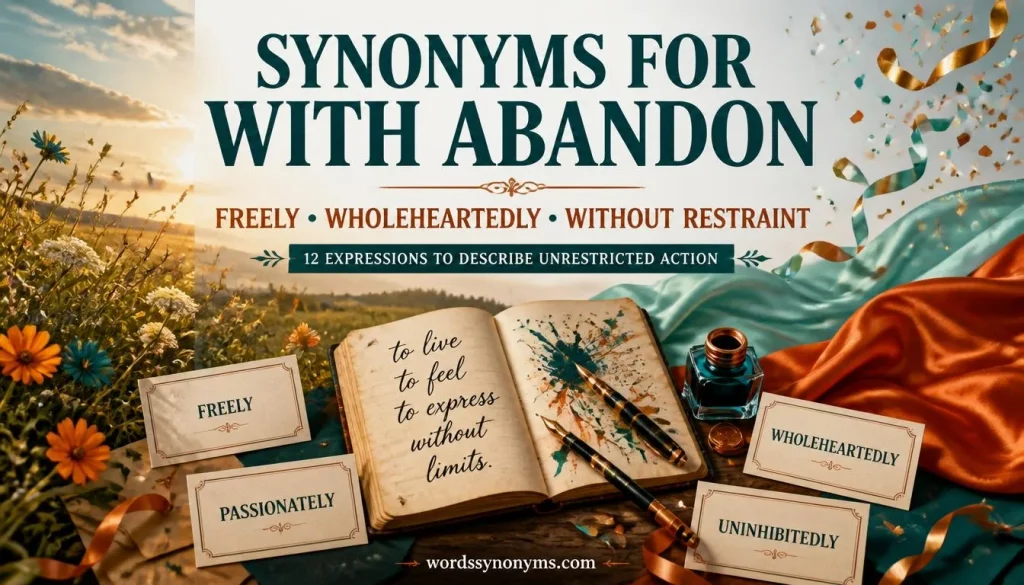
Synonyms for With Abandon
Several English expressions communicate meanings similar to with abandon. However, they don’t always work interchangeably.
Some emphasize enthusiasm, while others highlight a lack of caution or restraint.
Choosing the right synonym depends on the message you want to communicate.
Common Synonyms for With Abandon
Here are useful alternatives:
| Synonym | Meaning |
| Without restraint | Without controlling or limiting an action |
| Freely | Without unnecessary restrictions |
| Wholeheartedly | With complete enthusiasm and commitment |
| Enthusiastically | With excitement and interest |
| Unreservedly | Without hesitation or holding back |
| Uninhibitedly | Without embarrassment or self-consciousness |
| Recklessly | Without considering possible dangers |
| Wildly | With uncontrolled energy or excitement |
| Impulsively | Acting without careful thought |
| Unrestrainedly | Without keeping behavior under control |
| Passionately | With strong feelings or enthusiasm |
| Spontaneously | Acting naturally without planning beforehand |
Example Sentences Using With Abandon Synonyms
Understanding synonyms becomes easier when you see them in complete sentences.
Without restraint:
The audience cheered without restraint.
This describes people expressing their excitement openly.
Freely:
The children played freely in the garden.
This emphasizes freedom rather than excitement.
Wholeheartedly:
She supported her friend’s decision wholeheartedly.
This communicates complete commitment and genuine support.
Enthusiastically:
The students participated enthusiastically in the competition.
This highlights excitement and active involvement.
Unreservedly:
He praised her performance unreservedly.
This suggests he expressed his approval without hesitation.
Recklessly:
He spent his inheritance recklessly.
This emphasizes poor judgment and a lack of financial caution.
Which Synonym Should You Choose?
Not every synonym expresses exactly the same idea.
For instance, wholeheartedly generally communicates genuine enthusiasm or commitment. Meanwhile, recklessly emphasizes danger or irresponsible behavior.
Use these distinctions when selecting an alternative:
- Choose freely when emphasizing freedom from restrictions.
- Choose wholeheartedly when describing complete commitment.
- Choose enthusiastically when highlighting excitement.
- Choose unreservedly when describing open expression.
- Choose recklessly when emphasizing dangerous behavior.
- Choose uninhibitedly when describing freedom from embarrassment.
The best synonym preserves the original sentence’s meaning rather than simply replacing its words.
Difference Between With Abandon and Without Restraint
With abandon and without restraint share a similar meaning. Both describe actions performed without holding back or applying normal limitations.
However, their tone and natural usage can differ slightly.
With abandon often sounds more expressive and descriptive. It frequently appears in literary writing, storytelling, and everyday descriptions of enthusiastic behavior.
Without restraint sounds more direct. It can describe emotions, spending habits, speech, or behavior without necessarily creating a vivid image.
Compare these sentences:
- She danced with abandon at the celebration.
- She danced without restraint at the celebration.
Both sentences suggest unrestricted dancing. However, the first sounds more natural and expressive in many everyday contexts.
Consider another example:
- He spent money with abandon.
- He spent money without restraint.
Both communicate excessive spending. The second directly emphasizes the absence of limits.
| With Abandon | Without Restraint |
| More expressive and descriptive | More direct and literal |
| Often emphasizes freedom or enthusiasm | Emphasizes the absence of limits |
| Common in literary and conversational writing | Common in everyday and formal writing |
| She laughed with abandon. | She laughed without restraint. |
Neither expression is automatically better. Choose the one that fits your sentence and intended tone.
Common Mistakes When Using With Abandon
Although with abandon is a straightforward expression, some writers misunderstand its meaning or use it incorrectly.
Learning these common mistakes will help you use the phrase more naturally.
Confusing With Abandon With the Verb Abandon
The word abandon has several meanings, depending on how it functions in a sentence.
As a verb, it usually means leaving something behind or giving it up.
For example:
They abandoned the old house.
This means they left the house and stopped using it.
However:
They celebrated with abandon.
This means they celebrated freely and enthusiastically.
The two sentences use the same word differently.
Assuming With Abandon Always Means Recklessly
Another common mistake involves interpreting the phrase too negatively.
Although it can describe reckless behavior, it frequently communicates happiness, freedom, and enthusiasm.
For example:
The children played with abandon at the beach.
This sentence doesn’t suggest that the children behaved irresponsibly. It simply describes their carefree enjoyment.
Always consider the surrounding context before deciding what the phrase means.
Using With Abandon Without a Suitable Action
The expression works naturally with verbs that describe activities, emotions, and behavior.
However, forcing it into unrelated sentences can make your writing sound awkward.
Natural examples:
- She danced with abandon.
- He laughed with abandon.
- They celebrated with abandon.
Less natural:
- The table existed with abandon.
- The building stood with abandon.
These unusual examples don’t provide a clear action involving freedom or lack of restraint.
Choose a verb that makes the intended meaning understandable.
Treating With Abandon as a Verb
With abandon isn’t a verb. It’s an adverbial phrase that describes how an action happens.
For example:
She sings with abandon.
Here, sings is the verb. The phrase with abandon explains how she sings.
Understanding this grammatical role helps you construct clearer sentences.
Using With Abandon When a More Specific Word Works Better
Sometimes a simpler expression communicates your meaning more accurately.
For example:
He drove recklessly.
This sentence directly identifies dangerous driving.
He drove with abandon.
This suggests unrestricted or careless driving, but the exact behavior remains less specific.
Choose expressions according to the level of detail your sentence needs.
With Abandon vs. Abandon: What’s the Difference?
The word abandon can function as both a noun and a verb. Its meaning changes depending on its grammatical role.
Understanding this distinction is important because the expression with abandon uses the noun form rather than the verb.
| Word or Expression | Part of Speech | Meaning | Example |
| Abandon | Verb | To leave or give something up | They abandoned the project. |
| Abandon | Noun | Freedom from restraint | She danced with complete abandon. |
| With abandon | Adverbial phrase | Freely or without restraint | He laughed with abandon. |
Abandon as a Verb
As a verb, abandon means to leave something behind, stop supporting it, or give it up.
Examples:
- They abandoned their plans after the storm.
- The family abandoned the damaged vehicle.
- She abandoned her old habits.
- The company abandoned the unsuccessful project.
In each sentence, the word describes leaving or giving something up.
Abandon as a Noun
As a noun, abandon can describe a lack of restraint or inhibition.
For example:
The dancers performed with complete abandon.
Here, the noun describes freedom from ordinary restrictions.
You might also encounter the expression with reckless abandon. It emphasizes behavior that ignores caution or possible consequences.
With Abandon as an Expression
When you use with abandon, you’re describing the manner in which someone performs an action.
Examples:
- She danced with abandon.
- The children played with abandon.
- He spoke with abandon.
- They celebrated with abandon.
The expression adds a sense of freedom or intensity to the action.
Read more: Don’t Call Me Late for Dinner: Meaning and How to Use It
With Abandon vs. With Reckless Abandon
These expressions are closely related, but they don’t communicate exactly the same thing.
With abandon describes unrestricted behavior. It can suggest enthusiasm, freedom, or excess.
With reckless abandon places greater emphasis on ignoring risks, caution, or consequences.
For example:
She danced with abandon at the party.
This describes enthusiastic and unrestricted dancing.
He drove with reckless abandon through the busy streets.
This suggests dangerous behavior and disregard for safety.
The addition of reckless makes the negative meaning much stronger.
| Expression | Main Emphasis | Example |
| With abandon | Freedom or lack of restraint | She sang with abandon. |
| With reckless abandon | Ignoring caution or consequences | He spent his savings with reckless abandon. |
Use with abandon when you want to describe unrestricted action generally. Choose with reckless abandon when the behavior clearly involves excessive risk or poor judgment.
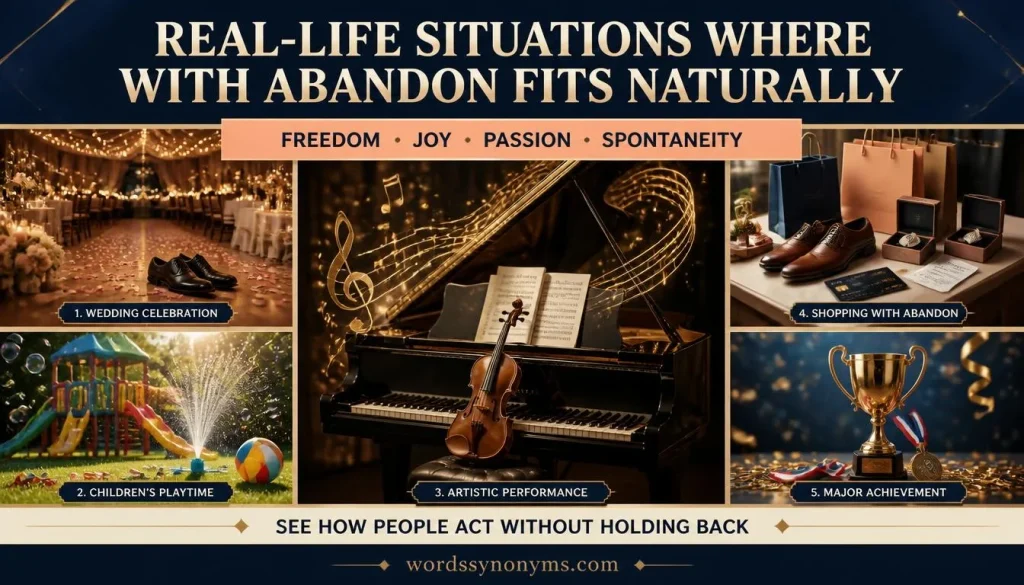
Real-Life Situations Where With Abandon Fits Naturally
The expression becomes easier to understand when you connect it to recognizable situations.
Here are several practical scenarios showing how people use it naturally.
At a Wedding Celebration
Imagine a wedding reception where guests gather around the dance floor.
Some guests dance carefully, while others forget their worries and enjoy every song.
You could write:
Everyone danced with abandon until the music stopped.
The expression captures the atmosphere of celebration, excitement, and freedom.
During a Children’s Playtime
Children often enjoy activities without worrying about appearances or social expectations.
For example:
The children ran with abandon through the sprinklers.
This describes energetic play and carefree enjoyment.
The phrase creates a picture of children laughing, running, and enjoying themselves.
During an Artistic Performance
Artists sometimes create their best work when they stop worrying about perfection.
For example:
The musician played with abandon, filling the room with energy.
The sentence suggests passionate performance and complete involvement.
During an Expensive Shopping Trip
Not every example describes something positive.
Imagine someone entering a shopping mall during a major sale. They buy expensive items without checking their budget.
You might say:
She shopped with abandon during the holiday sale.
The sentence suggests excessive spending rather than simply enjoying shopping.
During a Major Achievement
Celebrating success can also involve unrestricted happiness.
For example:
The entire team celebrated with abandon after winning the championship.
This communicates excitement, pride, and shared happiness.
These situations demonstrate that with abandon describes how freely someone behaves. The specific situation determines its emotional meaning.
FAQs
1. What does “with abandon” mean?
“With abandon” means doing something freely, enthusiastically, and without holding back. For example, children might dance with abandon when their favorite song plays.
2. Is “with abandon” a positive or negative expression?
It can be either positive or negative. It describes joyful actions when someone celebrates freely, but it can suggest recklessness when someone ignores risks or consequences.
3. What are the best synonyms for “with abandon”?
Common synonyms include freely, wholeheartedly, enthusiastically, recklessly, and without restraint. The best choice depends on whether you want to express excitement or a lack of caution.
4. How do you use “with abandon” in a sentence?
You can use it after a verb to describe how someone acts. For example, “She sang with abandon at the concert,” means she sang freely and enthusiastically.
5. Is “with abandon” formal or informal?
“With abandon” works in both formal and informal writing. You can use it in stories, everyday conversations, personal essays, and descriptive articles whenever you want to emphasize unrestricted behavior.
6. What is the difference between “with abandon” and “carelessly”?
“With abandon” emphasizes acting without restraint, often with excitement or passion. “Carelessly” usually suggests a lack of attention or concern. Someone can dance with abandon and still be careful about their surroundings.
Conclusion
Understanding “with abandon” is easier when you connect it with real-life actions and emotions. It describes doing something freely, passionately, or without holding back. You might dance with abandon at a wedding, laugh with abandon among friends, or spend money with abandon and later regret it. The meaning depends on the situation, so pay attention to the context before interpreting the phrase.
Adding “with abandon” to your vocabulary can make your English sound more natural and expressive. Try using it in your own sentences instead of simply memorizing its meaning and synonyms. The more you encounter this expression in conversations and reading, the easier it becomes to recognize when it fits.

Shafiq Ur Rehman is a writer and content contributor at WordsConfusing.com. He enjoys exploring the English language, common word confusions, vocabulary, and practical writing tips. His goal is to make English easier to understand through clear, simple, and useful articles.