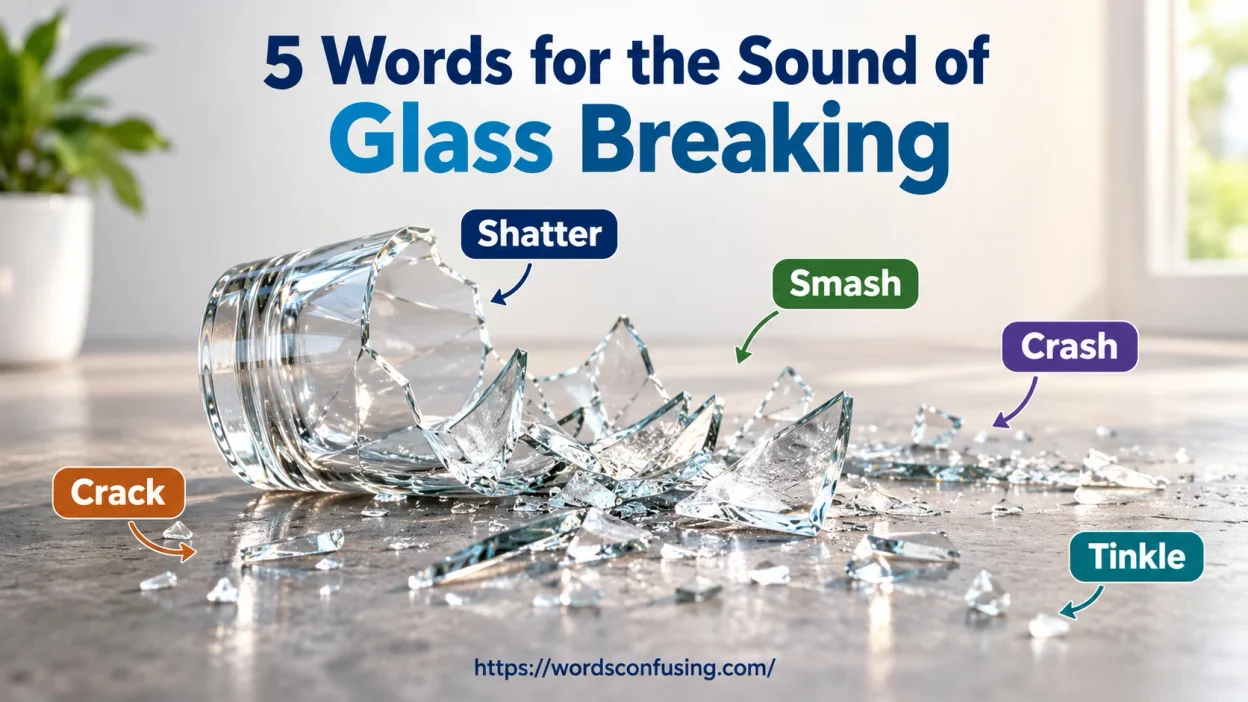
For 5 Words for the Sound of Glass Breaking, the right word can turn a sudden noise into a vivid scene readers can easily imagine and understand.
When a window shatters and glass pieces fall onto the floor, you may hear a loud crash, sharp crack, light crack, light tinkle, or tinkle. Each sound has a slightly different meaning, so your word choice should match the context.
In creative writing, storytelling, and formal writing, these expressive words make descriptions more vivid, precise, and engaging. The shattering of breaking glass can suggest a splintering effect, while onomatopoeia words can represent a certain sound naturally.
From my experience with writing, clear English usage, correct grammar, and precise vocabulary help writers describe scenes accurately without making the wording feel forced. This approach also supports clarity and consistency in business communication, broadcasting, and other communication where an accurate term fits the situation and works well.
Learning these five words through simple examples and their best-use situations can help you describe a noise or event confidently, whether you’re preparing content, a message, article, meetings, project management, calendar updates, scheduling, time management, or online booking material.
The key distinctions help you understand how each expression describes the sound of glass breaking and shattered glass in context.
Quick Answer
The five useful words are:
- Shatter — to break violently into many small pieces.
- Smash — to break something through a strong impact or force.
- Crash — a loud, sudden noise often associated with falling or breaking glass.
- Crack — a sharp sound or fracture that can happen before complete breakage.
- Tinkle — a light, delicate ringing sound made by small pieces of glass.
These words overlap, but each creates a slightly different image.
| Word | Main Meaning | Typical Intensity | Best Use |
| Shatter | Break into many fragments | High | Windows, mirrors, bottles |
| Smash | Break through force | High | Strong impacts or deliberate destruction |
| Crash | Loud impact or breaking noise | High | Falling glass and sudden accidents |
| Crack | Fracture or sharp splitting sound | Low to medium | Cracks, fractures, partial breaks |
| Tinkle | Light ringing sound | Low | Small or delicate glass pieces |
The best choice depends on how the glass breaks, how loud the event sounds, and what you want the reader to imagine.
What Is the Sound of Glass Breaking Called?
There isn’t one universal English word for every sound produced when glass breaks.
Glass can make several noises during the same incident. A heavy object might strike a window first. The glass could then produce a sharp crack as a fracture develops. A moment later, the entire pane may shatter. When the fragments hit the floor, they can create a scattered tinkle.
That sequence explains why English uses several different words.
Many of these terms also work as verbs. For example:
The mirror shattered when it hit the floor.
Here, shattered describes what happened to the mirror.
A writer can also describe the noise itself:
A loud crash echoed through the hallway.
In this sentence, crash describes the sound or noisy event.
This distinction is important. Some words primarily describe the action or result of breaking, while others can describe the sound associated with that event.
Why Glass Makes Different Sounds When It Breaks
Glass doesn’t always break in exactly the same way. Its sound depends on several physical factors.
The Type of Glass
A thin drinking glass may produce a different sound from a thick window pane. Tempered glass can also behave differently from ordinary glass because of the way it fractures.
The Force of Impact
A gentle impact may create a small crack. A powerful blow can cause glass to smash or shatter almost instantly.
The Size of the Object
A large window contains much more glass than a small tumbler. When a large pane breaks, the event can create a louder and more dramatic sound.
The Surface Beneath It
Glass landing on a hard floor can produce a sharp, noisy impact. Carpet, soil, or another soft surface can absorb some of the sound.
The Number of Fragments
A single fracture sounds different from dozens of fragments scattering across a floor. This difference makes words such as crack, shatter, and tinkle useful in different situations.
Shatter: A Powerful Word for Glass Breaking Into Pieces
Shatter is one of the strongest and most useful words for describing broken glass.
As a verb, shatter means to break suddenly into many pieces. The word often creates an image of glass fragmenting rapidly after a strong impact.
For example:
The baseball hit the window, and the glass shattered instantly.
The word shattered tells the reader that the window didn’t merely develop a small fracture. It broke apart into numerous fragments.
You can use shatter for:
- Windows
- Mirrors
- Glass doors
- Bottles
- Drinking glasses
- Windshields
- Decorative glass
- Glass panels
What Makes “Shatter” Different?
The key idea behind shatter is fragmentation.
Imagine dropping a glass bottle onto a concrete floor. Instead of remaining mostly intact with one visible crack, the bottle breaks into many pieces. Shatter captures that result extremely well.
It also works figuratively:
The news shattered her confidence.
Here, nothing physically breaks. The word describes something being completely damaged emotionally or psychologically.
For descriptions involving actual glass, however, the literal meaning usually focuses on breaking into numerous fragments.
Examples With “Shatter”
- The old mirror shattered when it fell.
- A stone struck the window and caused the glass to shatter.
- The bottle shattered against the pavement.
- The windshield shattered after the impact.
- Broken glass scattered across the floor after the vase shattered.
Best memory trick: Think of shatter when you picture glass becoming many pieces.
Smash: The Word for Forceful Glass Breaking
Smash emphasizes force and impact.
When someone throws a bottle against a wall, hits a window with a heavy object, or drops a glass with considerable force, smash can describe the event naturally.
For example:
He dropped the glass, and it smashed against the tile floor.
The word immediately suggests a forceful collision.
Unlike shatter, which emphasizes the resulting fragments, smash often emphasizes the action that caused the break.
Smash vs. Shatter
These words can describe the same event, but their focus differs.
Consider these two sentences:
The bottle smashed against the wall.
This sentence highlights the impact.
Now compare:
The bottle shattered against the wall.
This sentence highlights the bottle breaking into pieces.
The difference is subtle but useful. Smash feels more physical and forceful. Shatter paints a clearer picture of fragmentation.
Examples With “Smash”
- The heavy box fell onto the glass and smashed it.
- The bottle smashed against the pavement.
- A rock smashed through the window.
- The vase smashed when it hit the floor.
- The old glass ornament smashed into several pieces.
When “Smash” Works Best
Use smash when the scene involves:
- A strong collision
- Deliberate destruction
- A heavy object hitting glass
- A glass object falling hard
- A violent or dramatic impact
If the main idea is force, smash is usually the stronger choice.
Crash: A Loud and Sudden Glass-Breaking Sound
Crash is particularly useful when you want readers to notice the noise.
A crash usually suggests something loud, sudden, and disruptive. The word isn’t exclusive to glass. Cars can crash. Plates can crash onto floors. Heavy objects can crash into walls.
Still, crash fits broken glass naturally when the event creates a loud burst of noise.
For example:
The vase slipped from the shelf with a loud crash.
The sentence doesn’t necessarily explain how many fragments the vase produced. Instead, it focuses on the sound that interrupted the room.
Crash vs. Smash
The distinction becomes clearer with context.
The hammer smashed the window.
This emphasizes the force applied to the window.
The window fell with a tremendous crash.
This emphasizes the resulting noise.
Both sentences can describe a dramatic glass-breaking event. Their emphasis simply differs.
Examples With “Crash”
- The glass fell from the counter with a sharp crash.
- Everyone heard the window crash downstairs.
- The bottle hit the floor with a loud crash.
- A sudden crash came from the kitchen.
- The vase fell and broke with an unexpected crash.
Why “Crash” Works So Well in Stories
Writers often use crash to create an immediate reaction.
Imagine a quiet house at midnight. Suddenly, something breaks downstairs.
A crash came from the kitchen.
That’s enough to create tension. The reader immediately wonders what happened.
The word doesn’t need a lengthy explanation. It delivers the sound quickly.
Crack: The Sharp Sound of Glass Developing a Fracture
Crack is different from shatter because it doesn’t necessarily mean complete destruction.
Glass can crack without falling apart.
For example:
The window cracked when the stone struck it.
The window may still be standing. A visible fracture may run across the pane.
That makes crack particularly useful when the glass develops a fracture rather than completely breaking into fragments.
Crack as a Sound
Crack can also describe a short, sharp sound.
For example:
The glass made a sharp crack as the temperature changed.
The exact context determines whether crack describes the fracture, the sound, or both.
Crack vs. Shatter
This is one of the most important distinctions in the entire topic.
Crack can mean:
- Develop a fracture
- Split partly
- Produce a sharp sound
Shatter means:
- Break suddenly
- Fragment into many pieces
- Become extensively broken
Consider this progression:
The window cracked.
The pane may still be intact.
The window shattered.
The pane has broken into numerous fragments.
That difference can dramatically change a scene.
Examples With “Crack”
- The mirror cracked after the impact.
- A small stone caused the window to crack.
- The glass cracked but didn’t fall from the frame.
- Everyone heard a sudden crack from the old window.
- A thin crack appeared across the glass.
Best memory trick: Think crack = fracture, while shatter = fragments.
Tinkle: A Light Sound From Small Glass Pieces
Tinkle has a much softer character than the other words.
It describes a light, clear, ringing sound. The word can work well when small glass pieces strike each other or move across a hard surface.
For example:
The broken pieces tinkled across the floor.
This creates a very different image from:
The window crashed to the ground.
The first sentence sounds delicate and scattered. The second feels loud and abrupt.
When to Use “Tinkle”
Tinkle can work particularly well for:
- Small glass fragments
- Thin glass
- Decorative glass
- Small ornaments
- Pieces moving across a hard surface
- Light collisions between glass pieces
It isn’t usually the best choice for a massive window exploding after a powerful impact.
Examples With “Tinkle”
- Tiny fragments tinkled across the kitchen floor.
- The broken ornament made a soft tinkle.
- Small pieces of glass tinkled beneath his shoes.
- The fragments produced a faint tinkling sound.
- Broken glass tinkled as the pieces shifted.
The word gives a scene a lighter acoustic quality.
5 Words for the Sound of Glass Breaking Compared
Choosing the right word becomes much easier when you compare their central ideas.
| Word | Focus | Sound Quality | Does It Suggest Complete Breakage? |
| Shatter | Fragmentation | Sharp, dramatic | Usually |
| Smash | Force and impact | Harsh, forceful | Usually |
| Crash | Loud event or impact | Loud, abrupt | Often |
| Crack | Fracture or sharp sound | Sharp, sudden | Not necessarily |
| Tinkle | Light ringing sound | Soft, delicate | Not necessarily |
A useful way to remember them is:
Shatter = pieces.
Smash = force.
Crash = noise.
Crack = fracture.
Tinkle = light ringing.
That simple distinction can help you choose the most precise word quickly.
Shatter vs. Smash vs. Crash
These three words often appear together because they can describe dramatic breaking.
However, they aren’t interchangeable in every sentence.
Shatter
Use shatter when you want to emphasize the glass breaking into fragments.
The mirror shattered when it struck the floor.
Smash
Use smash when you want to emphasize force or impact.
The hammer smashed the window.
Crash
Use crash when you want to emphasize the loud event.
The window fell with a tremendous crash.
Think about a movie scene.
A character throws a bottle against a wall. The bottle smashes against it. The glass shatters into fragments. The resulting noise creates a loud crash.
One event can therefore involve all three words.
Crack vs. Shatter
The difference between crack and shatter is especially important.
A crack doesn’t necessarily destroy the object completely.
A shattered object has broken extensively.
Compare:
The windshield cracked after the collision.
The windshield may remain in place.
Now consider:
The windshield shattered after the collision.
The sentence suggests extensive fragmentation.
Tinkle vs. Crash
These words sit at opposite ends of the sound spectrum.
Crash suggests a loud, sudden, disruptive noise.
Tinkle suggests a light, ringing, delicate noise.
For example:
The chandelier fell with a deafening crash.
The scene feels dramatic.
Compare:
Tiny glass fragments tinkled across the floor.
The second scene feels quieter and more delicate.
The choice isn’t simply about grammar. It’s about sound, atmosphere, and imagery.
Read more: “By Now” Meaning and Grammar Guide
How to Describe Glass Breaking in Writing
Strong descriptive writing doesn’t rely on one word repeatedly.
Instead, choose vocabulary according to what actually happens.
A Window Breaking
For a dramatic window scene, these options work well:
The stone struck the window, and the glass shattered.
A loud crash echoed through the room as the window fell.
The impact caused the glass to crack before it finally shattered.
Each sentence creates a slightly different image.
A Drinking Glass Falling
A small glass falling from a table could:
- Crash onto the floor
- Smash against the tiles
- Shatter into pieces
- Crack without breaking completely
- Tinkle as fragments scatter
The physical details should determine the vocabulary.
A Bottle Breaking
A bottle thrown against a wall is usually better described with smash or shatter.
The bottle smashed against the brick wall.
The bottle shattered on impact.
If the focus shifts to the sound:
A sharp crash echoed across the alley.
How to Write Glass-Breaking Sound Effects
Sound effects work differently from ordinary descriptions.
In comics, screenplays, games, and informal fiction, writers may use words such as:
- CRASH!
- SMASH!
- CRACK!
- SHATTER!
Capital letters can make the sound feel immediate and dramatic.
For example:
CRASH! The window exploded into fragments.
A more conventional narrative style might say:
The window shattered with a violent crash.
Both approaches work. The choice depends on the style of writing.
Sound Effect vs. Descriptive Word
A sound effect tries to make the reader hear the event.
A descriptive sentence explains what happened.
For example:
CRACK!
This gives the reader an immediate sound.
A sharp crack split the silence.
This gives the reader both the sound and the surrounding atmosphere.
Good fiction often combines the two approaches carefully.
Examples of Glass-Breaking Sounds in Sentences
Here are practical examples showing how context changes the best word.
A Glass Slipping From a Table
The wine glass slipped from the table and shattered on the floor.
The emphasis falls on the fragments.
A Bottle Thrown Against a Wall
The bottle smashed against the wall with tremendous force.
The emphasis falls on the impact.
A Window Falling From Its Frame
The window dropped from its damaged frame with a deafening crash.
The emphasis falls on the noise.
A Mirror Developing a Fracture
A thin crack spread across the mirror.
The mirror hasn’t necessarily broken apart.
Tiny Pieces Moving Across the Floor
The loose fragments tinkled as they slid beneath the cabinet.
The emphasis falls on the light ringing sound.
These examples demonstrate why context matters more than simply memorizing synonyms.
How to Choose the Right Word for the Sound of Glass Breaking
When you’re unsure which word to use, ask three simple questions.
How Loud Is the Event?
If the sound is dramatic and disruptive, crash may work well.
If the sound is light and delicate, consider tinkle.
How Did the Glass Break?
If something struck the glass with strong force, smash may be appropriate.
If the glass broke into many fragments, shatter is often more precise.
What Happened to the Glass?
If it developed a fracture but remained largely intact, use crack.
If it broke into many pieces, use shatter.
A quick decision guide looks like this:
| Situation | Recommended Word |
| Glass breaks into many fragments | Shatter |
| Strong force causes the break | Smash |
| Loud impact dominates the scene | Crash |
| Glass develops a fracture | Crack |
| Small pieces create a light ringing sound | Tinkle |
Common Mistakes With Glass-Breaking Words
Even familiar words can become awkward when writers use them without considering context.
Using “Shatter” for Every Broken Object
Not every piece of broken glass has shattered.
A window with one long fracture may have cracked. A glass ornament might have broken without fragmenting dramatically.
Use shatter when extensive fragmentation actually matters.
Treating “Crash” as a Glass-Specific Word
Crash doesn’t specifically mean “the sound of glass breaking.”
Cars, furniture, dishes, machinery, and other objects can crash.
The context tells readers what produced the sound.
Using “Tinkle” for a Violent Break
Tinkle has a delicate quality.
Describing a huge storefront window exploding with a gentle “tinkle” can create an odd mismatch unless the unusual contrast is intentional.
For a powerful event, crash, smash, or shatter will usually sound more natural.
Confusing the Sound With the Action
Consider these sentences:
The glass shattered.
This describes what happened to the glass.
The glass made a loud crash.
This focuses on the noise.
The glass cracked.
This can describe a fracture or the associated sharp sound.
Understanding this difference makes your writing much more precise.
Are These Words Really Onomatopoeia?
Onomatopoeia refers to words that imitate or strongly evoke sounds.
Common examples include:
- Buzz
- Hiss
- Bang
- Pop
- Splash
- Clang
Glass-breaking vocabulary requires a little more care.
Words such as crash and crack can strongly evoke sounds. However, shatter and smash primarily function as verbs describing actions or results. They can certainly contribute to sound imagery, but calling every glass-breaking word pure onomatopoeia would oversimplify English usage.
This distinction matters for students and writers.
For example:
CRASH!
functions clearly as a sound effect.
Meanwhile:
The glass shattered across the floor.
The word shattered tells you what happened rather than simply reproducing the noise.
So, when discussing the 5 words for the sound of glass breaking, it’s better to describe these terms as useful sound-related and glass-breaking vocabulary rather than claiming that every word perfectly imitates the sound.
Which Word Sounds Most Dramatic?
If you’re writing fiction and want maximum dramatic impact, shatter, smash, and crash are usually stronger choices.
Most Dramatic for Fragmentation
Shatter
The mirror shattered across the bathroom floor.
Most Dramatic for Force
Smash
He smashed the bottle against the concrete.
Most Dramatic for Noise
Crash
A terrible crash erupted from the kitchen.
Best for a Sudden Fracture
Crack
A sharp crack raced across the window.
Best for a Delicate Sound
Tinkle
Tiny fragments tinkled beneath the chair.
The strongest word depends on what you want your reader to notice first.
A Practical Mini Case Study: One Broken Window
Imagine a baseball strikes a bedroom window.
You could describe the event in several ways.
The window cracked.
This suggests an initial fracture.
The window shattered.
Now the glass has fragmented.
The baseball smashed into the window.
This emphasizes the force of the impact.
A loud crash echoed through the bedroom.
This emphasizes the noise.
Tiny fragments tinkled onto the floor.
This focuses on the lighter sounds made by smaller pieces.
Notice what happened. The physical event stayed essentially the same, but each sentence highlighted a different feature.
That’s the real power of precise vocabulary.
Best Words for Different Writing Situations
Different types of writing call for different levels of intensity.
| Writing Situation | Strong Choice | Why |
| Fictional action scene | Shatter | Creates a vivid image |
| Violent impact | Smash | Highlights force |
| Suspense scene | Crash | Creates an abrupt interruption |
| Describing a damaged window | Crack | Indicates a fracture |
| Delicate fragments | Tinkle | Creates a softer sound |
| Comic-book sound effect | CRASH! / SMASH! | Immediate and dramatic |
| Formal description | Crack / shatter | Precise and clear |
| Creative dialogue | Crash / smash | Natural and expressive |
Useful Synonyms and Related Expressions
Although the five main words deserve the most attention, several related expressions can add variety to your writing.
You might describe glass as:
- Breaking apart
- Splintering
- Fragmenting
- Bursting into pieces
- Breaking into shards
- Falling apart
- Fracturing
- Splitting
- Colliding with the floor
- Scattering across the surface
However, these aren’t perfect replacements for the five main terms.
For example, fracture sounds more technical than smash. Fragment emphasizes pieces rather than noise. Splinter often works better for materials such as wood, although it can appear in figurative descriptions of other materials.
Precision always beats forced variety.
The Best Word Depends on the Scene
A good description doesn’t simply search for the loudest word.
Instead, it asks what the reader needs to picture.
If a mirror falls and breaks into hundreds of pieces, shatter gives the clearest image.
When someone deliberately throws a bottle, smash communicates the force.
A quiet house suddenly filled with a startling noise calls for crash.
For a window that develops a single fracture, crack is more accurate.
Meanwhile, tinkle provides a softer acoustic image when tiny fragments shift across a hard surface.
That’s why these words shouldn’t be treated as interchangeable synonyms.
5 Words for the Sound of Glass Breaking: At-a-Glance Guide
Here’s the easiest way to remember the entire topic:
| If the Glass… | Use… |
| Breaks into numerous pieces | Shatter |
| Breaks because of strong force | Smash |
| Creates a loud sudden noise | Crash |
| Develops a fracture | Crack |
| Produces a light ringing sound | Tinkle |
A simple mnemonic can make the distinction easier:
Shatter means pieces. Smash means force. Crash means noise. Crack means fracture. Tinkle means light ringing.
Keep that pattern in mind whenever you need the right word.
FAQs
What is the sound of glass breaking called?
The sound of glass breaking can be described with words such as crash, crack, tinkle, and shatter. The best choice depends on how the glass breaks and how loud the noise is.
Is “crash” a good word for breaking glass?
Yes. Crash works well when glass breaks with a loud, sudden impact. It fits scenes involving a window, mirror, or other large piece of glass.
What word describes the light sound of breaking glass?
Tinkle is useful for a softer, lighter sound. It can describe small pieces of glass hitting each other or falling onto a hard surface.
Is “shatter” an onomatopoeia word?
Shatter describes the action of breaking into many pieces rather than directly imitating the sound. Writers can still use it effectively when describing breaking glass.
How can I describe breaking glass in creative writing?
Choose a word that matches the scene. Use crash for a powerful noise, crack for a sharp sound, or tinkle for a lighter sound. Specific vocabulary makes your writing more vivid.
What are the five words for the sound of glass breaking?
Five useful words are crash, crack, tinkle, shatter, and clatter. Each one creates a slightly different impression of breaking or falling glass.
Conclusion
Describing the sound of breaking glass doesn’t have to be complicated. A word like crash, crack, or tinkle can instantly change how a reader imagines the scene. The best choice depends on how the glass breaks and the kind of moment you’re trying to create.
Once you understand these small differences, your writing becomes clearer, more expressive, and much easier to picture. Whether you’re writing a story, dialogue, or a simple description, the right sound word can make an ordinary sentence feel surprisingly alive.

Franklin Hayes is a writer and editor at WordsConfusing.com, focused on making English vocabulary, grammar, and commonly confused words easy to understand. He writes clear, practical articles with simple explanations and useful examples to help readers improve their English with confidence.
His goal is simple: Making Confusing Words Simple.