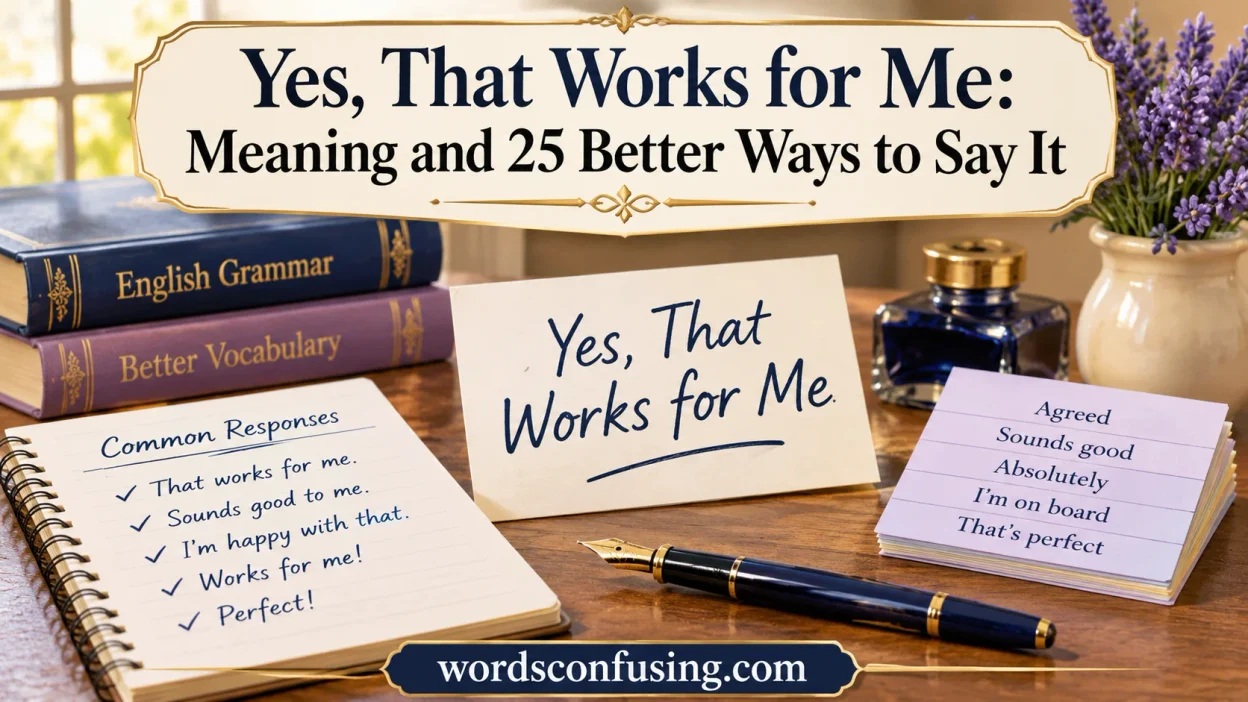
In Yes, That Works for Me: Meaning and 25 Better Ways to Say It, you’ll discover how this phrase communicates agreement in everyday situations.
“That works for me” is a simple phrase that expresses agreement, acceptance, or approval when someone suggests a proposal, plan, or arrangement. Its actual meaning shows that you’re satisfied with an idea or decision.
This commonly used expression appears in daily talk, casual conversations, and everyday communication. You might use it when texting friends, replying to a manager, or discussing arrangements during meetings.
However, repeating the same expression can create overused phrases, repetitive language, and stale wording in your writing and conversations. This becomes noticeable in business emails, academic writing, and workplace communication. Changing your word choice can make writing more engaging.
Learning 25 better ways to say it introduces natural alternatives, phrase alternatives, and alternative expressions without changing the meaning. You can choose formal alternatives for business settings and professional English, or informal alternatives for casual communication and natural conversation.
These language choices improve your vocabulary, language skills, and polished writing style. The right tone and communication style also add warmth, personality, and clarity. A quick-reference table makes useful agreement phrases and approval phrases easier to bookmark.
Quick Answer
“Yes, that works for me” means you agree with a suggestion because it suits your schedule, needs, or preferences. It’s a polite, natural expression for confirming plans, meetings, appointments, or invitations. You can also say “Sounds good to me,” “That suits me,” or “I’m happy with that” to express the same general idea.
What Does “Yes, That Works for Me” Mean?
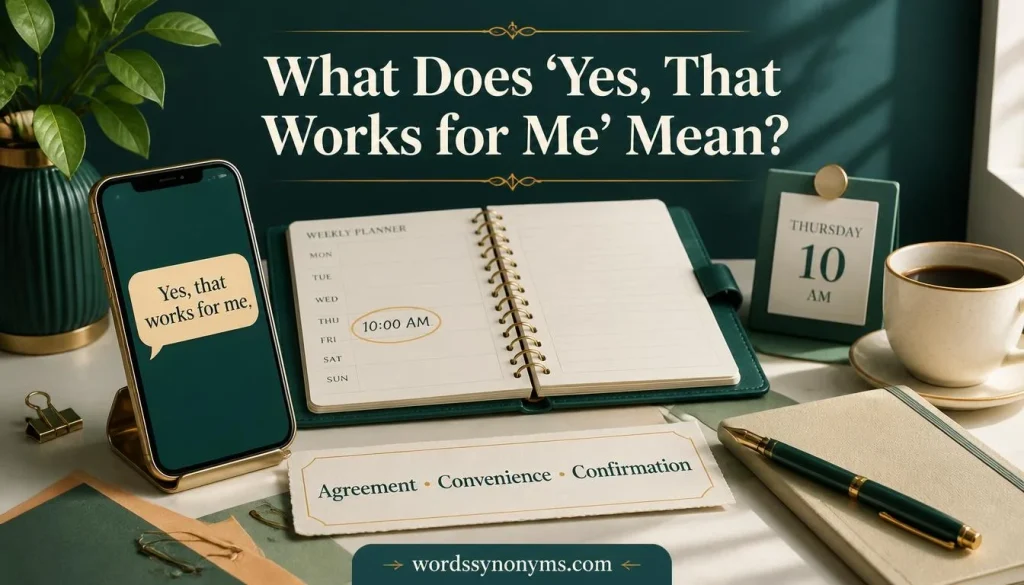
“Yes, that works for me” means that you agree with a suggestion, arrangement, plan, or proposed time because it suits your needs. It’s a polite way to confirm that something is acceptable or convenient.
For example, imagine your coworker sends you this message:
“Can we move our meeting to Thursday at 10 a.m.?”
You could respond:
“Yes, that works for me.”
Your response tells the other person that Thursday at 10 a.m. fits your schedule. You don’t need to explain why you’re available or provide additional details.
The expression contains three meaningful parts:
- Yes: Shows agreement or gives an affirmative response.
- That: Refers to something already mentioned, such as a suggestion or arrangement.
- Works for me: Means the proposed option is suitable or convenient for you.
Together, these words create a simple confirmation that sounds natural in spoken and written English.
Is “Yes, That Works for Me” a Positive Response?
Yes. It’s generally a positive response because it communicates agreement and acceptance.
However, the phrase doesn’t always express excitement. Instead, it usually indicates that you’re comfortable with the suggestion.
Consider these examples:
Example 1:
“Would you like to meet at the coffee shop tomorrow?”
“Yes, that works for me.”
Here, you’re agreeing to the proposed plan.
Example 2:
“Can you submit the report by Friday?”
“Yes, that works for me.”
In this situation, you’re confirming that the deadline is manageable.
Example 3:
“Should we have our discussion over Zoom instead?”
“Absolutely! That works perfectly for me.”
The additional word “perfectly” makes your response sound more enthusiastic.
Therefore, the expression can communicate simple agreement or stronger approval, depending on your wording and tone.
Is “Yes, That Works for Me” Polite and Professional?
Absolutely. “Yes, that works for me” is both polite and professional in most everyday workplace situations.
You can use it when communicating with:
- Your manager or supervisor.
- Coworkers and team members.
- Clients and business partners.
- Teachers and academic advisors.
- Customers and service providers.
- Friends, relatives, and acquaintances.
For example:
“Would Wednesday afternoon be convenient for our discussion?”
“Yes, that works for me. Thank you!”
This response sounds respectful without becoming unnecessarily formal.
However, certain situations require more precise wording. When confirming an important appointment or business commitment, include the relevant date and time.
When Should You Say “Yes, That Works for Me”?
The expression fits situations where someone suggests an option and you want to confirm that it suits you. It works particularly well when discussing schedules, invitations, deadlines, and shared arrangements.
Let’s explore the most common situations.
When Agreeing to a Meeting Time
Scheduling is one of the most common reasons people use this expression.
Someone might suggest a meeting time that fits your availability. Instead of writing a lengthy explanation, you can simply confirm.
Examples:
- “Can we meet Monday at 11 a.m.?” — “Yes, that works for me.”
- “Would Friday afternoon be suitable?” — “Yes, that works perfectly.”
- “Are you available for a quick meeting tomorrow?” — “Sure, that works for me.”
- “Can we move our meeting to 2 p.m.?” — “Yes, that’s convenient for me.”
If you’re confirming a professional meeting, consider mentioning the exact time. This small detail helps prevent scheduling misunderstandings.
When Accepting an Invitation or Plan
You can also use this phrase when someone invites you somewhere or suggests an activity.
For example, a friend might ask whether you’d like to have dinner on Saturday. If you’re available, this expression provides a friendly confirmation.
Examples:
- “Would you like to grab lunch tomorrow?” — “Yes, that works for me.”
- “How about watching a movie this weekend?” — “Sounds good. That works for me!”
- “Can we meet at the park around 5?” — “Yes, that works perfectly.”
- “Are you free for dinner on Friday?” — “Absolutely, that works for me.”
For close friends, you can make the response warmer by adding excitement.
“Perfect! I’m looking forward to it.”
When Responding to a Work Proposal
Professional conversations often involve suggestions about deadlines, project schedules, responsibilities, and working arrangements.
The phrase helps you acknowledge a proposal without making your response unnecessarily complicated.
Examples:
- “Can we finish the first draft by Wednesday?” — “Yes, that works for me.”
- “Would you prefer to handle the presentation next week?” — “That works for me.”
- “Let’s divide the project into three sections.” — “Yes, I’m happy with that arrangement.”
- “Can you review the document before Friday?” — “Absolutely. That timeline works for me.”
One important distinction matters here: agreeing that a proposal works for you doesn’t automatically mean you’ve accepted every responsibility involved. If the task requires additional commitments, clarify those details.
When Replying to Text Messages or Emails
Short confirmations are especially useful in digital conversations.
You don’t always need complete paragraphs when responding to a straightforward question. A simple sentence can communicate everything the other person needs.
Text message example:
Friend: “Let’s meet outside the restaurant at 7.”
You: “Yes, that works for me!”
Email example:
“Would Tuesday at 3 p.m. be suitable for our appointment?”
“Yes, that works for me. Thank you for arranging it.”
The best response depends on your relationship with the recipient and the importance of the arrangement.
Read more: 5 Terms to Describe Being Hard on the Outside But Soft on the Inside
How to Use “Yes, That Works for Me” in a Sentence
The expression usually appears as a complete response to a suggestion or question. It can also appear naturally within a longer sentence.
Here are several ways to use it correctly.
“Yes, That Works for Me” in Everyday Conversations
In casual conversations, the phrase confirms that you agree with someone’s suggestion.
You can use it with friends, relatives, classmates, and acquaintances.
Examples:
- “Would you like to go shopping this afternoon?” — “Yes, that works for me.”
- “Let’s have breakfast together tomorrow.” — “Sure, that works for me.”
- “Can we start the game at 6?” — “Yes, that works perfectly.”
- “How about visiting your grandparents on Sunday?” — “That works for me.”
- “Should we order pizza tonight?” — “Absolutely! That works for me.”
Notice how each response sounds natural without requiring additional explanations.
“Yes, That Works for Me” in Professional Communication
Professional communication benefits from clarity and respectful language. This phrase offers both.
However, adding a brief detail can make your response more useful.
Examples:
- “Yes, that works for me. I’ll prepare the documents beforehand.”
- “That works for me. Thursday at 10 a.m. is convenient.”
- “Yes, I’m comfortable with the proposed schedule.”
- “Absolutely. I can accommodate that deadline.”
- “Yes, that arrangement works well for our team.”
These responses acknowledge the suggestion while keeping the conversation focused.
“Yes, That Works for Me” in Email and Chat
Email responses often need slightly more context than casual text messages.
For example, when someone proposes a meeting, confirm the time and acknowledge their effort.
Professional email example:
Subject: Re: Meeting Schedule
“Hi,
Yes, that works for me. Thursday at 2 p.m. is convenient, and I’ll be ready for the discussion.
Thank you for coordinating the meeting.
Best regards”
For workplace chats, shorter responses usually work well:
- “Yes, that works for me. Thanks!”
- “Perfect, Thursday is good.”
- “That works. I’ll see you then.”
- “Sure, I’ll make that time.”
The main goal is to make your agreement easy to understand.
20 Examples of “Yes, That Works for Me” in Real Situations
Examples make it easier to understand how an expression functions in different conversations. The following situations show how you can use this phrase naturally.
| Situation | Example conversation |
| Confirming a meeting | “Can we meet at 10?” — “Yes, that works for me.” |
| Accepting lunch | “Want to grab lunch tomorrow?” — “Yes, that works for me!” |
| Scheduling a phone call | “Can I call you tonight?” — “Sure, that works for me.” |
| Confirming an appointment | “Does Friday morning suit you?” — “Yes, that works perfectly.” |
| Accepting a deadline | “Can you finish this by Monday?” — “Yes, that works for me.” |
| Choosing a location | “Let’s meet at the library.” — “That works for me.” |
| Planning a virtual meeting | “Should we use Zoom?” — “Yes, that works for me.” |
| Adjusting a work schedule | “Can you start at 9 tomorrow?” — “Sure, that works.” |
| Discussing a project | “Let’s divide the tasks equally.” — “Yes, that works for me.” |
| Arranging a study session | “Can we study together Saturday?” — “Absolutely, that works.” |
| Accepting dinner plans | “How about dinner at 7?” — “Yes, that works perfectly.” |
| Changing a delivery date | “Can we deliver it next Wednesday?” — “That works for me.” |
| Planning a weekend | “Let’s visit the museum Sunday.” — “Sounds good to me!” |
| Scheduling an interview | “Would Tuesday at noon suit you?” — “Yes, that works for me.” |
| Arranging a presentation | “Can you present on Thursday?” — “Yes, that works.” |
| Changing existing plans | “Could we move everything to Saturday?” — “Sure, that works for me.” |
| Choosing a meeting format | “Would you prefer an online meeting?” — “Yes, that works for me.” |
| Dividing responsibilities | “Can you handle the first section?” — “Absolutely, that works.” |
| Rescheduling an appointment | “Can we move your appointment to Monday?” — “Yes, Monday works for me.” |
| Arranging a conversation | “Would tomorrow evening be good for a chat?” — “Yes, that works for me.” |
These examples demonstrate one important point: the phrase works best when you genuinely agree with the suggested arrangement.
If something doesn’t suit your availability, don’t use it simply to sound polite. Instead, explain your situation and suggest another option.
25 Other Ways to Say “Yes, That Works for Me”
Although the original expression is perfectly natural, repeating it in every conversation can sound predictable.
Fortunately, English offers plenty of alternatives. Some sound relaxed and friendly, while others suit professional communication.
The following expressions help you communicate agreement without repeating the same sentence.
Casual Alternatives to “Yes, That Works for Me”
When talking with friends or people you know well, casual expressions can make conversations feel more relaxed.
1. Sounds Good to Me
This expression communicates agreement with someone’s suggestion. It’s especially common when discussing plans or activities.
Example: “Let’s meet at the mall around 4.”
“Sounds good to me!”
2. That Works
A shorter version of the original phrase. It communicates straightforward acceptance without extra wording.
Example: “Can we start at 9?”
“That works.”
3. Sure, That Works for Me
This variation sounds friendly and cooperative. It’s suitable for everyday conversations and informal workplace communication.
Example: “Can we talk after lunch?”
“Sure, that works for me.”
4. I’m Good With That
This expression means you’re comfortable with a suggestion or decision.
Example: “Let’s order Chinese food tonight.”
“I’m good with that!”
5. Yep, That Works for Me
A relaxed alternative that works particularly well in casual messages.
Example: “Are we meeting at the usual place?”
“Yep, that works for me.”
6. That Sounds Great
Use this expression when you want to communicate stronger enthusiasm.
Example: “Would you like to join us for dinner?”
“That sounds great!”
7. Works for Me!
This short response is common in informal conversations and group chats.
Example: “Let’s finish the assignment tomorrow.”
“Works for me!”
Polite and Friendly Alternatives
These expressions communicate agreement while maintaining a warm, considerate tone.
8. Yes, That Sounds Good
A simple and polite response to a suggestion.
Example: “Would you like to meet next Tuesday?”
“Yes, that sounds good.”
9. That Would Be Great
Use this phrase when someone offers an arrangement or opportunity you appreciate.
Example: “I can send you the notes tonight.”
“That would be great. Thank you!”
10. I’m Happy With That
This expression indicates satisfaction with a suggested option.
Example: “We can divide the work into two sections.”
“I’m happy with that.”
11. That Suits Me Well
A slightly more polished alternative that emphasizes personal convenience.
Example: “Would Thursday morning be suitable?”
“Yes, that suits me well.”
12. That Sounds Perfect
This phrase expresses strong approval and enthusiasm.
Example: “Let’s meet at 6 and have dinner afterward.”
“That sounds perfect!”
13. Absolutely, That Works for Me
A confident and positive way to accept a suggestion.
Example: “Can we schedule the call for tomorrow?”
“Absolutely, that works for me.”
14. Yes, I’m Fine With That
This expression communicates acceptance without necessarily showing excitement.
Example: “Would you prefer to change the meeting location?”
“Yes, I’m fine with that.”
Professional Alternatives to “Yes, That Works for Me”
Workplace conversations sometimes require more precise language. These alternatives sound professional while remaining easy to understand.
15. That Works Well for My Schedule
Use this when confirming a proposed time or appointment.
Example: “Can we meet Wednesday at 11?”
“That works well for my schedule.”
16. That Time Is Convenient for Me
This expression directly confirms your availability.
Example: “Would Friday at 2 p.m. work?”
“Yes, that time is convenient for me.”
17. I Can Make That Work
Use this when you can accommodate an arrangement, even if it requires some adjustment.
Example: “Could you attend the meeting at 8 a.m.?”
“Yes, I can make that work.”
18. That Arrangement Works for Me
A suitable response when discussing plans, responsibilities, or agreements.
Example: “We’ll divide the responsibilities between both departments.”
“That arrangement works for me.”
19. I Agree With That Plan
This expression communicates agreement with a proposed course of action.
Example: “Let’s complete the research before starting the presentation.”
“I agree with that plan.”
20. That Timeline Is Manageable
Use this when discussing project schedules or deadlines.
Example: “Can we complete the first stage within two weeks?”
“Yes, that timeline is manageable.”
21. Yes, That Would Be Suitable
A more formal expression for professional correspondence.
Example: “Would Monday afternoon be suitable for your appointment?”
“Yes, that would be suitable.”
Short Alternatives for Text Messages
Sometimes, a short answer is all you need. These expressions work particularly well in quick digital conversations.
22. Sounds Good!
A friendly way to accept an invitation or suggestion.
23. Perfect!
A brief response that communicates strong approval.
24. Sure Thing!
A relaxed expression that indicates willingness or agreement.
25. Absolutely!
A confident affirmative response that sounds positive and enthusiastic.
Remember that short replies depend heavily on context. For example, “Perfect!” works well with friends but may feel too casual in certain formal business exchanges.

“Yes, That Works for Me” vs. Similar Expressions
Several English expressions communicate agreement, but their meanings aren’t always identical.
Understanding these differences helps you choose the right phrase for each situation.
“That Works for Me” vs. “That Sounds Good to Me”
Both expressions communicate agreement. However, they emphasize slightly different things.
“That works for me” focuses on convenience, suitability, or practicality.
“That sounds good to me” expresses approval of an idea, suggestion, or plan.
Consider these examples:
- “Can we meet at 3 p.m.?” — “That works for me.”
- “Let’s try the new Italian restaurant.” — “That sounds good to me.”
The first response confirms availability. The second shows approval of an idea.
Of course, both expressions can work in either situation. Context determines the most natural choice.
“Yes, That Works for Me” vs. “That Works for Me”
These expressions have almost identical meanings.
The main difference is the additional word “yes.”
Compare the examples:
- “Yes, that works for me.”
- “That works for me.”
The first version provides an explicit affirmative response. The second is shorter and more direct.
Both are grammatically correct. You can choose either without changing the essential meaning.
“That Works for Me” vs. “I’m Fine With That”
These expressions both communicate acceptance, but their tone can differ.
“That works for me” generally sounds cooperative and practical.
“I’m fine with that” can sound neutral. Depending on the speaker’s tone, it may occasionally suggest reluctant acceptance.
For example:
“Would you prefer to move the meeting to Thursday?”
“That works for me.”
This sounds like straightforward agreement.
Now consider:
“Would you mind if we changed our plans?”
“I’m fine with that.”
The second response communicates acceptance without necessarily expressing excitement.
“That Works for Me” vs. “I Can Make That Work”
The difference involves convenience and accommodation.
When you say “that works for me,” the suggestion already suits your circumstances.
When you say “I can make that work,” you’re indicating that you can accommodate the arrangement, possibly with some adjustment.
Example:
“Can we meet at 4 p.m.?”
“That works for me.”
However:
“Can we meet earlier than planned?”
“I can make that work.”
The second response suggests flexibility.
“That Works for Me” vs. “Sounds Perfect”
Both expressions communicate positive reactions, but they don’t carry exactly the same level of enthusiasm.
“That works for me” is practical and straightforward.
“Sounds perfect” expresses stronger approval or excitement.
For example:
“Let’s meet at the coffee shop at noon.”
“Sounds perfect!”
This response feels more enthusiastic than a simple confirmation.
Is “Yes, That Works for Me” Grammatically Correct?
Yes, “Yes, that works for me” is grammatically correct and widely understood in everyday English.
The expression follows a natural sentence structure:
- Yes: An affirmative response.
- That: A demonstrative pronoun referring to a previously mentioned suggestion.
- Works: The present-tense form of the verb “work.”
- For me: A prepositional phrase identifying the person for whom the arrangement is suitable.
The verb “work” doesn’t only describe employment or physical activity. English speakers also use it figuratively to describe something that functions well or meets someone’s needs.
For example:
- “This schedule works for me.”
- “The new arrangement works perfectly.”
- “That solution works for everyone.”
- “Your suggested time works well.”
In these examples, “work” means that something is practical, suitable, or effective.
Should You Use a Comma in “Yes, That Works for Me”?
Yes. When “yes” begins a complete response, standard punctuation usually places a comma after it.
Correct:
- Yes, that works for me.
- Yes, I can attend the meeting.
- Yes, that sounds wonderful.
- Yes, Thursday is convenient.
Incorrect in standard punctuation:
- Yes that works for me.
- Yes I can attend the meeting.
The comma separates the introductory affirmative word from the main statement.
You can also use an exclamation point when you want to express enthusiasm:
“Yes, that works for me!”
However, a period generally creates a more neutral tone.
Should You Write “Works for Me” or “Works For Me”?
Both versions can appear correctly depending on capitalization style.
In ordinary sentences, write:
That works for me.
In title case, capitalize words according to your chosen style guide:
Yes, That Works for Me
Many title-case styles keep short prepositions such as “for” lowercase. However, capitalization rules can vary between publishers.
The important point is that “for” should remain lowercase in normal sentence writing.
Is “Yes, That Works for Me” Formal or Informal?
“Yes, that works for me” is a neutral expression. It doesn’t belong exclusively to formal or informal English. Its suitability depends on the conversation, relationship, and situation.
You can use it with friends, colleagues, managers, and clients. However, the surrounding words can make the response sound more casual or professional.
Consider the following comparison:
| Situation | Natural response | Tone |
| Talking to a friend | “Yep, that works for me!” | Casual |
| Replying to a coworker | “Yes, that works for me.” | Neutral |
| Responding to a manager | “Yes, that time works well for me.” | Professional |
| Confirming a client meeting | “That time is convenient for me.” | Polite and professional |
| Accepting an invitation | “Absolutely, that sounds great!” | Friendly |
When Is It Appropriate in Professional Emails?
The expression works well in professional emails when you need to confirm something straightforward.
For example, if a client suggests a meeting time, you can respond:
“Yes, that works for me. I’ll send a calendar invitation shortly.”
This response communicates agreement and identifies the next step.
However, when discussing contracts, deadlines, or important business commitments, avoid vague confirmations. Mention the specific arrangement you’re accepting.
For instance:
“Yes, the proposed delivery date of November 12 works for our team.”
This version makes your agreement clear and reduces the possibility of confusion.
How to Reply When Someone Says “Yes, That Works for Me”
When someone responds with “Yes, that works for me,” you usually don’t need another lengthy confirmation. A brief acknowledgment keeps the conversation moving.
Still, your response should match the situation.
Replies When Confirming a Meeting
If someone agrees to your proposed meeting time, acknowledge their confirmation and explain what happens next.
Here are some natural responses:
- “Great, I’ll send the calendar invitation.”
- “Perfect! See you on Thursday.”
- “Thanks for confirming.”
- “Excellent. I’ll share the meeting details shortly.”
- “Wonderful. Looking forward to our discussion.”
Example conversation:
A Person : “Would Thursday at 11 a.m. work for you?”
B Person: “Yes, that works for me.”
C Person: “Great! I’ll send you the meeting invitation.”
This exchange is short, polite, and clear.
Replies in Casual Conversations
When friends or family members agree with your plans, a warmer response usually feels natural.
Try these expressions:
- “Awesome, see you there!”
- “Great! Looking forward to it.”
- “Perfect, it’s a plan.”
- “Brilliant! I’ll see you then.”
- “Sounds good. Have a great day!”
Example conversation:
Friend: “Let’s meet at the restaurant around 7.”
You: “Does that work for you?”
Friend: “Yes, that works for me.”
You: “Awesome! See you there.”
There’s no need to turn a simple conversation into a formal exchange.
Replies in Professional Emails
Professional acknowledgments should remain courteous and relevant. You can also mention the next action when necessary.
| Their response | Your reply |
| “Yes, that works for me.” | “Thank you for confirming.” |
| “Thursday is convenient.” | “Excellent. I’ll update the invitation.” |
| “That arrangement works for me.” | “Great. We’ll proceed with that arrangement.” |
| “I can accommodate that deadline.” | “Thank you. I’ll share the updated timeline.” |
| “Absolutely, that works.” | “Perfect. I appreciate your confirmation.” |
A useful rule is to avoid repeating the same confirmation unnecessarily. Once both people understand the arrangement, move to the next step.
Common Mistakes to Avoid When Using “Yes, That Works for Me”
Although the expression is simple, a few communication mistakes can create confusion.
Here are some things worth remembering.
1. Using It When You Actually Disagree
Don’t say something works for you when it creates a genuine problem.
For example:
“Can we move the appointment to 6 a.m.?”
If you’re unavailable, respond honestly:
“Unfortunately, that time doesn’t work for me. Would 9 a.m. be possible?”
This answer remains polite while communicating your actual availability.
2. Forgetting to Confirm Important Details
A simple confirmation might not provide enough information for an important appointment.
Instead of saying:
“Yes, that works for me.”
Consider writing:
“Yes, Tuesday, November 10, at 2 p.m. works for me.”
Including the date and time helps both people avoid mistakes.
3. Assuming the Phrase Always Shows Excitement
The expression generally communicates acceptance rather than excitement.
If you’re genuinely enthusiastic, add a few words:
“Yes, that sounds fantastic! I’m looking forward to it.”
This makes your feelings clearer.
4. Using Casual Language in Every Professional Situation
“Yep, sounds good!” works perfectly well with familiar coworkers. However, some formal business exchanges require more polished wording.
Try:
“Yes, that arrangement is suitable.”
The wording sounds more formal without becoming unnecessarily complicated.
5. Confusing Agreement With a Firm Commitment
Saying that something works for you confirms suitability. It doesn’t automatically explain every responsibility or condition.
For example, agreeing to a proposed project deadline doesn’t necessarily mean you’ve accepted additional tasks.
When responsibilities matter, clarify them separately.

Real-Life Communication Examples: Choosing the Right Response
Let’s look at three practical situations where choosing the right wording makes a difference.
Case Study: Rescheduling a Workplace Meeting
Imagine your manager schedules a meeting for Wednesday morning. However, another commitment requires moving it to Thursday afternoon.
Your manager writes:
“Would Thursday at 3 p.m. work for you instead?”
You respond:
“Yes, that works for me. I’ll update my calendar.”
Why this response works:
- It clearly confirms your availability.
- It acknowledges the suggested change.
- It identifies the next action.
- It maintains a professional tone.
There’s no need for a long explanation when the proposed time already suits you.
Case Study: Accepting a Friend’s Invitation
Your friend sends you a message:
“How about getting dinner together on Saturday?”
You genuinely like the idea and want to accept.
You could respond:
“Yes, that works for me! Looking forward to it.”
Why this response works:
- It communicates agreement.
- It sounds friendly and natural.
- It adds enthusiasm without unnecessary wording.
In casual conversations, small additions can make a response feel warmer.
Case Study: Confirming a Project Deadline
A team member asks:
“Can we submit the completed draft by Friday afternoon?”
You review your schedule and realize the deadline is manageable.
Your response:
“Yes, that timeline works for me. I’ll complete my section by Thursday.”
Why this response works:
It confirms the deadline while establishing a personal commitment. Your teammate also knows when to expect your contribution.
These examples show that the original phrase works across different situations. The best responses simply add details when clarity requires them.
Read more: What Does It Mean When Someone Calls You Sunshine? Meanings
FAQs
1. Is “That Works for Me” a polite expression?
Yes, “that works for me” is a polite and friendly way to express agreement. You can use it with friends, coworkers, managers, and clients. It sounds natural in most everyday and professional conversations.
2. What does “Yes, That Works for Me” mean?
It means you’re happy with a suggestion, plan, or arrangement. You’re letting someone know that their idea suits your needs and you’re comfortable moving forward.
3. Is “That Works for Me” professional enough for emails?
Yes, it works well in most workplace emails. However, phrases like “That sounds good to me” or “I agree with this arrangement” may sound more suitable in formal business communication.
4. What is a more formal way to say “That Works for Me”?
You can say “That arrangement is suitable for me,” “I find that acceptable,” or “I am happy to proceed with that.” These alternatives sound polished in professional emails and business discussions.
5. Can I use “That Works for Me” when confirming a meeting time?
Absolutely! It’s a natural response when someone suggests a meeting date or time. For example, if a coworker suggests Friday at 10 a.m., you can simply reply, “Yes, that works for me.”
6. How can I avoid repeating “That Works for Me”?
Try keeping several alternatives ready for different situations. Use “Sounds perfect” in casual conversations, “That suits my schedule” for appointments, and “I am happy with that arrangement” in professional settings. This makes your communication sound more natural and less repetitive.
Conclusion
Saying “that works for me” is an easy way to show agreement, but you don’t have to rely on it every time. A few thoughtful alternatives can make your conversations, emails, and workplace replies sound more natural. Whether you’re talking to a friend, confirming an appointment, or responding to your manager, choose words that match the situation and your relationship with the other person.
The goal isn’t to use complicated vocabulary or make every reply sound formal. It’s simply to express yourself clearly while adding a little variety to your language. Keep a few of these 25 alternatives handy, try them in real conversations, and notice which ones feel most comfortable. Sometimes, changing just a few words makes your communication sound much more personal and confident.

Franklin Hayes is a writer and editor at WordsConfusing.com, focused on making English vocabulary, grammar, and commonly confused words easy to understand. He writes clear, practical articles with simple explanations and useful examples to help readers improve their English with confidence.
His goal is simple: Making Confusing Words Simple.


