
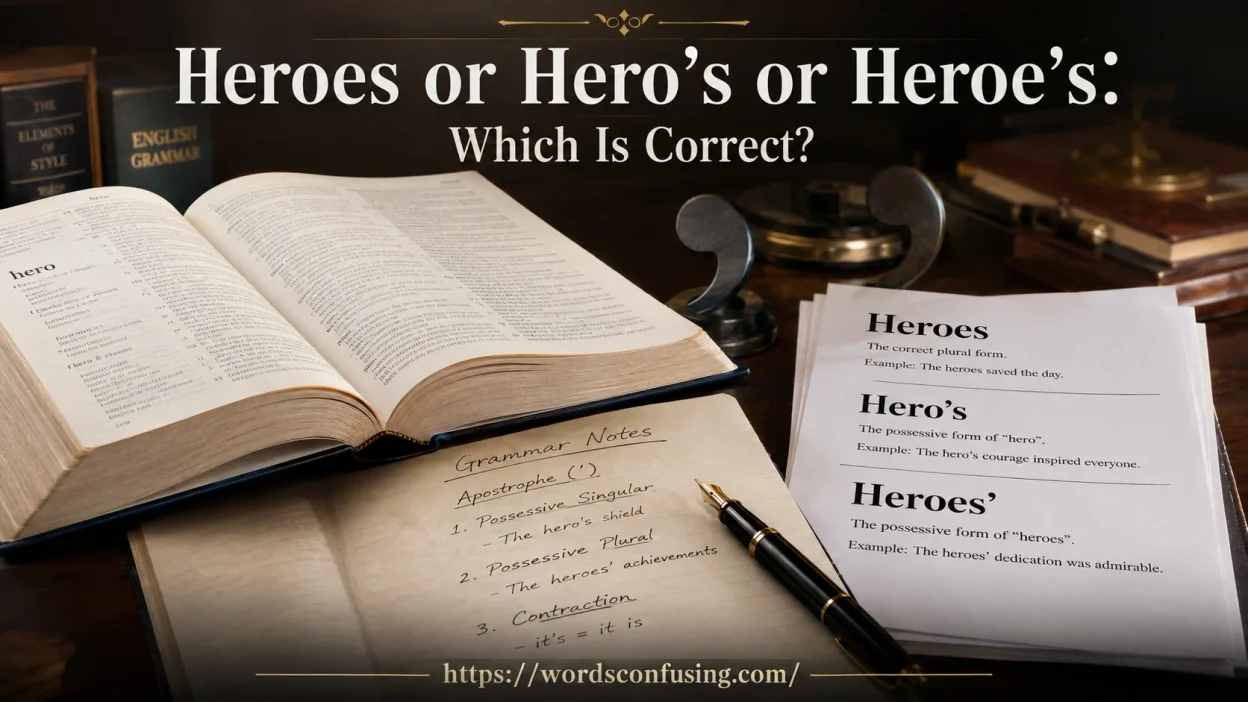
Heroes or Hero’s or Heroes’: Which Is Correct? becomes easier when you understand the English grammatical rules behind these spellings.
A Hero is a noun for a person admired for courage, outstanding achievements, or noble qualities. Its plural form is heroes, not heros. The common rule for nouns ending in o after a consonant is to add es, as with potatoes, tomatoes, and echoes, while pianos and photos are exceptions.
From my teaching experience, learners often understand this linguistic pattern through simple comparisons. Firefighters can be true heroes when more than one individual performs a heroic act.
In ordinary standard English, Heros is an incorrect plural form, although it is a valid term in ichthyology, the study of fish, referring to a genus in the cichlid family found in South America.
Hero’s and Heroes’ have a different purpose because they show ownership. The possessive form Hero’s can show that one hero owns an object, while Heroes’ indicates multiple heroes and plural ownership. In writing, spelling mistakes can appear in emails, social media posts, and formal documents.
Clear practical usage, examples, and practice improve writing clarity, accuracy, communication, and writing skills. Choosing the correct form depends on context, word choice, and established spelling patterns.
Quick Answer
Here’s the easiest way to separate the three forms:
| Form | Meaning | Grammatical Function | Example |
| hero | One hero | Singular noun | He became a hero. |
| heroes | More than one hero | Plural noun | The heroes arrived. |
| hero’s | Belonging to one hero | Singular possessive | The hero’s sword was broken. |
| heroes’ | Belonging to multiple heroes | Plural possessive | The heroes’ swords were broken. |
| heros | Usually an incorrect plural spelling | Incorrect in standard usage | ❌ The heros arrived. |
The most important distinction involves the apostrophe.
Heroes has no apostrophe because it simply forms the plural.
Hero’s places the apostrophe before the s because one hero owns or relates to something.
Heroes’ places the apostrophe after the s because multiple heroes own or relate to something.
Think of the apostrophe as a small signpost. It tells you that possession or association is involved.
What Does “Heroes” Mean?
Heroes is the standard plural form of hero.
When you write heroes, you’re talking about two or more heroes. The word doesn’t indicate ownership by itself.
For example:
- The heroes saved the town.
- Several heroes received awards.
- The movie features three heroes.
- Those firefighters became local heroes.
- The children admired the heroes in the story.
Notice something important in every example. Heroes identifies more than one person or character. It doesn’t tell you that anything belongs to them.
Heroes Is the Plural of Hero
The singular noun is:
hero
The plural noun is:
heroes
This spelling follows the traditional plural pattern for hero. You don’t normally create the plural by simply adding s.
So:
- ❌ hero → heros
- ✅ hero → heroes
That extra e matters.
The same pattern appears in several familiar English words:
| Singular | Plural |
| hero | heroes |
| potato | potatoes |
| tomato | tomatoes |
| echo | echoes |
| veto | vetoes |
However, English doesn’t apply one universal rule to every noun ending in -o. Other words take only -s:
| Singular | Plural |
| photo | photos |
| piano | pianos |
| radio | radios |
| video | videos |
That’s why memorizing the spelling of individual words can sometimes save you trouble.
Why “Heros” Is Usually Wrong
A common spelling mistake occurs when writers treat hero like words such as photo or piano.
They may write:
The movie’s heros were unforgettable.
The standard spelling is:
The movie’s heroes were unforgettable.
The mistake doesn’t change the pronunciation dramatically. That’s part of the problem. When you hear the word, you can’t see whether the writer included the second e.
Writing makes the distinction visible.
Heroes in Everyday English
The word heroes doesn’t only describe fictional characters wearing capes.
You might use it for:
- firefighters
- soldiers
- doctors
- parents
- community volunteers
- historical figures
- fictional characters
- athletes
- people who perform courageous acts
For example:
The firefighters were celebrated as heroes after rescuing the family.
Here, heroes simply identifies multiple people who performed an admirable action.
No apostrophe belongs in the word.
Related Topics: Universities or University’s or Universities’? Which Is Correct?
What Does “Hero’s” Mean?
Hero’s is the singular possessive form of hero.
It usually means something belongs to, comes from, relates to, or is associated with one hero.
For example:
The hero’s sword lay on the ground.
The sword belongs to one hero.
You can think of the structure this way:
one hero + possession → hero’s
The apostrophe appears before the s because the base noun is singular.
Examples of Hero’s in Sentences
Consider these examples:
- The hero’s courage inspired everyone.
- The hero’s costume was damaged.
- The hero’s decision changed the story.
- The hero’s horse disappeared.
- The hero’s name became famous.
- The hero’s family attended the ceremony.
In each sentence, you’re dealing with one hero.
The relationship doesn’t always represent literal ownership.
For instance:
The hero’s courage inspired the crowd.
Courage isn’t something a person physically owns like a bicycle. The possessive form still works because the courage belongs to or characterizes that hero.
Hero’s Can Show Relationships
Possessive constructions often describe relationships rather than physical ownership.
For example:
- the hero’s family
- the hero’s childhood
- the hero’s reputation
- the hero’s journey
- the hero’s identity
- the hero’s sacrifice
- the hero’s personality
In each case, hero’s connects one hero with another noun.
This is why thinking only in terms of “ownership” can sometimes make grammar confusing. A better question is:
Does this noun relate to one hero?
If the answer is yes and you’re using a possessive construction, hero’s may be the correct form.
What Does “Heroes’” Mean?
Heroes’ is the plural possessive form.
It indicates that something belongs to, relates to, or is associated with two or more heroes.
This distinction becomes much clearer when you compare it with hero’s.
The hero’s shield was polished.
One hero has the shield.
The heroes’ shields were polished.
Multiple heroes have the shields.
The apostrophe moved because the number of owners changed.
Why Is the Apostrophe After the S?
The plural noun heroes already ends in s.
When a regular plural noun ends in s, English generally forms the possessive by adding an apostrophe after that final s.
So:
heroes → heroes’
You don’t normally add another s after the apostrophe.
That gives you:
- hero’s = one hero
- heroes’ = multiple heroes
This tiny punctuation difference can completely change the meaning of a sentence.
Examples of Heroes’ in Sentences
Here are several natural examples:
- The heroes’ names appeared on the memorial.
- The heroes’ stories inspired a new generation.
- The museum displayed the heroes’ medals.
- The heroes’ uniforms were preserved.
- The children listened to the heroes’ stories.
- The heroes’ actions changed the course of the battle.
Each example involves more than one hero.
The apostrophe comes after the plural s.
Heroes vs. Hero’s vs. Heroes’: The Core Grammar Rule
The entire distinction can be reduced to four forms:
ONE PERSON
↓
hero
↓ possession
hero’s
MORE THAN ONE
↓
heroes
↓ possession
heroes’
That gives you this quick reference:
| Form | Number | Possessive? | Example |
| hero | One | No | The hero arrived. |
| heroes | More than one | No | The heroes arrived. |
| hero’s | One | Yes | The hero’s shield broke. |
| heroes’ | More than one | Yes | The heroes’ shields broke. |
There’s a useful mental shortcut here:
No apostrophe = just the noun.
Apostrophe before s = one owner.
Apostrophe after s = multiple owners.
That shortcut handles most ordinary sentences involving these three forms.
Heroes or Hero’s or Heroes’: Compare the Meaning
A single sentence can demonstrate all three forms.
The heroes gathered outside the castle.
Here, heroes means several heroes.
Now add possession:
The hero’s sword was missing.
Here, one hero has a missing sword.
Change the number:
The heroes’ swords were missing.
Now several heroes have missing swords.
The difference is small on the page. The grammatical meaning isn’t.
One Letter and One Apostrophe Can Change Everything
Compare these sentences:
The hero saved the village.
One hero performed the action.
The heroes saved the village.
Several heroes performed the action.
Now compare:
The hero’s plan saved the village.
One hero has a plan.
The heroes’ plan saved the village.
Several heroes share or are associated with the plan.
The apostrophe isn’t decoration. It carries information.
Heroes or Hero’s: When Should You Use Each?
The easiest way to decide between heroes and hero’s is to ask what the sentence needs.
Use Heroes When You Mean Multiple Heroes
Use heroes when the word functions as an ordinary plural noun.
Examples:
The heroes entered the building.
The children dressed as heroes for the festival.
Several heroes appear in the novel.
The town honored its heroes.
None of these sentences shows possession.
Use Hero’s When One Hero Is Connected to Something
Use hero’s when one hero possesses or relates to something.
Examples:
The hero’s shield was damaged.
Everyone admired the hero’s courage.
The hero’s story became famous.
The hero’s family moved away.
A simple test works well:
Replace hero’s with the hero’s in your mind.
If the sentence still makes sense as a relationship involving one hero, the singular possessive is probably right.
Hero’s vs. Heroes’: The Most Important Difference
Many writers understand heroes but still hesitate between hero’s and heroes’.
The deciding factor is the number of possessors.
| Sentence | Number of heroes | Correct form |
| The ___ costume was torn. | One | hero’s |
| The ___ costumes were torn. | Several | heroes’ |
| The ___ story inspired me. | One | hero’s |
| The ___ stories inspired me. | Several | heroes’ |
| The ___ medals were displayed. | One | hero’s |
| The ___ medals were displayed. | Several | heroes’ |
Here’s the key:
One hero → hero’s
Several heroes → heroes’
Once you identify the number of owners, apostrophe placement becomes much easier.
Heroes’ vs. Heroes: Why the Apostrophe Matters
Consider:
The heroes names were announced.
This sentence needs a possessive because the names belong to the heroes.
The correct version is:
The heroes’ names were announced.
Now remove the possessive relationship:
The heroes were announced.
Here, heroes simply acts as a plural noun.
That difference provides a useful editing test.
Ask:
Does something belong to or relate to the heroes?
If yes, you may need heroes’.
If you’re simply talking about the people themselves, use heroes.
Common Mistakes With Heroes, Hero’s, and Heroes’
These mistakes appear frequently because English uses the apostrophe for several related functions.
Mistake: Using Hero’s as the Plural
Incorrect:
The hero’s arrived at the scene.
Correct:
The heroes arrived at the scene.
Why?
The sentence talks about multiple heroes. It doesn’t show possession.
Mistake: Writing Heros
Incorrect:
The firefighters became local heros.
Correct:
The firefighters became local heroes.
The standard plural spelling is heroes.
Mistake: Adding an Apostrophe to a Simple Plural
Incorrect:
The heroes’ saved the city.
Correct:
The heroes saved the city.
The word heroes functions as the subject. Nothing belongs to the heroes in this sentence.
Mistake: Using Hero’s for Several Owners
Incorrect:
The hero’s medals were placed in the museum.
If several heroes own the medals, write:
The heroes’ medals were placed in the museum.
The plural possessive needs the apostrophe after s.
Mistake: Forgetting the Apostrophe in a Possessive
Incorrect:
The heroes names appeared in the newspaper.
Correct:
The heroes’ names appeared in the newspaper.
Without the apostrophe, the sentence loses its possessive marker.
A Simple Trick for Choosing the Correct Form
When you’re unsure, don’t stare at the apostrophe. Start with meaning.
Ask: How Many Heroes?
If there’s one, use:
hero
If there are two or more, use:
heroes
Ask: Is There Possession?
If no possession or relationship exists, stop there.
You need:
hero or heroes
If possession exists, continue.
Ask: How Many Owners?
One owner:
hero’s
Multiple owners:
Heroes or Hero’s or Heroes’: Real-World Examples
Grammar becomes easier when you see how these forms behave in practical writing.
Example: A Historical Memorial
Suppose a city creates a memorial for several people who performed heroic acts.
You might write:
The heroes’ names were engraved on the wall.
Why heroes’?
Because several heroes have their names engraved there.
Now imagine the memorial focuses on one individual:
The hero’s name was engraved beneath the photograph.
Only one hero is involved.
If you’re talking about the people themselves:
The heroes were honored during the ceremony.
No possession exists. Therefore, no apostrophe appears.
Example: A Fictional Story
Imagine a novel featuring three heroes.
You could write:
The heroes traveled across the kingdom.
That’s the plural noun.
Later:
The hero’s decision surprised everyone.
One hero made the decision.
Then:
The heroes’ decisions changed the outcome.
Now several heroes made decisions.
The sentence structure tells you which form you need.
Case Study: A School Writing Assignment
Imagine a student writes:
The heroes’s stories were inspiring.
This version contains an unnecessary extra s.
The correct form is:
The heroes’ stories were inspiring.
Why?
Heroes is already plural. The possessive apostrophe simply follows the existing s.
Now change the sentence:
The hero’s story was inspiring.
Here, only one hero has the story.
The contrast is straightforward:
- hero’s story = one hero
- heroes’ stories = multiple heroes
This distinction can help students avoid one of the most common apostrophe errors.
Case Study: A Restaurant Menu
Imagine a restaurant creates a themed menu honoring famous fictional characters.
A menu heading says:
Heroes Special
That wording may be intended to describe a special associated with multiple heroes.
However, if the restaurant wants to say the special belongs to one specific hero, the wording changes:
The Hero’s Special
If the restaurant refers to a special associated with several heroes, it could use:
The Heroes’ Special
A tiny punctuation mark can therefore change the intended meaning on a sign, menu, website, or advertisement.
That’s why apostrophe errors aren’t merely academic concerns. They can affect how professional writing looks and how readers interpret it.
Heroes in Literature, History, and Everyday English
The word hero has a broad range of uses.
Heroes in Fiction
Writers often use heroes to describe multiple central characters:
The heroes must overcome several obstacles.
Possessive forms appear when discussing individual or shared characteristics:
The hero’s journey begins in an unfamiliar world.
The heroes’ journeys eventually intersect.
Heroes in History
Historical writing frequently discusses groups of people who performed courageous acts:
The country honored its heroes.
If the text discusses something belonging to those individuals:
The heroes’ sacrifices became part of the nation’s history.
For one individual:
The hero’s actions inspired generations.
Heroes in Everyday Conversation
You can also use hero informally for someone who saves the day.
For example:
You’re a hero for helping me move.
With several people:
You guys are heroes for getting everything finished.
Possessive forms work in exactly the same way:
The hero’s kindness made everyone smile.
The heroes’ kindness made everyone smile.
The context changes. The grammar doesn’t.
Facts About the Word “Hero”
A few useful language facts make the spelling easier to remember.
- Hero is a singular noun.
- Heroes is its standard plural form.
- Hero’s is the singular possessive form.
- Heroes’ is the plural possessive form.
- Heros is generally not the standard plural spelling.
- The apostrophe in hero’s comes before the s.
- The apostrophe in heroes’ comes after the plural s.
- Possessive forms can show relationships as well as literal ownership.
One especially useful point deserves emphasis: possessive doesn’t always mean physical ownership.
In the hero’s story, the hero doesn’t “own” the story in the same way someone owns a backpack. The phrase simply establishes a relationship between the hero and the story.
Why English Apostrophes Cause So Much Confusion
Apostrophes perform several jobs in English.
They can indicate:
- possession
- omitted letters in contractions
- certain possessive constructions
The problem often starts when writers assume that an apostrophe automatically means “more than one.”
It doesn’t.
That’s one of the most important lessons here.
An apostrophe usually signals possession, not plurality.
So writing hero’s doesn’t mean “many heroes.” It means something associated with one hero.
Likewise, heroes’ doesn’t simply mean “heroes.” It means something associated with multiple heroes.
Heroes or Hero’s or Heroes’: Quick Editing Checklist
Before publishing an article, essay, caption, website page, or school assignment, check the sentence against this list:
- Are you talking about one hero?
- Use hero.
- Are you talking about multiple heroes?
- Use heroes.
- Does something belong to one hero?
- Use hero’s.
- Does something belong to multiple heroes?
- Use heroes’.
- Did you accidentally write heros?
- Change it to heroes in standard English.
- Did you add an apostrophe simply because a noun is plural?
- Remove it unless possession requires one.
This checklist takes only a few seconds.
Heroes vs. Hero’s vs. Heroes’: Complete Comparison
| Form | Correct? | What It Means | Example |
| hero | Yes | One hero | He is a hero. |
| heroes | Yes | More than one hero | The heroes arrived. |
| hero’s | Yes | Something associated with one hero | The hero’s sword gleamed. |
| heroes’ | Yes | Something associated with several heroes | The heroes’ swords gleamed. |
| heros | Usually no | Incorrect standard plural | ❌ The heros arrived. |
| hero’s as a plural | No | Incorrect use | ❌ Three hero’s arrived. |
| heroes’ without possession | No | Incorrect apostrophe use | ❌ The heroes’ arrived. |
The table reveals the pattern at a glance.
Number comes first. Possession comes second.
That’s the cleanest way to solve the problem.
How to Remember Heroes, Hero’s, and Heroes’
If you tend to forget apostrophe rules, use this three-part memory trick:
Heroes = Many
Think:
heroes = several heroes
No apostrophe.
Hero’s = One Owner
Think:
hero + ’s = one hero’s possession
The apostrophe comes before the s.
Heroes’ = Many Owners
Think:
heroes + ’ = several heroes’ possession
The apostrophe comes after the s.
A short phrase can make the pattern stick:
One hero’s. Many heroes’.
Once that becomes familiar, choosing the correct form gets almost automatic.
FAQs
Is “heroes” the correct plural of “hero”?
Yes. Heroes is the correct plural form of hero in standard English. For example, you can say, “The firefighters were true heroes.”
Is “heros” ever correct?
In ordinary English, heros is incorrect. However, Heros is also the name of a fish genus used in ichthyology, so its meaning depends on the context.
Is “Hero’s” grammatically correct?
Yes. Hero’s is the singular possessive form. Use it when something belongs to one hero, such as “The hero’s courage inspired everyone.”
When should I use “Heroes’”?
Use Heroes’ when something belongs to more than one hero. For example, “The heroes’ actions saved many lives.”
Why does “hero” become “heroes” instead of “heros”?
The plural follows a common spelling pattern for some nouns ending in o after a consonant. These words often take es, as in hero → heroes.
Are “heroes” and “Hero’s” interchangeable?
No. Heroes is plural, while Hero’s shows singular possession. The correct choice depends on whether you’re talking about multiple heroes or something owned by one hero.
Conclusion
At first, Heroes, Hero’s, and Heroes’ can look almost the same, but the difference is actually pretty simple. Think of heroes as the plural form, Hero’s as something belonging to one hero, and Heroes’ as something belonging to several heroes. Once you get used to this pattern, choosing the right form becomes almost automatic.
A little practice can go a long way, especially when you’re writing emails, assignments, or everyday messages. So the next time you pause over these three forms, don’t overthink it just check whether you’re talking about people or showing ownership.

Franklin Hayes is a writer and editor at WordsConfusing.com, focused on making English vocabulary, grammar, and commonly confused words easy to understand. He writes clear, practical articles with simple explanations and useful examples to help readers improve their English with confidence.
His goal is simple: Making Confusing Words Simple.