
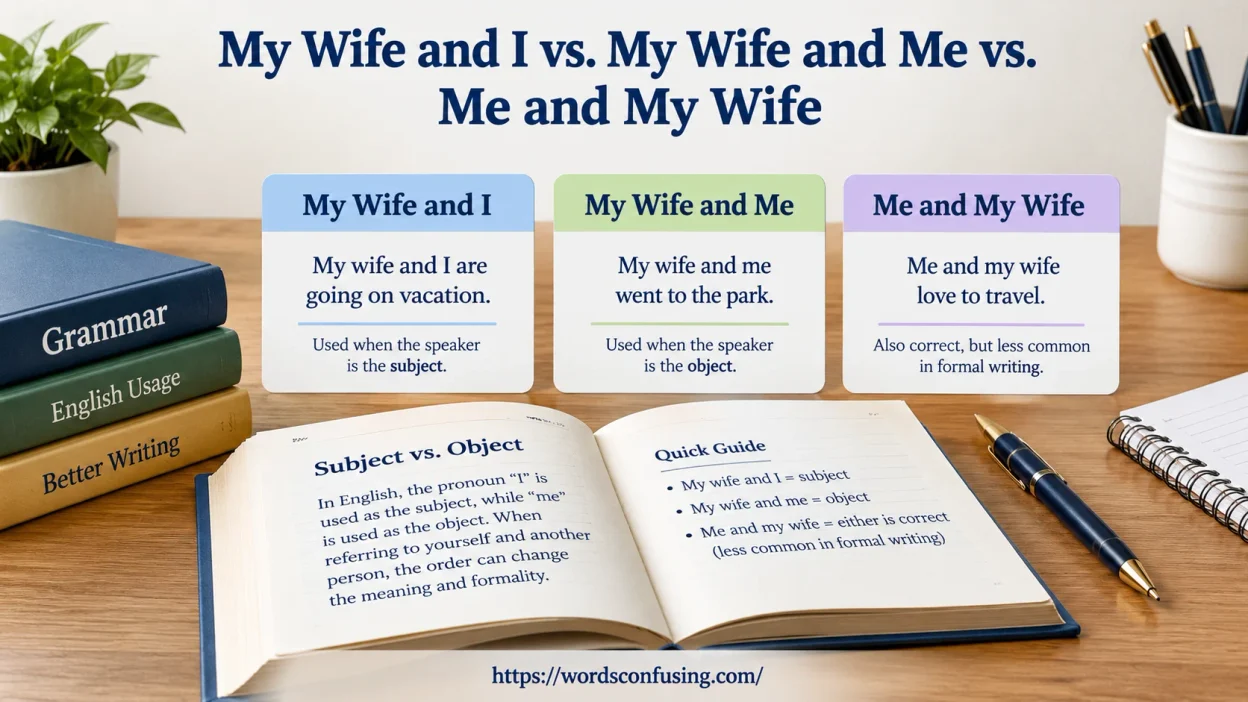
For English learners, My Wife and I vs. My Wife and Me vs. Me and My Wife can create confusion because these phrases sound familiar and sometimes seem interchangeable.
You may hear them in conversations, books, social media, emails, essays, social posts, job applications, and speeches. However, standard English grammar gives each phrase a different role in the sentence. The main difference depends on sentence structure and grammatical role. I works as a subject pronoun, while me works as an object pronoun.
For example, “My Wife and I went to the store” uses My Wife and I as the grammatical subject because they perform the action. This simple idea makes the correct phrase much easier to recognize.
A useful grammar trick can help you make the right phrase choice quickly. Remove the other person and test whether I or me sounds correct. If “I went to the store” works, choose My Wife and I. If “He gave me a gift” works, choose my wife and me.
This simple rule works in formal language, informal language, spoken English, and written English. Although native speakers sometimes bend the grammatical rule during casual speech, grammar experts still recommend following standard English grammar in formal writing.
From my experience, this approach prevents common mistakes, grammar errors, and grammar issues. You don’t need heavy memorization; understanding the context, subject position, object position, and grammatical context makes the difference clear.
Quick Answer
Use “my wife and I” when the phrase functions as the subject of a sentence.
My wife and I went to the restaurant.
Use “my wife and me” when the phrase functions as the object of a verb or preposition.
The restaurant manager greeted my wife and me.
“Me and my wife” occurs in casual conversation, but it is generally not the preferred form for a subject in standard formal English.
Formal: My wife and I went to the restaurant.
Casual/nonstandard: Me and my wife went to the restaurant.
A useful shortcut is to remove “my wife and” from the sentence.
- I went to the restaurant. → My wife and I went to the restaurant.
- They invited me. → They invited my wife and me.
- She spoke with me. → She spoke with my wife and me.
This simple test works because it reveals which pronoun belongs in the sentence.
“My Wife and I” — When Is It Correct?
“My wife and I” is correct when the two people together form the subject of the sentence.
A subject usually performs the action described by the verb. In the sentence below, the phrase performs the action of visiting:
My wife and I visited our friends.
If you remove “my wife and”, the sentence becomes:
I visited our friends.
That sounds correct, which confirms that “I” is the appropriate pronoun.
Consider a few more examples:
- My wife and I bought a house.
- My wife and I are planning a vacation.
- My wife and I attended the wedding.
- My wife and I discussed the problem.
- My wife and I live near the city.
- My wife and I decided to stay home.
In each example, “my wife and I” acts as the subject.
Why “I” Works Here
English distinguishes between subject pronouns and object pronouns. The subject form “I” identifies the person performing an action or occupying the subject position.
Compare these basic forms:
| Subject pronoun | Object pronoun |
| I | me |
| he | him |
| she | her |
| we | us |
| they | them |
The same pattern explains why we say:
- My wife and I went shopping.
- My wife and I called the doctor.
- My wife and I made the decision.
You wouldn’t normally say:
- Me went shopping.
- Me called the doctor.
- Me made the decision.
Adding “my wife and” doesn’t change the grammatical role of the pronoun. If “I” is required alone, then “my wife and I” remains appropriate when another person joins the phrase.
“My Wife and Me” — When Is It Correct?
“My wife and me” is correct when the phrase functions as an object.
An object can receive the action of a verb. It can also follow a preposition. This distinction explains many of the sentences that confuse English learners and native speakers alike.
For example:
The teacher called my wife and me.
The verb called acts on the people being called. Therefore, the phrase functions as an object.
Remove “my wife and”, and you get:
The teacher called me.
That sentence is correct, so “my wife and me” is correct too.
Other examples include:
- They invited my wife and me.
- The doctor examined my wife and me.
- The company contacted my wife and me.
- The police officer questioned my wife and me.
- Our friends surprised my wife and me.
In every case, “me” receives or experiences the action.
“My Wife and Me” After Prepositions
Prepositions provide another strong clue.
Words such as to, for, with, from, between, about, and against commonly introduce objects. Therefore, “me” normally follows them rather than “I.”
Examples:
- This gift is for my wife and me.
- She spoke with my wife and me.
- The decision affected my wife and me.
- Nobody knew about my wife and me.
- The agreement was between my wife and me.
- The message came from my wife and me.
The phrase “between my wife and me” is especially important because people frequently use “between my wife and I” incorrectly.
The word between is a preposition. Therefore, the pronoun following it normally takes the object form.
Correct: The secret stayed between my wife and me.
Incorrect in standard English: The secret stayed between my wife and I.
The Easiest Test: Remove “My Wife and”
When you’re unsure about “my wife and I” vs. “my wife and me,” use the removal test.
Temporarily remove “my wife and.” Then read the sentence using only the pronoun.
Example One
My wife and I went to the store.
Remove the other person:
I went to the store.
That works.
Therefore:
My wife and I went to the store.
Example Two
The cashier helped my wife and me.
Remove the other person:
The cashier helped me.
That works.
Therefore:
The cashier helped my wife and me.
Example Three
The invitation was sent to my wife and me.
Remove the other person:
The invitation was sent to me.
Again, the sentence works.
Therefore:
The invitation was sent to my wife and me.
This test is remarkably useful because it cuts through the instinct to choose whichever phrase sounds more polished.
“Me and My Wife” — Is It Correct?
“Me and my wife” appears frequently in informal spoken English. However, standard formal English generally prefers “my wife and I” when the phrase acts as the subject.
For example:
Me and my wife went shopping.
You may hear this sentence in casual conversation. However, for formal writing, a better version is:
My wife and I went shopping.
The issue involves more than word order. The pronoun “me” is normally an object form, while the phrase in this sentence functions as the subject.
Therefore, changing the order doesn’t solve the underlying grammatical issue.
Why Do People Say “Me and My Wife”?
Natural conversation often differs from carefully edited writing. Speakers may produce constructions that aren’t preferred in formal English without causing confusion.
The phrase “me and my wife” is easy to understand. Listeners immediately know who the speaker means. Still, standard edited English generally follows the subject-pronoun rule.
Compare:
My wife and I went to dinner.
Me and my wife went to dinner.
The first version is the safer choice for:
- Professional writing
- Academic assignments
- Formal emails
- Business documents
- Applications
- Reports
- Published articles
The second may appear in casual speech, dialogue, texts, or informal online writing.
Does Word Order Matter?
Yes, but not in the way many people think.
English speakers often place another person before themselves as a matter of politeness or convention:
My wife and I…
rather than:
I and my wife…
This convention is separate from grammatical case.
The important point is that “my wife and I” and “my wife and me” aren’t interchangeable simply because one sounds more formal.
The grammatical role decides the pronoun.
“My Wife and I” vs. “My Wife and Me”
The difference becomes clearer when you place the two forms side by side.
| Phrase | Function | Example |
| My wife and I | Subject | My wife and I traveled yesterday. |
| My wife and me | Object | They invited my wife and me. |
| My wife and me | Object after preposition | She spoke with my wife and me. |
| Me and my wife | Informal/nonstandard subject | Me and my wife went out. |
The key isn’t the presence of “wife.” The key is the role of the pronoun.
Think of “I” as the form that normally belongs in the subject position. Think of “me” as the form that normally belongs in the object position.
That distinction stays consistent even when another noun appears beside the pronoun.
Why “My Wife and I” Is Often Overused
One of the most common mistakes comes from treating “my wife and I” as a universally correct phrase.
Because “my wife and I” sounds polished, speakers sometimes use it wherever two people are mentioned.
That leads to sentences such as:
The manager spoke to my wife and I.
This sounds formal to some readers, but it doesn’t follow standard pronoun case.
The corrected sentence is:
The manager spoke to my wife and me.
Why?
Remove “my wife and.”
The manager spoke to me.
You wouldn’t normally write:
The manager spoke to I.
So the compound version should use “me.”
Hypercorrection Creates the Problem
This mistake is often called hypercorrection. Someone knows that “my wife and I” frequently appears in polished English, so they begin using it in places where “my wife and me” is required.
The result can sound oddly formal while still being grammatically incorrect.
Consider:
The invitation went to my wife and I.
The correct version is:
The invitation went to my wife and me.
The preposition to requires an object. Therefore, me fits the grammatical role.
Common Mistakes With “My Wife and I” and “My Wife and Me”
“My Wife and Me Went to Dinner”
This construction uses “me” as part of the subject.
In standard formal English, write:
My wife and I went to dinner.
The removal test confirms the choice:
I went to dinner.
Not:
Me went to dinner.
“The Teacher Called My Wife and I”
Here, the phrase receives the action of called.
The correct sentence is:
The teacher called my wife and me.
The single-pronoun version makes the answer obvious:
The teacher called me.
“Between My Wife and I”
This is another frequent error.
The standard form is:
Between my wife and me
The word between is a preposition. The pronoun after it should take the object form.
Other examples follow the same pattern:
- between you and me
- between him and me
- between her and me
- between my wife and me
“My Wife and I Were Invited”
This sentence is correct.
Although were invited uses a passive construction, “my wife and I” still functions as the grammatical subject.
Remove the other person:
I was invited.
That works.
Therefore:
My wife and I were invited.
The important point is that grammatical case depends on the phrase’s role, not simply on whether the sentence uses active or passive voice.
A Practical Decision Guide
When choosing between these expressions, follow this sequence.
Find the Verb
First, locate the main verb.
Ask what relationship the phrase has with that verb.
Ask Who Performs the Action
If the phrase performs the action, use:
my wife and I
Example:
My wife and I organized the event.
The phrase performs the action of organized.
Ask Who Receives the Action
If the phrase receives the action, use:
my wife and me
Example:
They invited my wife and me.
The phrase receives the action of invited.
Look for a Preposition
If a preposition comes immediately before the phrase, “me” will generally be the correct choice.
Examples:
- for my wife and me
- with my wife and me
- to my wife and me
- between my wife and me
- from my wife and me
Remove the Other Person
If you’re still unsure, remove “my wife and.”
This gives you a fast grammatical check.
| Original phrase | Remove “my wife and” | Correct form |
| My wife and I went home. | I went home. | My wife and I |
| They called my wife and me. | They called me. | My wife and me |
| She spoke with my wife and me. | She spoke with me. | My wife and me |
| My wife and I attended. | I attended. | My wife and I |
Real-World Examples of “My Wife and I”
Here are several sentence patterns where “my wife and I” works naturally.
My wife and I bought a new sofa.
We’re visiting our parents this weekend.
After discussing the proposal, we decided to postpone the trip.
The two of us also attended the conference.
For several years, we’ve lived here together.
In every example, the phrase acts as the subject.
You can also place the phrase later in a sentence:
After dinner, my wife and I watched a movie.
The position changes, but the grammatical function remains the same.
Real-World Examples of “My Wife and Me”
Now consider situations where “my wife and me” works naturally.
The host welcomed my wife and me.
They sent my wife and me an invitation.
The decision surprised my wife and me.
The company contacted my wife and me.
She asked my wife and me a difficult question.
The phrase acts as an object in each sentence.
Prepositions create another common group:
The tickets were for my wife and me.
She traveled with my wife and me.
The disagreement stayed between my wife and me.
The letter came from my wife and me.
These examples demonstrate why “my wife and me” isn’t an incorrect phrase. It simply has a different grammatical job from “my wife and I.”
Formal vs. Informal English
Context matters when deciding whether to use “me and my wife.”
In formal writing, standard English generally favors:
My wife and I attended the event.
In casual conversation, you may hear:
Me and my wife went to the event.
The second version communicates the meaning clearly. However, it doesn’t follow the standard formal subject-pronoun pattern.
This distinction matters because grammar isn’t always identical to everyday speech. Spoken language evolves naturally, and speakers often use constructions that edited writing avoids.
For professional communication, the safest approach is straightforward:
Use “my wife and I” as the subject and “my wife and me” as the object.
Case Study: Choosing the Right Phrase in One Conversation
Imagine someone describing a weekend trip.
They might say:
My wife and I drove to the coast.
Here, the couple performs the action. “My wife and I” is the subject.
Later, they might say:
The hotel receptionist greeted my wife and me.
Now the couple receives the action. “My wife and me” is the object.
Then they might say:
The receptionist spoke with my wife and me about our reservation.
The preposition with introduces the object phrase.
Finally, someone might casually say:
Me and my wife had a great time.
This construction can occur in informal speech. For polished writing, however, the standard version is:
My wife and I had a great time.
Notice that the people never changed. Only their grammatical role changed.
That’s the central idea behind this entire distinction.
“My Wife and I” vs. “My Wife and Me” vs. “Me and My Wife” Table
| Expression | Standard use | Formal writing | Example |
| My wife and I | Subject | Yes | My wife and I went shopping. |
| My wife and me | Object | Yes | They invited my wife and me. |
| Me and my wife | Informal subject usage | Usually avoid | Me and my wife went shopping. |
| My wife and me | After preposition | Yes | She spoke with my wife and me. |
| My wife and I | Passive subject | Yes | My wife and I were invited. |
This table captures the practical rule without requiring you to memorize dozens of isolated examples.
Does “My Wife and Me” Ever Come Before the Verb?
In standard formal English, “my wife and me” normally shouldn’t serve as the subject.
For example:
My wife and me went to the store.
The preferred standard form is:
My wife and I went to the store.
However, English contains many varieties and registers. Informal speech may use constructions that differ from formal written standards.
The important distinction is between describing how people speak and recommending what to write in formal English.
For polished writing, choose the standard subject form.
Read more: 6 Good Ways to Spell a Whistle Sound and Onomatopoeia
What About “I and My Wife”?
This construction is grammatically possible in some contexts, but it sounds unnatural in ordinary English.
Instead, English convention usually places the other person first:
My wife and I
rather than:
I and my wife
This convention is largely about natural phrasing and politeness. It doesn’t change the underlying subject-versus-object rule.
For example:
My wife and I went shopping.
If the phrase were an object, the natural form would be:
They invited my wife and me.
The position of wife doesn’t determine the pronoun. The grammatical role does.
A Few Tricky Examples
“My Wife and I Were Asked to Wait”
Correct.
The phrase acts as the subject of were asked.
I was asked to wait.
The singular test confirms it.
“They Asked My Wife and Me to Wait”
Correct.
The phrase acts as the object of asked.
They asked me to wait.
Again, the singular test confirms the choice.
“This Is a Secret Between My Wife and Me”
Correct.
The phrase follows the preposition between.
This is a secret between me and another person.
Therefore, “my wife and me” is appropriate.
“My Wife and I Have Something to Tell You”
Correct.
The couple performs the action of having something.
I have something to tell you.
Therefore, “my wife and I” works.
“The Award Was Given to My Wife and Me”
Correct.
The phrase follows the preposition to.
The award was given to me.
Therefore:
The award was given to my wife and me.
FAQs
Is “my wife and I” always correct?
No. “My wife and I” is correct when the phrase acts as the subject of a sentence. For example, “My wife and I went shopping.”
When should I use “my wife and me”?
Use “my wife and me” when the phrase acts as the object. For example, “She invited my wife and me to dinner.”
Is “me and my wife” grammatically correct?
It can appear in casual speech, but “my wife and I” is generally preferred when you are the subject. In formal writing, placing the other person first also sounds more polished.
Why do people confuse “I” and “me”?
People often think “I” sounds more formal, so they use it everywhere. However, the choice depends on the phrase’s grammatical role, not how formal it sounds.
What is the easiest way to choose between “I” and “me”?
Remove the other person from the sentence. If “I” sounds right, use “my wife and I.” If “me” sounds right, use “my wife and me.”
Should I use these phrases differently in formal writing?
Yes. In formal writing, follow standard grammar rules carefully. Use “my wife and I” for subjects and “my wife and me” for objects to keep your writing clear and grammatically correct.
Conclusion
Choosing between my wife and I vs my wife and me vs me and my wife doesn’t have to feel complicated. The trick is to look at the role the phrase plays in the sentence. When you and your wife perform the action, my wife and I is usually the right choice.
When someone performs an action toward both of you, my wife and me fits naturally. Me and my wife may appear in casual conversation, but it usually isn’t the best choice for formal writing. Once you get into the habit of testing the sentence without “my wife,” the correct option becomes much easier to spot.
This small grammar trick can save you from awkward wording in emails, essays, applications, and everyday communication. Rather than memorizing endless rules, focus on whether you’re dealing with a subject or an object. That simple distinction makes these three phrases much easier to handle with confidence.

Shafiq Ur Rehman is a writer and content contributor at WordsConfusing.com. He enjoys exploring the English language, common word confusions, vocabulary, and practical writing tips. His goal is to make English easier to understand through clear, simple, and useful articles.