

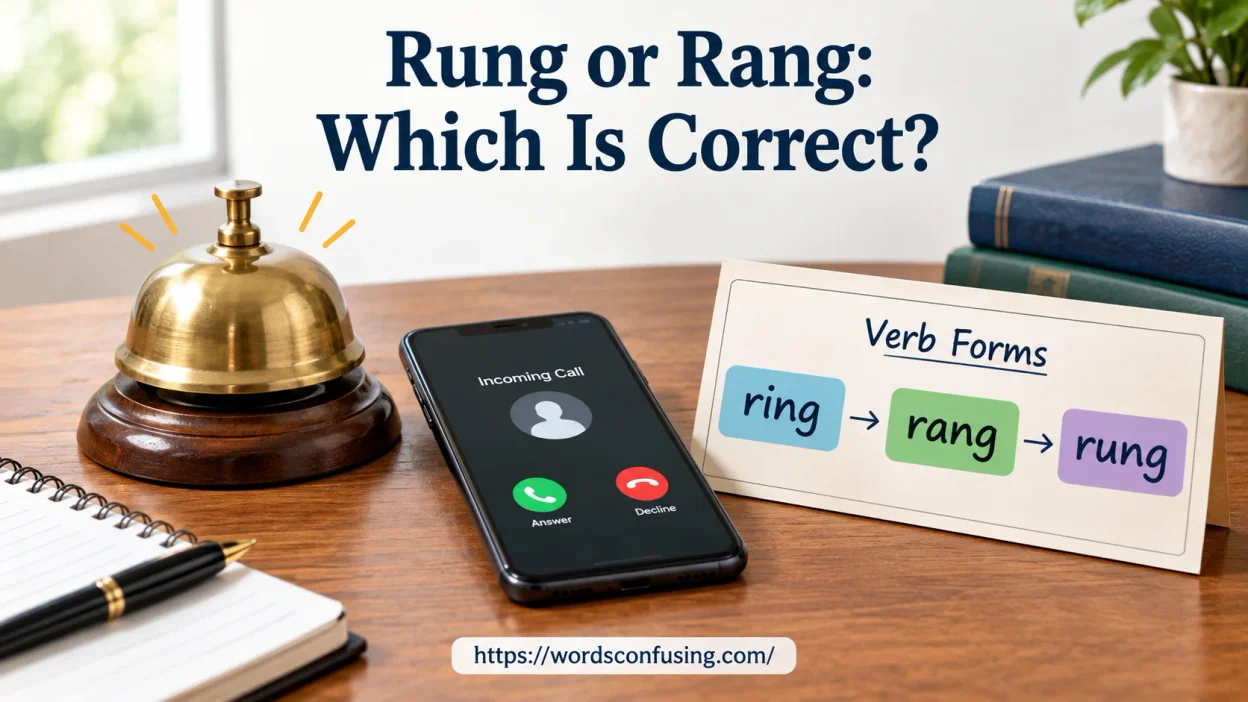
English learners often feel confused when choosing between rang and rung because these words look and sound similar. Rung or Rang: Which Is Correct? becomes easier to answer when you learn the basic forms of ring.
Ring is an irregular verb, while rang is its past tense verb and rung is the past participle. This difference can create confusion during language learning, especially when studying English grammar and verb forms. The grammar rules are simple once you understand each tense.
Use rang for a completed past action, while rung usually appears with an auxiliary verb, such as have rung, has rung, or had rung. The present tense uses ring, while present perfect and past perfect require the appropriate rung form.
The usage of these verb forms becomes clearer through spoken English, written English, and everyday communication. A bell, phone, alarm, or notification can ring, but your word choice depends on the sentence structure and context.
The rang form describes something that happened in the past, while the rung form normally needs a helping verb. These clear examples make the sentence meaning easier for learners to understand. This common mistake becomes easier to avoid through practice, exercises, and useful memory tricks.
In my experience, connecting grammar with real-life examples makes verb usage feel more simple and natural. This guide can explain the correct usage, incorrect form, word forms, tense forms, and similar pairs without making grammar seem complicated.
Quick Answer
If you’re wondering whether rung or rang is correct, look at the tense and sentence structure.
- Ring = base form
- Rang = simple past tense
- Rung = past participle
- Ringing = present participle or gerund
The three main forms are:
| Verb form | Correct word | Example |
| Base form | ring | I ring the bell every morning. |
| Simple past | rang | I rang the bell yesterday. |
| Past participle | rung | I have rung the bell already. |
| Present participle | ringing | Someone is ringing the bell. |
So, if you’re describing something that happened in the past, rang is normally the right choice.
The phone rang at midnight.
If you’re using a perfect tense, choose rung instead.
The phone has rung three times.
That distinction is the key to understanding rung vs. rang.
What Is the Difference Between “Rung” and “Rang”?
The difference between rung and rang comes down to grammatical function.
Rang is the simple past form of ring. You use it for an action that happened and finished in the past.
Rung is the past participle of ring. It usually works with an auxiliary verb such as has, have, or had.
Consider these two sentences:
- The alarm rang at six.
- The alarm has rung three times.
Both sentences describe an alarm making a sound. The grammar changes the verb form.
In the first sentence, rang directly expresses the past action. In the second, has carries the tense while rung functions as the past participle.
This pattern isn’t unique to ring. English has many irregular verbs that change form instead of simply adding -ed.
For example:
| Base | Simple past | Past participle |
| ring | rang | rung |
| sing | sang | sung |
| drink | drank | drunk |
| begin | began | begun |
| swim | swam | swum |
The pattern can help you remember the difference. Think of rang as the middle form and rung as the final form in the verb sequence.
Ring, Rang, and Rung: The Complete Verb Forms
The verb ring has several forms, each serving a different grammatical purpose.
Ring
Ring is the base form of the verb.
You use it in the present tense and after certain auxiliary verbs. It also appears after to in infinitive constructions.
Examples include:
- I ring the doorbell every morning.
- Please ring me after work.
- Did you ring your brother?
- I want to ring the office.
- The bells ring every Sunday.
Notice something important in the third example. After did, you use ring, not rang.
That’s because did already marks the sentence as past tense.
Rang
Rang is the simple past form.
Use it when an action happened at a definite or understood time in the past.
Examples include:
- The phone rang during dinner.
- The school bell rang at noon.
- She rang the doorbell twice.
- My alarm rang at six this morning.
- The church bells rang across the town.
Here, rang stands on its own as the main past-tense verb.
Rung
Rung is the past participle.
It usually needs an auxiliary verb to form a perfect tense.
Examples include:
- The phone has rung several times.
- The bell had rung before class began.
- I have rung the number twice.
- She has rung the doorbell already.
- The alarm had rung before anyone noticed.
The easiest memory pattern is:
ring → rang → rung
Think of it like three steps on a staircase. You don’t swap the steps randomly because each one has a specific grammatical position.
When Should You Use “Rang”?
Use rang when you need the simple past tense of ring.
The action happened in the past, and you’re presenting it as a completed event.
For example:
The phone rang while I was cooking.
The phone made the sound in the past. Therefore, rang is correct.
You can also use rang with a direct object when someone actively causes something to ring.
She rang the bell.
Here, ring means causing a bell to make a sound.
Use “Rang” for Completed Past Actions
The simple past often appears with words that identify when something happened.
Common time expressions include:
- yesterday
- last night
- this morning
- an hour ago
- earlier
- last week
- at noon
- at six o’clock
- before dinner
For example:
- The telephone rang yesterday.
- The alarm rang at 5:30.
- Someone rang the doorbell earlier.
- The school bell rang before lunch.
- The church bell rang last Sunday.
The time expression isn’t required. You can still use rang without one when the past meaning is clear.
The doorbell rang, and everyone looked toward the entrance.
The context already places the event in the past.
“Rang” in Questions and Negative Sentences
One of the most common mistakes involves using rang after did.
The correct structure is:
Did + subject + ring?
Not:
Did + subject + rang?
For example:
- Did the phone ring? ✓
- Did the phone rang? ✗
Why?
The auxiliary did already carries the past-tense meaning. The main verb returns to its base form.
The same rule applies to negative sentences.
- The phone didn’t ring.
- The bell didn’t ring.
- She didn’t ring the office.
- The alarm didn’t ring this morning.
Avoid these forms:
- The phone didn’t rang. ✗
- She didn’t rang the bell. ✗
A useful formula is:
Did + subject + ring
and
Subject + didn’t + ring
This rule also works with many other irregular verbs.
- Did she sing?
- Did he drink?
- Did they begin?
- Did you swim?
The past auxiliary does the tense work.
When Should You Use “Rung”?
Use rung when ring functions as a past participle.
Most often, you’ll see it with have, has, or had.
For example:
The alarm has rung three times.
Here, has creates the present perfect tense. The word rung supplies the past participle form.
Compare it with the simple past:
The alarm rang three times.
Both sentences are grammatical. They simply use different tense structures.
The first connects the past action with the present. The second simply reports a completed past event.
“Rung” With Have, Has, and Had
The most useful pattern is straightforward:
- have + rung
- has + rung
- had + rung
Examples:
I have rung the number twice.
She has rung the bell already.
They have rung the office several times.
He had rung the doorbell before I arrived.
The alarm had rung before anyone woke up.
The auxiliary determines the tense. Rung remains the past participle.
Here’s the difference in a table:
| Structure | Example | Tense |
| rang | The bell rang. | Simple past |
| has rung | The bell has rung. | Present perfect |
| have rung | The bells have rung. | Present perfect |
| had rung | The bell had rung. | Past perfect |
Once you recognize has, have, or had, rung becomes much easier to spot.
“Rung” in Perfect Tenses
The past participle rung appears in several perfect constructions.
Present Perfect
The present perfect uses has/have + rung.
Examples:
- The phone has rung twice.
- The bells have rung already.
- She has rung the number several times.
- We have rung the doorbell.
This tense often connects a past action with the present situation.
For example:
The phone has rung three times, but nobody has answered.
The ringing happened before now. Its result still matters.
Past Perfect
The past perfect uses had + rung.
Examples:
- The phone had rung before I entered.
- The bell had rung when the students arrived.
- She had rung the office before lunch.
- The alarm had rung several times before he woke up.
Past perfect helps show that one past event happened before another past event.
Consider this sentence:
The bell had rung before the teacher entered the classroom.
Two events happened in the past. The bell rang first, and the teacher entered afterward.
That sequence is exactly what the past perfect can clarify.
“Rung” in Passive Constructions
The word rung can also appear in passive constructions.
For example:
The bell was rung at noon.
Here, was rung forms a passive construction.
The sentence focuses on the bell rather than the person who rang it.
Compare:
The caretaker rang the bell at noon.
with:
The bell was rung at noon.
The first sentence emphasizes the person performing the action. The second emphasizes the bell and the event.
You shouldn’t assume that every occurrence of rung needs has, have, or had. Those auxiliaries are especially common in active perfect constructions, but rung can occur in other grammatical structures too.
“Rang” vs. “Rung” Examples
A quick comparison can make the difference crystal clear.
| Sentence | Correct? | Explanation |
| The phone rang. | ✓ | Rang is simple past. |
| The phone has rung. | ✓ | Rung is the past participle. |
| The phone had rung. | ✓ | Rung follows had. |
| The phone rung. | ✗ | Standard simple past requires rang. |
| Did the phone ring? | ✓ | Did takes the base form. |
| Did the phone rang? | ✗ | Don’t use the past form after did. |
| The phone didn’t ring. | ✓ | Didn’t takes the base form. |
| The phone didn’t rang. | ✗ | Rang cannot follow didn’t. |
These examples reveal a useful pattern.
When rang stands alone as the main past-tense verb, it’s correct:
The telephone rang.
When has, have, or had appears, use rung:
The telephone has rung.
When did or didn’t appears, return to ring:
Did the telephone ring?
That three-part distinction eliminates most mistakes.
Common Mistakes With “Rung” and “Rang”
Mistake: Using “Rung” as the Simple Past
A common error is:
The phone rung yesterday.
The standard form is:
The phone rang yesterday.
Rang is the simple past form.
Mistake: Using “Rang” After “Has”
Another common error is:
The phone has rang three times.
The correct sentence is:
The phone has rung three times.
After has, use the past participle.
Mistake: Using “Rang” After “Had”
You may also see:
The alarm had rang before breakfast.
The standard form is:
The alarm had rung before breakfast.
The formula is had + past participle.
Mistake: Using “Rang” After “Did”
This mistake often appears in questions:
Did the bell rang?
The correct version is:
Did the bell ring?
The same applies to negatives:
The bell didn’t ring.
Not:
The bell didn’t rang.
“Rang” vs. “Rung” in Everyday Sentences
The distinction becomes easier when you see it in familiar situations.
Talking About Phones
Phones provide some of the most common examples.
Use rang for a simple past event:
My phone rang during dinner.
Use rung with a perfect construction:
My phone has rung several times.
Use ring after did:
Did your phone ring?
Use ring after will:
The phone will ring when the timer ends.
The surrounding words tell you which form belongs there.
Talking About Doorbells
The same rule applies to doorbells.
Someone rang the doorbell last night.
Someone has rung the doorbell twice.
Did someone ring the doorbell?
Someone was ringing the doorbell continuously.
Each sentence uses a different grammatical form.
Talking About Alarms
Alarms create another familiar set of examples.
My alarm rang at six.
By then, the alarm had already rung.
Before I woke up, it had rung again.
Why didn’t my alarm ring?
Notice how ring, rang, and rung shift according to the sentence structure.
Talking About Bells
Bells can ring naturally or someone can ring them deliberately.
The church bell rang at noon.
The bell has rung three times.
The caretaker rang the bell.
Did the bell ring?
The meaning stays related, but the grammar determines the form.
Read more: 7 Good Words for the Sound of Thunder and Onomatopoeia
Is “Rung” Ever Used Without “Have,” “Has,” or “Had”?
Yes. Although rung frequently appears with have, has, or had, those aren’t the only words that can accompany it.
The past participle can appear in passive constructions.
For example:
The bell was rung at noon.
Here, was supports the passive structure.
Another example is:
The bell was being rung when the ceremony began.
In this sentence, rung remains the past participle while the surrounding auxiliary verbs create the tense and aspect.
This distinction matters because a common shortcut says, “Always use rung after has, have, or had.” That’s useful advice, but it doesn’t describe every grammatical situation.
A better rule is:
Use “rung” when the grammar requires the past participle of “ring.”
That rule is broader and more accurate.
Is “Rang” Always the Correct Past Tense?
For standard US English, rang is the simple past form of ring.
So these are correct:
- The phone rang.
- The bell rang.
- She rang the doorbell.
- The alarm rang.
- His ears rang after the concert.
In standard usage, don’t replace rang with rung simply because both forms belong to the same verb.
The difference is grammatical rather than optional.
Think about another familiar pair:
I sang yesterday.
but:
I have sung before.
You wouldn’t normally say:
I sung yesterday.
The same principle applies to:
I rang yesterday.
but:
I have rung before.
English irregular verbs can seem unpredictable at first. However, learning their principal parts makes the pattern much more manageable.
“Rang” or “Rung” for Phone Calls?
The verb ring can also refer to making a telephone call, especially in British English.
For example:
She rang me yesterday.
or:
She has rung me twice.
In US English, call is generally more common for this meaning.
For example:
She called me yesterday.
However, the grammatical distinction remains the same when ring is used.
- She rang me yesterday.
- She has rung me twice.
- Did she ring you?
- She didn’t ring me.
So the choice between rang and rung doesn’t change because the verb refers to a phone call rather than a bell.
Ring vs. Rang vs. Rung: Common Grammar Patterns
This table provides a practical reference you can return to whenever the forms become confusing.
| Grammar pattern | Correct form | Example |
| Present simple | ring | I ring the bell every day. |
| Infinitive | ring | I want to ring the office. |
| Simple past | rang | I rang the bell yesterday. |
| Present perfect | has/have rung | She has rung the bell. |
| Past perfect | had rung | She had rung the bell earlier. |
| After did | ring | Did you ring the bell? |
| After didn’t | ring | I didn’t ring the bell. |
| Continuous | ringing | Someone is ringing the bell. |
| Passive | was/were rung | The bells were rung at noon. |
The most important pattern is worth memorizing:
Ring → Rang → Rung
Then remember what each form does:
Ring = base form
Rang = simple past
Rung = past participle
How to Remember “Rang” vs. “Rung”
A simple memory trick can save you from repeatedly checking the answer.
Think of rang as the middle word in the sequence:
ring → rang → rung
The first form is the base verb. The second is simple past. The third is the past participle.
You can also connect the forms with other irregular verbs:
sing → sang → sung
ring → rang → rung
drink → drank → drunk
The vowel pattern gives you a useful mental anchor.
Another trick is to look for an auxiliary verb.
If you see:
- has
- have
- had
then rung is often the form you need.
If you’re simply describing something that happened in the past, rang is usually the right choice.
For example:
Yesterday, the phone rang.
The phone has rung three times.
The first sentence reports a past event. The second connects a previous event with the present.
A Simple Decision Guide for “Rung or Rang”
When you’re unsure, follow these steps.
Step One: Look for “Did”
If the sentence contains did or didn’t, use ring.
Did she ring?
She didn’t ring.
Step Two: Look for “Has,” “Have,” or “Had”
If you’re forming a perfect tense, use rung.
She has rung.
They have rung.
He had rung.
Step Three: Look for a Simple Past Action
If the sentence simply reports something that happened in the past, use rang.
She rang yesterday.
The alarm rang at six.
Step Four: Check the Meaning
Ask yourself what the sentence is doing.
Is it simply telling you that something happened? Choose rang.
Does the grammar require a past participle? Choose rung.
Does an auxiliary like did require the base form? Choose ring.
This approach works far better than memorizing isolated sentences.
A Closer Look at “Rang” and “Rung”
The difference isn’t about the meaning of the action itself. Both words come from the same verb, ring.
Instead, the difference comes from tense and grammatical structure.
Consider these three sentences:
The bell rings every morning.
Yesterday, the bell rang as usual.
By now, it has already rung.
The event is similar in all three sentences. The grammatical time frame changes.
Rings describes a present or habitual action.
Rang places the action in the simple past.
Rung appears as the past participle in a perfect construction.
This is why choosing between rang and rung requires more than simply asking which word “sounds right.” The surrounding words provide the real clue.
“Rang” vs. “Rung” in Questions
Questions deserve special attention because they cause frequent errors.
Compare these examples:
- Did the phone ring? ✓
- Has the phone rung? ✓
- Did the phone rang? ✗
- Has the phone rang? ✗
The first question uses did, so the base form ring follows.
The second uses has, so the past participle rung follows.
This creates a useful contrast:
| Question starter | Correct form | Example |
| Did | ring | Did the phone ring? |
| Has | rung | Has the phone rung? |
| Have | rung | Have the bells rung? |
| Had | rung | Had the bell rung? |
The auxiliary verb acts like a grammatical signpost. Once you spot it, the correct verb form becomes much easier to choose.
“Rang” vs. “Rung” in Negative Sentences
Negative sentences follow the same basic logic.
With didn’t, use ring:
The phone didn’t ring.
With hasn’t, use rung:
The phone hasn’t rung.
With hadn’t, use rung:
The phone hadn’t rung.
Compare the structures:
| Negative structure | Correct sentence |
| didn’t + base form | The phone didn’t ring. |
| hasn’t + past participle | The phone hasn’t rung. |
| haven’t + past participle | The phones haven’t rung. |
| hadn’t + past participle | The phone hadn’t rung. |
This distinction becomes almost automatic once you learn the role of the auxiliary verb.
“Rang” or “Rung”: Which One Is Correct?
If the sentence is:
The phone ___ yesterday.
Choose rang.
If the sentence is:
The phone has ___ twice.
Choose rung.
If the sentence is:
Did the phone ___?
Choose ring.
If the sentence is:
The phone had ___ before I arrived.
Choose rung.
Here’s the shortcut:
Past action alone → rang
Perfect tense → rung
After did → ring
That three-part rule handles most everyday situations.
Final Comparison: Rung or Rang?
| If you mean… | Use | Example |
| A present action | ring | The bell rings every hour. |
| A completed past action | rang | The bell rang at noon. |
| Present perfect | rung | The bell has rung already. |
| Past perfect | rung | The bell had rung before lunch. |
| A question with “did” | ring | Did the bell ring? |
| A negative with “didn’t” | ring | The bell didn’t ring. |
| A continuous action | ringing | Someone is ringing the bell. |
| A passive construction | rung | The bell was rung at noon. |
The answer to “rung or rang?” isn’t that one word is right and the other is wrong.
Both are correct forms of ring. They simply perform different grammatical jobs.
Use rang for the simple past:
The telephone rang.
Use rung as the past participle:
The telephone has rung.
Use ring after did:
Did the telephone ring?
Once you remember ring → rang → rung, the confusion largely disappears.
FAQs
Is “rang” the past tense of “ring”?
Yes. Rang is the simple past tense of ring. For example, “The phone rang during dinner.” You use rang when the action happened and finished in the past.
Is “rung” the past tense of “ring”?
No. Rung is the past participle of ring. It usually needs a helping verb such as has, have, or had. For example, “The bell has rung.”
What is the difference between rang and rung?
The main difference is their verb forms. Rang is the simple past form, while rung is the past participle. Choosing between them depends on the tense and sentence structure.
Can I say “I have rang the bell”?
No. The correct sentence is “I have rung the bell.” After have, you need the past participle rung, not the simple past form rang.
Is “the phone rang” correct?
Yes, “The phone rang” is completely correct. Here, rang shows that the phone made its ringing sound at a particular time in the past.
How can I remember when to use rang or rung?
A simple trick is to connect rang with the simple past and rung with helping verbs. Remember the pattern: ring → rang → rung. Regular practice with everyday examples makes the difference much easier to remember.
Conclusion
Choosing between rang and rung becomes much easier once you see how each form works. Remember the simple pattern: ring → rang → rung. Use rang for a completed action in the past, while rung normally follows a helping verb such as has, have, or had. A little practice with everyday sentences can quickly make this distinction feel natural.
You don’t need to memorize complicated grammar rules to get it right. Pay attention to the tense, the helping verb, and the meaning of the sentence. Once these patterns become familiar, the confusion between rang and rung fades away, and your spoken English and written English become more accurate.

Franklin Hayes is a writer and editor at WordsConfusing.com, focused on making English vocabulary, grammar, and commonly confused words easy to understand. He writes clear, practical articles with simple explanations and useful examples to help readers improve their English with confidence.
His goal is simple: Making Confusing Words Simple.