In this guide, Can You Start a Sentence With “For”? Grammar Rules and Examples explains when this sentence opening works and how to use it correctly.
Many people consider starting a sentence with for impossible, but this is a common belief rooted in a misconception about English grammar. Like other prepositions, this word follows special rules that depend on its context and intended meaning.
Understanding these grammar rules helps you recognize its correct usage across different parts of a sentence.
The word for can function as a conjunction or an introductory preposition, depending on the sentence structure. Its proper usage becomes clearer when you understand how it introduces a reason or explanation. As a coordinating conjunction, it can connect ideas while appearing at the beginning of a sentence.
These practical examples and usage guidelines also show how word usage affects your writing. Learning these language rules helps you use for effectively and create more natural sentence beginnings through better sentence construction.
Quick Answer
Yes, you can start a sentence with “for.” It’s grammatically correct when “for” introduces a prepositional phrase or functions as a coordinating conjunction. As a preposition, it expresses purpose, benefit, or duration. As a conjunction, it introduces a reason or explanation. The key is using the correct sentence structure and punctuation.
Can You Start a Sentence With “For”?
Yes, you can start a sentence with “for.” English grammar doesn’t prohibit this construction. However, you need to understand how the word functions before using it.
The word “for” belongs to two different grammatical categories:
- Coordinating conjunction: It connects independent clauses and introduces a reason or explanation.
- Preposition: It introduces a noun, pronoun, or noun phrase that expresses a relationship involving purpose, benefit, duration, or other meanings.
When “for” functions as a preposition, beginning a sentence with it is completely natural.
For example:
- For your safety, please wear protective equipment.
- For several months, the company operated without a permanent manager.
- For this reason, the committee postponed its decision.
Each sentence begins with a prepositional phrase. These constructions appear frequently in everyday, professional, and academic writing.
However, using “for” as a coordinating conjunction requires more attention. This usage sounds formal or literary because modern English speakers generally prefer “because” when explaining reasons.
Consider this example:
“He decided to leave early. For he had an important appointment.”
Here, “for” introduces an explanation for the preceding statement. Although this construction is grammatically possible in certain literary styles, it sounds unusual in everyday conversation.
The important point is that starting a sentence with “for” isn’t automatically incorrect. Its grammatical function, sentence structure, and surrounding context determine whether the construction works.

When Can You Start a Sentence With “For”?
You can begin a sentence with “for” in several situations. The most important distinction involves its function as a preposition or coordinating conjunction.
Let’s examine these uses individually.
When “For” Functions as a Coordinating Conjunction
A coordinating conjunction connects grammatical elements with equal importance. In particular, it can connect two independent clauses.
The English language has seven coordinating conjunctions, commonly remembered through the acronym FANBOYS:
| Conjunction | Function |
| For | Introduces a reason or explanation |
| And | Adds related information |
| Nor | Connects negative alternatives |
| But | Shows contrast |
| Or | Presents alternatives |
| Yet | Shows contrast or unexpected results |
| So | Expresses a result |
Among these seven conjunctions, “for” has a distinctive purpose. It introduces a reason that explains the preceding statement.
Consider this example:
“I decided to stay home, for the weather looked unpleasant.”
The sentence contains two independent clauses:
- I decided to stay home.
- The weather looked unpleasant.
The coordinating conjunction “for” connects these clauses and explains why the speaker stayed home.
Now consider another example:
“She accepted the invitation, for she genuinely wanted to attend the celebration.”
The second clause explains the reason behind her decision. Here, “for” carries a meaning similar to “because.”
Can you place this coordinating conjunction at the beginning of a sentence?
Yes, particularly in literary or rhetorical writing. However, this construction is less common than using “for” between two independent clauses.
For example:
“He knew the journey would be difficult. For he had traveled that road before.”
The second sentence provides an explanation for the first statement. This style can create a deliberate, formal rhythm.
However, don’t confuse this construction with an ordinary introductory dependent clause. When “for” introduces a reason in its coordinating-conjunction sense, it connects ideas rather than functioning like “because.”
When “For” Functions as a Preposition
Using “for” as a preposition offers much greater flexibility. You can naturally place it at the beginning of a sentence without creating an unusual grammatical construction.
A preposition establishes a relationship between its object and another part of the sentence. Its object can be a noun, pronoun, or noun phrase.
For example:
- For beginners, this grammar rule might seem confusing.
- For your convenience, the instructions are available online.
- For several hours, the children played outside.
- For my family, Sunday dinner is an important tradition.
- For the next three weeks, the office will operate remotely.
In each example, “for” introduces a prepositional phrase.
Notice how these phrases provide additional information about the sentence. They tell readers who benefits, how long something lasts, or whom something concerns.
Here are some common meanings of “for” as a preposition:
| Meaning | Example |
| Purpose | For cooking, use a sharp kitchen knife. |
| Benefit | For your health, regular exercise matters. |
| Duration | For two hours, they discussed the proposal. |
| Intended recipient | For Sarah, this gift carries special meaning. |
| Support | For this proposal, several members voted. |
| Reason or occasion | For his birthday, we arranged a surprise party. |
Unlike its coordinating-conjunction usage, the prepositional use of “for” doesn’t depend on a preceding sentence.
You can begin an article, paragraph, or standalone sentence with a prepositional phrase containing “for.” Just make sure the complete sentence expresses a clear thought.
When “For” Introduces a Purpose or Intended Recipient
Another common use involves identifying the purpose of an action or the person receiving something.
In these situations, “for” often appears at the beginning because the writer wants to emphasize the intended recipient or purpose.
Consider these examples:
- For the students, the new library provides a quiet place to study.
- For her younger brother, she prepared a special birthday gift.
- For better results, follow the instructions carefully.
- For professional development, employees can attend training sessions.
- For the upcoming event, organizers need additional volunteers.
These sentences sound natural because the introductory phrases establish context before presenting the main information.
This technique also helps writers organize information logically. Instead of making readers discover the purpose halfway through a sentence, you provide that information immediately.
For instance:
“Employees can attend training sessions for professional development.”
You can also write:
“For professional development, employees can attend training sessions.”
Both sentences are correct. However, the second version emphasizes professional development more strongly.
Read more: 7 Words to Describe Someone Who Is Able to See the Big Picture
Grammar Rules for Starting a Sentence With “For”
Although starting a sentence with “for” is acceptable, certain grammatical principles deserve attention.
Understanding these rules prevents awkward constructions and helps you maintain a natural writing style.
Understand the Two Grammatical Functions
First, identify whether “for” introduces a prepositional phrase or functions as a coordinating conjunction.
This distinction matters because each construction follows different grammatical patterns.
As a preposition:
“For several years, she studied classical literature.”
Here, “for several years” introduces a prepositional phrase. The sentence’s main clause is “she studied classical literature.”
As a coordinating conjunction:
“He refused to give up. For he believed success was still possible.”
Here, “for” introduces an explanation connected to the preceding statement.
Remember that these two functions aren’t interchangeable. A preposition introduces an object, whereas a coordinating conjunction connects clauses.
Use Appropriate Punctuation
Punctuation depends on how “for” functions within your sentence.
When “for” begins a sentence as a preposition, a comma often separates a longer introductory phrase from the main clause.
For example:
- For several months, the researchers collected information.
- For this particular reason, the manager changed the schedule.
- For your convenience, the payment instructions appear below.
However, short introductory prepositional phrases don’t always require commas.
For example:
- For now everything remains unchanged.
- For today the meeting has ended.
These sentences can take commas when the writer wants to emphasize the introductory phrases. The punctuation should support clarity and natural reading.
When “for” introduces a coordinating clause, the punctuation depends on its relationship with the preceding sentence.
For example:
“She stayed late, for the assignment required additional attention.”
The comma separates two independent clauses joined by the coordinating conjunction.
When the explanation begins a new sentence, the period separates the preceding thought:
“She stayed late. For the assignment required additional attention.”
This second construction is more literary and less common in everyday writing.
Make Sure the Sentence Expresses a Complete Thought
A sentence should communicate a complete idea rather than leave readers waiting for missing information.
This rule becomes particularly important when “for” functions as a coordinating conjunction.
Consider this incorrect example:
“For the meeting.”
This expression doesn’t communicate a complete thought. It contains a prepositional phrase rather than an independent clause.
You can correct it by adding a complete statement:
“For the meeting, everyone must arrive before nine.”
Now the sentence contains an introductory phrase followed by a complete independent clause.
Another example:
Incorrect: “For she was tired.”
This construction may work as a literary continuation when it explains a preceding sentence. However, it lacks a complete contextual connection when presented alone.
Better: “She went to bed early because she was tired.”
The revised version communicates the relationship clearly without relying on an unusual sentence structure.
Avoid Using “For” When It Makes Your Sentence Awkward
Grammatical correctness doesn’t automatically guarantee good writing.
Sometimes, “for” introduces a sentence that sounds unnecessarily formal or confusing. In such cases, a simpler alternative may improve readability.
For example:
Formal: “For the weather was getting worse, they canceled the trip.”
Better: “They canceled the trip because the weather was getting worse.”
The second sentence sounds more natural and communicates the same relationship.
Remember that good grammar should support communication. Don’t choose a construction simply because it sounds sophisticated.
Examples of Sentences Starting With “For”
Examples make grammatical rules easier to understand. The following sentences demonstrate how “for” works in different situations.
Examples of “For” as a Coordinating Conjunction
When “for” introduces an explanation, it connects the current thought with information already established.
Here are several examples:
- He couldn’t attend the ceremony. For he had already committed to another event.
- She continued practicing. For she wanted to improve her performance.
- They decided to postpone the trip. For the road conditions had become dangerous.
- Nobody questioned his decision. For everyone understood the circumstances.
- The audience remained silent. For the speaker had captured their attention.
- He trusted her completely. For she had never broken a promise.
- The village celebrated throughout the night. For the harvest had been successful.
Important: These examples use a literary sentence-opening construction. In ordinary prose, combining the clauses with a comma and “for” often sounds more natural.
For example:
“He couldn’t attend the ceremony, for he had already committed to another event.”
This construction follows the standard coordinating-conjunction pattern.
Examples of “For” as a Preposition
The prepositional use appears much more frequently in everyday English.
Here are practical examples:
- For beginners, this lesson provides a helpful introduction.
- For your convenience, the office offers online appointments.
- For several weeks, the workers repaired the damaged building.
- For my parents, family gatherings mean everything.
- For better results, practice the exercises regularly.
- For this project, we need reliable information.
- For the children, the playground became a favorite destination.
- For many people, learning English requires patience.
- For your protection, always wear the recommended equipment.
- For the first time, she spoke confidently before an audience.
Each example begins with a prepositional phrase that provides useful context.
Examples of “For” in Formal and Academic Writing
Formal writing frequently uses introductory prepositional phrases to establish a subject, purpose, or limitation.
Consider these examples:
- For this study, researchers examined the effects of regular exercise.
- For the purposes of this analysis, the original figures remain unchanged.
- For these reasons, the proposed solution deserves further consideration.
- For the present investigation, participants completed a series of assessments.
- For comparison, the researchers included results from an earlier experiment.
- For practical applications, these findings offer several useful insights.
- For future research, additional evidence will be necessary.
These constructions work particularly well in academic papers, research reports, and professional documents.
However, formal writing should remain readable. Avoid using complicated introductory phrases when simpler alternatives communicate your point.
When Should You Avoid Starting a Sentence With “For”?
Although the construction is grammatically acceptable, some situations call for a different approach.
Your goal should always be clarity. If starting with “for” makes the sentence harder to understand, revise it.
Avoid Incomplete Sentence Structures
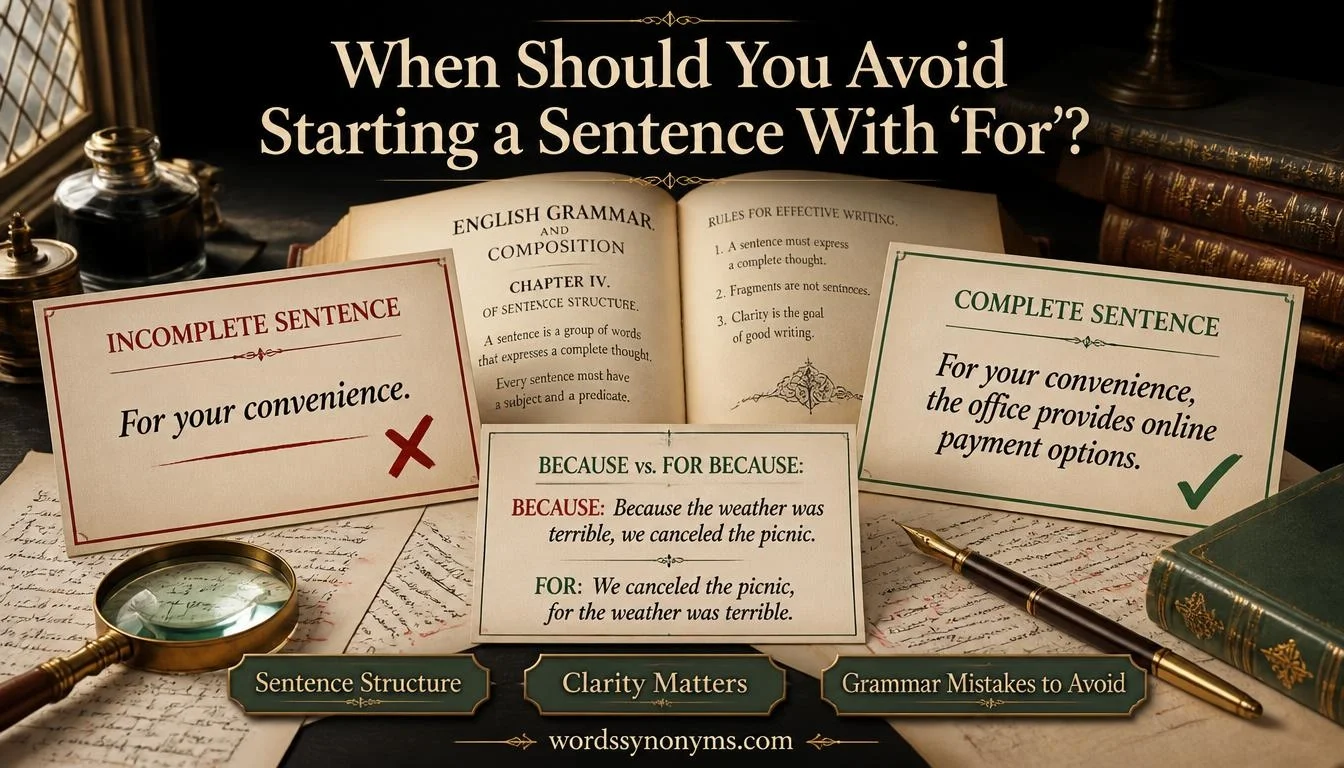
A prepositional phrase cannot normally stand alone as a complete sentence.
For example:
Incorrect: “For your convenience.”
This expression identifies a purpose but doesn’t communicate a complete thought.
Correct: “For your convenience, the office provides online payment options.”
The revised version adds an independent clause and completes the meaning.
Another example:
Incorrect: “For several important reasons.”
Correct: “For several important reasons, the committee rejected the proposal.”
The second sentence gives readers the information they need.
Avoid Confusing “For” With “Because”
Although “for” and “because” can introduce reasons, they don’t always work in the same grammatical situations.
The most important difference involves their grammatical roles.
Because introduces a subordinate clause. That clause explains why something happens.
Example:
“She stayed home because she wasn’t feeling well.”
The clause “because she wasn’t feeling well” explains the reason behind her decision.
For, when used as a coordinating conjunction, connects independent clauses.
Example:
“She stayed home, for she wasn’t feeling well.”
Both clauses can stand independently:
- She stayed home.
- She wasn’t feeling well.
The conjunction connects these complete thoughts.
Here is a helpful comparison:
| Because | For |
| Introduces a subordinate clause | Connects independent clauses |
| Common in everyday conversation | More formal or literary |
| Can naturally begin a sentence | Usually connects to an earlier statement |
| Expresses a direct reason | Often presents an explanation or justification |
For example:
“Because the weather was terrible, we canceled the picnic.”
This sentence is completely natural.
“For the weather was terrible, we canceled the picnic.”
This version is incorrect because “for” doesn’t introduce a subordinate clause like “because.”
You can instead write:
“We canceled the picnic, for the weather was terrible.”
The distinction is small but important.
Avoid Unnecessary Repetition
Repeating “for” too frequently can make your writing sound mechanical.
Consider this example:
“For the students, the new program offers support. For the teachers, it provides additional resources. For the administration, it creates new responsibilities.”
Although each sentence is grammatically acceptable, the repetition weakens the paragraph’s rhythm.
A smoother version might read:
“The new program supports students and provides additional resources for teachers. It also creates responsibilities for the administration.”
The revised paragraph communicates the same information with better flow.
Can You Start an Academic Sentence With “For”?
Yes, you can begin an academic sentence with “for.” However, the grammatical function and context matter.
Academic writing doesn’t prohibit introductory prepositional phrases. In fact, they often help researchers establish context and organize complex information.
Consider these examples:
Introducing a research topic:
“For this study, researchers examined how sleep patterns affect concentration.”
Explaining a limitation:
“For practical reasons, the investigation focused on participants within a specific age group.”
Presenting supporting information:
“For comparison, the research team reviewed results from previous experiments.”
Establishing a purpose:
“For the purposes of this analysis, all measurements were recorded in centimeters.”
These examples use “for” as a preposition. Each sentence begins with an introductory phrase that provides context.
What about “for” as a coordinating conjunction?
Academic writers can use it, particularly in historical, philosophical, or literary discussions. However, the construction may sound unnecessarily old-fashioned in modern research writing.
For example:
“The results supported the original hypothesis. For the evidence revealed a consistent pattern.”
This construction is grammatically possible in a suitable literary context. However, a more direct academic version would read:
“The results supported the original hypothesis because the evidence revealed a consistent pattern.”
The practical rule: Use introductory “for” phrases freely when they improve clarity. Reserve conjunction-opening constructions for situations where their tone and structure genuinely suit your writing.
What Can You Use Instead of “For” at the Beginning of a Sentence?
Sometimes, another word communicates your meaning more naturally. The best alternative depends on what you want to express.
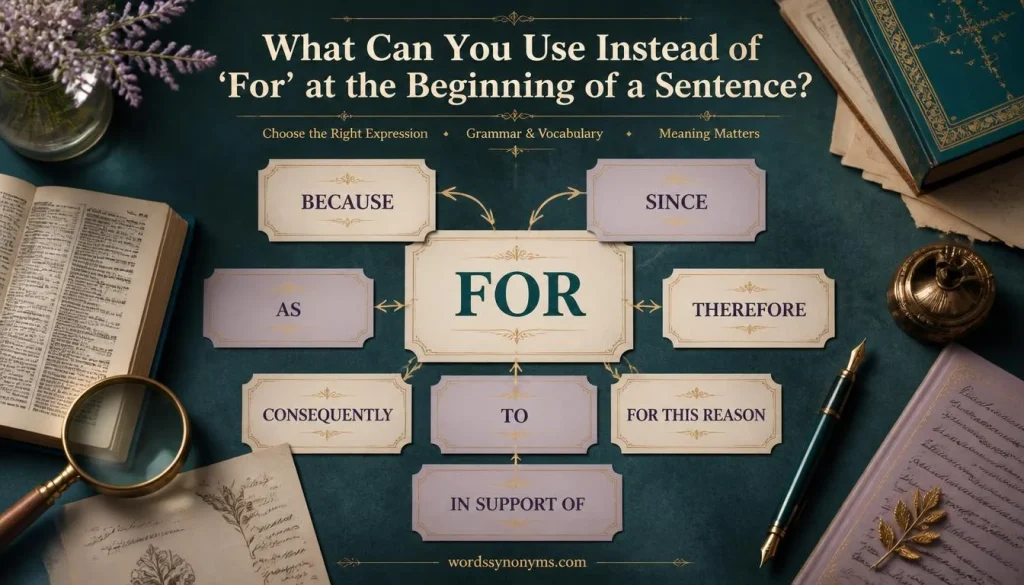
Here are several useful replacements.
| Alternative | Main purpose | Example |
| Because | Explains a reason | Because the road was closed, we took another route. |
| Since | Introduces a reason | Since everyone agreed, the meeting ended early. |
| As | Explains a cause | As the deadline approached, everyone worked faster. |
| Therefore | Shows a result | Therefore, the company changed its policy. |
| Consequently | Expresses an outcome | Consequently, the project required additional funding. |
| To | Introduces a purpose | To improve accuracy, check every calculation. |
| For this reason | Connects an explanation | For this reason, the manager rejected the proposal. |
| In support of | Expresses agreement or backing | In support of the proposal, several members voted. |
Although these expressions sometimes communicate similar ideas, they aren’t interchangeable in every sentence.
Use “Because” to Explain a Direct Reason
“Because” works particularly well when you want to explain why something happened.
Example:
“Because she practiced regularly, her confidence improved.”
This construction sounds natural in everyday and professional writing.
Use “Since” to Introduce a Known Reason
“Since” can introduce a reason that provides background information.
Example:
“Since the office was closed, employees worked remotely.”
However, “since” can also refer to time. Make sure your meaning remains clear.
Use “Therefore” to Show a Result
When the second sentence presents a conclusion or consequence, “therefore” may work better.
Example:
“The deadline had passed. Therefore, the application couldn’t be accepted.”
Unlike “for,” this word emphasizes the result rather than explaining the original reason.
Use “To” When Expressing Purpose
If “for” introduces an intended goal, “to” may provide a shorter alternative.
Example:
“For better results, review the instructions carefully.”
Alternative:
“To achieve better results, review the instructions carefully.”
Both sentences express purpose, although their grammatical structures differ.
Common Mistakes When Starting a Sentence With “For”
Even experienced writers sometimes misuse “for.” Understanding these mistakes can help you avoid confusing constructions.
| Common mistake | Why it’s problematic | Better version |
| For the weather was cold, we stayed home. | Incorrectly uses a coordinating conjunction like “because.” | We stayed home because the weather was cold. |
| For the meeting. | Creates an incomplete sentence. | For the meeting, everyone prepared a presentation. |
| For she was tired, she went home. | Uses “for” to introduce a subordinate clause. | Because she was tired, she went home. |
| For your convenience. | Provides no complete statement when used alone. | For your convenience, online services are available. |
| For the reason that he was late. | Creates an awkward introductory phrase without a complete clause. | Because he was late, he missed the introduction. |
Notice that most problems involve confusing grammatical functions or leaving thoughts unfinished.
Once you understand the difference between prepositions and coordinating conjunctions, these mistakes become easier to recognize.
Read more: Gesture of Goodwill: Meaning and How to Use It Correctly
FAQs
1. Is It Grammatically Correct to Start a Sentence With “For”?
Yes, starting a sentence with for is grammatically correct. You can use it as a coordinating conjunction to introduce a reason or explanation.
2. What Does “For” Mean at the Beginning of a Sentence?
When for begins a sentence as a conjunction, it means because or since. It introduces a reason that explains the previous idea.
3. Is “For” a Preposition or a Conjunction?
For can function as both. It acts as a preposition when it shows purpose, benefit, or duration. It works as a coordinating conjunction when it connects two related ideas.
4. Should You Put a Comma After “For” at the Beginning of a Sentence?
Usually, no. When for introduces a reason as a coordinating conjunction, place a comma before it when it joins two independent clauses. A comma doesn’t normally follow it.
5. Can You Use “For” to Begin a Formal Sentence?
Yes, you can use for at the beginning of a formal sentence. However, this conjunction can sound literary or somewhat old-fashioned. Choose it when it fits your tone and meaning.
6. What Is the Difference Between Starting a Sentence With “For” and “Because”?
For introduces a reason as a coordinating conjunction, while because introduces a dependent clause. For example, “She stayed home, for she felt tired” and “She stayed home because she felt tired.” Both express a reason, but their grammatical structures differ.
Conclusion
Starting a sentence with “for” isn’t a grammar mistake. The key is understanding how the word works in different situations. As a coordinating conjunction, for introduces a reason or explanation and connects related ideas. It can also function as a preposition when it shows purpose, benefit, or duration. Once you recognize these differences, choosing the right sentence structure becomes much easier.
Don’t let the common misconception stop you from using “for” naturally. Pay attention to the meaning, sentence structure, and punctuation whenever you begin a sentence with this word. Good writing isn’t about following unnecessary restrictions. It’s about understanding grammar rules and using them to express your thoughts clearly and confidently.