


This guide to 7 Words to Describe Someone Who Is Able to See the Big Picture explains how wider thinking connects details, decisions, and goals.
People with this skill look beyond small details and understand how separate parts fit together. They consider the overall context, recognize patterns, and use a broad perspective to make thoughtful choices.
Words such as visionary, perceptive, analytical, and forward-thinking describe people who combine insight with practical reasoning.
This ability grows through experience, reflection, and an open mindset. In leadership and teamwork, big-picture thinkers connect shared goals with daily actions. They consider long-term outcomes, explore alternatives, and help others understand the plan.
Their strategic thinking supports problem-solving, clear communication, and effective decision-making. They also recognize how each person’s contribution affects the whole team. By encouraging discussion, building relationships, and staying aware of changing circumstances, they help groups move forward with clarity and purpose.
This practical approach links immediate tasks with future priorities and prevents scattered decisions.
Quick Answer:
Someone who can see the big picture is often called a big-picture thinker, visionary, or strategic thinker. Other fitting words include holistic, insightful, foresighted, and perceptive. These words describe people who look beyond immediate details, recognize connections, anticipate future outcomes, and understand how everything fits together.
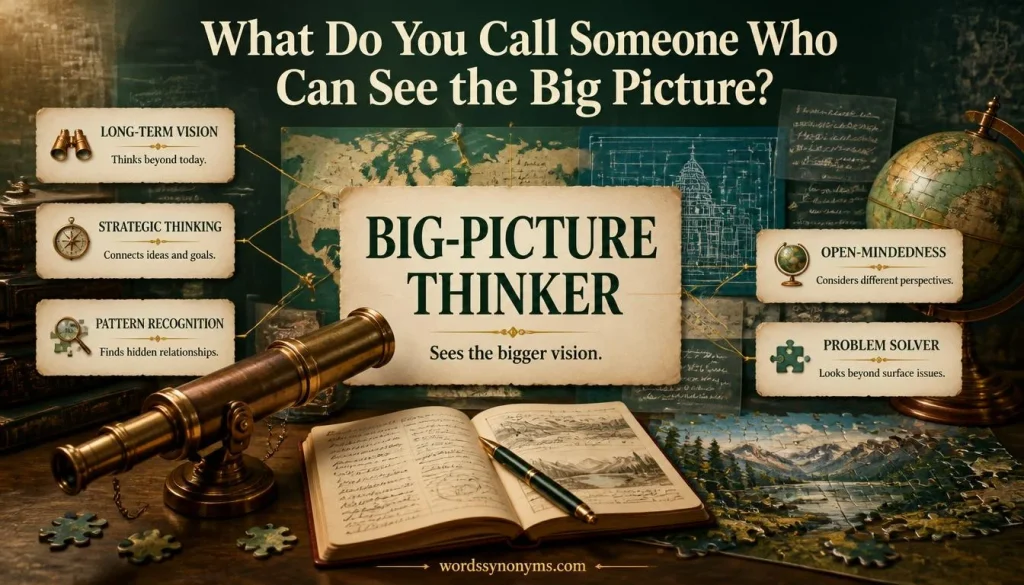
What Do You Call Someone Who Can See the Big Picture?
A person who can see the big picture is commonly called a big-picture thinker. This person understands how individual details, decisions, and actions connect to a larger purpose. Instead of concentrating exclusively on immediate responsibilities, they consider the overall situation.
For example, imagine a business experiencing declining sales. Someone who focuses only on individual problems might suggest changing the product packaging or increasing advertising. A big-picture thinker examines the entire business situation.
They might consider customer expectations, market conditions, pricing, product quality, and long-term business goals. This broader perspective helps them identify problems that smaller adjustments might never solve.
Big-picture thinkers usually demonstrate several recognizable qualities:
- Long-term perspective: They consider how today’s decisions might affect future results.
- Pattern recognition: They notice relationships between seemingly unrelated events.
- Strategic judgment: They evaluate different possibilities before choosing an approach.
- Open-mindedness: They consider alternative perspectives instead of relying on one explanation.
- Problem-solving ability: They look for underlying causes rather than treating symptoms.
- Adaptability: They adjust their plans when circumstances or priorities change.
- Goal awareness: They understand how individual responsibilities contribute to larger objectives.
However, seeing the big picture doesn’t mean ignoring smaller details. Effective thinkers understand when to step back and when to examine something closely.
Read more: “I Hear You” Meaning: Is It Impatient or Sympathetic?
7 Words to Describe Someone Who Is Able to See the Big Picture
Different words describe different aspects of big-picture thinking. Some emphasize future possibilities, while others highlight broader understanding, awareness, or decision-making.
Here are seven useful descriptions with their meanings, characteristics, and practical examples.
Visionary
Visionary describes someone who can imagine future possibilities and recognize opportunities beyond present circumstances. A visionary person doesn’t simply accept how things currently work. Instead, they consider what could happen and how to make that possibility real.
Visionaries often connect present actions with ambitious long-term goals. They recognize opportunities that others might overlook because they’re willing to think beyond familiar methods.
For example, a visionary business leader doesn’t focus exclusively on this quarter’s sales. They also consider how technology, customer expectations, and changing markets might influence the company’s future.
This quality makes the word particularly useful when describing innovative leaders, entrepreneurs, creative thinkers, and people with ambitious plans.
Characteristics of a visionary person:
- Imagines possibilities beyond existing circumstances.
- Recognizes opportunities before they become obvious.
- Develops clear long-term goals.
- Encourages innovation and fresh ideas.
- Connects present decisions with future possibilities.
- Inspires others to work toward meaningful objectives.
Example sentences:
- Sarah is a visionary leader who always considers where the company could be in ten years.
- His visionary approach helped the team develop a completely different business strategy.
- We need someone visionary enough to recognize opportunities beyond our current plans.
- A visionary teacher understands how today’s lessons can shape tomorrow’s possibilities.
When should you use visionary?
Choose this word when someone demonstrates imagination, innovation, and an ability to recognize future opportunities. It works particularly well when describing people who don’t simply understand the current situation but can also imagine a better future.
However, visionary doesn’t automatically mean practical. Someone might have excellent ideas without knowing how to implement them. Therefore, the word emphasizes future-oriented imagination more than practical execution.
Strategic
Strategic describes someone who considers the wider situation before making important decisions. A strategic thinker evaluates available resources, possible risks, competing priorities, and long-term objectives.
Rather than reacting immediately to every problem, this person considers which actions will produce meaningful results. They understand that one decision can influence several other areas.
Consider a project manager responsible for completing a complicated assignment. Instead of concentrating only on the next deadline, a strategic thinker examines the entire project.
They consider staffing, available time, potential obstacles, financial resources, and the final objective. This approach helps them organize individual tasks around a common purpose.
Strategic thinking is especially valuable in business, management, leadership, education, and project planning.
Characteristics of a strategic person:
- Evaluates the overall situation before acting.
- Understands priorities and competing responsibilities.
- Considers risks and possible consequences.
- Connects short-term actions with long-term objectives.
- Uses available resources thoughtfully.
- Develops practical plans to achieve larger goals.
Example sentences:
- Daniel is a strategic thinker who considers the consequences before making decisions.
- Her strategic approach helped the organization overcome several complicated challenges.
- We need a strategic leader who understands both immediate needs and future objectives.
- He always takes a strategic approach instead of making decisions without considering the bigger picture.
When should you use strategic?
Use strategic when someone understands how different decisions contribute to broader objectives. It’s especially appropriate for describing people who plan carefully and make thoughtful choices.
The main distinction between strategic and visionary is practical focus. A visionary imagines future possibilities, while a strategic thinker develops plans to reach desired outcomes.
Someone can certainly possess both qualities.
Holistic
Holistic describes someone who considers an entire situation rather than examining individual parts separately. A holistic thinker understands that different elements often influence one another.
This perspective is particularly useful when a problem involves several connected factors. Instead of treating each issue independently, holistic thinkers examine how everything works together.
For example, consider a student struggling with academic performance. A narrow approach might focus exclusively on study hours or examination results.
However, a holistic thinker considers several possible influences:
- Study habits and learning methods.
- Sleep quality and daily routines.
- Emotional well-being and stress.
- Classroom environment and teaching methods.
- Family responsibilities and available support.
- Access to learning materials and resources.
By examining these connected factors, the person can develop a more complete understanding of the situation.
Holistic thinking is useful in education, healthcare, management, personal development, and problem-solving.
Characteristics of a holistic thinker:
- Considers the entire situation.
- Understands relationships between different elements.
- Avoids drawing conclusions from isolated information.
- Recognizes how one change can affect other areas.
- Considers multiple perspectives before making judgments.
- Looks for solutions that address interconnected problems.
Example sentences:
- Maria has a holistic understanding of the project and considers every department’s contribution.
- His holistic approach helped the team identify problems beyond individual performance.
- A holistic thinker examines how different factors contribute to the overall outcome.
- The manager takes a holistic view of employee development rather than focusing only on productivity.
When should you use holistic?
Choose holistic when someone understands how separate elements contribute to an entire system. This word works particularly well when describing comprehensive thinking and an ability to recognize interconnected relationships.
Remember that holistic and strategic aren’t interchangeable. Holistic emphasizes understanding the whole, whereas strategic emphasizes planning and decision-making toward specific objectives.
Insightful
Insightful describes someone who understands situations deeply and recognizes meaningful connections that others might overlook. An insightful person doesn’t simply collect information. They interpret it and identify what it actually means.
This quality often helps people understand complicated situations, recognize underlying problems, and reach thoughtful conclusions.
Imagine a workplace where employees frequently miss deadlines. Someone without much insight might immediately blame poor time management.
An insightful manager investigates further. They might discover that unclear instructions, unrealistic workloads, or inefficient communication cause the repeated delays.
Instead of addressing the visible symptoms, they recognize the underlying issue.
Insightful people often ask thoughtful questions and notice relationships between different pieces of information. Their observations can help others understand situations more clearly.
Characteristics of an insightful person:
- Understands the deeper meaning of situations.
- Recognizes underlying problems and patterns.
- Connects information to reach meaningful conclusions.
- Notices important details others might overlook.
- Offers thoughtful observations and suggestions.
- Understands how different circumstances influence outcomes.
Example sentences:
- Emma is an insightful thinker who understands the reasons behind complicated problems.
- His insightful observations helped the company recognize an overlooked opportunity.
- She offered an insightful explanation that changed everyone’s understanding of the situation.
- An insightful leader looks beyond immediate problems to identify their underlying causes.
When should you use insightful?
Use insightful when someone demonstrates deep understanding and the ability to recognize important connections. It’s an excellent choice for describing thoughtful individuals who can interpret complicated situations.
However, insightful doesn’t necessarily mean someone plans far into the future. It emphasizes understanding and interpretation rather than long-term forecasting.
Foresighted
Foresighted describes someone who can anticipate future possibilities and consider the consequences of present decisions. A foresighted person thinks ahead rather than concentrating exclusively on immediate circumstances.
This quality helps people prepare for potential challenges before they become serious problems. Instead of waiting for difficulties to appear, they consider what might happen and take sensible precautions.
For example, a foresighted business owner might recognize that relying on one supplier creates unnecessary risk. They establish relationships with alternative suppliers before an unexpected disruption affects operations.
Similarly, a foresighted student doesn’t wait until examination week to prepare. They organize their study schedule early and leave enough time for revision.
Characteristics of a foresighted person:
- Anticipates possible future challenges.
- Considers the long-term consequences of decisions.
- Recognizes potential risks and opportunities.
- Prepares for changing circumstances.
- Makes thoughtful decisions before problems develop.
- Understands the importance of future planning.
Example sentences:
- Our foresighted director invested in better technology before the company needed it.
- She is a foresighted planner who prepares for potential difficulties in advance.
- His foresighted decisions protected the organization from unnecessary financial risks.
- A foresighted individual considers how today’s choices might influence tomorrow’s results.
When should you use foresighted?
Choose foresighted when someone demonstrates the ability to anticipate future consequences and prepare accordingly. It’s particularly useful when describing responsible decision-makers, planners, and leaders.
The difference between foresighted and visionary is worth remembering. A visionary imagines future possibilities, while a foresighted person anticipates what might happen and prepares for it.
Perceptive
Perceptive describes someone who notices important information and understands situations quickly. A perceptive person often recognizes patterns, subtle changes, and meaningful connections that others overlook.
This quality combines observation with understanding. It’s not simply about noticing something. It’s about recognizing why that observation matters.
For example, imagine a team meeting where everyone agrees with a proposed plan. A perceptive colleague notices that several team members seem uncertain despite their agreement.
They recognize that the group might have unresolved concerns. By asking the right questions, they help uncover potential problems before implementation begins.
Perceptive individuals can also understand different viewpoints and recognize how people respond to changing circumstances.
Characteristics of a perceptive person:
- Notices meaningful patterns and subtle changes.
- Understands situations beyond their surface appearance.
- Recognizes connections between different events.
- Observes how people respond to circumstances.
- Identifies potential concerns before they become obvious.
- Uses observations to develop a clearer understanding.
Example sentences:
- James is a perceptive individual who quickly recognizes problems others overlook.
- Her perceptive understanding of the situation helped the team avoid a costly mistake.
- A perceptive manager notices how individual decisions affect the entire department.
- He made a perceptive observation that revealed the project’s underlying problem.
When should you use perceptive?
Use perceptive when someone demonstrates strong awareness and understands the significance of different observations. This adjective works well for describing people who notice connections and interpret situations accurately.
Although perceptive and insightful share similarities, they emphasize slightly different abilities. Perceptive highlights awareness and observation, while insightful emphasizes deeper understanding.
Big-Picture-Oriented
Big-picture-oriented is a direct descriptive phrase for someone who naturally focuses on broader objectives and overall outcomes.
A big-picture-oriented person understands that individual tasks rarely exist independently. Each responsibility contributes to a larger goal, and recognizing that relationship helps them make better decisions.
For instance, a teacher with a big-picture-oriented mindset doesn’t concentrate exclusively on completing the syllabus. They also consider whether students understand the material and can apply their knowledge.
Similarly, an employee might complete individual assignments while keeping the organization’s wider objectives in mind.
This phrase is especially useful in professional communication because it describes the thinking style without suggesting that someone possesses a particular personality trait.
Characteristics of a big-picture-oriented person:
- Focuses on broader goals and overall outcomes.
- Understands how individual responsibilities connect.
- Avoids becoming distracted by insignificant details.
- Recognizes the importance of long-term priorities.
- Considers the wider impact of decisions.
- Balances immediate tasks with larger objectives.
Example sentences:
- We need a big-picture-oriented manager who understands the company’s long-term direction.
- Sarah is highly big-picture-oriented and always connects individual tasks with organizational goals.
- His big-picture-oriented approach helped the team understand why the project mattered.
- A big-picture-oriented employee recognizes how everyday responsibilities contribute to business success.
When should you use big-picture-oriented?
Choose this phrase when you want to describe someone’s overall approach to thinking, planning, or working.
It’s particularly suitable for performance reviews, professional biographies, workplace recommendations, and job descriptions.
Unlike visionary or foresighted, this expression doesn’t emphasize one specific ability. It describes a general preference for understanding broader objectives.
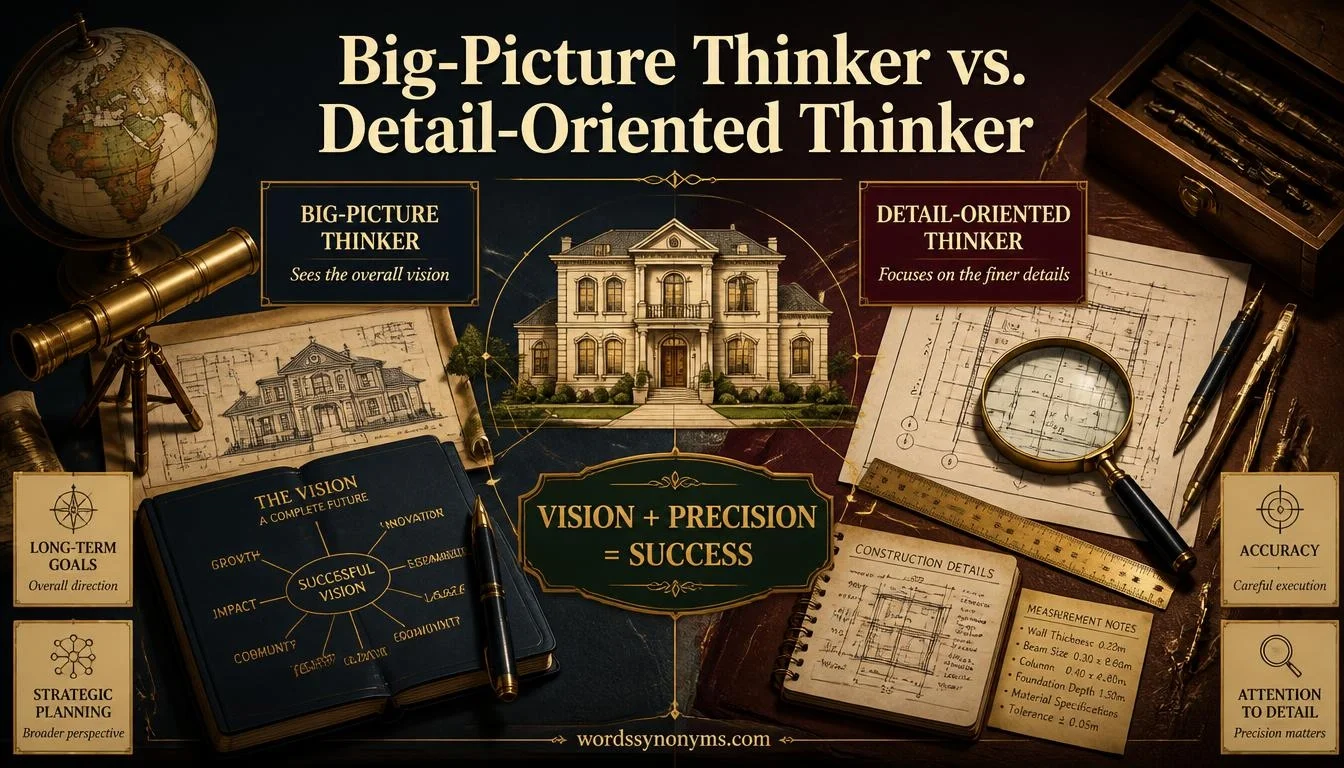
Big-Picture Thinker vs. Detail-Oriented Thinker
Big-picture thinkers and detail-oriented thinkers approach situations differently. One focuses on broader goals, while the other examines individual elements closely.
However, these approaches aren’t competing abilities. Most successful projects require both perspectives.
Consider building a house. Someone must understand the overall design, purpose, and layout. Someone else must ensure that measurements, materials, and construction details meet the required standards.
Without the broader plan, individual efforts might lack direction. Without careful attention to details, the final result might contain serious problems.
Here’s how these thinking styles compare:
| Area | Big-Picture Thinker | Detail-Oriented Thinker |
| Main focus | Overall goals and outcomes | Individual tasks and specifics |
| Planning | Considers long-term direction | Organizes specific steps |
| Problem-solving | Examines underlying causes | Investigates individual issues |
| Decision-making | Evaluates broader consequences | Checks facts and details |
| Work approach | Connects separate responsibilities | Ensures accurate execution |
| Strength | Recognizes patterns and relationships | Identifies errors and inconsistencies |
| Possible challenge | Might overlook small details | Might lose sight of broader goals |
Can someone possess both qualities?
Absolutely. In fact, combining these approaches creates a valuable balance.
A project manager might understand the entire project’s direction while checking individual deadlines, budgets, and responsibilities. This person can recognize the broader objective without overlooking practical requirements.
The goal isn’t to choose one thinking style over another. It’s to understand when each approach becomes necessary.
Characteristics of Someone Who Can See the Big Picture
People who see the big picture often share several recognizable thinking habits. These characteristics influence how they approach decisions, relationships, challenges, and responsibilities.
Although individuals express these qualities differently, the following traits commonly describe broader thinking.
They Understand Long-Term Goals
Big-picture thinkers don’t judge every decision by its immediate results. They consider whether an action supports their larger objectives.
For example, someone learning a new language might struggle with difficult grammar lessons. However, they understand that consistent practice contributes to long-term fluency.
This perspective helps them remain focused when progress feels slow.
They Recognize Patterns and Connections
A broader perspective allows people to recognize relationships between separate events. They notice how different factors influence one another.
For example, a business owner might connect declining customer satisfaction with delayed deliveries and inconsistent product quality.
Recognizing these patterns makes it easier to identify meaningful solutions.
They Think Beyond Immediate Problems
Instead of reacting to the first visible issue, big-picture thinkers investigate the entire situation.
Suppose an employee repeatedly struggles with deadlines. Rather than immediately questioning their commitment, a thoughtful manager examines workload distribution, communication, and available resources.
This approach encourages better problem-solving.
They Consider Different Perspectives
Understanding the bigger picture requires looking beyond personal assumptions. People with this ability consider different experiences, opinions, and circumstances.
For example, a team leader might listen to employees, customers, and department managers before introducing a major change.
Considering different viewpoints can reveal important information that one perspective alone might miss.
They Anticipate Possible Outcomes
Big-picture thinkers often consider what might happen after a decision. They evaluate potential benefits, risks, and unintended consequences.
For instance, introducing a new company policy might improve productivity while creating additional administrative work.
Considering both effects helps decision-makers prepare more effectively.
They Connect Individual Tasks With Broader Objectives
People with a wider perspective understand why smaller responsibilities matter.
A marketing employee, for example, recognizes that writing an email campaign isn’t simply about producing attractive messages. The campaign might support customer retention, product awareness, or sales growth.
Understanding this connection makes everyday work more purposeful.
They Make Decisions With the Bigger Purpose in Mind
Not every attractive opportunity supports an organization’s actual priorities. Big-picture thinkers recognize this difference.
They evaluate whether a decision contributes to the overall objective instead of choosing whatever looks appealing immediately.
This habit helps them maintain direction when circumstances change.
Why Is Big-Picture Thinking Important?
Seeing the bigger picture helps people make decisions with greater awareness. It allows them to understand how individual actions influence larger outcomes.
This ability becomes particularly valuable when situations involve uncertainty, competing priorities, or complicated problems.
Better Long-Term Decision-Making
Decisions often create consequences beyond their immediate results. Big-picture thinking encourages people to consider those effects before taking action.
For example, choosing cheaper equipment might reduce initial expenses. However, higher maintenance costs could make that decision less economical over time.
Considering the complete situation leads to more informed choices.
More Effective Problem-Solving
Some problems continue because people address visible symptoms instead of underlying causes.
A big-picture thinker examines the wider circumstances and identifies connections that might explain repeated difficulties.
This approach helps individuals develop solutions that address the actual problem rather than temporary inconveniences.
Stronger Leadership and Strategic Planning
Effective leaders need to understand how different departments, employees, and responsibilities contribute to organizational goals.
A leader with a broader perspective can coordinate individual efforts and maintain a clear direction.
They also recognize when priorities need adjustment.
Improved Adaptability
Circumstances change, and plans don’t always work as expected. People who understand the bigger picture can adjust their methods without losing sight of their objectives.
For example, a company might change its marketing strategy after customer preferences shift. Its methods change, but its broader business goals remain important.
Greater Awareness of Consequences
Every decision can influence other people, responsibilities, or resources.
Big-picture thinking encourages individuals to consider these connections before acting.
This awareness can improve teamwork, personal relationships, financial planning, and professional decisions.
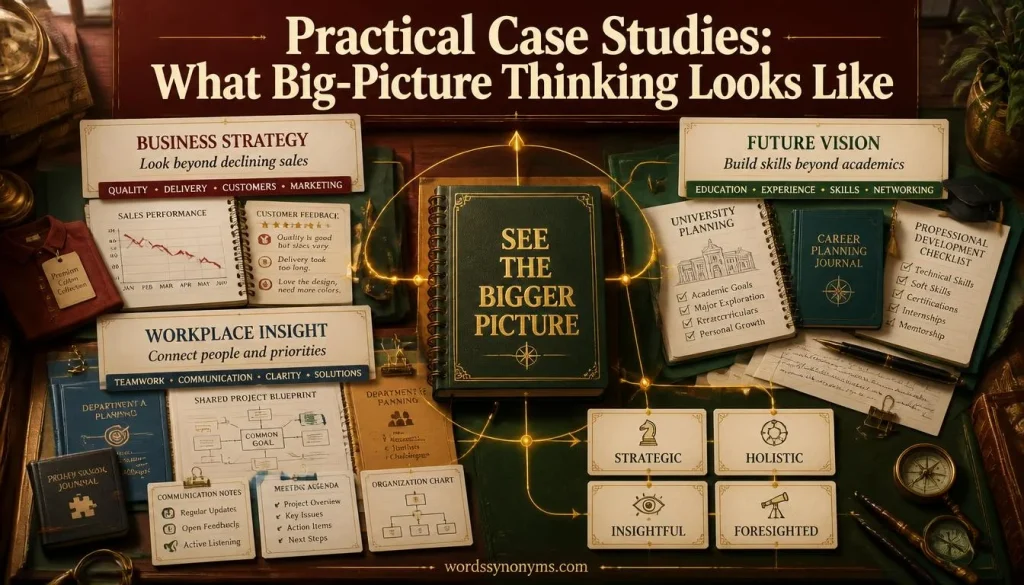
Practical Case Studies: What Big-Picture Thinking Looks Like
Understanding the seven words becomes easier when you see how broader thinking works in real situations.
The following hypothetical examples demonstrate how these qualities appear in everyday professional and personal settings.
Case Study: A Business Facing Declining Sales
Imagine a small clothing company experiencing falling sales for several months.
A narrow approach might focus entirely on advertising. The company could increase its marketing budget without investigating other factors.
A big-picture-oriented manager examines the entire business operation.
They discover several connected issues:
- Customers complain about inconsistent product quality.
- Delivery times have increased.
- Competitors offer better customer service.
- The company’s advertising doesn’t reflect current customer preferences.
The manager develops a coordinated improvement plan addressing these problems.
Relevant qualities: Strategic, holistic, insightful, and foresighted.
The example demonstrates why understanding the entire business situation matters. Increasing advertising alone might not solve problems involving quality and customer satisfaction.
Case Study: A Student Planning for Future Success
Consider a university student who wants to build a successful career after graduation.
Instead of focusing exclusively on examination results, the student considers several areas of development.
They prioritize academic performance, practical experience, communication skills, professional relationships, and relevant training.
Their decisions support a broader career objective.
Relevant qualities: Visionary, foresighted, and big-picture-oriented.
The student understands that academic success matters. However, they also recognize that professional development requires several connected abilities.
Case Study: A Manager Resolving Workplace Conflict
Imagine two departments repeatedly disagreeing about project responsibilities.
A manager who focuses only on individual complaints might treat each disagreement separately.
A perceptive and insightful manager examines the wider situation.
They discover that both departments receive different instructions and misunderstand their responsibilities.
The manager introduces clearer communication procedures and shared project expectations.
Relevant qualities: Perceptive, insightful, and holistic.
This example shows how recognizing connections can resolve problems more effectively than repeatedly addressing individual disagreements.
Read more: “As Evidenced By” or “As Evident By”: Which Is Correct?
How to Use These Words in Sentences
Choosing the right adjective depends on what you want to emphasize. Some words highlight future planning, while others describe awareness, understanding, or overall perspective.
The following examples demonstrate how to use all seven expressions naturally.
| Word | Example sentence |
| Visionary | Our visionary director has a clear understanding of where the organization should be in the future. |
| Strategic | She takes a strategic approach to solving problems and achieving long-term objectives. |
| Holistic | His holistic perspective helps him understand how different departments work together. |
| Insightful | The insightful manager recognized the underlying reasons behind the team’s difficulties. |
| Foresighted | Their foresighted planning helped prevent several potential problems. |
| Perceptive | A perceptive employee notices important changes before they become obvious. |
| Big-picture-oriented | We need a big-picture-oriented leader who understands the organization’s wider goals. |
Describing Someone in a Professional Setting
When writing a recommendation, professional biography, or performance review, choose words that reflect actual behavior.
For example:
- “She is a visionary leader who consistently identifies opportunities for growth.”
- “He demonstrates strategic thinking when managing complicated projects.”
- “Her holistic perspective helps different departments work toward shared objectives.”
- “He is an insightful problem-solver who identifies underlying challenges.”
- “She takes a foresighted approach to planning and risk management.”
These descriptions sound more meaningful when you support them with specific examples.
Describing Someone in Everyday Conversation
You don’t always need formal vocabulary to describe someone who understands the bigger picture.
Try these natural expressions:
- “She always sees the bigger picture.”
- “He’s good at looking at the whole situation.”
- “She thinks several steps ahead.”
- “He understands how everything connects.”
- “She’s always thinking about the long-term results.”
- “He doesn’t get caught up in every little detail.”
These expressions work well in everyday conversations because they’re clear and easy to understand.
FAQs
1. What does it mean to see the big picture?
Seeing the big picture means understanding how different details, events, and decisions connect. Instead of focusing on one small issue, you consider the entire situation and its possible outcomes.
2. What is another word for someone who sees the big picture?
A visionary is a common word for someone who sees the big picture. Other suitable words include strategic thinker, holistic thinker, forward-thinking, and broad-minded.
3. Is seeing the big picture a leadership skill?
Yes, seeing the big picture is an important leadership skill. It helps leaders set clear goals, understand challenges, guide teams, and make decisions that support long-term success.
4. How can you describe someone who thinks beyond small details?
You can describe such a person as perceptive, analytical, insightful, or forward-thinking. These words highlight their ability to recognize connections and understand situations from different perspectives.
5. How can someone develop the ability to see the big picture?
You can develop this ability by looking at situations from different angles, asking thoughtful questions, and considering long-term consequences. Listening to others and connecting individual details also improves your perspective.
6. Why is seeing the big picture important in teamwork?
It helps team members understand shared goals and recognize how their individual efforts contribute to success. This approach improves communication, encourages collaboration, and makes problem-solving easier.
Conclusion
Being able to see the big picture is more than noticing how different details connect. It means understanding the wider situation, recognizing possibilities, and thinking about what comes next. Words like visionary, strategic thinker, perceptive, and holistic thinker help describe people who naturally look beyond immediate concerns. Each word highlights a slightly different quality, so choosing the right one depends on the person’s actions and the situation.
This ability also makes a meaningful difference in everyday life, leadership, and teamwork. People who understand the bigger picture can make thoughtful decisions, support shared goals, and help others stay focused. You don’t have to understand everything at once to develop this skill. Start by looking beyond individual problems and asking how each detail affects the whole situation.

Shafiq Ur Rehman is a writer and content contributor at WordsConfusing.com. He enjoys exploring the English language, common word confusions, vocabulary, and practical writing tips. His goal is to make English easier to understand through clear, simple, and useful articles.