The guide to 3 Terms for Asking a Question You Already Know the Answer To explains how familiar questions can shape a conversation with purpose.
Sometimes, asking a question isn’t about finding information or getting a known answer. You might want to make a point, challenge an idea, or guide a conversation instead. These intentional questions appear in everyday conversations, casual discussions, and professional meetings. Recognizing different question types, expressions, and language patterns helps you understand this communication technique.
Understanding these questions also improves your English usage, grammar, and language skills. The 3 Terms for Questions You Already Know explain their meanings, differences, and practical examples. These terms for questions with known answers also connect with rhetorical strategies and questioning methods. Together, they show how questions can make everyday communication more purposeful.
These communication techniques appear in different real-world scenarios, including formal writing, business communication, workplace discussions, broadcasting, and online booking conversations. You might also encounter them while creating content, managing project management tasks, organizing scheduling details, or improving time management. A well-chosen question can bring clarity, confidence, and consistency to your communication.
Knowing which methods to use helps you guide conversations more effectively and develop stronger communication skills. With a better understanding of purposeful questions, you can see how they strengthen your professional expression. These skills are useful in business and everyday writing, where clear communication makes a difference.
Quick Answer
A question you already know the answer to is usually called a rhetorical question. You ask it to make a point, express an opinion, or emphasize something obvious rather than get information. However, if your wording suggests a particular response, it’s a leading question. If it contains an unfair or hidden assumption, it’s a loaded question.

What Do You Call a Question You Already Know the Answer To?
A rhetorical question is the most common term for a question someone asks without expecting an actual answer. Instead of requesting information, the speaker uses the question to emphasize an idea, express an opinion, or encourage reflection.
For example, imagine your friend leaves the house without an umbrella on a rainy day. You look outside and ask, “Do you think it’s going to rain?”
You already know the weather forecast. Your question doesn’t necessarily seek information. Instead, it highlights something your friend should have noticed.
However, not every question with a known answer qualifies as rhetorical. Sometimes, people ask questions to encourage agreement, confirm information, or influence another person’s response.
That’s where leading and loaded questions enter the picture.
Why Do People Ask Questions They Already Know the Answers To?
People don’t always ask questions because they need information. Sometimes, a question communicates more effectively than a straightforward statement.
Here are several common reasons:
- To emphasize a point: A question can make an obvious fact sound more memorable.
- To encourage reflection: Someone might ask a question that makes another person reconsider their actions.
- To express emotions: Questions can communicate frustration, excitement, disappointment, or surprise.
- To persuade someone: A carefully worded question can encourage agreement with a particular viewpoint.
- To confirm information: People sometimes ask questions to hear someone acknowledge what they already know.
- To add humor: A rhetorical question can make an ordinary conversation more entertaining.
- To challenge an assumption: Someone might use a question to expose a contradiction or questionable belief.
Consider the question, “Who doesn’t want a little extra money?”
The speaker probably isn’t conducting a survey. Instead, the question emphasizes how appealing extra money can be.
The important distinction lies in the speaker’s intention. The wording and context help determine which questioning technique applies.
Read more: Why Does “Polly Want a Cracker”? Meaning and History Explained
Rhetorical Question: Asking a Question Without Expecting an Answer
A rhetorical question is a question someone asks to make a statement, emphasize an idea, or encourage thought rather than receive information.
In most situations, the speaker already knows the answer or considers it obvious. Sometimes, the expected answer remains unspoken because the audience can easily understand the intended meaning.
For example:
“Isn’t honesty the best policy?”
The speaker isn’t necessarily asking for a detailed explanation. Instead, the question reinforces the belief that honesty matters.
Rhetorical questions appear in everyday conversations, speeches, advertisements, literature, and persuasive writing. They help speakers connect with audiences without making every statement sound direct or forceful.
Examples of Rhetorical Questions
The following examples show how rhetorical questions work in different situations.
| Rhetorical question | Intended meaning |
| Who doesn’t love a good vacation? | Almost everyone enjoys a vacation. |
| Is the sky blue? | The answer is obviously yes. |
| Do you think money grows on trees? | Money doesn’t come easily. |
| Isn’t life too short to hold grudges? | People shouldn’t waste life holding grudges. |
| How could anyone forget such a beautiful day? | The day was unforgettable. |
| Does a fish need water? | Water is essential for fish. |
| Why make things harder than they need to be? | There’s no reason to complicate things. |
| Isn’t that what friends are for? | Friends should support one another. |
| Who has time for unnecessary drama? | Unnecessary drama isn’t worth anyone’s time. |
| What’s the point of working hard without enjoying life? | Enjoyment matters alongside hard work. |
Notice that these questions communicate complete ideas without requiring detailed responses.
When Should You Use a Rhetorical Question?
Rhetorical questions work particularly well when you want to communicate an idea naturally. However, their effectiveness depends on the situation.
In everyday conversations
People frequently use rhetorical questions to express opinions or make lighthearted observations.
For example:
- “What could possibly go wrong?”
- “Isn’t this just wonderful?”
- “Who needs another headache?”
These expressions can add personality and humor to ordinary conversations.
In speeches and presentations
Speakers use rhetorical questions to capture attention and encourage audiences to consider an argument.
For example:
“How can we expect better results without changing our approach?”
This question encourages listeners to consider the connection between actions and outcomes.
In persuasive writing
Writers often use rhetorical questions to make readers examine their assumptions.
For example:
“Why settle for an ordinary experience when you can create something memorable?”
The question encourages readers to consider the benefits of another option.
In advertisements and marketing
Advertisers use rhetorical questions to connect products with familiar needs and desires.
For example:
“Ready to make your mornings easier?”
The question encourages readers to imagine a convenient solution.
Why Do Rhetorical Questions Work?
Rhetorical questions make communication more engaging because they invite mental participation.
Instead of simply presenting information, speakers encourage listeners to complete an idea themselves.
Here are some important benefits:
- They capture attention: A question can interrupt predictable communication and make people listen.
- They emphasize important ideas: A carefully chosen question makes the intended message easier to remember.
- They encourage reflection: Readers and listeners mentally consider the question before accepting its message.
- They create emotional connections: Questions can communicate excitement, frustration, humor, or concern.
- They make arguments memorable: A strong rhetorical question can summarize an entire argument in one sentence.
However, excessive rhetorical questions can weaken your writing. Use them when they genuinely improve the message rather than inserting them into every paragraph.
Leading Question: Asking a Question That Suggests a Particular Answer
A leading question is a question worded to encourage a specific response. Instead of allowing someone to answer freely, its wording suggests the answer the questioner wants or expects.
For example:
“You enjoyed the movie, didn’t you?”
The question suggests that the speaker expects a positive answer. The person answering might agree, even if their opinion differs.
Unlike rhetorical questions, leading questions generally invite a response. The speaker wants the other person to confirm, accept, or consider a particular idea.
Leading questions frequently appear in interviews, negotiations, surveys, sales conversations, and persuasive discussions.
They’re not necessarily dishonest or manipulative. Their appropriateness depends on the situation and how someone uses them.
Examples of Leading Questions
Here are several examples that demonstrate how leading questions influence responses.
| Leading question | Suggested answer |
| You enjoyed the party, didn’t you? | Yes, I enjoyed it. |
| Don’t you agree that this is the best option? | Yes, this is the best option. |
| Wouldn’t you say she handled everything perfectly? | Yes, she handled it well. |
| You understand why this decision makes sense, right? | Yes, I understand. |
| Isn’t this the most convenient solution? | Yes, it’s convenient. |
| You’d prefer a better salary, wouldn’t you? | Yes, I’d prefer a better salary. |
| Surely you want to finish this project today? | Yes, I want to finish today. |
Each question contains wording that encourages a particular response.
For instance, “You enjoyed the party, didn’t you?” differs from “What did you think about the party?”
The first question suggests a positive opinion. The second allows the person to express any opinion.
When Are Leading Questions Used?
Leading questions serve several purposes, particularly when someone wants to guide a conversation toward a particular outcome.
During interviews
Interviewers sometimes use leading questions to explore a candidate’s experiences or confirm specific information.
For example:
“You enjoyed working with your previous team, didn’t you?”
This question suggests a positive answer. However, an open-ended question would provide a more balanced understanding.
In sales and marketing
Salespeople may use leading questions to help customers consider a product’s benefits.
For example:
“Wouldn’t you appreciate having a more comfortable chair?”
The question directs attention toward comfort and encourages the customer to consider the product.
During negotiations
People sometimes use leading questions to establish common ground.
For example:
“We both want this agreement to benefit everyone, don’t we?”
The speaker encourages agreement around a shared objective.
In persuasive conversations
Leading questions can help someone introduce an opinion without stating it directly.
For example:
“Wouldn’t it make more sense to finish the assignment before taking a break?”
The speaker suggests a preferred course of action while inviting agreement.
Leading Questions vs. Neutral Questions
Understanding the difference between leading and neutral questions helps you communicate more fairly.
A neutral question doesn’t suggest which answer someone should provide. Instead, it gives the other person room to express their genuine thoughts.
Compare these examples:
| Leading question | Neutral question |
| You liked the restaurant, didn’t you? | What did you think of the restaurant? |
| Don’t you think this plan is excellent? | What do you think about this plan? |
| Surely the meeting was productive? | How would you describe the meeting? |
| You agree that this is unfair, right? | How do you feel about this situation? |
| Wouldn’t you prefer the cheaper option? | Which option would you prefer? |
The difference becomes clear when you examine the expected responses.
Leading questions guide answers, while neutral questions encourage independent opinions.
If you want honest feedback, neutral questions usually provide more useful information. Leading questions can unintentionally influence responses and make feedback less reliable.

Loaded Question: Asking a Question That Contains an Assumption
A loaded question is a question that contains an assumption the person answering hasn’t necessarily accepted.
It often combines an accusation or questionable belief with a request for information. Consequently, answering directly can make someone appear to agree with something they never admitted.
Consider this familiar example:
“Have you stopped lying to your parents?”
The question contains an assumption that the person previously lied to their parents.
Answering “yes” suggests that the person used to lie but has stopped. Answering “no” suggests that the behavior continues.
Neither response addresses the underlying assumption.
That’s what makes a loaded question different from an ordinary question.
Loaded questions frequently appear during arguments, confrontations, political debates, and manipulative conversations. However, someone can use one unintentionally without realizing its hidden assumption.
Examples of Loaded Questions
Here are several examples that demonstrate how loaded questions work.
| Loaded question | Hidden assumption |
| Have you stopped lying to your parents? | You previously lied to your parents. |
| Why are you always so irresponsible? | You’re consistently irresponsible. |
| When did you stop wasting your money? | You previously wasted money. |
| Why don’t you care about other people’s feelings? | You don’t care about other people. |
| Have you finally learned to respect others? | You previously lacked respect. |
| Why do you keep making the same mistakes? | You repeatedly make the same mistakes. |
| When will you stop making excuses? | You’re currently making excuses. |
These questions can put someone in an uncomfortable position because they contain claims that haven’t been established.
For example, imagine someone asks, “Why did you ignore my message?”
You might not have ignored the message intentionally. Perhaps you were busy, missed the notification, or simply forgot to respond.
The question assumes that you deliberately ignored the sender.
A more neutral version would be:
“I noticed you haven’t replied to my message. Is everything okay?”
This alternative requests information without automatically assigning blame.
When Are Loaded Questions Used?
Loaded questions can appear in different situations, although their effects depend on the context.
During arguments and confrontations
Someone might use a loaded question to make another person defend themselves.
For example:
“Why do you always make everything about yourself?”
This question assumes selfish behavior instead of identifying a specific incident.
In political debates
Debaters sometimes use loaded questions to challenge an opponent’s position.
For example:
“Why does your proposal ignore ordinary families?”
The question assumes that the proposal overlooks ordinary families. The person answering must first address that assumption.
In manipulative conversations
Someone might deliberately frame a question to make another person feel guilty.
For example:
“Why don’t you appreciate everything I’ve done for you?”
This wording assumes a lack of appreciation. It also places emotional pressure on the person answering.
During confrontations about personal behavior
Loaded questions can introduce accusations without clearly presenting evidence.
For example:
“When will you finally take responsibility for your mistakes?”
The question assumes that the person hasn’t accepted responsibility.
How to Respond to a Loaded Question
You don’t have to accept an assumption simply because someone places it inside a question.
Instead, address the hidden premise before providing an answer.
Here are four practical ways to respond.
Challenge the assumption directly
If the question contains an inaccurate accusation, correct it.
Example:
Question: “Have you stopped lying about your work?”
Response: “I haven’t been lying about my work.”
This response rejects the assumption rather than accepting the question’s framing.
Ask for clarification
Sometimes, the other person might not realize their question contains an unfair assumption.
Example:
Question: “Why are you always late?”
Response: “Which occasion are you referring to?”
This encourages the person to identify a specific situation instead of making a general accusation.
Separate facts from opinions
If someone presents an opinion as an established fact, ask them to explain it.
Example:
Question: “Why do you keep making careless decisions?”
Response: “What specific decision do you consider careless?”
This shifts the conversation toward actual examples.
Reframe the question
You can also replace the loaded wording with a neutral question.
Example:
Question: “Why don’t you care about this project?”
Response: “Are you asking whether I have concerns about the project?”
This approach removes the accusation and creates room for an honest discussion.
Rhetorical vs. Leading vs. Loaded Questions: Key Differences
Although rhetorical, leading, and loaded questions can overlap, they describe different questioning techniques.
The biggest difference involves the speaker’s intention and the way the question influences the conversation.
A rhetorical question generally doesn’t require an answer. A leading question encourages a particular response, while a loaded question contains an assumption.
Here’s a side-by-side comparison:
| Feature | Rhetorical Question | Leading Question | Loaded Question |
| Main purpose | Emphasize an idea | Encourage a particular answer | Introduce an assumption |
| Expected answer | Usually none | A suggested response | A response accepting its premise |
| Main characteristic | Doesn’t seek information | Guides the response | Contains a hidden assumption |
| Typical use | Speeches and conversations | Interviews and persuasion | Arguments and confrontations |
| Effect on listeners | Encourages reflection | Influences responses | Creates pressure to accept a premise |
| Example | Who doesn’t love freedom? | You love freedom, don’t you? | Why don’t you appreciate your freedom? |
Understanding the Difference Through Similar Examples
Sometimes, changing just a few words can transform the type of question you’re asking.
Consider three questions about someone’s performance at work.
Rhetorical question:
“Who doesn’t want to do a good job?”
The speaker isn’t expecting a detailed answer. Instead, the question emphasizes the general importance of good performance.
Leading question:
“You want to do a good job, don’t you?”
The wording encourages the other person to agree with a particular statement.
Loaded question:
“Why don’t you care about doing a good job?”
This question assumes that the person doesn’t care about their performance.
Although all three questions concern work performance, their purposes differ considerably.
Can One Question Be Both Leading and Loaded?
Yes. A question can contain a hidden assumption while also encouraging a particular answer.
For example:
“Don’t you agree that you’ve been neglecting your responsibilities?”
This question suggests that the person has neglected their responsibilities. It also encourages them to agree with that accusation.
Therefore, it combines elements of both leading and loaded questions.
However, the terms aren’t interchangeable. Leading describes how wording guides a response, while loaded describes an assumption built into the question.
A rhetorical question can also contain a loaded premise. For example:
“Why does everyone refuse to take responsibility?”
The speaker might not expect an answer. At the same time, the question assumes that everyone refuses responsibility.
Context determines which features are present.
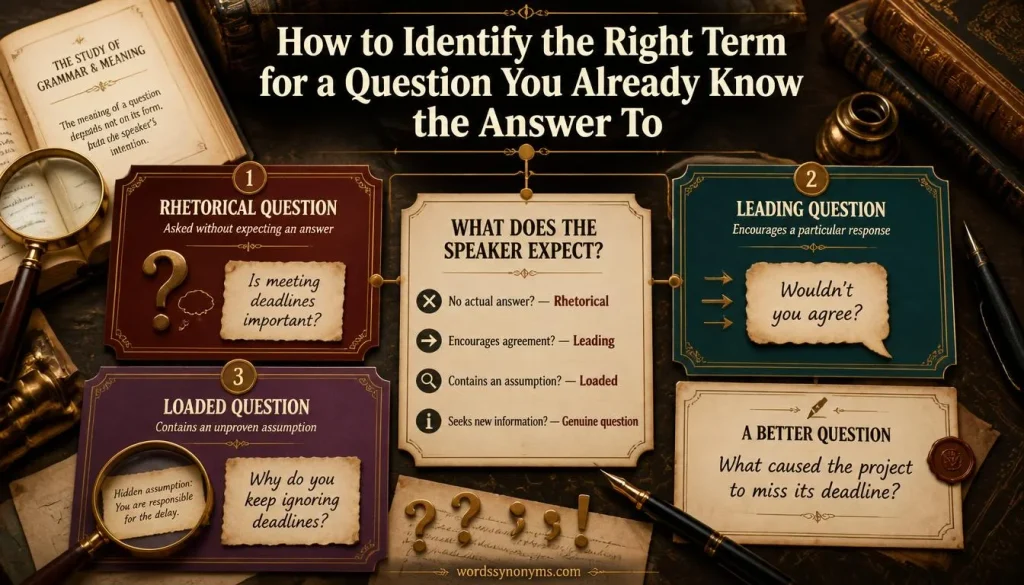
How to Identify the Right Term for a Question You Already Know the Answer To
Choosing the correct term becomes easier when you examine what the speaker expects from the listener.
Start by considering whether the speaker actually wants an answer.
If not, a rhetorical question is probably the right description. If the speaker expects agreement or confirmation, consider a leading question.
Finally, check whether the wording contains an assumption that the listener hasn’t accepted. If it does, the question may be loaded.
Use This Simple Decision Guide
| Ask yourself | Appropriate term |
| Does the speaker ask without expecting an actual answer? | Rhetorical question |
| Does the wording encourage a particular response? | Leading question |
| Does the question contain an unproven assumption? | Loaded question |
| Does the speaker genuinely want new information? | Genuine or information-seeking question |
For example, consider these everyday situations.
Situation A: Your friend complains about being tired after staying awake all night.
You ask, “What did you expect?”
This is rhetorical because you aren’t necessarily requesting information. You’re emphasizing that staying awake naturally leads to tiredness.
Situation B: A salesperson asks, “Wouldn’t you agree that this model offers better value?”
This is leading because the wording encourages agreement with a particular opinion.
Situation C: Someone asks, “When will you stop wasting everyone’s time?”
This is loaded because it assumes the person has been wasting everyone’s time.
A Practical Case Study: Three Questions in One Conversation
Imagine a manager discussing a delayed workplace project with an employee.
The manager knows the deadline has passed and wants to address the situation.
Consider three possible questions:
Example one: Rhetorical question
“Is meeting deadlines important for this team?”
The manager probably isn’t seeking new information. Instead, the question emphasizes an existing workplace expectation.
Example two: Leading question
“Wouldn’t you agree that better planning could prevent these delays?”
The manager encourages the employee to acknowledge the benefits of planning.
Example three: Loaded question
“Why do you keep ignoring important deadlines?”
This question assumes the employee repeatedly ignores deadlines. However, delays might result from unexpected problems or unclear instructions.
The third question could create unnecessary conflict because it presents an assumption as an established fact.
A more constructive alternative would be:
“What caused the project to miss its deadline?”
This version encourages the employee to explain the situation without accepting an accusation.
The lesson: The same subject can produce three different types of questions. Their wording determines how the conversation develops.
Read more: “Involved With” or “Involved In”: What’s the Difference?
FAQs
1. What do you call a question when you already know the answer?
A question asked when you already know the answer is often called a rhetorical question. People use it to make a point, express an opinion, or encourage someone to think.
2. Why do people ask questions they already know the answers to?
People ask these questions to emphasize an idea, challenge someone’s thinking, or guide a discussion. They may also use them to create humor or make a conversation more interesting.
3. Is asking a question you already know the answer to rude?
Not always. It depends on your tone, timing, and intention. A friendly question can encourage discussion, while a sarcastic or judgmental question may sound rude.
4. What is the difference between a rhetorical question and a regular question?
A regular question seeks information or an answer. A rhetorical question usually makes a point without expecting an actual response.
5. Can you use questions with known answers in professional conversations?
Yes. These questions can help emphasize important points during meetings, presentations, and workplace discussions. However, you should use them carefully to avoid sounding sarcastic or confrontational.
6. What is an example of asking a question when you already know the answer?
Suppose someone arrives late to a meeting. You might ask, “Isn’t punctuality important?” You already know the answer, but the question emphasizes your point about being on time.
Conclusion
Knowing how to ask a question when you already know the answer can make your communication more effective. These 3 terms for asking a question you already know the answer to help explain how people use questions to make a point, express an opinion, or encourage deeper thinking. Whether you’re having everyday conversations, participating in professional meetings, or improving your English usage, understanding these questioning methods helps you choose the right words. Each approach serves a different purpose, so recognizing its meaning and tone matters.
The key is to consider your audience and the situation before asking. A well-placed rhetorical question can add emphasis, create humor, or guide a discussion without demanding an answer. However, the wrong tone can make the same question sound sarcastic or uncomfortable. Once you understand these communication techniques, you can express your thoughts with greater clarity, confidence, and professional expression. Use them thoughtfully, and your questions will do more than seek answers.

Franklin Hayes is a writer and editor at WordsConfusing.com, focused on making English vocabulary, grammar, and commonly confused words easy to understand. He writes clear, practical articles with simple explanations and useful examples to help readers improve their English with confidence.
His goal is simple: Making Confusing Words Simple.