

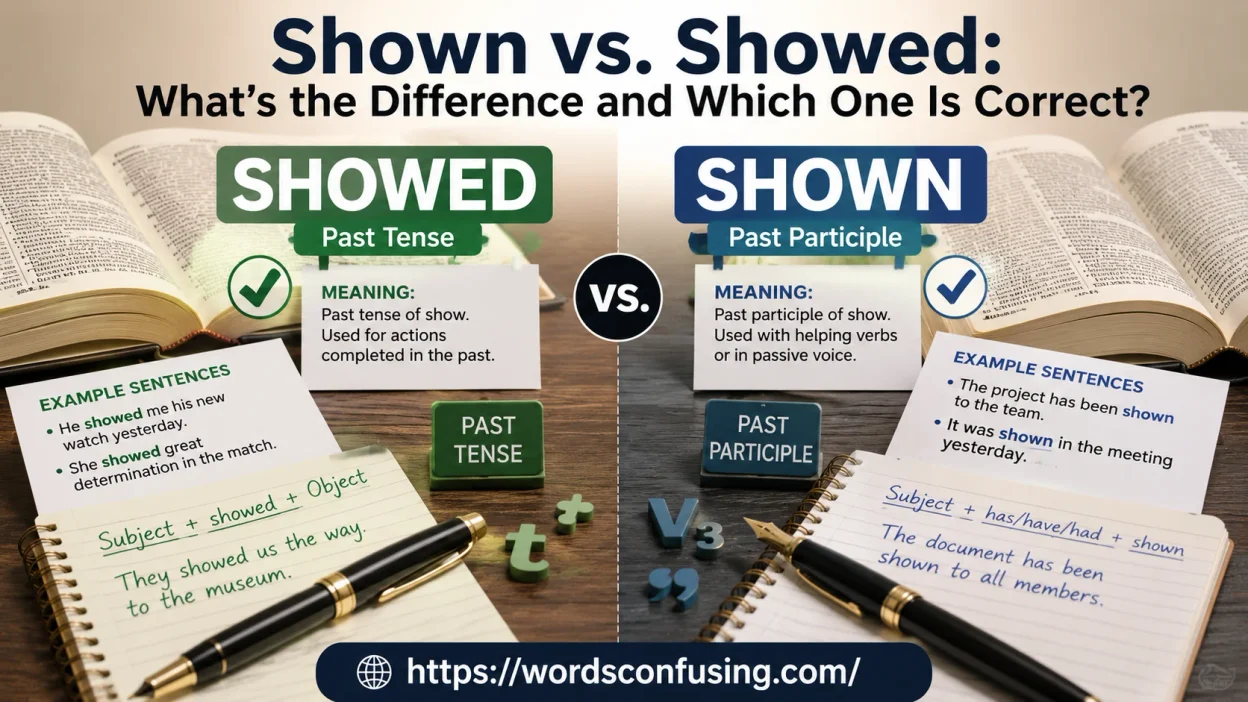
Shown vs. Showed becomes easier when you know that showed is the past tense, while shown is the past participle of the verb “to show.”
Many English learners find these forms tricky, but the rule is simple. In simple English, showed is the simple past tense, while shown usually needs a helping verb such as has, have, or had.
I’ve seen this confusion in writing, conversations, books, and school assignments, where learners may hesitate, rewrite sentences, or second-guess their choice. The difference becomes easier to understand when you notice how the verb behaves in each situation.
A practical way to remember the grammar rules is to make quick comparisons and follow them step-by-step. For examples, “She showed me the picture yesterday” uses the past tense, while “She has shown me the picture” uses the present perfect. The past participle also works when displaying, presenting, or letting someone see something.
The phrase “I’ve shown you this before” is a clear example. Tables, memory tricks, and simple examples can make grammar easier to use, helping you speak and write more naturally. This guide will explore the past tense of show, irregular verbs, simple phrases, words, sentences, and differences between each form.
Quick Answer
The clearest distinction looks like this:
| Word | Grammatical form | Main use | Example |
| Showed | Simple past | A completed past action | She showed me her new car. |
| Shown | Past participle | Perfect tenses and passive constructions | She has shown me her new car. |
Think of the verb forms as a three-part sequence:
show → showed → shown
Here’s the practical rule:
Use “showed” when you’re talking about a straightforward action in the past. Use “shown” when the grammar calls for a past participle.
For example:
- I showed him the email yesterday.
- I have shown him the email already.
- Someone showed the email to the manager.
- The results had shown a significant change.
The meaning of show remains connected in every sentence. The grammatical job changes.
What Does “Showed” Mean?
Showed is the simple past form of show. You use it when someone or something performed the action at a particular point in the past.
The action might involve displaying something, explaining something, revealing something, demonstrating something, or making something visible.
Consider these examples:
- She showed me her new apartment.
- Mark showed his passport to the officer.
- The teacher showed the students an experiment.
- The report showed a sharp increase in sales.
- He showed great courage during the emergency.
Notice something important: showed doesn’t need another verb to make the sentence grammatically complete.
You can say:
She showed me the photograph.
You don’t need has, have, had, was, or were before showed.
When Should You Use “Showed”?
Use showed when the sentence describes a completed action in the past.
Past-time expressions often make this especially obvious:
- yesterday
- last night
- last week
- earlier
- a few minutes ago
- in 2024
- when I was younger
- during the meeting
Examples:
The manager showed us the new design yesterday.
My brother showed me the message last night.
The study showed a noticeable improvement in performance.
She showed everyone how to use the software.
The word showed doesn’t necessarily require a specific time expression. Context alone can establish the past.
I walked into the room and showed everyone the photograph.
The entire sequence clearly takes place in the past.
The Basic “Showed” Sentence Pattern
A common structure looks like this:
Subject + showed + object
Examples:
- Sarah showed her friend the picture.
- The scientist showed the results.
- They showed us the way.
- He showed remarkable patience.
- The chart showed a decline.
You can also use showed without a direct object:
The results showed clearly that something had changed.
Here, showed means the results revealed or indicated something.
What Does “Shown” Mean?
Shown is the usual past participle of show.
That distinction is the heart of the shown vs. showed question.
A past participle doesn’t normally function like an ordinary simple-past verb. It commonly appears with an auxiliary or helping verb.
For example:
She has shown remarkable improvement.
They have shown strong support.
He had shown me the document earlier.
The screen showed the results.
The word shown carries the meaning of show, while the helping verb carries important information about tense, aspect, or voice.
“Shown” With Has, Have, and Had
One of the easiest ways to recognize shown is to look for has, have, or had.
These combinations create perfect constructions:
- has shown
- have shown
- had shown
Examples:
The company has shown steady growth.
Researchers have shown that the method can work.
She had shown the document to her supervisor before the meeting.
Compare those sentences with their simple-past versions:
The company showed steady growth.
Researchers showed that the method could work.
She showed the document to her supervisor before the meeting.
Both forms can be grammatically correct in the right context. The difference comes from the tense and grammatical construction.
Why “Has Shown” Works
The structure is:
has + shown
For example:
The student has shown considerable progress.
The auxiliary has creates the present perfect construction. Shown supplies the past participle.
You wouldn’t normally write:
The student has showed considerable progress.
In standard modern American English, has shown is the preferred form.
Why “Had Shown” Works
The structure had + shown creates the past perfect.
The witness had shown the document before the trial began.
The past perfect helps establish which of two past events happened first.
First, the witness showed the document.
Later, the trial began.
The phrase had shown makes that sequence easier to understand.
Shown vs. Showed in Passive Voice
Passive constructions create another major source of confusion.
In an active sentence, the subject performs the action:
The presenter showed the chart.
In a passive sentence, the grammatical subject receives the action:
The presenter showed the chart.
The difference becomes much clearer when you put the sentences side by side.
| Active | Passive |
| The teacher showed the video. | The video was shown by the teacher. |
| The manager showed the results. | The results were shown to the manager. |
| The company showed the product. | The product was shown at the event. |
| The scientist showed the evidence. | The evidence was shown to the panel. |
The passive construction generally follows this pattern:
Be + Shown
Shown is the past participle of show. When it appears with a form of be, it can create a passive-voice construction.
Examples of “Be + Shown”
Common forms include:
- was shown
- were shown
- is shown
- are shown
- has been shown
- have been shown
- had been shown
Examples of “Shown” in Passive Sentences
- The photograph was shown to the audience.
- The results were shown on the screen.
- The documentary was shown at the festival.
- The evidence has been shown to the jury.
- The method has been shown to produce reliable results.
In each example, shown is the past participle of show, and the sentence uses a form of be to create the passive construction.
The key is the helping verb. Shown functions as the participle.
Shown vs. Showed Examples Side by Side
A direct comparison often makes the distinction click.
| Simple Past: Showed | Past Participle: Shown |
| She showed me the report. | She has shown me the report. |
| He showed his identification. | He had shown his identification. |
| They showed us the house. | They have shown us the house. |
| The study showed a clear trend. | The study has shown a clear trend. |
| The teacher showed the video. | The video was shown in class. |
| The chart showed a decline. | The decline was shown in the chart. |
| He showed great confidence. | He has shown great confidence. |
The important lesson isn’t that one word is “correct” while the other is “wrong.”
Instead, the sentence structure determines which form you need.
A Simple Comparison
Consider these two sentences:
The report showed an increase in sales.
The report has shown an increase in sales.
Both can be correct.
The first uses the simple past. It presents the report’s finding as a completed past event.
The second uses the present perfect. It connects the past finding with the present context.
That distinction becomes particularly useful in academic and professional writing.
Is “Shown” the Past Tense of “Show”?
No. Showed is the standard simple past form of show.
Shown is the usual past participle.
The three principal forms are:
| Base form | Simple past | Past participle |
| show | showed | shown |
This pattern resembles several other irregular verbs:
| Base | Simple Past | Past Participle |
| see | saw | seen |
| write | wrote | written |
| give | gave | given |
| take | took | taken |
| break | broke | broken |
| speak | spoke | spoken |
| show | showed | shown |
This comparison can help if you tend to mix up verb forms.
You wouldn’t normally say:
I have saw the movie.
You say:
I have seen the movie.
Likewise, you wouldn’t normally say:
I have showed the movie.
The standard form is:
I have shown the movie.
The pattern is consistent:
simple past ≠ past participle
Can “Showed” Ever Be Used as a Past Participle?
Here’s where the story gets slightly more interesting.
Although shown is the normal past participle in contemporary standard English, showed has also appeared as a past participle, particularly in older or dialectal usage.
That means the simple rule “showed can never be a participle” is too absolute.
For practical modern writing, however, shown is the form you should generally choose when you need the past participle.
For example:
She has shown excellent judgment.
The evidence has shown a different pattern.
The theater showed the movie twice.
These forms sound natural and standard to modern American English readers.
Why “Shown” Is the Safer Choice
If you’re writing:
- an academic paper
- a business report
- a website
- an email
- an essay
- professional documentation
- formal correspondence
shown is the clear choice for the past participle.
You might encounter showed in participial use, but that doesn’t make it the best choice for contemporary standard writing.
Think of it this way:
Showed is your everyday past-tense workhorse.
Shown handles the past-participle jobs.
That’s a useful rule of thumb.
Common Mistakes With Shown and Showed
Most errors happen because writers recognize the meaning of the verb but overlook its grammatical form.
“She Shown Me the Picture”
Incorrect:
❌ She shown me the picture.
Correct:
✅ She showed me the picture.
Why?
The sentence uses the simple past. There’s no helping verb requiring a past participle.
“She Has Showed Me the Picture”
Less standard:
❌ She has showed me the picture.
Preferred:
✅ She has shown me the picture.
The structure is has + past participle.
Therefore:
has + shown
“The Results Showed Been Significant”
Incorrect:
❌ The results showed been significant.
A natural correction would be:
✅ Researchers have shown the results to be significant.
Here, shown appears within a passive perfect construction.
Mixing the Forms
Another common problem looks like this:
❌ They have showed us the results.
Use:
✅ They have shown us the results.
But when you remove have, the form changes:
✅ They showed us the results.
This is why learning the entire structure is more useful than memorizing isolated words.
How to Choose Between “Shown” and “Showed”
When you’re unsure, don’t guess. Run through three quick questions.
Is the Action Simple Past?
If the sentence describes a straightforward completed past action, use showed.
She showed me the photograph yesterday.
The study showed a significant difference.
They showed us the building last week.
Does the Sentence Use Has, Have, or Had?
If you’re using a perfect construction, shown is normally required.
She has shown remarkable patience.
They have shown strong interest.
He had shown the document before the meeting.
Is the Sentence Passive?
If the sentence uses a passive construction, use shown.
The photograph was shown to the audience.
The results were shown during the presentation.
The evidence has been shown to the committee.
A quick mental test can help:
Has/have/had → shown
Was/were/is/are + passive → shown
Simple past → showed
Read more: 8 Words for Someone Who Is Good With Words
Shown vs. Showed in Different Types of Writing
The distinction becomes especially useful when you move between casual conversation, academic writing, and professional communication.
Everyday Conversation
In ordinary conversation, showed often appears when you’re telling someone about something that happened.
I showed my friend the new picture.
She showed me where the keys were.
He showed us his new phone.
However, shown naturally appears with perfect constructions:
I’ve shown you this picture before.
She’s shown me the same message twice.
The grammatical pattern remains the same regardless of how casual the conversation sounds.
Academic Writing
Academic writing frequently uses shown because researchers often discuss findings that remain relevant to the present.
For example:
Previous studies have shown a relationship between the two variables.
The results have shown consistent improvement.
At the same time, showed works perfectly when discussing a particular completed study or experiment:
The 2024 experiment showed a significant difference.
That difference is subtle but useful.
Showed can place the finding firmly in a completed past event.
Has shown can connect previous evidence with the current discussion.
Business and Professional Writing
Business reports often use both forms.
The quarterly report showed a decline in revenue.
This sentence refers to a particular report.
But:
Recent reports have shown steady growth.
Here, the writer connects multiple past reports with the present situation.
The choice isn’t merely grammatical decoration. It can subtly affect how readers understand the timing and relevance of the information.
Shown vs. Showed in American English
For American English, the practical rule is straightforward.
Showed is the standard simple past form:
I showed him the document.
Shown is the standard past participle:
I have shown him the document.
The participle shown is particularly common in constructions such as:
- has shown
- have shown
- had shown
- was shown
- were shown
- has been shown
- have been shown
- had been shown
You’ll encounter these forms constantly in journalism, academic research, business reports, technical writing, and everyday conversation.
There isn’t a need to invent a complicated rule. The verb behaves like many other irregular verbs whose simple-past and participle forms differ.
Shown vs. Showed in Active and Passive Sentences
Voice provides another helpful way to understand the difference.
Active Voice
The subject performs the action.
The researcher showed the results.
The researcher performs the showing.
Passive Voice
The subject receives the action.
The results were shown by the researcher.
The results receive the action.
Here’s the pattern:
| Construction | Example |
| Simple past active | The researcher showed the results. |
| Present perfect active | The researcher has shown the results. |
| Past perfect active | The researcher had shown the results. |
| Simple past passive | The results were shown. |
| Present perfect passive | The results have been shown. |
| Past perfect passive | The results had been shown. |
Once you recognize these structures, choosing between shown vs. showed becomes almost automatic.
Real-World Examples of “Showed”
Here are practical examples that demonstrate how showed works in different contexts.
Showing an Object
Maria showed me her new watch.
Showing a Photograph
He showed everyone the photograph.
Showing Identification
The passenger showed her identification to the officer.
Showing Directions
A local resident showed us the way to the station.
Showing Evidence
The lawyer showed the jury several documents.
Showing Results
The report showed a sharp increase in demand.
Showing Improvement
The athlete showed significant improvement during the season.
Showing Emotion
She showed no sign of disappointment.
Showing a Skill
The technician showed us how to operate the machine.
Showing Someone Around
The manager showed the visitors around the facility.
In each example, showed acts as the simple past verb.
Real-World Examples of “Shown”
Now compare those examples with situations requiring the past participle.
Present Perfect
The company has shown strong growth this year.
Present Perfect
Researchers have shown that the method works.
Past Perfect
The teacher had shown the students the procedure before the test.
Passive Voice
The results were shown on a large screen.
Passive Perfect
The technique has been shown to improve accuracy.
Academic Writing
Previous research has shown similar results.
Business Writing
Customer surveys have shown increasing demand.
Data Analysis
The latest figures have shown a gradual decline.
Visual Reference
As shown in the chart, sales increased during the final quarter.
Demonstration
The process was shown to new employees during training.
These examples reveal a strong pattern: shown frequently appears alongside another verb.
“As Shown” vs. “As Showed”
The phrase as shown deserves special attention because it appears frequently in essays, reports, articles, presentations, and technical documents.
Correct:
As shown in the chart, sales increased significantly.
Correct:
As shown above, the two results differ.
Correct:
As shown in Figure 2, the temperature declined.
Incorrect in standard usage:
❌ As showed in the chart, sales increased.
Why does as shown work?
Because shown functions as a past participle in a shortened passive construction.
The fuller idea is roughly:
As it is shown in the chart…
English often shortens this type of construction to:
As shown in the chart…
“Showed” Can Work With “The Chart”
There’s an important contrast:
The chart showed an increase in sales.
That’s correct because the chart is the subject performing the grammatical action.
But:
As shown in the chart, sales increased.
That’s also correct because the construction uses the past participle.
So don’t memorize as shown as an isolated phrase. Understand the structure behind it.
A Practical Case Study: Choosing the Right Form
Imagine you’re writing a business report about quarterly sales.
You could write:
The report showed that sales increased by 12% in the final quarter.
That’s simple past. You’re discussing what a particular report revealed.
Now imagine you’re comparing several reports:
Recent reports have shown a steady increase in sales.
Here, have shown uses the present perfect. The findings began in the past but remain relevant to the present discussion.
Now imagine you’re referring to a chart:
As shown in the chart, sales increased sharply in December.
Finally, imagine using passive voice:
The December results were shown to the executive team.
Four sentences. Four related ideas. The correct form depends on the grammatical structure.
| Sentence | Why it works |
| The report showed an increase. | Simple past |
| Reports have shown an increase. | Present perfect |
| As shown in the chart… | Past participle |
| The results were shown to executives. | Passive voice |
This is the kind of distinction that makes grammar practical rather than theoretical.
Common Phrases With “Showed”
You may regularly encounter showed in phrases such as:
- showed a difference
- showed improvement
- showed an increase
- showed a decline
- showed interest
- showed concern
- showed support
- showed evidence
- showed how
- showed that
Examples:
The test showed a significant difference between the groups.
The student showed improvement after several weeks.
The survey showed that customers preferred the new design.
The results showed how quickly conditions had changed.
These are all ordinary simple-past constructions.
Common Phrases With “Shown”
Similarly, you’ll often see shown in these patterns:
- has shown
- have shown
- had shown
- was shown
- were shown
- has been shown
- have been shown
- as shown
- shown to be
- previously shown
Examples:
The approach has shown promising results.
Studies have shown similar patterns.
The evidence was shown to the committee.
The treatment has been shown to improve outcomes.
As shown above, the figures are different.
Learning these common patterns gives you a practical shortcut.
A Quick Test for Shown vs. Showed
When you’re editing a sentence, look immediately before the blank.
If you have:
She ___ me the photograph yesterday.
Use:
showed
If you have:
She has ___ me the photograph.
Use:
shown
If you have:
The photograph was ___ to the audience.
Use:
shown
If you have:
They ___ us the photograph last night.
Use:
showed
The surrounding words often reveal the answer almost instantly.
Shown vs. Showed: Quick Reference
| Situation | Correct form | Example |
| Simple past | showed | She showed me the picture. |
| Present perfect | shown | She has shown me the picture. |
| Past perfect | shown | She had shown me the picture. |
| Passive voice | shown | The picture was shown to us. |
| Perfect passive | shown | The picture has been shown to us. |
| “As demonstrated/displayed” | shown | As shown above… |
| Past action with a specific time | showed | He showed me the report yesterday. |
FAQs
Is “shown” or “showed” correct?
Both shown and showed are correct, but they’re used differently. Showed is the simple past form, while shown is the past participle.
Can I use “shown” by itself?
Usually, no. Shown normally needs a helping verb, such as has, have, or had. For example, “She has shown me the results.”
When should I use “showed”?
Use showed when talking about a completed action in the past. For example, “He showed me his new car yesterday.”
When should I use “shown”?
Use shown with helping verbs in forms such as the present perfect or past perfect. For example, “They have shown great improvement.”
Is “I showed you this before” correct?
Yes. Showed is correct because the sentence describes an action that happened in the past. You can also say, “I’ve shown you this before,” when using the present perfect.
What’s the easiest way to remember shown vs. showed?
Think of showed as the regular past-tense choice and shown as the participle that usually needs a helping verb. If you see has, have, or had, shown is often the right choice.
Conclusion
Choosing between shown and showed doesn’t have to be confusing. Just remember that showed is the simple past form, while shown is the past participle and usually appears with a helping verb like has, have, or had. Once you get comfortable with this small difference, you’ll find it much easier to use both forms naturally in your everyday English.
A good way to build confidence is to notice these forms whenever you read or write. Pay attention to the words around shown and showed, and the correct choice will start to feel more natural over time.

Shafiq Ur Rehman is a writer and content contributor at WordsConfusing.com. He enjoys exploring the English language, common word confusions, vocabulary, and practical writing tips. His goal is to make English easier to understand through clear, simple, and useful articles.