


Suits You Well – Meaning and Examples explains how this phrase compliments someone’s appearance, personality, or choices.
When a friend says, “That suits you,” they express appreciation, approval, and admiration. The phrase commonly describes an outfit, hairstyle, personal style, or fashion choice that looks good on someone. It can also describe a decision, role, or personality trait that matches someone’s skills and preferences.
In everyday English, this natural expression creates a positive impression and builds confidence. Understanding its meaning, grammar, tone, and context helps you use it naturally in conversations.
In business communication, formal writing, and workplace interactions, choosing the right wording improves clarity and effective communication. You might discuss meetings, scheduling, time management, or project management using precise language.
Exploring synonyms, alternative expressions, and creative alternatives expands your vocabulary and improves communication skills. Consider the situation, purpose, and professional tone before choosing an expression. A genuine compliment feels more personal than a predictable phrase.
Whether writing emails, offering professional feedback, or talking with friends, use appropriate wording to express appreciation, warmth, and personality. These choices make your message sound sincere and natural.
Quick Answer
“Suits you well” means something looks good on you, matches your personality, or fits your needs. For example, “That blue jacket suits you well” means the jacket complements your appearance. You can also use the phrase for careers, lifestyles, and personal choices. Similar expressions include “looks good on you,” “flatters you,” “fits you perfectly,” and “is a good fit for you.”
What Does “Suits You Well” Mean?
“Suits you well” means that something looks attractive on you, matches your personality, or fits your circumstances. The exact meaning depends on what you’re describing.
For example, if someone says, “That blue shirt suits you well,” they’re probably complimenting your appearance. If they say, “This job suits you well,” they mean the job matches your abilities, interests, or working style.
The phrase commonly expresses three ideas:
- Appearance: Something looks attractive on a person.
- Compatibility: Something matches a person’s personality, preferences, or abilities.
- Practical suitability: Something works well for a person’s needs or circumstances.
Here are examples that show these different meanings:
| Example sentence | Meaning |
| That dress suits you well. | The dress looks attractive on you. |
| Teaching suits her well. | Teaching matches her personality or abilities. |
| The new schedule suits me well. | The schedule fits my needs. |
The key is context. Once you understand what the speaker means, choosing the right response or alternative becomes much easier.

How to Use “Suits You Well” in a Sentence
You can use this phrase in everyday conversations, professional discussions, and friendly compliments. The following examples show how it works in different contexts.
When Talking About Clothes and Appearance
When someone wears an outfit that complements their appearance, “suits you well” offers a friendly compliment. It can refer to colors, dresses, jackets, glasses, hairstyles, and other style choices.
For example, you might tell a friend, “That navy-blue jacket suits you well.” You’re saying the jacket looks particularly good on them.
Here are more examples:
- That red dress suits you well.
- Your new haircut really suits you well.
- Those glasses suit you well.
- This shade of green suits you well.
- That formal outfit suits you well.
- Your new hairstyle suits you well.
Usage tip: When complimenting someone’s appearance, you can also say “That looks great on you” or “That color really flatters you.” These alternatives often sound more conversational.
When Describing Personality or Personal Style
The phrase can describe more than physical appearance. You can use it for something that reflects a person’s character, habits, or natural way of doing things.
For instance, someone who enjoys creative work might thrive in a design role. Saying “A creative career suits you well” suggests that the career matches their interests and strengths.
Consider these examples:
- This relaxed style suits you well.
- A leadership role suits her well.
- Working independently suits him well.
- That approach suits your personality well.
- A creative career suits you well.
- The role of team leader suits her well.
Notice that the phrase often expresses a positive judgment about compatibility. It suggests that the person and the situation make a good match.
When Talking About Jobs, Roles, and Lifestyles
“Suit you well” also works when discussing schedules, careers, living arrangements, and everyday choices. In these situations, the phrase usually means something fits your needs or circumstances.
For example, a flexible work schedule might suit someone who has family responsibilities. A quiet lifestyle might suit someone who prefers peaceful surroundings.
Here are some practical examples:
- Working from home suits me well.
- The new position suits him well.
- City life suits them well.
- This schedule suits my routine well.
- The university program suits her well.
- The flexible arrangement suits everyone well.
These examples demonstrate an important point: something can suit you without looking attractive on you. A job or schedule doesn’t need to affect your appearance to be a good fit.
Read more: When Was the Letter “J” Invented? And Was It Before Jesus?
12 Synonyms for “Suits You Well”
Sometimes, the best way to compliment someone is to choose words that fit the moment. While “suits you well” works in many situations, other expressions can sound more natural, specific, or enthusiastic.
Here are 12 useful alternatives, along with their meanings and examples.
Looks Good on You
“Looks good on you” is one of the most common alternatives when discussing clothes, accessories, or hairstyles. It focuses on appearance rather than personality or practical suitability.
Examples:
- That blue shirt looks good on you.
- Your new glasses look good on you.
- This jacket looks surprisingly good on you.
Use this expression when you want to give someone a straightforward, friendly compliment.
Flatters You
“Flatters you” means that something enhances your appearance or emphasizes your attractive features. People often use it when discussing clothing cuts, colors, hairstyles, and accessories.
Examples:
- That dress flatters you.
- This color really flatters your complexion.
- The fitted jacket flatters your shape.
Unlike “looks good on you,” this expression suggests that something enhances particular features.
Becomes You
“Becomes you” means that something looks attractive or appropriate on you. It sounds somewhat traditional or formal compared with everyday expressions such as “looks great on you.”
Examples:
- That elegant coat becomes you.
- The new hairstyle becomes you.
- Such a confident look becomes you.
This expression is grammatically correct, but it isn’t as common in casual American English. Use it when a slightly polished or old-fashioned tone fits the conversation.
Looks Great on You
“Looks great on you” is a warm, enthusiastic way to compliment someone’s appearance. It expresses stronger approval than the more neutral “looks good on you.”
Examples:
- That suit looks great on you.
- Your new haircut looks great on you.
- Those sunglasses look great on you.
It’s especially useful when shopping with a friend or reacting to someone’s new look.
Fits You
“Fits you” can refer to physical size, but it can also describe compatibility with someone’s personality or circumstances. Context determines which meaning the speaker intends.
Examples:
- This jacket fits you perfectly.
- The leadership role fits you.
- That style fits your personality.
Be careful, though. When discussing clothes, “fits you” usually refers to size and shape. When discussing a job or role, it refers to suitability.
Matches Your Style
“Matches your style” describes something that reflects someone’s usual preferences, taste, or personal identity. It works particularly well for fashion, interior design, and creative choices.
Examples:
- That leather jacket matches your style.
- This modern apartment matches your taste and style.
- Your new website matches your professional image.
Choose this expression when you want to emphasize personal taste rather than general attractiveness.
Complements You
“Complements you” means that something enhances your appearance or works harmoniously with your qualities. Depending on the context, it can describe clothing, colors, accessories, or even a person’s strengths.
Examples:
- The silver necklace complements you beautifully.
- That color complements your features.
- Her practical skills complement his creative strengths.
The related verb complement often suggests that two things work well together. It doesn’t simply mean that they look similar.
Goes Well With You
“Goes well with you” is understandable, but it isn’t always the most natural choice in American English when describing a person’s appearance. Native speakers generally prefer “suits you,” “looks good on you,” or “goes well with your style.”
Examples:
- That color goes well with your overall style.
- The jacket goes well with your other clothes.
- This hairstyle works well with your features.
For the most natural phrasing, describe the specific match whenever possible.
Is a Good Fit for You
“Is a good fit for you” is especially useful when discussing jobs, educational programs, responsibilities, or personal decisions. It emphasizes compatibility rather than physical appearance.
Examples:
- This position is a good fit for you.
- The course is a good fit for your goals.
- That schedule is a good fit for your family.
This expression works well in professional conversations because it sounds clear and practical.
Fits You Perfectly
“Fits you perfectly” expresses a very close match. It can describe clothing that fits properly or a role that aligns closely with someone’s strengths.
Examples:
- That jacket fits you perfectly.
- This career fits you perfectly.
- The new position fits your experience perfectly.
Remember that the expression can refer to physical fit or broader suitability. The surrounding sentence makes the intended meaning clear.
Works Well for You
“Works well for you” focuses on usefulness, convenience, or practicality. It is particularly appropriate for schedules, routines, working arrangements, and personal preferences.
Examples:
- Working remotely works well for you.
- The new schedule works well for your routine.
- This study method works well for you.
Use this alternative when something helps you achieve a goal or makes your life easier.
Is Well Suited to You
“Is well suited to you” means that something matches your abilities, preferences, personality, or circumstances. It often sounds more formal than “suits you well.”
Examples:
- This career is well suited to you.
- The role is well suited to your experience.
- A flexible work arrangement is well suited to your needs.
This phrase is particularly useful in professional writing, career discussions, and recommendations.
Comparison Table: 12 Alternatives to “Suits You Well”
| Synonym | Best use | Example |
| Looks good on you | Appearance | That coat looks good on you. |
| Flatters you | Enhancing appearance | This dress flatters you. |
| Becomes you | Traditional compliment | That color becomes you. |
| Looks great on you | Enthusiastic compliment | Your new glasses look great on you. |
| Fits you | Size or compatibility | This role fits you. |
| Matches your style | Personal taste | That jacket matches your style. |
| Complements you | Enhancing qualities | The color complements you. |
| Goes well with your style | Coordinated appearance | That outfit goes well with your style. |
| Is a good fit for you | Roles and opportunities | The job is a good fit for you. |
| Fits you perfectly | Close compatibility | This position fits you perfectly. |
| Works well for you | Practical suitability | The schedule works well for you. |
| Is well suited to you | Formal suitability | The role is well suited to you. |
Quick tip: Choose “looks good on you” for a simple compliment, “flatters you” for enhanced appearance, and “is a good fit for you” for careers or opportunities.
“Suits You Well” in Everyday Conversations
Understanding a phrase is one thing. Using it naturally in conversation is another. These examples show how “suits you well” works in realistic situations.
Complimenting Someone’s Outfit
Imagine you’re shopping with a friend who tries on a navy-blue blazer. The color complements their appearance, and the cut looks polished.
You could say:
“That blazer suits you well. You should consider getting it.”
The compliment sounds natural because it refers to a specific item. You could also say, “That blazer looks great on you,” if you want a more casual tone.
Other examples include:
- That sweater suits you well.
- The black jacket suits you well.
- This outfit suits you better than the other one.
The final example introduces a comparison. Use “better” when comparing two or more choices.
Talking About a New Hairstyle or Look
A new haircut can change someone’s appearance significantly. When a friend tries a different style, “suits you well” offers a positive reaction without sounding exaggerated.
For example:
“Your new haircut really suits you well. It gives you a fresh look.”
You can also use these variations:
- Short hair really suits you.
- That hairstyle looks great on you.
- The new color flatters you.
- This style matches your personality.
Each expression offers a slightly different compliment. Choose the one that best describes what you noticed.
Discussing a Career or Personal Choice
The phrase also works when discussing someone’s professional development. Suppose a friend recently became a teacher and seems to enjoy working with students.
You might say:
“Teaching suits you well. You’re patient, organized, and good at explaining things.”
Here, the compliment focuses on the connection between the person’s qualities and their profession.
Other examples:
- The management role suits you well.
- Working with children suits her well.
- Freelancing seems to suit him well.
- A career in design might suit your interests.
These sentences express suitability rather than certainty about someone’s future. The phrase describes a perceived match based on the information available.
Giving Friendly Advice
You can use “suits you well” to recommend an option that matches someone’s needs or preferences.
For example:
“I think the morning class would suit you well because you prefer studying early.”
Other examples include:
- This course would suit you well.
- The smaller apartment might suit your needs better.
- A flexible schedule would suit your routine.
- This approach seems to suit your working style.
When giving advice, words such as might, would, and seems can make your suggestion sound considerate rather than forceful.
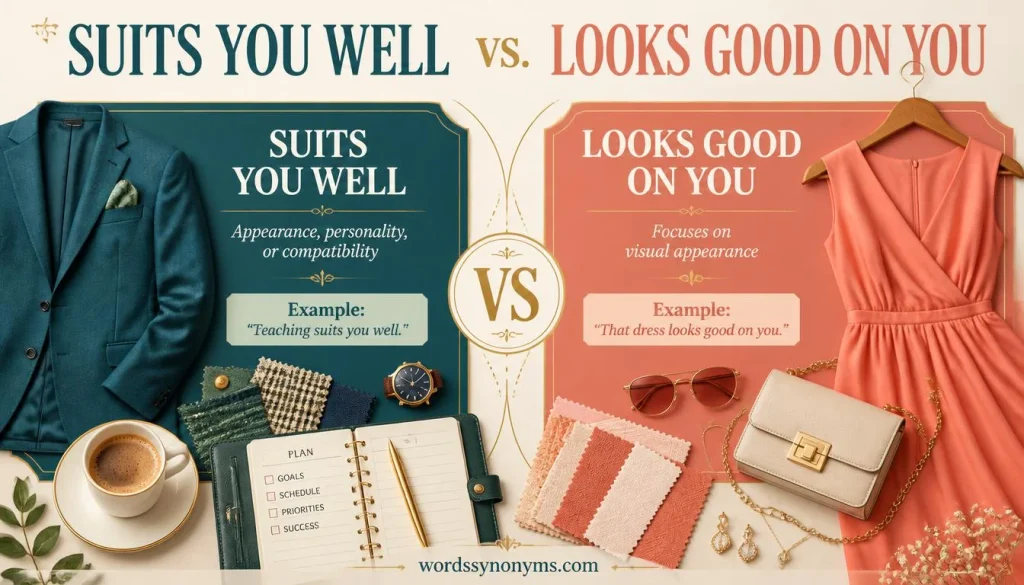
“Suits You Well” vs. “Looks Good on You”
These expressions are similar, but they don’t cover exactly the same ground. The main difference lies in what the speaker wants to emphasize.
“Looks good on you” focuses on visual appearance. “Suits you well” can describe appearance, personality, or broader compatibility.
Compare these examples:
| Sentence | What it emphasizes |
| That dress looks good on you. | The dress makes you look attractive. |
| That dress suits you well. | The dress complements your appearance or style. |
| Teaching suits you well. | Teaching matches your abilities or personality. |
| This schedule suits you well. | The schedule fits your needs. |
You wouldn’t normally say “Teaching looks good on you” to describe someone’s professional abilities. The expression sounds more like a comment on their appearance in a particular role or outfit.
However, both expressions work well when complimenting clothing.
Which should you choose? Use “looks good on you” for a direct visual compliment. Choose “suits you well” when you want to emphasize a good overall match.
“Suits You Well” vs. “Suits You”
Both expressions are grammatically correct. In many situations, they communicate essentially the same idea.
The main difference is emphasis. Adding “well” highlights the degree of suitability, although it doesn’t necessarily change the core meaning.
Examples:
- That color suits you.
- That color suits you well.
- The new job suits her.
- The new job suits her well.
All four sentences are correct. The version with well gives a little more emphasis to how appropriate the choice seems.
In casual American English, “That really suits you” is also a natural compliment. It often sounds more conversational than “That suits you well.”
Here is a quick comparison:
| Expression | Tone | Example |
| Suits you | Neutral and direct | That haircut suits you. |
| Suits you well | Slightly more emphatic | That haircut suits you well. |
| Really suits you | Warm and conversational | That haircut really suits you. |
| Suits you perfectly | Strong approval | That haircut suits you perfectly. |
Choose the version that matches your intended tone. You don’t need to add well every time.
Is “Suits You Well” Grammatically Correct?
Yes, “suits you well” is grammatically correct when you use it with the appropriate subject and sentence structure.
The verb suit means to be appropriate, convenient, or attractive for someone. The word well acts as an adverb that describes how something suits the person.
Understanding the Basic Sentence Structure
A common sentence pattern is:
Subject + suit + object + well
Examples:
- This jacket suits you well.
- The new schedule suits me well.
- The position suits her well.
The subject identifies what is suitable. The object identifies the person affected by that suitability.
Subject–Verb Agreement
The verb changes depending on whether the subject is singular or plural in the simple present tense.
| Subject | Correct sentence |
| This color | This color suits you well. |
| These colors | These colors suit you well. |
| The role | The role suits her well. |
| The roles | The roles suit her well. |
| The schedule | The schedule suits us well. |
| The schedules | The schedules suit us well. |
Remember this simple rule: use “suits” with a third-person singular subject and “suit” with plural subjects.
For example, “This jacket suits you” is correct, while “These jackets suits you” is incorrect. The correct plural version is “These jackets suit you.”
Can You Use “Suits You Well” in Questions?
Yes. You can use the phrase in questions about appearance or suitability.
Examples:
- Does this jacket suit you well?
- Do these colors suit you well?
- Would this schedule suit you well?
- What time suits you best?
Notice that does takes the base form suit, not suits. Similarly, do takes the base form when the subject is plural.
For example:
- Correct: Does this color suit you?
- Incorrect: Does this color suits you?
- Correct: Do these colors suit you?
- Incorrect: Do these colors suits you?
These small details help your sentences sound polished and natural.
Common Mistakes to Avoid When Using “Suits You Well”
Although the phrase is straightforward, a few common errors can make your English sound less natural. Understanding them helps you use the expression with confidence.
Confusing “Suit” With “Suite”
The words suit and suite sound alike in many varieties of English, but they have different meanings.
- Suit: To be appropriate, convenient, or attractive for someone.
- Suite: A set of connected rooms or a collection of related items, such as a software suite.
Examples:
- Correct: That jacket suits you well.
- Incorrect: That jacket suites you well.
- Correct: The hotel suite has two bedrooms.
Use suit when discussing appearance or suitability.
Using “Suits” With a Plural Subject
In the simple present tense, plural subjects take suit, not suits.
Examples:
- Correct: These shoes suit you well.
- Incorrect: These shoes suits you well.
- Correct: Those colors suit her.
- Incorrect: Those colors suits her.
The verb agrees with the subject, not the person receiving the compliment.
Saying “Suits on You”
When suit means to look attractive on someone, you don’t need the preposition on.
Examples:
- Correct: This jacket suits you.
- Incorrect: This jacket suits on you.
- Correct: This jacket looks good on you.
The difference comes from the verbs themselves. Suit takes the person directly as its object, while look good uses the preposition on in this construction.
Using “Good” Instead of “Well”
When you want to say that something is suitable for someone, the standard expression is “suits you well,” not “suits you good.”
Examples:
- Correct: That dress suits you well.
- Incorrect: That dress suits you good.
- Correct: This schedule works well for me.
Here, well describes how something suits the person. The phrase “suits you good” is nonstandard in this context.
Choosing a Synonym That Doesn’t Match the Meaning
Not every alternative works in every situation.
For example, “flatters you” usually describes appearance, while “works well for you” focuses on practical usefulness.
Compare:
- Natural: That color flatters you.
- Natural: This schedule works well for you.
- Awkward: This schedule flatters you.
The last sentence sounds unusual because a schedule doesn’t enhance someone’s appearance. Always choose a synonym that fits the subject.

15 Example Sentences With “Suits You Well”
The best way to remember a phrase is to see how people use it in different contexts. These examples cover clothing, personality, careers, and everyday arrangements.
1. Examples About Appearance
- That blue jacket suits you well.
- Your new haircut suits you well.
- The glasses suit you well.
- This shade of green suits you well.
- That formal outfit suits you well.
2. Examples About Personality and Skills
- Leadership suits her well.
- Teaching suits him well.
- Working independently suits me well.
- This creative approach suits your personality well.
- Public speaking seems to suit you well.
3. Examples About Jobs and Lifestyles
- The new position suits her well.
- Working from home suits them well.
- City life suits him well.
- The flexible schedule suits me well.
- This arrangement suits everyone well.
These examples demonstrate the phrase’s flexibility. You can use it for something visible, such as clothing, or something less tangible, such as a career or routine.
Read more: Ridden or Rode: Which Is Correct?
A Short Case Study: Choosing the Right Expression
Imagine Alex is deciding between two job offers. The first offers a higher salary but requires frequent travel. The second provides flexible hours and more time for creative work.
After discussing the options, Alex’s friend says:
“The second job seems to suit you well because it matches your interests and gives you more flexibility.”
This sentence works because suit describes compatibility with Alex’s priorities.
Now imagine Alex tries on a new jacket before an interview. The same friend says:
“That jacket looks great on you.”
Both comments are positive, but they serve different purposes. The first evaluates a practical decision. The second compliments an outfit.
This is the central lesson: choose your wording based on what you’re describing, not simply because two phrases share a similar meaning.
FAQs
1. What does “suits you well” mean?
“Suits you well” means something looks good on you or matches your personality, preferences, or circumstances. It can describe clothing, hairstyles, decisions, or suitable roles.
2. Is “suits you well” a compliment?
Yes, it’s usually a compliment. It shows that someone likes how something looks on you or believes it fits you perfectly.
3. What is the difference between “suits you” and “looks good on you”?
“Looks good on you” mainly describes appearance. “Suits you” can describe appearance, personality, lifestyle, or suitability for a particular situation.
4. Can I use “suits you well” in professional conversations?
Yes. You can use it when discussing a colleague’s role, a professional choice, or an appropriate style. For formal emails, consider the context and tone before using it.
5. What are some alternatives to “suits you well”?
You can say “looks great on you,” “fits you perfectly,” “complements your style,” “matches your personality,” or “works well for you.” Choose an expression that fits the situation.
6. Is it correct to say “That suits you well”?
Yes, “That suits you well” is grammatically correct. You can use it to compliment someone’s outfit, hairstyle, decision, or choice. The exact meaning depends on the context.
Conclusion
The phrase “suits you well” is a simple, natural way to say that something looks good on someone or matches their personality. You can use it when talking about clothes, hairstyles, career choices, or personal decisions. For example, a new jacket might suit your style, while a leadership role might suit your skills. Understanding the context helps you express your thoughts clearly and make your compliments sound genuine.
When choosing similar expressions, think about what you want to communicate. “Looks great on you” focuses on appearance, while “fits your personality” highlights someone’s character. You can also say “works well for you” when discussing a choice or situation. By using these phrases naturally, you can make everyday conversations warmer, more precise, and more engaging.


