

This guide to 3 Words for a Person Who Takes a Survey: Meaning and Usage clarifies common names for survey participants and their roles.
Have you ever wondered what to call someone who collects opinions, asks questions, and gathers information from people? The answer often depends on the situation, purpose, and level of involvement. Common terms include survey participant, survey taker, and respondent. Although these words share similar meanings, their applications can differ.
Learning these synonyms and understanding survey terminology improves your English usage, grammar, and formal writing. These terms are especially useful in business communication, market research, and professional reports prepared for meetings and project management.
Understanding proper usage also helps you choose the correct word and maintain clarity and consistency. Survey-related expressions appear in various professional contexts, including online booking, broadcasting, and customer feedback systems, where accurate information gathering and collecting responses matter. You may also encounter these terms in research activities, scheduling, time management, and calendar planning.
If you’ve participated in a survey before, you might wonder how others describe your role. Exploring their meanings, interesting facts, and practical examples makes these expressions easier to understand. You’ll also learn how to use these common words naturally in everyday conversations and professional communication, regardless of the different situations in which surveys take place.
Quick Answer
The three words for a person who takes a survey are respondent, participant, and survey taker.
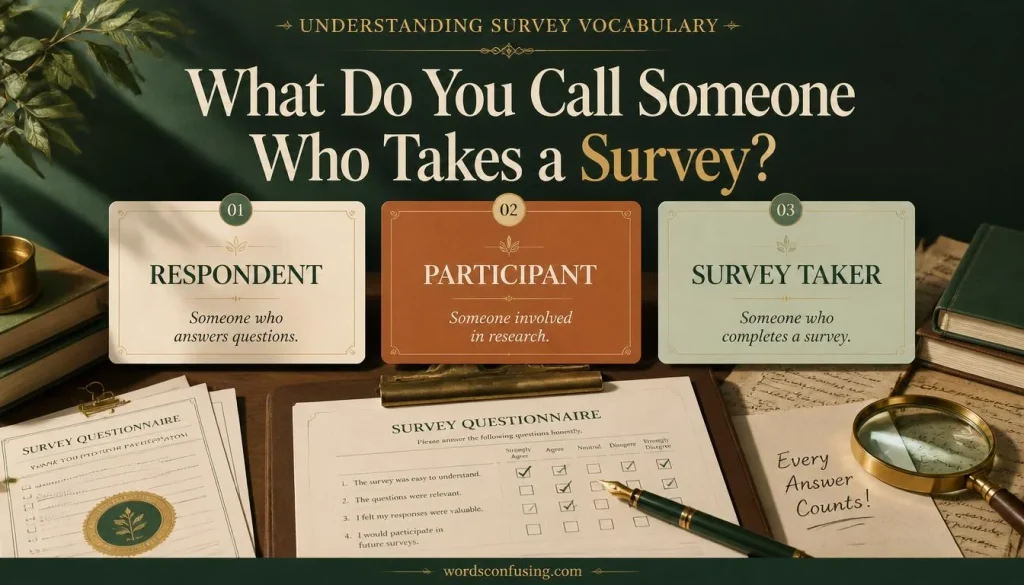
- Respondent: Someone who answers questions in a survey, questionnaire, or opinion poll.
- Participant: Someone who takes part in a research study, survey, experiment, or other organized activity.
- Survey taker: Someone who completes a survey by answering its questions.
Respondent is generally the most precise term for someone who answers survey questions. However, participant and survey taker are also suitable alternatives in certain contexts. For example, participant works well when referring to someone involved in a research study. Meanwhile, survey taker specifically describes someone who completes a questionnaire. Therefore, respondent remains the best choice when you want to emphasize the person providing survey answers.
What Do You Call Someone Who Takes a Survey?
A person who takes a survey is commonly called a respondent. This term appears frequently in market research, academic studies, customer feedback reports, and public opinion polls.
“For example, imagine a company sends 500 customers a questionnaire about its latest product. ”Every customer who submits answers becomes a survey respondent.
However, the best term depends on the activity involved. For example, someone involved in a university research project is often called a participant, even when the study includes surveys. In this context, participant describes their broader role in the research rather than simply answering questions.
Similarly, survey taker is a simple, clear term for someone who completes an online questionnaire or feedback form. For instance, companies often use this term when asking customers to share their opinions about products or services.
Understanding these differences helps you select the most appropriate expression.
Quick Comparison of the Three Words for a Person Who Takes a Survey
| Word | Meaning | Common Context |
| Respondent | Someone who answers survey questions | Surveys, polls, and questionnaires |
| Participant | Someone involved in a study or research activity | Academic and scientific research |
| Survey taker | Someone who completes a survey | Online surveys and feedback forms |
All three expressions describe people who may answer survey questions. However, they don’t always communicate exactly the same role.
Three Words for a Person Who Takes a Survey
Each of these three terms has a distinct meaning and practical purpose. Let’s examine how they work in different situations.
Respondent: Someone Who Answers Survey Questions
Respondent is the most established and precise term for someone who answers questions in a survey or questionnaire.
The word comes from the verb respond, which means to answer, reply, or react to something. A respondent provides information by answering questions presented by a researcher, organization, or survey administrator.
In survey research, respondents supply the answers that researchers later examine. Their responses might reveal opinions, preferences, experiences, habits, or demographic information.
For example, a restaurant might ask customers to rate their dining experience. Anyone who completes the feedback questionnaire becomes a respondent.
Researchers commonly use this term when discussing collected answers and survey results.
Examples of respondent in sentences:
- Each respondent answered twelve questions about their shopping habits.
- The researchers collected responses from 300 survey respondents.
- Every respondent received an email confirming their submission.
- The survey asked respondents about their experiences with online learning.
- Researchers analyzed the answers provided by each respondent.
- The company invited previous customers to become respondents in its satisfaction survey.
Where is respondent commonly used?
You will frequently encounter this word in the following settings:
- Market research: Companies collect information about customer preferences and purchasing decisions.
- Academic research: Students and researchers gather information for studies and dissertations.
- Public opinion polls: Organizations ask people about social issues, public policies, and current events.
- Customer satisfaction surveys: Businesses evaluate service quality through customer feedback.
- Employee surveys: Organizations collect opinions about workplace conditions and management practices.
- Healthcare research: Researchers gather information about patient experiences and health-related behaviors.
One important distinction deserves attention. A respondent doesn’t necessarily participate in every part of a research project. Their specific role involves providing answers.
For instance, someone might complete a questionnaire without attending an interview or participating in an experiment. In that situation, respondent accurately describes their contribution.
When should you use respondent?
Choose this word when your sentence focuses on people answering questions or supplying information.
For example:
“The study included 250 respondents who completed an online questionnaire.”
This sentence clearly identifies the individuals who provided the research data.
Participant: Someone Who Takes Part in Research
Participant describes someone who takes part in an activity, event, experiment, or research study.
The word comes from participate, meaning to become involved in something. Unlike respondent, participant doesn’t specifically refer to answering questions.
A participant might complete a survey, attend an interview, perform an assigned task, or take part in an experiment. Their involvement can include several activities throughout a research project.
For example, a university might conduct a study about students’ learning habits. Researchers could ask participants to complete questionnaires, attend interviews, and perform learning exercises.
These individuals are participants because they contribute to the broader research process.
The term also appears frequently in psychology, education, medicine, sociology, and other research fields.
Examples of participant in sentences:
- Every participant completed a questionnaire before the research began.
- The study included 150 participants from different educational backgrounds.
- Researchers asked participants to share their experiences during individual interviews.
- Each participant received instructions before starting the experiment.
- The research team contacted participants through email.
- All participants voluntarily agreed to take part in the study.
Where is participant commonly used?
This expression works particularly well in situations involving broader involvement.
- Academic studies: Students or volunteers contribute to university research.
- Psychological experiments: Individuals complete tasks or undergo controlled assessments.
- Medical research: Volunteers take part in clinical or observational studies.
- Educational research: Teachers and students contribute information about learning experiences.
- Social science research: Individuals share information about their communities and social behaviors.
- Training programs: People attend organized activities and complete assigned exercises.
However, participant and respondent aren’t always interchangeable.
Consider a university research project involving 100 students. Researchers ask each student to complete a questionnaire and attend a follow-up interview.
The students are participants because they contribute to the overall study. They are also respondents when they answer the questionnaire.
The distinction becomes especially important in formal research writing.
When should you use participant?
Use this term when discussing someone’s involvement in a larger study or organized activity.
For example:
“All participants completed the initial survey before attending their interviews.”
Here, participant identifies the individuals involved in the research rather than focusing exclusively on their survey answers.
Survey Taker: Someone Who Completes a Survey
Survey taker is a straightforward expression for someone who completes a survey by answering its questions.
Unlike respondent and participant, this term directly describes the activity of taking a survey. It sounds natural in everyday communication and online survey environments.
For example, imagine a website offering customers a short questionnaire about their shopping experience. Every person who completes that questionnaire can be described as a survey taker.
The expression doesn’t necessarily suggest involvement in a formal research project. It simply identifies someone who answers a survey.
You might encounter it in online feedback systems, customer experience platforms, opinion polls, and survey reward programs.
Examples of survey taker in sentences:
- Every survey taker must answer the required questions.
- The website provides clear instructions for first-time survey takers.
- Each survey taker can submit only one response.
- The company thanked every survey taker for providing feedback.
- Survey takers received a confirmation message after completing the questionnaire.
- The online platform makes the process easier for survey takers.
Where is survey taker commonly used?
This expression is particularly useful in informal and practical situations.
- Online surveys: Websites invite visitors to complete questionnaires.
- Customer feedback: Businesses ask customers to evaluate products and services.
- Opinion polls: Polling websites collect public opinions about different topics.
- Market research platforms: Companies recruit people to answer research questions.
- Feedback forms: Organizations collect suggestions from customers or employees.
- Survey reward programs: Platforms offer eligible users incentives for completing surveys.
One advantage of this expression is its simplicity. Readers immediately understand what the person does.
However, survey taker may sound less formal in academic reports. Researchers generally prefer respondent when describing individuals who supplied survey answers.
When should you use survey taker?
Choose this expression when discussing the practical act of completing a survey.
For example:
“Each survey taker must complete the questionnaire before receiving the confirmation email.”
The expression fits naturally because the sentence focuses on completing the survey.
Respondent vs. Participant vs. Survey Taker: Key Differences
Although these three terms describe people involved in surveys, their meanings have slightly different boundaries.
Understanding those differences helps you avoid awkward or inaccurate wording.
Meaning and Main Focus
The biggest difference involves what each word emphasizes.
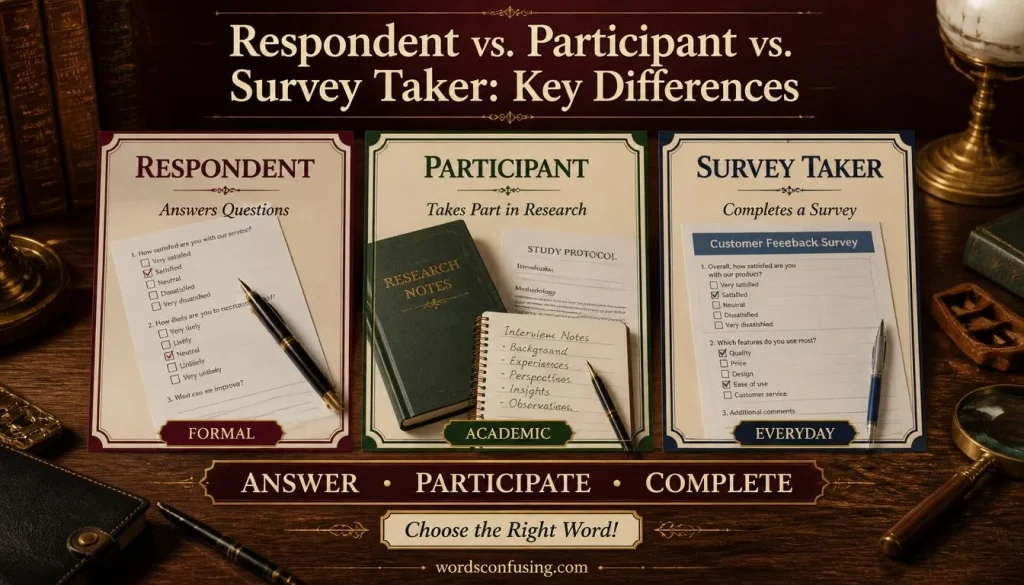
- Respondent focuses on answering questions and providing information.
- Participant focuses on taking part in a research activity or study.
- Survey taker focuses on completing a survey.
For example, a person who answers a customer satisfaction questionnaire is a respondent. If that person also joins a follow-up research interview, they become a participant in the broader study.
Survey taker simply describes their action of completing the questionnaire.
Formality and Writing Style
Your choice also depends on the tone of your writing.
| Word | Formality | Best Writing Context |
| Respondent | Formal and professional | Research papers, reports, and surveys |
| Participant | Formal or neutral | Academic studies and research descriptions |
| Survey taker | Informal or neutral | Websites, instructions, and everyday communication |
Respondent works especially well in professional documents. Participant suits both formal research and general explanations.
Survey taker sounds more conversational and direct.
Common Usage
The following examples demonstrate how each term works in real situations.
| Situation | Best Term | Example |
| Answering a customer questionnaire | Respondent | Each respondent rated the service. |
| Joining a university research project | Participant | Every participant attended the interview. |
| Completing an online feedback form | Survey taker | Each survey taker submitted the form. |
| Answering a public opinion poll | Respondent | Poll respondents supported the proposal. |
| Taking part in a psychology experiment | Participant | Researchers monitored each participant. |
| Completing a website survey | Survey taker | Survey takers answered five questions. |
Can You Use These Three Words Interchangeably?
Sometimes, yes. However, their meanings aren’t identical.
Imagine a company conducts a customer satisfaction study. Customers receive an online questionnaire and answer questions about product quality.
You could describe them as respondents or survey takers. Both expressions accurately identify their role.
However, if the company also invites those customers to participate in product testing, participant becomes more appropriate for the broader activity.
The easiest way to remember the distinction:
- A respondent answers.
- A participant takes part.
- A survey taker completes a survey.
These simple definitions make the three expressions easier to remember and use correctly.
Read more: Hands-On Experience: Meaning, Benefits and Examples
How to Choose the Right Word for Someone Who Takes a Survey
Choosing the correct word doesn’t require complicated grammar rules. You simply need to understand what the person actually does.
The following situations can help you make the right choice.
Use Respondent When Someone Answers Questions
Choose respondent when your main focus involves collecting answers or analyzing survey information.
This term works especially well when discussing numerical findings, written feedback, or research results.
Examples:
- “The respondents rated their satisfaction on a five-point scale.”
- “Researchers collected answers from 400 respondents.”
- “Each respondent provided information about their employment history.”
If you’re writing a research paper, this is usually your safest choice when referring specifically to survey answers.
Use Participant When Someone Joins a Larger Study
Choose participant when someone contributes to a research project that involves more than answering questions.
For example, a medical study might involve questionnaires, physical assessments, and follow-up appointments.
The people involved are participants because their contribution extends beyond completing a survey.
Examples:
- “The participants attended three research sessions.”
- “Researchers explained the study requirements to all participants.”
- “Each participant completed an initial questionnaire.”
This term is particularly useful when describing the people involved in an entire research process.
Use Survey Taker When Someone Completes a Questionnaire
Choose survey taker when you want a simple expression that readers immediately understand.
It works naturally in website instructions, customer surveys, and everyday discussions.
Examples:
- “Survey takers should answer every required question.”
- “The platform welcomes new survey takers.”
- “Each survey taker receives a submission confirmation.”
This expression is especially suitable for content aimed at general readers.
Practical Decision Guide
Use these questions to identify the best term:
| Ask Yourself | Choose |
| Is the person answering survey questions? | Respondent |
| Is the person involved in a broader research study? | Participant |
| Is the person simply completing a survey? | Survey taker |
| Am I discussing collected survey answers? | Respondent |
| Am I describing research involvement? | Participant |
| Am I writing simple website instructions? | Survey taker |
Practical tip: When accuracy matters, describe the person’s actual role rather than choosing a word simply because it sounds more sophisticated.

Real-World Examples: How to Use the Three Terms Correctly
Realistic situations make the differences between these expressions easier to understand.
Here are three examples from common survey environments.
Case Study: A Company Conducts a Customer Satisfaction Survey
Imagine an electronics company wants to understand how customers feel about its latest smartphone.
The company emails a questionnaire to 1,000 customers. Questions cover battery life, camera quality, pricing, and customer support.
Of those customers, 650 complete the questionnaire.
The company can describe these 650 individuals as respondents because they supplied answers.
It can also call them survey takers when discussing the process of completing the online questionnaire.
If some customers later join interviews or product testing, those individuals become participants in the broader research project.
| Research Activity | Appropriate Term |
| Answering the questionnaire | Respondent |
| Completing the online survey | Survey taker |
| Joining additional product testing | Participant |
Case Study: A University Conducts an Academic Study
Consider a university researching how students manage their study schedules.
Researchers recruit 120 students and ask them to complete weekly questionnaires. They also interview selected students about their learning routines.
All 120 students are participants because they contribute to the research project.
When they answer the questionnaires, they also act as respondents.
This example demonstrates why academic researchers often use both terms within the same report.
Case Study: A Website Collects Customer Feedback
Suppose an online clothing store displays a feedback form after every purchase.
Customers can answer five questions about delivery speed, product quality, website navigation, and customer service.
The store might refer to people completing the form as survey takers.
However, its research report might call the same individuals respondents when presenting the collected answers.
Both expressions work. The appropriate choice depends on the sentence’s purpose.
Related Survey Terminology You Should Know
Understanding the three main terms becomes easier when you recognize other words associated with survey research.
Some related expressions describe different roles or parts of the research process. However, they aren’t direct synonyms for respondent, participant, or survey taker.
Questionnaire
A questionnaire is a structured set of questions designed to collect information from people.
It may include multiple-choice questions, rating scales, short answers, or open-ended questions.
For example, a restaurant might create a questionnaire asking customers to rate food quality and service.
A questionnaire is the collection of questions rather than the person answering them.
Example: “Every respondent received the same questionnaire.”
Survey Administrator
A survey administrator is someone responsible for organizing, distributing, or managing a survey.
This person may send invitations, explain instructions, monitor submissions, and coordinate the data collection process.
For example, a university research assistant might distribute questionnaires to students and collect completed responses.
A survey administrator manages the process rather than necessarily answering the questions.
Example: “The survey administrator distributed the questionnaires to all eligible students.”
Survey Researcher
A survey researcher is someone who studies a population’s opinions, experiences, preferences, or behaviors through surveys.
Their responsibilities may include designing questions, selecting respondents, analyzing answers, and interpreting findings.
For example, a market researcher might survey consumers to understand their preferences before launching a new product. In this case, the researcher collects and analyzes customer feedback to identify useful insights. By contrast, a respondent simply answers the survey questions rather than conducting the research.
Example: “The survey researcher analyzed the responses to identify customer preferences.”
Survey Sample
A survey sample is the selected group of people invited or chosen to provide information for a survey.
Researchers use samples because studying every member of a population can be expensive and time-consuming. Therefore, they select a smaller group to collect information more efficiently. As a result, researchers can analyze the findings without surveying the entire population.
For example, a university might survey 500 students to understand the opinions of its entire student population. In this way, researchers can use the selected students’ responses to identify broader trends and preferences.
Those 500 selected individuals form the sample. The people who actually submit answers become respondents.
It’s important to distinguish the two concepts.
- Population: The entire group researchers want to understand.
- Sample: The smaller group selected for the survey.
- Respondents: The individuals who actually provide answers.
- Responses: The information those individuals submit.
These terms describe different parts of the same research process.

Common Mistakes When Describing Someone Who Takes a Survey
Even familiar survey terminology can create confusion when writers use related words incorrectly.
Here are some mistakes worth avoiding.
Calling Every Participant a Respondent
Not every research participant answers a survey.
Some participants perform experiments, attend interviews, or complete practical activities without answering questionnaires.
Therefore, respondent is appropriate only when someone actually provides answers.
Using Survey Taker in Every Formal Report
Survey taker is understandable, but it may sound too conversational in academic writing.
For formal reports, respondent usually provides a more professional and precise description.
However, survey taker remains useful in website content and everyday instructions.
Confusing a Survey Administrator With a Respondent
These two individuals perform different roles.
A survey administrator manages the survey process while a respondent answers the questions.
For example, the employee distributing a company questionnaire isn’t automatically a respondent. That person becomes one only if they also complete it.
Treating a Questionnaire and Survey as Identical
People often use these words interchangeably in everyday conversations.
However, they have different meanings in research.
A questionnaire refers to the actual set of questions. A survey describes the broader process of gathering information from people.
For instance, a survey might include a questionnaire, distribution process, response collection, and data analysis.
Understanding this distinction makes your writing more precise.
Read more: 9 Words to Use Instead of “However” With Examples and Usage
FAQs
1. What do you call a person who takes part in a survey?
A person who takes part in a survey is called a survey participant or respondent. They answer questions and share their opinions to help researchers collect useful information.
2. Is a survey taker the same as a survey participant?
Yes, both terms generally describe someone who answers survey questions. However, survey participant sounds more formal and is commonly used in research settings.
3. What is the difference between a respondent and a data collector?
A respondent answers survey questions and provides information. A data collector gathers responses or information from people. These terms describe two different roles in the survey process.
4. What is another word for someone who answers questionnaires?
You can use words such as respondent, survey participant, or questionnaire participant. The best choice depends on your sentence and the type of research.
5. Why do researchers need survey participants?
Researchers need survey participants to collect opinions, experiences, and feedback. Their answers help identify trends, understand customer needs, and support informed decisions.
6. Can I use the term survey respondent in formal writing?
Absolutely! Survey respondent is a clear and professional term. You can use it in academic papers, business reports, research documents, and formal communication.
Conclusion
Choosing the right word for someone who takes a survey depends on the role they play and the context. Survey participant, survey taker, and respondent are three useful terms you can use in everyday conversations, research discussions, and professional writing. Although their meanings overlap, each expression adds a slightly different tone to your sentence. Knowing these differences helps you communicate clearly without making simple ideas sound complicated.
The next time you discuss a questionnaire or research project, think about the person’s actual role before choosing a term. If someone answers questions and shares opinions, respondent or survey participant usually works well. If you want a simpler expression, survey taker is also appropriate. A little attention to word choice can make your English sound more natural, accurate, and confident.

Shafiq Ur Rehman is a writer and content contributor at WordsConfusing.com. He enjoys exploring the English language, common word confusions, vocabulary, and practical writing tips. His goal is to make English easier to understand through clear, simple, and useful articles.


