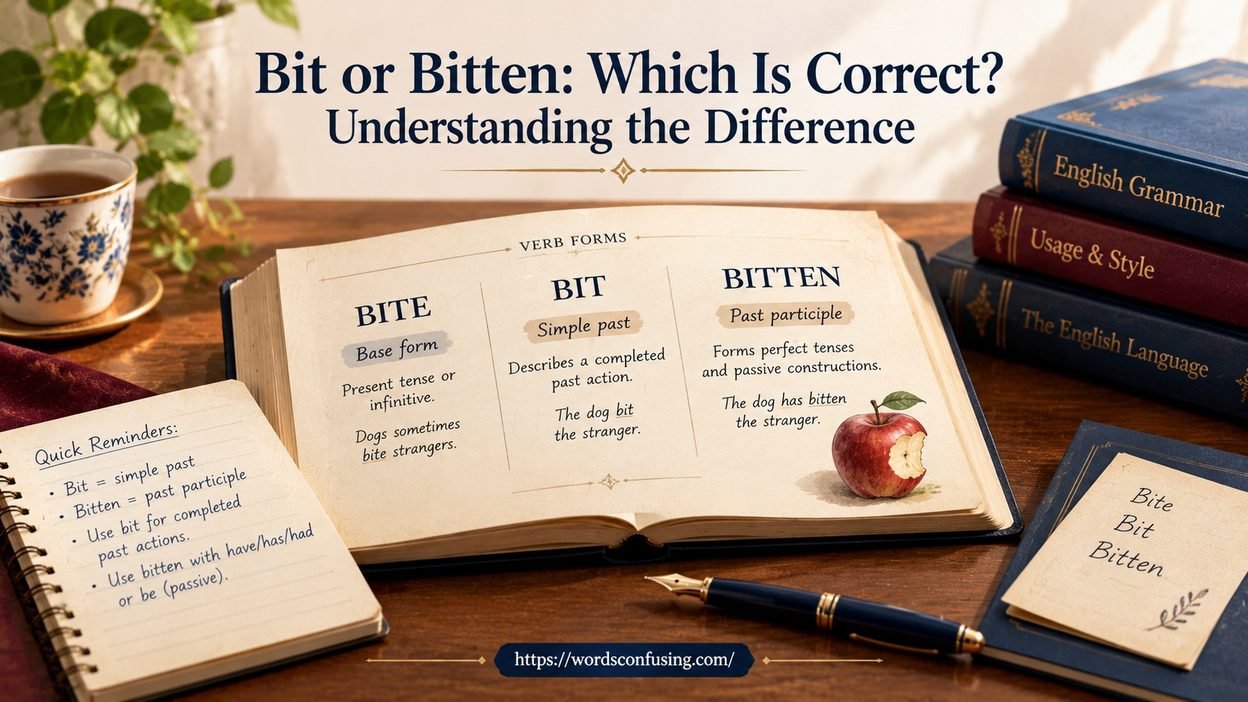
Bit or Bitten: Which Is Correct? Understanding the Difference becomes easier when you understand these two verb forms.
Both words come from bite, an irregular verb that often confuses English learners and native speakers. The main difference is their grammatical role. Bit is the simple past form, used for a past action or completed action.
For example, “The dog bit the mail carrier yesterday.” This sentence describes a finished action in the past tense. Understanding these grammar rules improves your English grammar, English usage, and clear communication.
In contrast, bitten is the past participle form and usually needs a helping verb or auxiliary verb, such as has, have, had, or be. You can use it in the present perfect, past perfect, and passive voice. For example, “The dog has bitten him before.” Checking the sentence structure, different tenses, and tense selection helps you choose the correct word.
These practical examples improve verb usage, sentence formation, clarity, and consistency. With regular practice, you can remember the difference and avoid common mistakes in everyday and professional writing.
Quick Answer
Both bit and bitten are correct, but they serve different grammatical purposes. Bit is the simple past tense of bite, while bitten is the past participle used with helping verbs such as have, has, and had. For example, say “The dog bit me yesterday” but “The dog has bitten me before.” Remember the pattern: Bite → Bit → Bitten.

Bit or Bitten: Which Is Correct?
Both bit and bitten are correct English words. However, they aren’t interchangeable because they represent different forms of the irregular verb bite.
The word bit is the simple past tense of bite. You use it when describing an action that happened and finished in the past.
The word bitten is the past participle of bite. It generally appears with auxiliary verbs such as have, has, and had. You also use it in passive constructions with forms of be.
Consider these examples:
- Bit: The puppy bit my finger yesterday.
- Bitten: The puppy has bitten my finger before.
- Bitten: My finger was bitten by the puppy.
Notice how the verb changes depending on the sentence structure. The first example describes a completed past action. The second uses the present perfect tense. The third uses passive voice.
Here’s a quick comparison:
| Word | Verb Form | Main Function | Example |
| Bite | Base form | Present tense or infinitive | Dogs sometimes bite strangers. |
| Bit | Simple past | Describes a completed past action | The dog bit the stranger. |
| Bitten | Past participle | Forms perfect tenses and passive constructions | The dog has bitten the stranger. |
The easiest rule to remember: Use bit for the simple past and bitten after the appropriate auxiliary verb.
What Does Bit Mean?
Bit is the simple past tense of the verb bite. It describes an action that happened at an earlier time and is now complete.
When someone or something uses its teeth to cut, grip, or injure another object or person, you can describe that action using bit if it happened in the past.
For example:
- The dog bit the mail carrier.
- My little brother bit his sandwich.
- A mosquito bit my ankle last night.
- The snake bit the farmer.
- She bit her lower lip nervously.
In each sentence, the action happened in the past. Therefore, bit is the appropriate verb form.
Bit as the Simple Past Tense of Bite
Understanding the simple past tense makes the difference between bit and bitten much clearer.
The simple past tense describes an action that occurred at a specific or understood time in the past. You don’t need an auxiliary verb to form an ordinary affirmative sentence.
For example:
Present tense: The dog bites people when frightened.
Simple past: The dog bit someone yesterday.
The present-tense verb bites changes to bit when the sentence describes a completed past action.
You can also use bit with different subjects:
- I bit my tongue while eating.
- You bit into the apple.
- He bit his fingernails.
- She bit the chocolate bar.
- We bit into our sandwiches.
- They bit their lips nervously.
The subject doesn’t change the past-tense form. Whether you’re talking about one person or several people, the simple past form remains bit.
How to Use Bit in Different Sentence Structures
The word bit works in several common sentence patterns.
Affirmative sentences
Use bit directly after the subject to describe a completed action.
Examples:
- The horse bit the farmer.
- She bit her lip during the conversation.
- My puppy bit my shoe.
- He bit into a fresh peach.
Negative sentences
When forming negative sentences in the simple past, use did not or didn’t followed by the base verb bite.
Examples:
- The dog didn’t bite anyone.
- She did not bite her nails.
- He didn’t bite the sandwich.
- The snake did not bite the child.
Remember this important rule: After did or didn’t, use bite, not bit.
Incorrect: The dog didn’t bit me.
Correct: The dog didn’t bite me.
Questions
Use did followed by the subject and the base form bite when asking about past actions.
Examples:
- Did the dog bite you?
- Did she bite her tongue?
- Did the mosquito bite your arm?
- Did he bite into the fruit?
This pattern stays the same regardless of the subject.
Examples of Bit in Sentences
Here are additional examples showing how bit works in everyday English.
| Sentence | Explanation |
| The puppy bit my hand. | Describes a completed action in the past. |
| A mosquito bit me during the night. | Identifies a past biting incident. |
| She bit her lip while thinking. | Describes a past physical action. |
| He bit into the apple. | Shows an action completed in the past. |
| The snake bit the hiker. | Describes a past incident involving an animal. |
| My brother bit his tongue accidentally. | Identifies an accidental past action. |
| The child bit the cookie in half. | Describes an action involving food. |
These examples demonstrate one consistent pattern: bit works as the main verb in ordinary affirmative simple past sentences.
What Does Bitten Mean?
Bitten is the past participle of the verb bite. Unlike bit, it usually needs an auxiliary verb to form a complete verb phrase.
You commonly find bitten in perfect tenses and passive constructions. These structures help explain when an action happened or who experienced it.
For example:
- I have bitten my tongue.
- She has bitten her nails.
- The dog had bitten someone before.
- The child was bitten by an insect.
- Several people have been bitten by mosquitoes.
In these sentences, bitten works with another verb to create the correct grammatical structure.
Bitten as the Past Participle of Bite
A past participle is a verb form used with auxiliary verbs to create perfect tenses and certain passive constructions.
For the verb bite, the three principal forms are:
- Base form: Bite
- Simple past: Bit
- Past participle: Bitten
The past participle doesn’t normally stand alone as the main verb in a standard affirmative sentence.
For example:
Incorrect: She bitten her finger.
Correct: She has bitten her finger.
The auxiliary verb has makes the second sentence grammatically complete.
Similarly:
Incorrect: The dog bitten my shoe.
Correct: The dog had bitten my shoe.
The word bitten needs the appropriate helping verb in these examples.
Using Bitten With Have, Has, and Had
One of the easiest ways to recognize bitten is to look for the auxiliary verbs have, has, and had.
These verbs help form perfect tenses.
Using Have Bitten
Use have bitten with the subjects I, you, we, and they in the present perfect tense.
Examples:
- I have bitten my tongue several times.
- You have bitten into the wrong apple.
- We have bitten our lips during stressful moments.
- They have bitten their fingernails for years.
The present perfect connects a past action with the present in some way. The exact time may be unknown, unimportant, or understood through context.
Using Has Bitten
Use has bitten with third-person singular subjects such as he, she, it, or a singular noun.
Examples:
- He has bitten his tongue.
- She has bitten her nails again.
- The dog has bitten two people.
- The child has bitten his toy.
The auxiliary has changes according to the subject. However, the participle remains bitten.
Using Had Bitten
Use had bitten to describe an action completed before another past event. This construction is called the past perfect tense.
Examples:
- The dog had bitten someone before its owner arrived.
- She had bitten her lip before answering.
- The snake had bitten the farmer before help arrived.
- He had bitten into the sandwich before noticing the mistake.
In each example, had bitten identifies an earlier action relative to another past event.
Using Bitten in Passive Voice
Another important use of bitten appears in passive constructions.
Passive voice shifts attention from the person or animal performing an action to the person or object receiving it.
Compare these sentences:
Active voice: The dog bit the boy.
Passive voice: The boy was bitten by the dog.
The first sentence emphasizes the dog. The second focuses on the boy.
You can also use bitten with other passive structures:
- I was bitten by a mosquito.
- The child was bitten by the puppy.
- Several workers were bitten by insects.
- My hand has been bitten by the dog.
- The hiker had been bitten before reaching the campsite.
Notice that bitten appears after forms of the verb be, including was, were, and been.
A useful distinction is that passive voice doesn’t always require the same auxiliary verb. Its structure depends on the tense.
| Passive Construction | Example |
| Present simple | The boy is bitten by the dog. |
| Past simple | The boy was bitten by the dog. |
| Present perfect | The boy has been bitten by the dog. |
| Past perfect | The boy had been bitten by the dog. |
| Future | The boy will be bitten if the dog attacks. |
The passive construction uses the past participle bitten.
Examples of Bitten in Sentences
The following examples show how bitten appears in different grammatical situations.
| Sentence | Grammatical Use |
| I have bitten my tongue. | Present perfect |
| She has bitten her nails. | Present perfect |
| The dog had bitten the visitor. | Past perfect |
| He was bitten by a mosquito. | Past passive |
| They have been bitten by insects. | Present perfect passive |
| The child had been bitten before. | Past perfect passive |
| The apple was bitten by the horse. | Past passive |
These examples show why bitten generally needs an auxiliary verb in standard English.
Bit vs. Bitten: Key Differences
Although bit and bitten share the same root verb, their grammatical roles differ.
The most important distinction involves their relationship with tense and auxiliary verbs.
Bit describes a completed action in the simple past tense. Meanwhile, bitten appears in perfect tenses and passive constructions.
Consider these pairs:
- The cat bit my hand.
- The cat has bitten my hand.
Both sentences describe a biting action. However, their grammatical structures communicate different relationships with time.
The first sentence places the action in the past. The second connects the past action to the present.
Here’s a detailed comparison:
| Feature | Bit | Bitten |
| Verb type | Simple past | Past participle |
| Base verb | Bite | Bite |
| Main purpose | Describes completed past actions | Forms perfect tenses and passive voice |
| Common structure | Subject + bit + object | Subject + have/has/had + bitten |
| Passive structure | Not used as the standard participle | Was/were/been + bitten |
| Example | The dog bit me. | The dog has bitten me. |
Differences in Tense
The simple past and perfect tenses don’t always communicate the same relationship with time.
Simple Past:
Use bit when describing an action that happened in the past.
Example: A bee bit me yesterday.
The word yesterday identifies a specific completed past time.
Present Perfect:
Use have bitten or has bitten when connecting a past action with the present.
Example: A bee has bitten me.
This sentence reports a past event without specifying exactly when it happened.
Past Perfect:
Use had bitten when one past action happened before another.
Example: The bee had bitten me before I noticed it.
The biting happened first. Noticing the bite happened afterward.
Differences in Sentence Structure
The easiest way to distinguish these forms is by examining the words around them.
Look at these patterns:
- Simple past: Subject + bit + object.
- Present perfect: Subject + have/has + bitten + object.
- Past perfect: Subject + had + bitten + object.
- Past passive: Subject + was/were + bitten.
- Present perfect passive: Subject + have/has been + bitten.
These structures help you choose the right form without memorizing dozens of unrelated examples.

Bite, Bit, and Bitten: All Three Forms of the Verb
To understand bit and bitten completely, you should learn all three principal forms of bite.
English has several irregular verbs that don’t follow the usual pattern of adding -ed to create the past tense and past participle.
For example, regular verbs follow patterns such as:
- Walk → Walked → Walked
- Talk → Talked → Talked
- Jump → Jumped → Jumped
However, bite changes its spelling across its three principal forms:
- Bite → Bit → Bitten
This pattern is important because using the wrong form can make an otherwise correct sentence sound unnatural.
The Three Principal Forms of Bite
| Verb Form | Word | Example Sentence |
| Base form | Bite | Dogs sometimes bite when frightened. |
| Simple past | Bit | The dog bit my shoe. |
| Past participle | Bitten | The dog has bitten my shoe. |
Each form has a different grammatical purpose.
Bite: Use the base form after modal verbs, infinitives, and certain auxiliary constructions. It also appears in the simple present with plural subjects and the first- and second-person subjects.
Examples:
- Dogs bite when they feel threatened.
- I don’t want to bite anyone.
- You should never bite your nails.
- The puppy might bite the furniture.
Bit: Use this form for ordinary affirmative simple past statements.
Examples:
- The puppy bit my shoe.
- She bit her lip.
- The mosquito bit my arm.
Bitten: Use this form with the appropriate auxiliary verb in perfect tenses and passive constructions.
Examples:
- The puppy has bitten my shoe.
- She had bitten her lip.
- My arm was bitten by a mosquito.
Why Is Bite an Irregular Verb?
The verb bite is irregular because its past-tense and past-participle forms don’t follow the standard -ed pattern.
You can’t write bited in standard English.
The correct forms are:
- Present: Bite
- Past: Bit
- Past participle: Bitten
Similar irregular patterns appear in other common English verbs:
| Base Form | Simple Past | Past Participle |
| Bite | Bit | Bitten |
| Write | Wrote | Written |
| Drive | Drove | Driven |
| Ride | Rode | Ridden |
| Speak | Spoke | Spoken |
| Break | Broke | Broken |
| Choose | Chose | Chosen |
| Forget | Forgot | Forgotten |
Learning these patterns can make English verb conjugation easier. Once you recognize the structure, you can apply the same approach to other irregular verbs.
When to Use Bit or Bitten in a Sentence
Choosing between bit and bitten becomes much easier when you identify the sentence’s grammatical structure.
Instead of guessing, look at the tense and auxiliary verbs.
Use Bit for Completed Past Actions
Choose bit when describing a completed action in the simple past tense.
You can use this form with different subjects and objects. It doesn’t require have, has, or had in an ordinary affirmative sentence.
Examples:
- The dog bit the postman.
- My sister bit into the chocolate.
- A spider bit my foot.
- The horse bit the wooden fence.
- He bit his lip during the meeting.
You can also use bit with past-time expressions such as:
- Yesterday
- Last night
- Last week
- Two days ago
- A few minutes ago
- When I was younger
For example, “A mosquito bit me last night” is correct because the sentence describes a completed past action.
Use Bitten With Have, Has, or Had
Choose bitten when forming perfect tenses with the appropriate auxiliary verb.
The correct combination depends on your subject and the time relationship.
Examples:
- I have bitten my tongue.
- She has bitten her nails.
- They have bitten into the fruit.
- The dog had bitten the visitor.
- We had bitten our lips before speaking.
Remember the basic combinations:
| Subject | Correct Construction |
| I | Have bitten |
| You | Have bitten |
| He | Has bitten |
| She | Has bitten |
| It | Has bitten |
| We | Have bitten |
| They | Have bitten |
| Singular or plural subject with past perfect | Had bitten |
A common mistake is writing has bit or have bit when standard written English requires has bitten or have bitten.
Use Bitten in Passive Sentences
Passive sentences use bitten when the subject receives the biting action.
For example:
- The child was bitten by the dog.
- My leg was bitten by an insect.
- Several campers were bitten by mosquitoes.
- The visitor has been bitten by a puppy.
In these sentences, the person or object receiving the action becomes the subject.
You can recognize passive voice by looking for a form of be followed by the past participle.
Can You Say “I Was Bit” Instead of “I Was Bitten”?
You may hear people say, “I was bit by a dog” in casual American conversations.
This construction appears in informal speech and some regional varieties of English. However, “I was bitten by a dog” is the standard form for formal writing and conventional grammar instruction.
For school assignments, professional writing, and edited articles, choose was bitten.
Compare:
- Standard: I was bitten by a dog.
- Informal usage: I was bit by a dog.
Knowing this distinction helps you understand everyday speech without confusing it with standard written English.
Read more: Alexis’ or Alexis’s? Here’s the Correct Possessive Form
Common Mistakes When Using Bit or Bitten
Even experienced English speakers sometimes mix up irregular verb forms. The confusion usually comes from forgetting which auxiliary verb a sentence requires.
Here are common mistakes and their corrections.
Using Bitten Without an Auxiliary Verb
Incorrect: The dog bitten my shoe.
Correct: The dog bit my shoe.
Why? The sentence describes a completed action in the simple past. Therefore, bit is the appropriate form.
If you want to use bitten, add an auxiliary verb:
Correct: The dog has bitten my shoe.
Using Bit After Have or Has
Incorrect: She has bit her tongue.
Correct: She has bitten her tongue.
Why? The present perfect tense requires the past participle. For the verb bite, that form is bitten.
More examples:
- Incorrect: I have bit my lip.
- Correct: I have bitten my lip.
- Incorrect: He has bit the apple.
- Correct: He has bitten the apple.
Using Bit After Had
Incorrect: The snake had bit the farmer.
Correct: The snake had bitten the farmer.
Why? The past perfect tense follows the same participle rule. Use had with bitten.
Using Bit After Did or Didn’t
Incorrect: Did the dog bit you?
Correct: Did the dog bite you?
Why? The auxiliary did already indicates the past tense. The main verb must return to its base form.
The same rule applies to negative sentences.
Incorrect: She didn’t bit her nails.
Correct: She didn’t bite her nails.
Confusing Active and Passive Voice
Incorrect: The boy was bit the dog.
Correct: The boy was bitten by the dog.
Why? The passive construction requires a past participle after was. In this case, the correct form is bitten.
Quick Correction Table
| Incorrect Sentence | Correct Sentence |
| The dog bitten me. | The dog bit me. |
| She has bit her tongue. | She has bitten her tongue. |
| He had bit the apple. | He had bitten the apple. |
| Did the snake bit him? | Did the snake bite him? |
| I didn’t bitten anyone. | I didn’t bite anyone. |
| The child was bit by a dog. | The child was bitten by a dog. |
These corrections cover the most common mistakes. Pay particular attention to the auxiliary verb because it often determines which form you need.
Bit or Bitten: A Practical Case Study
Imagine that Sarah visits her friend’s house and meets a playful puppy named Max.
During their visit, Max suddenly bites Sarah’s finger. Later, she tells her family what happened.
She could describe the incident in several ways:
Example One: Simple Past
“Max bit my finger while we were playing.”
Sarah uses bit because she’s describing a completed action in the past.
Example Two: Present Perfect
“Max has bitten my finger.”
She uses has bitten because the present perfect connects the past event with the present.
Example Three: Past Passive
“My finger was bitten by Max.”
Sarah uses was bitten because the sentence focuses on the finger receiving the action.
Example Four: Past Perfect
“Max had bitten my finger before I realized what happened.”
She uses had bitten because the biting occurred before another past event.
All four sentences describe the same general incident. However, each sentence uses a different grammatical structure.
The lesson is simple: The meaning of the event doesn’t determine the verb form by itself. The sentence structure does.
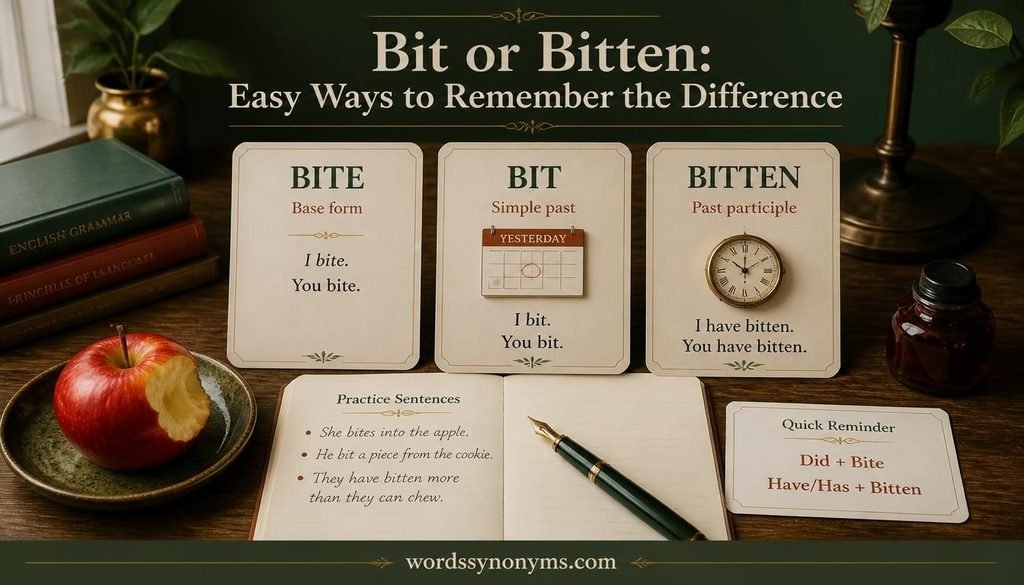
Bit or Bitten: Easy Ways to Remember the Difference
Memorizing irregular verbs can feel like collecting puzzle pieces. Fortunately, a few practical techniques make the process easier.
Remember the Bite–Bit–Bitten Pattern
Start by learning the three principal forms together:
Bite → Bit → Bitten
Repeat this pattern when practicing English verbs. It helps you recognize which form belongs to each grammatical situation.
Look for Auxiliary Verbs
Before choosing bit or bitten, check whether the sentence contains a helping verb.
- No auxiliary in an affirmative simple past sentence? Use bit.
- Have or has? Use bitten.
- Had? Use bitten.
- Was or were in a passive construction? Use bitten.
For example:
- Yesterday, the dog bit me.
- The dog has bitten me before.
- I was bitten by the dog.
Remember the Did Rule
When you see did or didn’t, use the base form bite.
Examples:
- Did the dog bite you?
- I didn’t bite anyone.
- She didn’t bite her nails.
Never add another past-tense marker to the main verb in these constructions.
Practice With Everyday Situations
Try making sentences about familiar experiences.
For example:
- A mosquito bit me yesterday.
- I have been bitten by mosquitoes before.
- The dog bit my shoe last week.
- My shoe has been bitten by the puppy.
Creating your own examples helps turn grammar rules into natural habits.
Practice Exercises: Bit or Bitten?
Now that you understand the difference, test your knowledge with these sentences.
Fill in each blank with bite, bit, or bitten.
Choose the correct verb form:
- The dog ______ my hand yesterday.
- I have ______ my tongue accidentally.
- She ______ into the sandwich last night.
- The child was ______ by a mosquito.
- Have you ever ______ your nails?
- The snake ______ the farmer two days ago.
- He had ______ the apple before leaving.
- Did the puppy ______ your shoe?
- They have been ______ by insects.
- My brother didn’t ______ anyone.
Answer Key With Explanations
| No. | Correct Answer | Explanation |
| 1 | Bit | Simple past action completed yesterday. |
| 2 | Bitten | Present perfect requires the past participle. |
| 3 | Bit | Simple past with a completed past-time expression. |
| 4 | Bitten | Passive construction with was. |
| 5 | Bitten | Present perfect question using have. |
| 6 | Bit | Simple past action completed two days ago. |
| 7 | Bitten | Past perfect requires the past participle. |
| 8 | Bite | Did requires the base verb. |
| 9 | Bitten | Present perfect passive uses been bitten. |
| 10 | Bite | Didn’t requires the base verb. |
What Did You Learn From the Exercise?
If you answered most questions correctly, you’ve understood the essential pattern.
Remember these three rules:
- Bit describes an ordinary completed past action.
- Bitten forms perfect tenses and passive constructions.
- Bite follows did, didn’t, and most modal verbs.
A little practice can make these forms feel natural in everyday conversations and writing.
FAQs
1. Is bit or bitten grammatically correct?
Both are grammatically correct, but they serve different purposes. Bit is the simple past tense, while bitten is the past participle of the verb bite.
2. What is the past tense of bite?
The past tense of bite is bit. For example, “My dog bit my shoe yesterday.” It describes an action that happened in the past.
3. Is bitten the past tense of bite?
No. Bitten is the past participle, not the simple past tense. It usually appears with helping verbs such as has, have, or had.
4. Should I say the dog bit me or the dog bitten me?
Say “The dog bit me.” This sentence uses the simple past correctly. You can also say, “The dog has bitten me” when using the present perfect tense.
5. Can I use bitten without a helping verb?
Yes, in certain structures. For example, “A bitten apple was lying on the table.” Here, bitten describes the apple rather than functioning as the main verb.
6. How can I remember the difference between bit and bitten?
Remember this simple pattern: bite, bit, bitten. Use bit for a completed past action and bitten with helping verbs in perfect tenses.
Conclusion
Understanding the difference between bit and bitten doesn’t have to be difficult. Both words come from the verb bite, but they perform different jobs in a sentence. Use bit when describing something that happened in the past, such as “The dog bit my hand.” Choose bitten when using a helping verb, as in “The dog has bitten my hand.” Once you recognize this simple pattern, choosing the correct form becomes much easier.
The best way to remember these words is to practice them in everyday sentences. Pay attention to the verb tense and the helping verbs around each word. Whether you’re writing emails, sharing stories, or preparing professional documents, correct verb usage makes your message clearer. Keep the simple pattern bite, bit, bitten in mind, and you’ll avoid this common grammar mistake with confidence.