
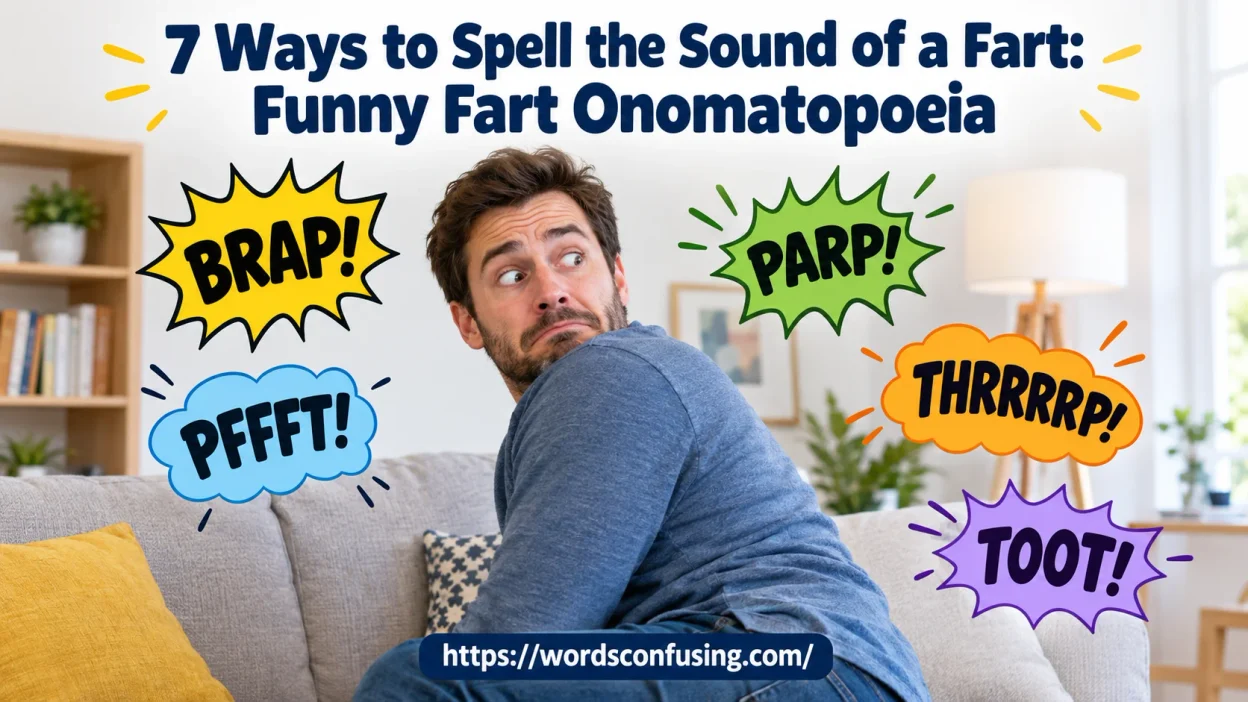
The 7 Ways to Spell the Sound of a Fart guide helps you choose playful onomatopoeia for vivid, humorous creative writing and dialogue.
When trying to describe a fart humorously, we can explore a range of options that imitate or suggest real sounds. For writers, these flexible ways to spell the sound can turn a funny moment into memorable dialogue, stories, comics, and fiction.
From my experience, the best sound words should feel natural for your audience and suit the purpose, style, and tone of the scene. Different spellings and expressions can create varied volumes, situations, meanings, and effects, while playful choices keep writing vivid and entertaining.
Strong English usage and grammar also matter because readers quickly notice whether a sound feels clear and appropriate within the content.
These words also show how language changes with context. Casual conversations can use simple sound effects, while formal writing needs more careful attention to detail and consistency.
The same approach can strengthen communication skills across modern communication, business communication, broadcasting, meetings, project management, scheduling, time management, calendar planning, and online booking, where clear wording remains useful.
This guide provides practical examples and tips for choosing expressive words effectively, so you can understand how each option uses sound to make writing more memorable in the mind.
Some choices work best for humor, while others fit particular contexts, and knowing these variations helps you choose the right expression for your audience.
Quick Answer
The sound of a fart can be spelled in different ways depending on how it sounds. There’s no single correct spelling because these are sound-effect words. Use pfft for a quiet sound, brap for a loud burst, or toot for a softer, playful version.
| Spelling | Sound or Tone |
| Pfft | Quiet and quick |
| Pffft | Soft and airy |
| Brap | Loud and sudden |
| Parp | Short and playful |
| Thrrrrp | Long and vibrating |
| Sssss | Quiet and sneaky |
| Toot | Gentle and innocent |
What Is the Sound of a Fart Called in Writing?
The written representation of a sound is often called onomatopoeia. It’s a word or expression that imitates, resembles, or evokes a real sound.
Think about familiar examples:
- Bang for a loud impact
- Buzz for an insect
- Hiss for escaping air
- Pop for a small explosion
- Splash for water
- Boom for a deep explosion
Fart sounds work in much the same way. A writer might use pfft, brap, or toot to help the reader imagine what happened.
The important thing to remember is that these aren’t precise spellings. They’re sound representations.
A real fart doesn’t follow English spelling rules. Your written version doesn’t have to either.
For example, imagine a character sitting quietly in a room. A subtle sound might appear as:
Pfffft.
A louder, more abrupt sound could become:
BRAP!
Both communicate the basic idea. However, they create very different mental pictures.
That’s why how to spell the sound of a fart depends heavily on the effect you’re trying to create.
7 Ways to Spell the Sound of a Fart
There isn’t one universally correct answer. Writers have several options, and each one creates a slightly different impression.
| Fart Sound Spelling | Suggested Sound | Tone | Best Use |
| Brap | Loud and abrupt | Bold and comic | Comics, jokes, fiction |
| Parp | Short and rounded | Playful | Humor and dialogue |
| Thrrrrp | Vibrating and prolonged | Exaggerated | Cartoons and comedy |
| Pfffft | Airy and soft | Subtle | Fiction and quiet humor |
| Fffff | Continuous airflow | Very subtle | Sound effects |
| Sssss | Hissing release | Sneaky | Comedy and cartoons |
| Toot | Gentle burst | Innocent | Children’s writing and euphemistic humor |
Now let’s look at each spelling more closely.
How to Spell a Fart Sound as “Brap”
Brap is one of the punchier ways to represent a fart.
The spelling has a hard beginning and a sharp ending. That gives it a sudden, forceful quality. When you see brap, you can almost hear a short burst coming from nowhere.
It works especially well in humorous writing where the sound itself becomes part of the joke.
For example:
Brap! The entire room went silent.
That one word immediately creates a comic moment.
What Does “Brap” Sound Like?
Brap generally suggests a fart that is:
- Loud
- Abrupt
- Short
- Vibrating
- Comical
- Noticeable
It’s a better choice for a sudden blast than a quiet release.
Compare these:
Pfffft.
and
BRAP!
The first feels discreet. The second practically kicks down the door.
When Should You Use “Brap”?
Use brap when you want the reader to notice the sound.
It’s particularly effective in:
- Comic books
- Cartoon scripts
- Funny stories
- Informal fiction
- Comedy captions
- Slapstick scenes
You can also capitalize it when the sound needs extra emphasis:
BRAP!
However, lowercase brap often looks more natural when the sound appears inside ordinary prose.
Example of “Brap” in a Story
Marcus leaned back in his chair with complete confidence. Brap! His confidence disappeared instantly.
The humor comes from the contrast between the character’s confidence and the unexpected noise.
How to Spell a Fart Sound as “Parp”
Parp gives you another playful option.
Compared with brap, parp usually feels lighter and sillier. It doesn’t necessarily suggest a huge blast. Instead, it can represent a short, cheeky burst.
For example:
Parp! He stared at the ceiling as if nothing had happened.
The spelling works because the word itself feels slightly ridiculous. That’s exactly what makes it useful for comedy.
What Does “Parp” Suggest?
A parp can suggest:
- A short burst
- A moderately loud sound
- A playful noise
- A comic interruption
- A deliberately silly moment
It can also work when you don’t want the scene to sound particularly crude.
Brap vs. Parp
These two spellings are close cousins, but they aren’t identical.
| Feature | Brap | Parp |
| Sound | Sharper | Rounder |
| Impression | Stronger | Lighter |
| Humor | Bold | Playful |
| Length | Usually short | Usually short |
| Best setting | Slapstick | Light comedy |
If the sound needs to feel like a tiny sonic explosion, brap works nicely.
If you want something sillier and less aggressive, parp fits better.
How to Spell a Fart Sound as “Thrrrrp”
Sometimes a normal word just doesn’t capture the moment.
That’s where thrrrrp comes in.
This spelling is deliberately exaggerated. The repeated r suggests vibration and duration. It looks as though the sound keeps rolling forward.
For example:
Thrrrrp! The dog jumped off the couch.
The extra letters aren’t there because English grammar demands them. They’re visual sound effects.
Why Does “Thrrrrp” Work?
When writers repeat letters, readers naturally interpret the repetition as an extension of the sound.
Compare:
- Thrp — extremely brief
- Thrrp — slightly longer
- Thrrrrp — prolonged
- Thrrrrrrp — comically excessive
This technique appears frequently in comic writing.
The written word becomes almost like a tiny audio waveform. More repeated letters suggest more time.
When to Use “Thrrrrp”
Use thrrrrp when the sound needs to feel:
- Vibrating
- Extended
- Ridiculous
- Cartoonish
- Dramatic
- Intentionally exaggerated
It’s especially useful in children’s humor, comics, memes, and exaggerated fiction.
Example
The room fell silent. Then came a long, unmistakable thrrrrp.
The reader doesn’t need an explanation. The spelling does most of the work.
Read more: 7 Other Ways to Say “Sorry to Bother You” in an Email
How to Spell a Fart Sound as “Pfffft”
If brap sounds loud, pfffft moves in the opposite direction.
Pfffft suggests air escaping quickly and quietly. The repeated f creates an airy quality that makes the sound feel softer.
It’s one of the most useful choices when you want a subtle fart sound.
What Does “Pfffft” Suggest?
The spelling can represent:
- A quiet release
- A soft burst
- Escaping air
- A short sound
- A discreet moment
- A comic attempt at secrecy
For example:
Pfffft. Nobody moved.
That tiny sound can become funnier precisely because the characters refuse to acknowledge it.
Pft, Pfft, Pffft, or Pfffft?
Writers often vary the number of letters.
| Version | Suggested Effect |
| Pft | Very quick |
| Pfft | Short and noticeable |
| Pffft | Slightly longer |
| Pfffft | Longer and more airy |
| Pfffffft | Deliberately exaggerated |
There’s no mathematical formula here. The spelling simply gives readers a visual clue.
Example
He shifted in his chair. Pffft. Then he looked around the room.
The short sound keeps the scene moving without overexplaining the joke.
How to Spell a Fart Sound as “Fffff”
Sometimes the simplest spelling works best.
Fffff emphasizes airflow rather than a sharp burst. It can represent a very quiet or sustained release.
Unlike brap, this spelling doesn’t sound explosive. It feels more like air escaping.
What Does “Fffff” Communicate?
The repeated f can suggest:
- Soft airflow
- A sustained release
- Low volume
- A discreet sound
- A subtle comedic moment
You can stretch the spelling depending on the scene.
Ff.
feels almost instantaneous.
Meanwhile:
Ffffffff.
looks longer and more exaggerated.
Example in Fiction
A faint fffff came from the other side of the couch.
This works particularly well when the writer wants understatement.
The joke doesn’t have to shout. Sometimes a whisper lands harder.
How to Spell a Fart Sound as “Sssss”
Sssss is another quiet option.
The letter s naturally creates a visual association with hissing. Stretching the letter makes the reader imagine a prolonged release of air.
For example:
Sssss.
The spelling feels sneaky.
That’s useful when the character desperately hopes nobody notices.
What Does “Sssss” Suggest?
This spelling can represent:
- A quiet release
- Hissing airflow
- A sneaky sound
- A prolonged noise
- Understated comedy
It also works nicely in cartoons where visual sound effects matter as much as dialogue.
Example
Sssss. Jake froze and slowly looked toward the nearest window.
The humor comes from the reaction rather than the sound itself.
Why Letter Repetition Matters
Repeated letters give written sounds a sense of movement.
Consider:
S → barely a sound
Sss → short hiss
Sssss → sustained hiss
Sssssssss → exaggerated comic effect
Writers can manipulate this visual length to shape how readers imagine the sound.
How to Spell a Fart Sound as “Toot”
Toot takes a softer approach.
Rather than sounding crude or explosive, toot feels innocent and playful. That’s why it’s common in children’s humor and situations where the writer wants a gentler alternative to the word “fart.”
For example:
Toot! The little boy giggled.
The word can also describe other short sounds, including a horn. Context therefore matters.
What Does “Toot” Suggest?
A toot generally feels:
- Short
- Gentle
- Lighthearted
- Innocent
- Playful
- Child-friendly
It doesn’t usually suggest a huge or prolonged noise.
When Should You Use “Toot”?
Toot works well in:
- Children’s books
- Family-friendly stories
- Parenting content
- Light comedy
- Casual conversation
- Humorous dialogue
It’s also useful when the writer wants to soften the subject.
Compare:
He farted loudly.
with:
He let out a tiny toot.
The second sentence feels considerably more playful.
How to Choose the Right Fart Sound Spelling
Choosing how to spell the sound of a fart becomes easier when you focus on the sound you’re trying to portray.
Don’t pick a spelling randomly. Think about four basic qualities:
- Volume
- Duration
- Texture
- Tone
These factors help you choose a sound effect that actually fits the scene.
Match the Spelling to Volume
1 For a quiet sound, consider:
- Pfft
- Pfffft
- Fffff
- Sssss
2 For a louder sound, consider:
- Brap
- Parp
- Thrrrrp
3 For a gentle sound, toot often works best.
Match the Spelling to Duration
Short sounds generally need short spellings.
Pft!
A longer sound can use repeated letters.
Pffffffffffft!
Likewise:
Thrrrrrrrrp!
visually tells the reader that the noise lasted longer.
Match the Spelling to Tone
Tone matters just as much as volume.
| Desired Tone | Good Choice |
| Innocent | Toot |
| Playful | Parp |
| Loud and comic | Brap |
| Quiet | Pfft |
| Airy | Pfffft |
| Sneaky | Sssss |
| Ridiculously long | Thrrrrp |
The goal isn’t technical accuracy. It’s reader recognition.
If the reader immediately understands the sound, the spelling has done its job.
How Repeated Letters Change a Fart Sound
One of the most interesting tricks in sound-effect writing involves repetition.
English doesn’t have a formal system saying that five f’s equal a particular number of milliseconds. Still, readers instinctively understand the visual signal.
For example:
Pft
looks quick.
Pffft
looks longer.
Pfffffffft
looks dramatically longer.
The same principle works with other letters:
Brap!
versus:
Braaaap!
The second version visually stretches the vowel and makes the sound feel more prolonged.
Repetition Can Show More Than Duration
Repeated letters can also suggest intensity.
Compare:
Pfft.
with:
PFFFFT!
The capitalization makes the second sound feel louder and more dramatic.
Writers can therefore combine:
- Repeated letters
- Capitalization
- Exclamation marks
- Punctuation
- Italics
to create a stronger auditory impression.
However, restraint matters.
A sound effect doesn’t need twelve extra letters to be funny.
Is There an Official Way to Spell a Fart Sound?
No single spelling works as the universal English answer.
That’s because fart sounds vary naturally. One sound might be short and dry. Another could be low and rumbling. A third might sound like escaping air.
Written language can’t reproduce those physical differences perfectly.
Instead, writers use approximations.
This is common with many sound effects.
A dog might make:
Woof!
A cat might make:
Meow!
A gunshot might appear as:
Bang!
Yet real dogs, cats, and gunshots don’t produce perfectly standardized sounds.
Fart sounds work the same way.
Why Different Spellings Exist
Sound-effect words depend heavily on:
- Language
- Culture
- Writing style
- Audience
- Context
- Personal interpretation
That’s why you’ll encounter several versions instead of one fixed spelling.
A comic writer might choose BRAP!
A children’s author might choose toot.
A novelist might prefer pfffft.
All three can work.
Is “Fart” Itself an Onomatopoeia?
This question gets surprisingly complicated.
Fart is the ordinary English word for the act or sound of passing intestinal gas. It isn’t simply a modern sound effect invented to imitate a noise.
The word has a long history in English and related Germanic languages.
That distinction matters because onomatopoeia generally refers to words that imitate or strongly resemble sounds. Words such as buzz, hiss, and splash provide straightforward examples.
The relationship between a word’s sound and its historical origin can be much more complicated.
So if you’re writing an article about fart onomatopoeia, it’s better to distinguish between the word fart and creative sound representations such as pfft, brap, or thrrrrp.
How to Write a Fart Sound in a Story
A sound effect can work in several ways.
You don’t always need to write the sound by itself.
Use the Sound Alone
This is the most direct approach:
PFFFFT!
It works particularly well in comics and scripts.
Combine the Sound With an Action
Brap! Tom immediately stopped talking.
The action gives the sound context.
Focus on the Character’s Reaction
Sometimes the reaction provides the punchline.
Pfft. Everyone suddenly became very interested in their phones.
The sound remains understated while the reaction delivers the humor.
Describe the Sound Instead
You don’t always need onomatopoeia.
For example:
A short burst of air escaped from the chair.
Or:
A low rumble interrupted the conversation.
Descriptive prose can work better when the writing has a more serious or literary tone.
Fart vs. Toot vs. Poot vs. Brap vs. Parp
Several words can refer to farting or represent fart-like sounds. However, they don’t all create the same impression.
| Word | Typical Impression | Tone |
| Fart | Direct name for the act or sound | Blunt |
| Toot | Gentle bodily sound | Innocent |
| Poot | Playful fart reference | Informal |
| Brap | Loud comic sound | Exaggerated |
| Parp | Short playful burst | Humorous |
These aren’t rigid definitions.
A writer can use toot for a deliberately ridiculous loud fart. Likewise, brap can appear as a tiny sound if the context makes the joke work.
Still, readers bring familiar associations to each word. Good writing uses those associations instead of fighting them.
Common Mistakes When Writing Fart Sounds
Even a silly topic benefits from good writing technique.
Treating One Spelling as the Only Correct Answer
There isn’t one universal spelling.
Calling pfft, brap, or toot the only correct answer oversimplifies how sound effects work.
Using Too Many Repeated Letters
A little exaggeration can be funny.
Too much repetition can become distracting:
Pffffffffffffffffffffffffffffffffffffft!
Unless you’re deliberately creating cartoonish comedy, that’s probably overkill.
Choosing the Wrong Sound for the Scene
A quiet scene needs a quiet sound.
If the character releases a tiny burst, pfft makes more sense than BRAP!
Likewise, a dramatic comic-book moment might need something bigger.
Using Too Many Sound Effects
One well-placed sound often gets a bigger laugh than five unnecessary ones.
The sound should support the scene rather than bury it.
Forgetting the Audience
A children’s story may benefit from toot.
A mature comedy might use brap or pfffft.
The best choice depends on who will read the material.
A Simple Fart Sound Spelling Guide
If you need a quick answer, use this cheat sheet.
For a loud fart:
BRAP!
For a playful fart:
PARP!
For a long vibrating fart:
THRRRRRP!
For a quiet fart:
PFFT.
For an airy fart:
PFFFFT.
For a soft hissing fart:
SSSSS.
For a child-friendly fart:
TOOT!
There’s no need to overthink it. Listen to the imaginary sound in your head and choose the spelling that best matches it.
Case Study: Choosing the Right Sound for Three Scenes
Imagine three completely different scenes.
Scene One: A Silent Office
Everyone sits quietly during a serious meeting.
A tiny sound escapes.
Pfft.
That’s more effective than BRAP! because the quiet spelling matches the atmosphere.
Scene Two: A Cartoon Character
A character sits on a bench. Suddenly, an absurdly loud noise interrupts the scene.
BRAP!
The sharp spelling supports the cartoon’s exaggerated tone.
Scene Three: A Children’s Story
A young character accidentally makes a tiny noise and starts laughing.
Toot!
The word keeps the moment playful without making the language unnecessarily crude.
The lesson is simple: the best fart sound spelling depends on context.
Interesting Facts About Fart Sound Spellings
Here are a few useful facts to remember:
- There isn’t one standardized English spelling for a fart sound.
- Fart sound words often function as onomatopoeic or sound-effect expressions.
- Repeated letters can visually suggest duration or intensity.
- Capital letters can make a sound effect appear louder or more dramatic.
- Toot generally creates a softer impression than brap.
- Pfft and pfffft usually suggest escaping air rather than a sharp blast.
- Thrrrrp relies heavily on visual exaggeration.
- Context determines whether a sound effect feels funny, childish, subtle, or ridiculous.
- A descriptive phrase can sometimes work better than an onomatopoeic word.
- Good sound effects should make the reader understand the moment without excessive explanation.
FAQs
What are some common ways to spell a fart sound?
Common playful spellings include pfft, toot, frrt, poot, brap, fart, and prrrt. The best choice depends on the sound you want readers to imagine.
Why is onomatopoeia useful for fart sounds?
Onomatopoeia makes writing more vivid because the word suggests the actual sound. It can also add humor and personality without requiring a long description.
Which fart sound spelling works best in comedy?
Short and exaggerated spellings usually work well in comics, humorous stories, and casual dialogue. Words such as toot, poot, and brap can create different comic effects.
Can fart sound words be used in fiction?
Yes. Fart sound words can fit naturally into fiction, especially when a scene needs humor or a playful tone. Choose a spelling that matches the characters and situation.
Should fart onomatopoeia be used in formal writing?
Usually, no. Formal writing generally favors clear and direct language rather than playful sound effects. However, you might discuss onomatopoeia itself in an academic or language-focused context.
How do I choose the right spelling for a fart sound?
Think about the volume, tone, and context first. A soft sound might suit one spelling, while a loud or exaggerated sound may need another. Your audience and the overall style of your writing should guide the final choice.
Conclusion
Finding the right way to spell a fart sound can make your writing more playful, expressive, and memorable. While these sounds may seem simple, the spelling you choose can change how readers imagine the moment. A soft “pffft” can feel very different from a loud “BRRRP” or a quick “toot.” That small difference can give a scene its own personality and make the humor land more naturally.
Whether you’re writing dialogue, fiction, comics, stories, or casual content, think about the situation before choosing your sound word. Consider the volume, timing, mood, and reaction you want readers to picture. There’s no single spelling that works every time, so don’t be afraid to experiment with different onomatopoeia. The goal is to choose a sound that feels natural within your writing and helps readers hear the moment in their minds.

Franklin Hayes is a writer and editor at WordsConfusing.com, focused on making English vocabulary, grammar, and commonly confused words easy to understand. He writes clear, practical articles with simple explanations and useful examples to help readers improve their English with confidence.
His goal is simple: Making Confusing Words Simple.