

It’s Better to Ask for Forgiveness Than Permission: Meaning explores an old saying, popular saying, and common expression used in everyday language.
Its meaning encourages people to take action and apologize later rather than wait for approval. This philosophy can become a personal philosophy or way of life for those who live by it. It influences life choices, decision-making, and making decisions.
Instead of seeking approval, getting approval, or approval before acting, people prefer taking initiative, acting independently, and sometimes acting without approval. However, avoiding permission isn’t always the right choice.
The origin, history, and background of this expression connect with independence, self-confidence, courage, and taking risks. A small decision may save time and help you learn, but bold decisions involving other people’s rights, workplace policies, or important rules need care. Good workplace behavior and professional conduct require ethical decisions, personal responsibility, responsible behavior, and accountability.
Every action has consequences. When mistakes happen, you should apologize, accept regret, make amends, and consider seeking forgiveness instead of making excuses. This explanation highlights human behavior, social expectations, and the reasons behind the saying’s central idea.
Quick Answer
“It’s better to ask for forgiveness than permission” means it’s sometimes wiser to take action first rather than wait for approval. If your decision is reasonable and low-risk, acting independently can save time and show initiative. However, when your actions affect other people, involve safety, or require legal approval, asking permission first is the smarter choice.
What Does “It’s Better to Ask for Forgiveness Than Permission” Mean?
The expression means that taking action without asking for approval may sometimes be easier than requesting permission beforehand. If someone objects afterward, you can explain your reasoning, apologize if necessary, and accept the consequences.
People often use this saying when they believe a decision is worthwhile but expect the approval process to create unnecessary obstacles.
For example, an employee might rearrange a shared workspace to make frequently used supplies easier to access. Rather than waiting for a manager’s response to a minor change, the employee makes the adjustment and offers to restore the original arrangement if needed.
The idea isn’t necessarily about being careless or disrespectful. Instead, it emphasizes initiative, independence, and a willingness to take responsibility.
The Main Idea Behind the Saying
Three principles explain why people use this expression:
- Initiative: Take reasonable action instead of waiting indefinitely for someone else to decide.
- Efficiency: Avoid unnecessary delays when a decision falls within your authority.
- Accountability: Accept responsibility for the outcome rather than blaming others.
Nevertheless, these principles work best when the decision carries limited risk. They don’t justify ignoring laws, safety requirements, contracts, or another person’s consent.
A Simple Example of Asking for Forgiveness Instead of Permission
Suppose a coworker notices that a shared document contains outdated information. The coworker updates the information, checks the changes, and tells the team what happened.
If the update falls within the coworker’s responsibilities, taking action makes sense. The team avoids delays and gets accurate information sooner.
Now imagine the coworker changes confidential information without authorization. That decision could create serious problems, even if the coworker intended to help.
The important distinction is whether the action falls within reasonable boundaries. Good initiative solves problems without creating unnecessary risks for other people.
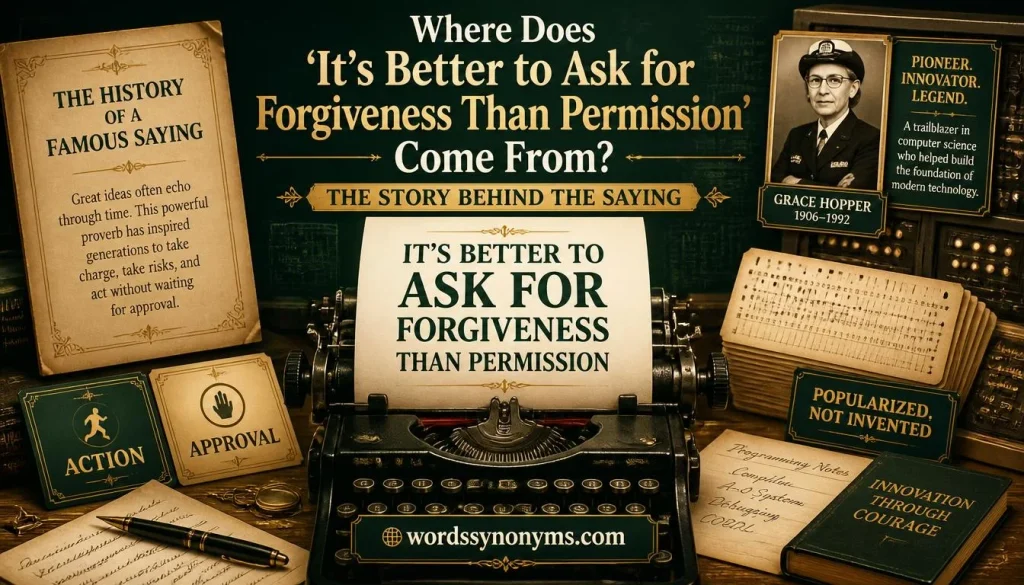
Where Does “It’s Better to Ask for Forgiveness Than Permission” Come From?
The saying has a longer history than many people realize. Although people often associate it with computer scientist and U.S. Navy Rear Admiral Grace Hopper, the expression existed before her career.
That historical example expressed the same basic idea, even though its wording differed from the modern proverb.
Why Is Grace Hopper Associated With the Saying?
Grace Hopper was a pioneering computer scientist and a rear admiral in the U.S. Navy. She became closely associated with the expression because she used and helped popularize it while advocating action and innovation.
Historical quotation research identifies examples of the saying in circulation before Hopper’s widely reported remarks. For that reason, it’s more accurate to say that she popularized the expression rather than definitively invented it.
Her association with the phrase makes sense because her career involved challenging slow processes and encouraging people to solve problems. In technology and government, excessive approval requirements can sometimes prevent useful ideas from becoming practical solutions.
How Did the Expression Become Popular?
The phrase spread because it captures a familiar conflict between taking action and waiting for approval.
You can recognize this conflict in several settings:
- Business: Employees want to solve problems without waiting for several managers.
- Technology: Developers need room to test ideas and improve existing systems.
- Entrepreneurship: Business owners must make decisions despite incomplete information.
- Everyday life: People sometimes need to make small decisions independently.
The expression also works as a memorable shortcut. Rather than explaining every detail of a decision, someone can use the saying to communicate a preference for action over bureaucracy.
Still, popularity doesn’t make the advice universally correct. Its value depends on the situation.
When Should You Use “It’s Better to Ask for Forgiveness Than Permission”?
The expression makes the most sense when you can take a useful action without creating significant risks. It can help you overcome hesitation, solve small problems, and avoid unnecessary delays.
However, you should consider your authority and the likely consequences before deciding to act.
When a Decision Is Low-Risk and Reversible
Low-risk decisions are among the best situations for taking initiative. If you can easily undo an action, the potential cost of experimenting may be small.
For example, imagine you’re organizing a presentation. You change the slide order to make the main argument easier to follow. Your colleagues can review the revised version, and you can restore the original if necessary.
This kind of decision usually doesn’t require a lengthy approval process when editing the presentation falls within your role.
Other examples include:
- Reorganizing your own work files for easier access.
- Testing a different format for an internal report.
- Creating a draft before a scheduled team discussion.
- Suggesting a more efficient way to complete a routine task.
- Trying a new personal study schedule and adjusting it later.
The common factor is reversibility. You can correct the decision without causing substantial harm or violating anyone’s rights.
When Waiting Could Cause Unnecessary Delays
Sometimes, you already have enough information and authority to solve a problem. Waiting for approval may add little value.
Suppose a customer asks for a copy of a publicly available product guide. Your job allows you to share that guide, and you know exactly where to find it. Sending it promptly provides better service than waiting for an unnecessary confirmation.
However, if the request involves private customer records or restricted documents, you should follow the relevant access rules.
Use independent judgment when the task is familiar, the boundaries are clear, and the consequences are manageable.
When You Need to Test an Idea
Creative work often involves experimentation. You may not know whether an idea will succeed until you try it.
A small test can help you gather useful information before making a larger commitment.
For example, a business owner might test two versions of a product description on a small audience. If the test follows applicable advertising, privacy, and platform rules, the results can guide future improvements.
The sensible approach is to experiment on a small scale before committing substantial resources.
That principle is different from making a large purchase, launching an unapproved campaign, or promising customers something your business cannot deliver.
When Should You Not Use “It’s Better to Ask for Forgiveness Than Permission”?
Some decisions require permission before you act. In these situations, the expression can become an excuse for crossing boundaries rather than a useful guide to initiative.
A later apology cannot always repair the damage.
When Laws or Safety Rules Require Approval
Legal requirements and safety procedures aren’t optional obstacles. They exist to protect people, property, and public interests.
For example, you shouldn’t begin construction that requires a permit simply because you believe approval will take too long. You also shouldn’t bypass workplace safety procedures to finish a task faster.
Even if someone eventually forgives your decision, you may still face legal penalties, financial losses, or disciplinary action.
When Money or Contracts Are Involved
Financial decisions can create obligations that are difficult to reverse. Spending company funds without authorization may breach workplace rules, even when the purchase seems helpful.
Consider these situations:
- Signing a contract on behalf of your employer without authority.
- Approving an expense that exceeds your spending limit.
- Promising a client a discount you cannot authorize.
- Using someone else’s payment information without consent.
- Committing a business to a service agreement without approval.
These decisions involve more than personal initiative. They can affect budgets, legal responsibilities, and other people’s expectations.
Ask first when an action commits someone else to a financial or contractual obligation.
When Privacy, Property, or Consent Is Involved
Another person’s permission matters when an action affects their belongings, information, or personal boundaries.
For example, borrowing a friend’s car without asking isn’t automatically acceptable because you intend to return it with a full tank. Your good intentions don’t replace the owner’s consent.
The same principle applies to digital information. Accessing someone’s private messages or sharing confidential photographs without permission can violate trust and privacy.
Remember these boundaries:
- Ask before using another person’s property.
- Obtain consent before sharing private information.
- Follow authorization requirements before accessing restricted accounts.
- Respect copyright and ownership when using creative work.
- Never assume that silence automatically means approval.
The phrase encourages independence, not entitlement.
Read more: Don’t Call Me Late for Dinner: Meaning and How to Use It
Real-Life Examples of “It’s Better to Ask for Forgiveness Than Permission”
Everyday examples make the saying easier to understand. The following hypothetical scenarios show how the same principle can produce different results depending on the circumstances.
Example of Asking for Forgiveness at Work
Imagine a marketing employee notices that the team’s internal presentation uses an outdated template. The employee creates a cleaner version and shares it with the team.
The change is easy to review and doesn’t alter any approved claims or confidential information. The manager appreciates the initiative and adopts the template.
This is a reasonable example because the employee improves an internal document without exceeding their authority.
Now consider a different employee who publishes an unapproved advertisement using the company’s official account. Even if the advertisement performs well, the employee may have violated brand policies or made unauthorized claims.
The difference isn’t simply whether the result was successful. A good outcome doesn’t automatically make an unauthorized decision appropriate.
Example of Asking for Forgiveness in Everyday Life
Suppose you’re preparing a family gathering and notice that the dining table needs more space. You move a few chairs and rearrange decorations to accommodate everyone.
If the changes are harmless and easy to reverse, you probably don’t need a formal family discussion.
However, moving someone else’s expensive furniture, throwing away their belongings, or inviting additional guests into their home raises different concerns.
A decision that affects only your own arrangements may be straightforward. One that affects other people deserves more consideration.
Example of Asking for Forgiveness in Business
A small business owner wants to improve the way customers navigate an online store. The owner tests a revised menu on a staging site before making a wider change.
The test reveals that customers can find popular products more easily. The owner then reviews the results and decides whether to implement the update.
This approach encourages learning without committing the entire business to an untested change.
Contrast that with launching an unapproved price increase, changing contractual terms, or using customer information for an unauthorized purpose. Those decisions can create disputes and lasting damage.
Example of Asking for Forgiveness in Creative Projects
A designer may experiment with different fonts, layouts, or color combinations while developing a draft. Creative exploration often benefits from freedom and quick feedback.
For instance, a designer might prepare two alternative homepage concepts before the next meeting. The client can compare them and select the stronger option.
However, using copyrighted artwork without the necessary rights or publishing confidential project materials presents a different problem.
Creativity benefits from experimentation, but ownership and confidentiality still matter.
Is It Better to Ask for Forgiveness Than Permission at Work?
At work, the expression can encourage employees to solve problems independently. However, its usefulness depends on the employee’s role, workplace culture, and level of authority.
A company that requires approval for every minor decision may struggle with slow processes. Employees can become reluctant to suggest improvements when even small changes involve several layers of management.
On the other hand, organizations need clear controls for safety, finances, customer data, and legal compliance.
When Employees Can Take Initiative
Employees can often act independently when a task falls within their responsibilities and established guidelines.
Examples include:
- Correcting a minor formatting error in an internal report.
- Organizing personal work files more efficiently.
- Preparing a proposed solution before a team meeting.
- Resolving a routine customer issue within approved limits.
- Testing an alternative workflow when workplace rules allow it.
These actions demonstrate ownership. They also help managers focus on decisions that genuinely need their attention.
When Employees Should Ask Their Managers
Seek approval when a decision goes beyond your authority or creates a meaningful risk for the organization.
For example, changing a department’s budget, making a public company statement, or granting a customer an exceptional refund may require authorization.
If you’re unsure, explain your intended action rather than remaining silent.
A useful message might be:
I’ve noticed a problem with our current process. I plan to test a small change that we can easily reverse. Please let me know if you see a concern I may have missed.
This approach gives your manager an opportunity to raise objections without turning every routine decision into a formal permission request.
How Managers Can Encourage Responsible Initiative
Managers can reduce unnecessary delays by clearly defining which decisions employees can make independently.
A practical workplace policy might specify:
- Decisions employees can make without approval.
- Spending limits and authorization requirements.
- Changes that require consultation or formal review.
- Situations that require immediate escalation.
- How employees should report mistakes and unexpected results.
Clear boundaries allow employees to work confidently. They also reduce the temptation to bypass procedures simply to get something done.

Is It Better to Ask for Forgiveness Than Permission a Good Rule to Live By?
The saying can be useful, but it shouldn’t guide every decision. It works best as a reminder to avoid needless hesitation rather than a blanket excuse to ignore approval.
Its advantages become clearer when you compare them with the possible consequences.
Advantages of Asking for Forgiveness Instead of Permission
It encourages independent thinking. You learn to evaluate situations instead of relying on others to make every small decision.
It can save time. Straightforward tasks move forward without unnecessary delays.
It supports experimentation. You can test low-risk ideas and learn from the results.
It builds confidence. Taking responsibility for appropriate decisions can strengthen your judgment over time.
It encourages problem-solving. Instead of waiting for someone else to fix an issue, you look for a practical solution.
These benefits matter most when you understand the boundaries of your role and can manage the consequences.
Disadvantages of Asking for Forgiveness Instead of Permission
It can damage trust. People may feel ignored when you make decisions that affect them without consulting them.
It can create financial problems. Unauthorized spending or commitments may expose you or your organization to losses.
It can lead to disciplinary action. Employers may respond seriously when employees disregard established policies.
It can harm relationships. An apology may not repair a person’s sense that you ignored their wishes.
It can create legal or ethical problems. Some actions require authorization regardless of your intentions.
The biggest weakness of the saying is its assumption that forgiveness will be available afterward. In reality, people may refuse to forgive you, and some consequences cannot be undone.
A Balanced Rule for Everyday Decisions
Instead of following the saying blindly, consider three questions:
- Can I make this decision within my authority?
- Can I reverse the action if something goes wrong?
- Could this action harm someone, violate their rights, or create a serious obligation?
If you can act within your authority and correct the decision easily, taking initiative may be reasonable.
If the action could cause significant harm or requires someone else’s consent, ask first.
“It’s Better to Ask for Forgiveness Than Permission” vs. Asking Permission First
Both approaches can be sensible, depending on what you’re trying to accomplish. The key is knowing when independence helps and when consultation protects everyone involved.
| Factor | Act First, Ask Later | Ask Permission First |
| Speed | Often faster for simple decisions | May take longer |
| Independence | Encourages personal initiative | Requires prior approval |
| Risk | Can introduce unexpected problems | Helps identify risks beforehand |
| Accountability | Requires responsibility for the decision | Clarifies expectations in advance |
| Relationships | May frustrate people who expect consultation | Can build trust and cooperation |
| Best situation | Low-risk actions within your authority | Decisions involving consent, safety, money, or significant consequences |
Which Approach Is Better?
Neither approach wins in every situation. The best choice depends on the decision’s potential impact.
Imagine you’re choosing a better way to organize your own study notes. You can experiment without asking anyone because the decision affects your work alone.
Now imagine you’re changing a shared project deadline. Your decision affects colleagues who may have other commitments. Discussing the change first helps everyone coordinate.
Use independence for decisions you own and consultation for decisions you share.
This simple distinction prevents unnecessary delays without treating other people’s interests as obstacles.
What Are the Pros and Cons of Asking for Forgiveness Instead of Permission?
The saying offers a useful perspective on decision-making, but its benefits come with trade-offs.
| Advantages | Disadvantages |
| Encourages initiative | Can undermine trust |
| Reduces unnecessary delays | May create avoidable conflicts |
| Supports creative experiments | Can lead to wasted resources |
| Builds decision-making confidence | May trigger workplace discipline |
| Helps solve routine problems quickly | Can cross legal or ethical boundaries |
A major advantage is that you don’t need approval for every small choice. However, the biggest disadvantage appears when you assume other people will accept your decision simply because you’ve already made it.
That assumption can be costly.
How to Reduce the Risks
You can preserve the useful parts of the saying without adopting its most reckless interpretation.
- Start small: Test an idea before making a major commitment.
- Know your limits: Understand your authority and responsibilities.
- Protect others: Consider how your action affects their time, property, and privacy.
- Keep records: Document important decisions when your role requires it.
- Be transparent: Explain what you did and why.
- Accept responsibility: Correct mistakes rather than expecting others to absorb the consequences.
These habits turn impulsive action into thoughtful initiative.
What Is the Difference Between Initiative and Overstepping Boundaries?
Initiative means identifying a problem and taking appropriate steps to address it. Overstepping means acting beyond your authority or disregarding boundaries that should guide your decision.
The two can look similar at first. Both involve acting without waiting for someone else to make the next move. Their differences become clear when you examine authority, consent, and consequences.
What Responsible Initiative Looks Like
Responsible initiative usually has several features:
- You understand the problem you’re trying to solve.
- The action fits your role or responsibilities.
- You consider foreseeable risks.
- You avoid unnecessary harm to other people.
- You can explain your reasoning honestly.
- You accept responsibility for the outcome.
For example, an employee who notices a broken link in an internal document may correct it immediately if editing is part of their job.
The employee solves a problem without creating a new one.
What Overstepping Looks Like
Overstepping occurs when someone treats personal judgment as a substitute for legitimate authority.
Examples include signing another person’s name without authorization, sharing confidential files, or making promises on behalf of an employer without approval.
Even a helpful motive doesn’t automatically make these actions acceptable.
A useful question is: Am I solving a problem I’m responsible for, or am I making a decision that belongs to someone else?
If the decision belongs to someone else, consultation is usually the better choice.
Read more: Comma Before “Like”: When Should You Use a Comma?
How to Apply “It’s Better to Ask for Forgiveness Than Permission” Without Creating Problems
You don’t have to choose between acting recklessly and waiting for approval forever. A few practical habits can help you move forward while protecting your responsibilities.
Evaluate the Possible Consequences
Before acting, consider what could happen if your decision goes wrong.
Ask yourself:
- Could someone lose money or access to important resources?
- Could this decision affect another person’s privacy or property?
- Would reversing the action be easy?
- Could the action violate a rule or agreement?
- Would I be comfortable explaining this decision to the people affected?
If the likely consequences are serious, slow down and seek the appropriate approval.
Choose Reversible Actions Whenever Possible
A reversible action gives you room to learn without committing to a permanent outcome.
For example, prepare a proposed website redesign on a private test page before changing the live site. Draft a new workplace procedure before replacing the existing one.
This approach allows you to gather feedback and identify problems early.
Of course, reversibility doesn’t override permission requirements. Even a change you can undo may expose confidential information or disrupt an important service.
Communicate Before Problems Develop
Sometimes, you can avoid a formal approval process by clearly explaining your intended action.
For example, you might tell a colleague, “I’ll reorganize these shared files using the existing folder structure. Let me know if there’s a reason to keep them as they are.”
This approach encourages collaboration while allowing work to proceed when appropriate.
However, communication isn’t the same as permission. If a decision requires explicit approval, silence or a lack of objections doesn’t automatically authorize it.
Take Responsibility for Mistakes
If your decision creates a problem, acknowledge it directly. Explain what happened, correct what you can, and identify how you’ll prevent a repeat.
A meaningful apology should include more than the words “I’m sorry.”
It should demonstrate that you understand the impact of your actions and intend to address it.
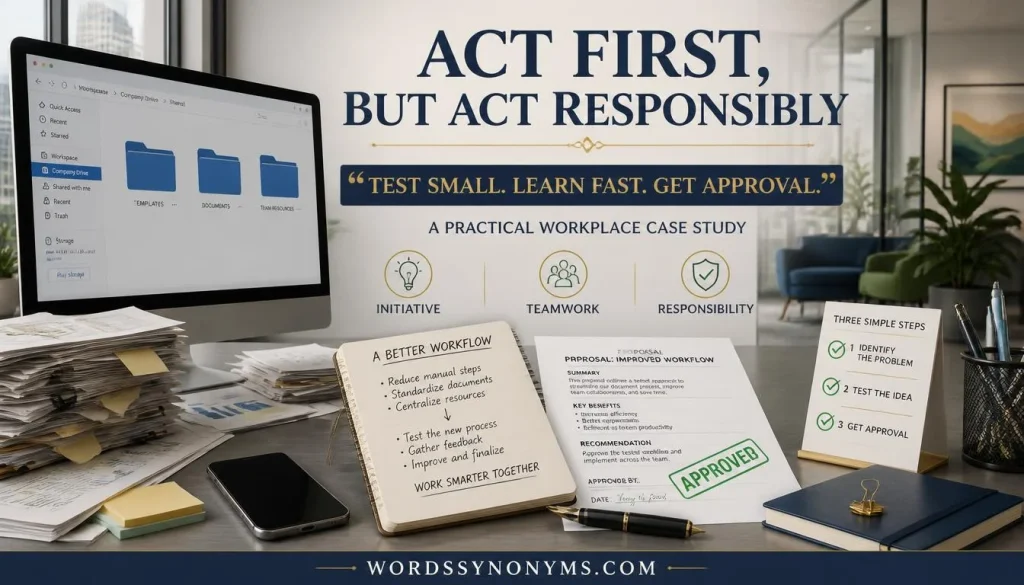
A Practical Case Study: Acting First Without Ignoring Responsibility
Consider this hypothetical example of an employee improving a routine workplace process.
The Situation
An office team spends too much time searching for frequently used templates. Employees repeatedly ask colleagues where to find the latest versions.
One employee notices the problem and proposes a centralized folder.
The Decision
Instead of immediately changing the entire shared drive, the employee creates a proposed folder structure in a test location. The employee organizes a few approved templates and invites colleagues to review the setup.
This small experiment demonstrates initiative without disrupting existing files.
The Outcome
The team finds the new structure easier to use. After receiving the appropriate approval, the employee helps implement the change across the shared drive.
The experiment saves time while respecting the team’s existing responsibilities.
What This Example Teaches
The employee didn’t wait passively for someone else to solve the problem. At the same time, the employee didn’t assume that a good idea justified every possible action.
The lesson is straightforward: test what you can safely test, then obtain approval for changes that require it.
This example is illustrative rather than a documented company case study. It shows how the principle can work when initiative and accountability operate together.
What Are Some Alternatives to “It’s Better to Ask for Forgiveness Than Permission”?
Several English expressions communicate a similar preference for action, although their meanings aren’t identical.
| Expression | Meaning | When to Use It |
| Fortune favors the bold. | Courageous people may gain opportunities by taking risks. | Encouraging someone to pursue a reasonable opportunity |
| Nothing ventured, nothing gained. | You may need to take a risk to achieve something. | Motivating someone to try something worthwhile |
| Better safe than sorry. | Taking precautions is wiser than risking regret. | Encouraging caution before a consequential decision |
| Actions speak louder than words. | What people do often matters more than what they say. | Emphasizing follow-through and practical effort |
| It’s better to take initiative than wait for approval. | Independent action can prevent unnecessary delays. | Discussing workplace efficiency and responsibility |
These expressions serve different purposes. “Fortune favors the bold” emphasizes courage, while “better safe than sorry” emphasizes caution.
The forgiveness-and-permission saying focuses specifically on the timing of action and approval.
Choose the expression that fits your intended meaning rather than treating every proverb as interchangeable.
FAQs
1. What does “It’s Better to Ask for Forgiveness Than Permission” mean?
It means taking action without waiting for approval and apologizing afterward if things don’t go as planned. People often use this phrase to describe bold or independent decisions.
2. Is it better to ask for forgiveness than permission?
Not always. It may work for small, low-risk decisions, but important matters require permission. You should consider other people’s rights, responsibilities, and possible consequences before acting.
3. Where did the saying “It’s Better to Ask for Forgiveness Than Permission” originate?
The exact origin of this saying isn’t clearly established. However, it has become a popular expression associated with independence, initiative, and challenging unnecessary restrictions.
4. Who is associated with the phrase “Ask for Forgiveness, Not Permission”?
The phrase is commonly associated with Grace Hopper, a computer scientist and U.S. Navy rear admiral. However, its attribution and exact wording should be treated cautiously.
5. When should you use the phrase “Better to Ask for Forgiveness Than Permission”?
You can use it when discussing situations where taking initiative matters more than waiting for approval. For example, an employee might suggest a small improvement without seeking permission first.
6. Is asking for forgiveness instead of permission a good approach at work?
It depends on the situation. Taking initiative can demonstrate confidence and problem-solving skills. However, ignoring workplace policies, financial limits, or management instructions can damage professional relationships.
Conclusion
“It’s Better to Ask for Forgiveness Than Permission” encourages you to take initiative instead of waiting for approval every time. Sometimes, acting independently helps you discover opportunities, solve problems, and learn from experience. However, this doesn’t mean you should ignore rules or make decisions that affect others without their consent. Knowing when to act and when to ask first is what really matters.
At the end of the day, confidence and courage are valuable, but so are respect and accountability. If you make a mistake, accept responsibility, apologize sincerely, and try to make things right. Remember, asking for forgiveness may repair a mistake, but it doesn’t always undo its consequences.

Franklin Hayes is a writer and editor at WordsConfusing.com, focused on making English vocabulary, grammar, and commonly confused words easy to understand. He writes clear, practical articles with simple explanations and useful examples to help readers improve their English with confidence.
His goal is simple: Making Confusing Words Simple.


