


“It’s All Downhill From Here: Meaning, Origin and How to Use It” explains how context changes this widely used idiom. It has two different meanings.
The positive meaning suggests life becomes easier after a difficult period, while the negative meaning describes decline, worsening conditions, or trouble ahead. In everyday conversation, personal communication, and professional settings, this idiomatic expression can describe success, progress, or unexpected challenges.
For example, completing a difficult exam may make the remaining work feel easier. However, during business meetings or project discussions, it may suggest disappointing future outcomes.
Understanding the context-dependent meaning, speaker’s tone, and surrounding words helps avoid confusion and improves your ability to interpret conversations accurately.
The historical origin connects to traveling downhill, which usually requires less effort than climbing uphill. This explains its association with ease and progress, although modern interpretations also include decline and difficulty.
Today, its modern usage appears in spoken communication, written communication, formal writing, and business communication. You may also encounter it in workplace discussions, broadcasting, and organizational workflows. Its practical application extends to planning, long-term goals, time management, task management, and project management.
Even scheduling, calendar planning, online booking, and booking systems provide opportunities for informal use. Recognizing the contextual interpretation improves your English grammar, grammar skills, and communication clarity, helping you develop more natural usage, correct usage, and confident usage in different situations.
Quick Answer
“It’s all downhill from here” means things will either get easier or worse, depending on the context. Positively, it suggests the hardest part is over. Negatively, it means a situation is expected to deteriorate. For example, after finishing a difficult exam, you might say, “It’s all downhill from here!” to express relief. However, after repeated business failures, the same phrase can suggest that things will only get worse.

What Does “It’s All Downhill From Here” Mean?
The expression “it’s all downhill from here” means that the remaining part of a situation will become easier or worse, depending on the context.
It comes from the literal idea of traveling downhill. When you walk or drive down a slope, you generally move with gravity rather than against it. This can make the journey feel easier.
However, going downhill can also represent a decline. Something that moves downward may lose quality, strength, value, or success.
That’s why this idiom has two opposite interpretations.
The Positive Meaning: The Hardest Part Is Over
In its positive sense, “it’s all downhill from here” means that the most difficult part of a task or experience has finished. The remaining work should require less effort.
People commonly use it after completing a challenging responsibility, reaching an important milestone, or overcoming a major obstacle.
For example:
- After completing the hardest exam, a student might say, “It’s all downhill from here.”
- After finishing a complicated project proposal, an employee might tell a colleague, “The difficult part is done. It’s all downhill from here.”
- After moving heavy furniture upstairs, someone might joke, “It’s all downhill from here.”
In each example, the speaker feels relieved because the toughest stage has passed.
Example conversation:
Alex: We finally finished the first three chapters of the project.
Sam: Great! It’s all downhill from here.
Here, Sam expects the remaining work to become easier.
The Negative Meaning: Things Will Get Worse
The negative interpretation describes a situation that is expected to deteriorate. Instead of improving, things may become increasingly difficult or unpleasant.
People use this meaning when discussing declining performance, financial problems, unsuccessful projects, or personal setbacks.
For example:
- After a company loses several important clients, someone might say, “It’s all downhill from here.”
- If a sports team keeps losing matches, a disappointed supporter might use this expression.
- After making a serious mistake at work, an employee might worry that everything is going downhill.
Example conversation:
Daniel: The company lost another major customer this morning.
Chris: At this rate, it’s all downhill from here.
Here, Chris predicts further problems rather than an easier experience.
Quick Difference Between the Two Meanings
| Meaning | Explanation | Example situation |
| Positive | The hardest part has passed | Finishing a difficult examination |
| Negative | Things are expected to worsen | A business losing customers |
| Sarcastic | The speaker humorously suggests more trouble is coming | Facing another unexpected problem |
Remember: The expression doesn’t have one fixed emotional meaning. The surrounding situation tells you what the speaker intends.
Where Does the Phrase “It’s All Downhill From Here” Come From?
The expression comes from the physical experience of moving downhill. Its figurative meanings developed from two different ways of understanding that movement.
When you travel down a hill, gravity helps pull you toward a lower point. Depending on the slope, walking downhill may require less effort than climbing upward.
This physical experience provides a natural comparison for easier circumstances.
However, downhill movement also suggests a fall from a higher position. In everyday language, people often associate downward movement with decline, deterioration, or loss.
Consider these familiar expressions:
- Going downhill: Becoming worse or declining.
- Downward spiral: A continuing series of worsening events.
- On the decline: Gradually losing strength, quality, or success.
- Uphill battle: A difficult struggle that requires considerable effort.
These expressions demonstrate how physical directions can represent changes in everyday life.
How the Literal Meaning Became Figurative
Imagine climbing a steep mountain.
The upward journey requires energy, patience, and determination. Once you reach the summit, the downward journey may feel easier because gravity assists your movement.
That experience resembles completing a demanding task. After handling the most challenging stage, the remaining work may seem manageable.
Now consider a different situation.
A company begins at the top of its industry but gradually loses customers, revenue, and public trust. People might describe its decline as going downhill.
Both interpretations use the same physical image. However, they focus on different aspects of downward movement.
Historical note: The exact first use of the complete expression is difficult to establish without a reliable dated historical citation. Its meaning is connected to the much older figurative use of uphill and downhill movement.
Read more: With Abandon: Meaning, Synonyms and Examples in Sentences
Is “It’s All Downhill From Here” Positive or Negative?
The phrase can be positive or negative. Neither interpretation is automatically correct without considering the surrounding conversation.
This is one reason people sometimes misunderstand it. A speaker may intend to celebrate progress while a listener interprets the words as a warning.
When the Expression Is Positive
The phrase sounds positive when someone has completed a difficult stage and expects fewer challenges ahead.
Typical situations include:
- Completing a demanding school assignment.
- Passing a difficult examination.
- Finishing the first stage of a business project.
- Recovering from a particularly stressful period.
- Reaching an important personal milestone.
- Completing the most physically demanding part of a journey.
Example:
“We survived the first week of training. It’s all downhill from here!”
The speaker expects the remaining training sessions to become easier.
When the Expression Is Negative
The phrase sounds negative when circumstances suggest a continuing decline.
People might use it to describe:
- A business experiencing repeated financial losses.
- A relationship becoming increasingly unhealthy.
- A project suffering from repeated failures.
- A sports team performing poorly.
- A person’s situation becoming more complicated.
- A service gradually losing its quality.
Example:
“After the manager resigned and three employees left, it was all downhill from here.”
The speaker describes a series of worsening events.
How to Identify the Intended Meaning
Pay attention to three important clues:
| Clue | Positive interpretation | Negative interpretation |
| Situation | A difficult milestone has been completed | Problems continue to appear |
| Speaker’s attitude | Relief, confidence, or excitement | Disappointment, frustration, or concern |
| Expected outcome | Easier progress | Further deterioration |
Tone matters, too. A cheerful voice often suggests optimism, while a disappointed voice may signal pessimism.
However, sarcasm can complicate things. Someone might smile while describing an obviously terrible situation.
Examples of “It’s All Downhill From Here” in Sentences
Examples make idioms easier to understand because they show how people use them naturally.
The following sentences demonstrate both meanings across everyday situations.
Positive Examples of “It’s All Downhill From Here”
These examples suggest that the most difficult stage has already passed.
1. After finishing my final examination, I realized it’s all downhill from here. The remaining academic responsibilities seem easier.
2. We’ve completed the difficult part of the renovation, so it’s all downhill from here. The remaining work should be manageable.
3. Once you learn the basic rules, it’s all downhill from here. Understanding the fundamentals makes further learning easier.
4. The first week of training was exhausting, but it’s all downhill from here. The speaker expects future sessions to become less demanding.
5. We’ve finally submitted the application. It’s all downhill from here! The speaker feels relieved after completing an important step.
6. After organizing the entire event, preparing the decorations should be easy. It’s all downhill from here. The hardest responsibility is finished.
7. I finally passed the hardest subject. It’s all downhill from here. The student expects the remaining subjects to feel easier.
8. The initial setup took hours, but it’s all downhill from here. The difficult preparation has ended.
Negative Examples of “It’s All Downhill From Here”
These examples describe situations expected to become worse.
1. After the company lost its biggest client, it was all downhill from here. The business continued experiencing difficulties.
2. The team started losing important matches, and it was all downhill from here. Its performance continued declining.
3. Their relationship suffered another major argument, and things were all downhill from here. Their relationship became increasingly difficult.
4. After the restaurant received several poor reviews, business was all downhill from here. Its reputation and performance continued suffering.
5. The project missed its first deadline, and it was all downhill from here. Additional problems followed.
6. Once the manager ignored the employees’ concerns, everything seemed to go downhill from there. Workplace conditions deteriorated.
7. The company made several poor decisions, and its financial position was all downhill from here. Its financial situation continued worsening.
8. After the first major mistake, the entire presentation went downhill. The situation became increasingly unsuccessful.
Examples in Everyday Conversations
Here are a few short conversations showing how the phrase works naturally.
Conversation 1: Between Friends
Emma: I finally finished cleaning the entire house.
Olivia: Nice! It’s all downhill from here.
Meaning: The most exhausting part is over.
Conversation 2: At Work
James: We’ve finished the product launch, but sales are dropping.
Michael: It looks like it’s all downhill from here.
Meaning: The situation may continue getting worse.
Conversation 3: At School
Teacher: You’ve mastered the difficult concepts. The next lessons should feel easier.
Student: So, it’s all downhill from here?
Teacher: Exactly!
Meaning: The student expects future lessons to become easier.
Conversation 4: During a Road Trip
Mark: We’ve finally crossed the mountain pass.
Ryan: Great! It’s all downhill from here.
Meaning: The remaining physical journey involves descending.
These conversations demonstrate why context matters more than the expression alone.
How to Use “It’s All Downhill From Here” Correctly
Using this expression correctly requires understanding its meaning and choosing the right situation. Although the phrase sounds casual, it fits many everyday conversations.
You can use it when discussing school, work, relationships, travel, personal achievements, or unexpected problems.
Understand the Sentence Structure
The expression usually follows this structure:
Subject + linking verb + all downhill + from here.
For example:
- It’s all downhill from here.
- Things are all downhill from here.
- After this difficult stage, it’s all downhill from here.
- Unfortunately, everything was all downhill from there.
The word “it’s” is a contraction of “it is.” Meanwhile, “from here” refers to the current point in a situation or journey.
You can also use “from there” when describing a past event.
Compare these examples:
| Expression | Usage |
| It’s all downhill from here. | Refers to the present or future |
| It was all downhill from there. | Describes a past situation |
| Things are all downhill from here. | Refers to how circumstances may develop |
| Everything went downhill after that. | Describes a worsening situation |
Use It in Casual Conversations
The phrase works particularly well in informal conversations. You can use it with friends, family members, classmates, and coworkers.
For example:
- “We’ve finished the hardest assignment. It’s all downhill from here.”
- “The first day was terrible. Hopefully, it’s all downhill from here.”
- “After that argument, everything went downhill.”
These sentences sound natural because the expression matches the situations being discussed.
Use It in Text Messages
You can also use the idiom in text messages when discussing progress or setbacks.
Here are some natural examples:
- “Finally finished my exams! It’s all downhill from here.”
- “One more deadline? Well, it’s all downhill from here 😂”
- “We lost another customer. Things are going downhill fast.”
- “The hardest part is done. Smooth sailing from here!”
The expression can communicate relief, disappointment, or sarcasm without requiring lengthy explanations.
Use It in Professional Conversations
Although the phrase isn’t strictly unprofessional, its informal tone makes it less suitable for certain business documents.
You can use it during casual workplace conversations, especially when discussing project milestones.
For example:
“Now that we’ve completed the initial testing, it’s all downhill from here.”
However, a formal report should communicate the intended meaning more clearly.
Instead of writing:
“After completing the initial phase, it’s all downhill from here.”
Consider:
“After completing the initial phase, the remaining development work should require fewer resources.”
This version avoids ambiguity and sounds more precise.
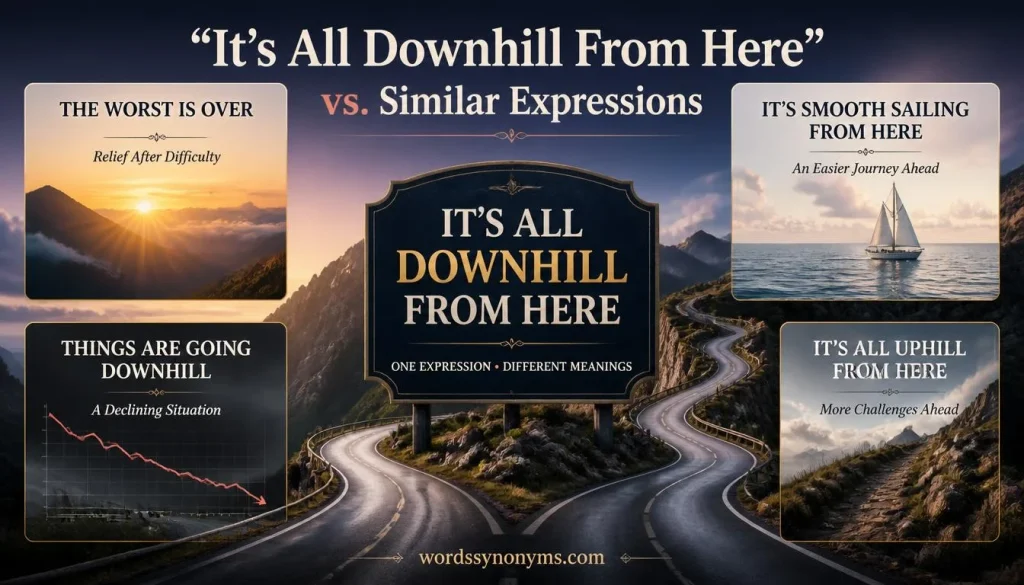
“It’s All Downhill From Here” vs. Similar Expressions
Several English expressions communicate easier progress or worsening circumstances. However, their meanings aren’t always interchangeable.
Understanding these differences will help you choose the right phrase.
“It’s All Downhill From Here” vs. “The Worst Is Over”
Both expressions can describe relief after completing a difficult experience.
However, “the worst is over” has a more consistently positive meaning. It suggests that the most unpleasant part has passed.
“It’s all downhill from here” can communicate the same idea, but it also has a negative interpretation.
Examples:
- “The worst is over. We can finally relax.”
- “It’s all downhill from here. We’ve completed the hardest stage.”
The first sentence emphasizes relief. The second predicts an easier journey ahead.
“It’s All Downhill From Here” vs. “It’s Smooth Sailing From Here”
These expressions share a positive meaning, but their emphasis differs slightly.
“It’s smooth sailing from here” suggests that things should continue without major obstacles.
Meanwhile, “it’s all downhill from here” often emphasizes that the hardest part has already finished.
For example:
- “We completed the difficult negotiations. It’s all downhill from here.”
- “The agreement is signed. It’s smooth sailing from here.”
The second expression suggests an easier path without necessarily emphasizing an earlier struggle.
“It’s All Downhill From Here” vs. “Things Are Going Downhill”
These expressions can both describe negative situations, but they aren’t identical.
“Things are going downhill” directly communicates deterioration. It doesn’t normally suggest that life will become easier.
On the other hand, “it’s all downhill from here” can carry either meaning.
Compare:
- “The restaurant’s service has been going downhill.”
- “After the restaurant lost its chef, it was all downhill from here.”
The first sentence describes declining service. The second suggests that further problems followed a particular event.
“It’s All Downhill From Here” vs. “It’s All Uphill From Here”
These expressions create an interesting contrast through opposite directions.
“It’s all uphill from here” generally suggests that more effort or difficulty lies ahead.
An uphill journey requires you to work against gravity. Therefore, it naturally represents struggle or challenging progress.
For example:
- “We’ve finished the easy part. It’s all uphill from here.”
- “The worst is over. It’s all downhill from here.”
The first speaker expects greater difficulty. The second expects an easier experience.
Comparison Table of Similar Expressions
| Expression | Meaning | Tone |
| It’s all downhill from here | Things become easier or worse | Positive or negative |
| The worst is over | The hardest part has passed | Positive |
| Smooth sailing from here | Little difficulty is expected | Positive |
| Things are going downhill | Circumstances are worsening | Negative |
| It’s all uphill from here | More challenges lie ahead | Usually negative |
| We’re over the hump | The most difficult stage has passed | Positive |
| The hard part is behind us | The greatest challenge is finished | Positive |
| Going from bad to worse | A situation continues deteriorating | Negative |
Synonyms and Alternatives to “It’s All Downhill From Here”
Sometimes, another expression communicates your intended meaning more clearly. The best alternative depends on whether you’re discussing easier progress or worsening circumstances.
Positive Alternatives to “It’s All Downhill From Here”
Use these expressions when the most difficult part has passed.
1. The Worst Is Behind Us
This expression means that the most difficult or unpleasant experience has ended.
Example: “We survived the difficult first month. The worst is behind us.”
2. It’s Smooth Sailing From Here
Use this phrase when you expect things to proceed without major problems.
Example: “The contract is signed. It’s smooth sailing from here.”
3. We’re Over the Hump
This informal expression means you’ve passed the most challenging stage.
Example: “We’ve completed half the project. We’re finally over the hump.”
4. The Hard Part Is Over
This straightforward alternative emphasizes that the greatest challenge has finished.
Example: “The interview is finished. The hard part is over.”
5. Things Should Get Easier Now
This alternative directly communicates an expectation of easier circumstances.
Example: “We’ve completed the initial training. Things should get easier now.”
6. The Toughest Part Is Behind Us
This expression works in personal and professional situations.
Example: “We finally secured the funding. The toughest part is behind us.”
Negative Alternatives to “It’s All Downhill From Here”
Use these expressions when circumstances are deteriorating.
1. Things Are Going From Bad to Worse
This phrase describes a situation that continues becoming more unpleasant.
Example: “First, we missed the deadline. Now the client has canceled the contract. Things are going from bad to worse.”
2. It’s Only Getting Worse
This expression suggests that a difficult situation continues deteriorating.
Example: “The weather keeps getting worse. It’s only getting worse out there.”
3. Things Are Deteriorating
This alternative sounds more formal and works well in professional writing.
Example: “The company’s financial position is deteriorating.”
4. Everything Is Falling Apart
Use this expression when several parts of a situation seem to be failing.
Example: “The project has lost its funding and its main developer. Everything is falling apart.”
5. We’re Heading in the Wrong Direction
This phrase suggests that current decisions or actions may lead to unfavorable results.
Example: “Customer complaints keep increasing. We’re heading in the wrong direction.”
Which Alternative Should You Choose?
Consider your audience and intended meaning before selecting an alternative.
| Situation | Recommended expression |
| Finishing a difficult examination | The worst is behind us |
| Completing a challenging project | We’re over the hump |
| Expecting an easy journey | Smooth sailing from here |
| Describing business problems | Things are deteriorating |
| Discussing repeated failures | Going from bad to worse |
| Expressing frustration | Everything is falling apart |
The simplest option is often the clearest. Choose an expression that leaves little room for misunderstanding.
Is “It’s All Downhill From Here” Sarcastic?
Yes, “it’s all downhill from here” can sound sarcastic, depending on the speaker’s tone and situation.
Sarcasm happens when someone says something that contrasts with what they actually mean. People often use it to express frustration, disappointment, or humor.
For example, imagine someone spills coffee on their shirt before an important interview. Their phone then stops working.
They might laugh and say:
“Well, it’s all downhill from here!”
The speaker isn’t celebrating. Instead, they’re joking about a situation that already feels disastrous.
Sarcastic Examples
Here are some situations where people might use the expression sarcastically.
- “I missed the bus, lost my wallet, and forgot my presentation. It’s all downhill from here!”
- “The computer crashed right before the deadline. It’s all downhill from here.”
- “First, the electricity went out. Then the internet stopped working. It’s all downhill from here.”
- “I accidentally sent the wrong document to the client. It’s all downhill from here!”
In these examples, the phrase highlights an unpleasant chain of events.
How to Recognize Sarcasm
Pay attention to these common signals:
- Tone of voice: The speaker may sound exaggerated, amused, or frustrated.
- Facial expression: A sarcastic smile or eye roll can change the meaning.
- Situation: The surrounding circumstances may contradict the literal statement.
- Word choice: Exaggerated language can signal humor or irony.
Remember that sarcasm doesn’t always require a negative situation. Sometimes, people use it simply to make an ordinary inconvenience sound dramatic.
Is “It’s All Downhill From Here” Formal or Informal?
The expression “it’s all downhill from here” is generally informal. It belongs naturally in everyday speech, casual writing, and relaxed workplace conversations.
However, its suitability depends on the audience and purpose.
Where You Can Use the Expression
| Setting | Suitable? | Explanation |
| Casual conversations | Yes | Sounds natural and conversational |
| Text messages | Yes | Communicates feelings briefly |
| Social media posts | Yes | Works well for humorous updates |
| Conversations with friends | Yes | Fits relaxed communication |
| Informal workplace discussions | Yes | Useful when discussing project progress |
| Academic essays | Usually avoid | Its informal tone may weaken formal writing |
| Business reports | Usually avoid | Its double meaning can create confusion |
| Professional presentations | Depends | Appropriate in relaxed presentations |
Formal Alternatives
If you’re writing an academic paper, business report, or professional email, choose clearer wording.
For a positive meaning:
- The most challenging stage has been completed.
- The remaining work should be less demanding.
- Future progress is expected to become easier.
- The initial difficulties have been resolved.
For a negative meaning:
- The situation is continuing to deteriorate.
- Conditions have progressively worsened.
- The organization is experiencing further setbacks.
- Performance continues to decline.
These alternatives communicate your message without relying on an ambiguous idiom.
Read more: You All vs. All of You: Meaning and Correct Usage
Common Mistakes When Using “It’s All Downhill From Here”
Although this expression is easy to remember, its double meaning can create misunderstandings.
Here are some common mistakes and ways to avoid them.
Assuming It Always Has a Negative Meaning
One common mistake involves interpreting the expression as a prediction of failure.
However, people frequently use it to describe relief after completing something difficult.
Incorrect interpretation:
“Your final examination is finished. It’s all downhill from here.”
This doesn’t necessarily mean that your situation will become worse.
Correct interpretation: The hardest examination is over, so the remaining responsibilities should feel easier.
Assuming It Always Means Things Will Get Easier
The opposite misunderstanding happens when someone overlooks its negative interpretation.
For example:
“After the company lost its investors, it was all downhill from here.”
The speaker clearly describes a worsening situation.
Always consider the surrounding circumstances before interpreting the phrase.
Confusing It With “Things Are Going Downhill”
These expressions are related, but their meanings differ.
- It’s all downhill from here: Things may become easier or worse.
- Things are going downhill: A situation is deteriorating.
For example:
“After the difficult first stage, it’s all downhill from here.”
This sentence expresses optimism.
“After the new management arrived, things started going downhill.”
This sentence describes deterioration.
Using It Without Enough Context
Because the expression has two interpretations, listeners may misunderstand it without additional information.
Consider this sentence:
“It’s all downhill from here.”
The listener might wonder whether the speaker feels relieved or disappointed.
A little extra information makes the intended meaning clearer.
For example:
“The difficult training sessions are finished. It’s all downhill from here.”
Now the positive meaning becomes obvious.
Forgetting the Importance of Tone
Sometimes, the words alone don’t communicate the speaker’s intention.
A cheerful delivery may suggest optimism. A sarcastic delivery may communicate frustration instead.
When speaking, use your tone to support your intended meaning.
When writing, provide enough context to make your message clear.
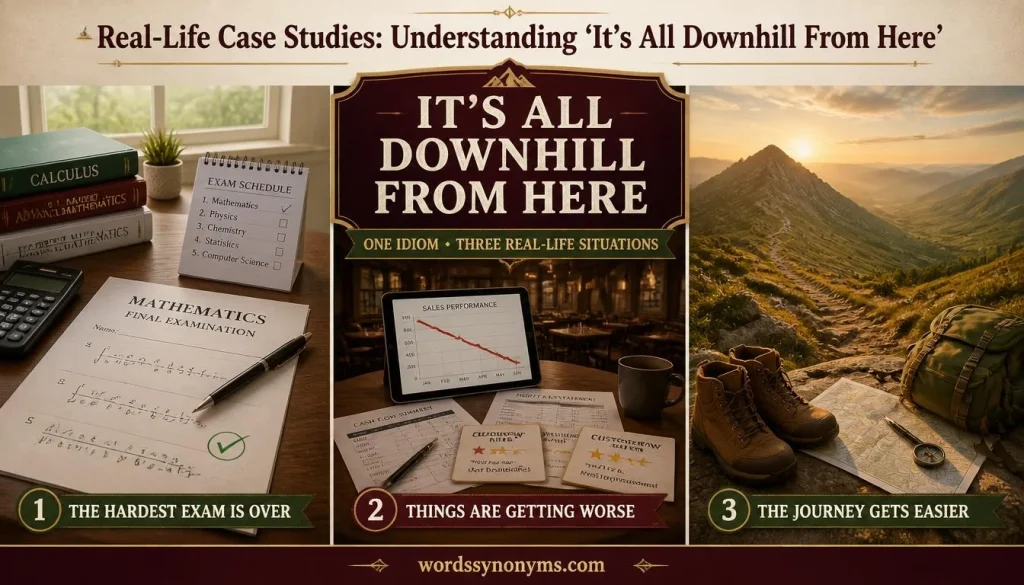
Real-Life Case Studies: Understanding “It’s All Downhill From Here”
Looking at realistic situations makes the expression’s two meanings easier to recognize. The following examples show how the same phrase can communicate completely different expectations.
Case Study: A Student Finishes the Hardest Examination
Imagine a student preparing for five final examinations. Mathematics is the most difficult subject, requiring weeks of preparation.
After completing the mathematics examination, the student feels relieved. The remaining subjects seem much easier.
The student tells a friend:
“Mathematics is finally over. It’s all downhill from here!”
Interpretation: The student uses the positive meaning because the most challenging examination has finished.
Case Study: A Business Experiences Repeated Losses
Consider a small restaurant that initially attracts many customers. Unfortunately, the owner starts making poor business decisions.
The restaurant increases prices, reduces food quality, and receives negative customer reviews. Eventually, regular customers stop visiting.
An employee might describe the situation:
“After we lost our regular customers, it was all downhill from here.”
Interpretation: The employee uses the negative meaning because the restaurant’s circumstances continued deteriorating.
Case Study: A Difficult Mountain Journey
Imagine a group of hikers climbing a steep mountain trail. The first section requires considerable physical effort.
After reaching the summit, they begin descending toward their destination. The remaining route appears less demanding.
One hiker tells the group:
“We’ve reached the top. It’s all downhill from here!”
Interpretation: The speaker uses the literal meaning while also suggesting that the remaining journey should feel easier.
These examples demonstrate that the expression works through context. The same words can describe relief, disappointment, or an actual downhill journey.
FAQs
1. What does “It’s All Downhill From Here” mean?
“It’s All Downhill From Here” means things will either become easier or start getting worse. The intended meaning depends on the situation and the speaker’s tone.
2. Is “It’s All Downhill From Here” positive or negative?
It can be both. Positively, it suggests the hardest part is over. Negatively, it warns that a situation may continue to decline.
3. Where did the phrase “It’s All Downhill From Here” originate?
The expression comes from the physical idea of traveling downhill. Going downhill often requires less effort than climbing uphill, which explains its association with easier progress.
4. Can you use “It’s All Downhill From Here” in everyday conversations?
Yes! You can use it with friends, family, and coworkers. For example, after completing a difficult assignment, you might say it to suggest the remaining tasks should be easier.
5. Is “It’s All Downhill From Here” appropriate for professional situations?
Yes, but consider the context. It works in casual workplace conversations and informal meetings. For formal reports, clearer expressions such as “the remaining work should be easier” may sound more professional.
6. What is an example of the negative meaning of “It’s All Downhill From Here”?
Imagine a business losing important customers and experiencing falling sales. Someone might say, “After the manager resigned, it was all downhill from here.” This suggests that the situation kept getting worse.
Conclusion
“It’s All Downhill From Here” is an interesting expression because it can describe both easier progress and worsening situations. Its meaning isn’t always obvious from the words alone. You need to consider the conversation, the speaker’s tone, and what happened before. Once you understand this difference, you’ll find it easier to recognize the phrase in everyday conversations, workplace discussions, and written communication.
The next time someone uses this idiom, pay attention to the situation before deciding what they mean. If they’ve overcome a major challenge, they may expect things to become easier. If they’re describing repeated problems, they might be suggesting further decline. Learning these small differences makes your English sound more natural and helps you use idiomatic expressions with confidence.

Shafiq Ur Rehman is a writer and content contributor at WordsConfusing.com. He enjoys exploring the English language, common word confusions, vocabulary, and practical writing tips. His goal is to make English easier to understand through clear, simple, and useful articles.


