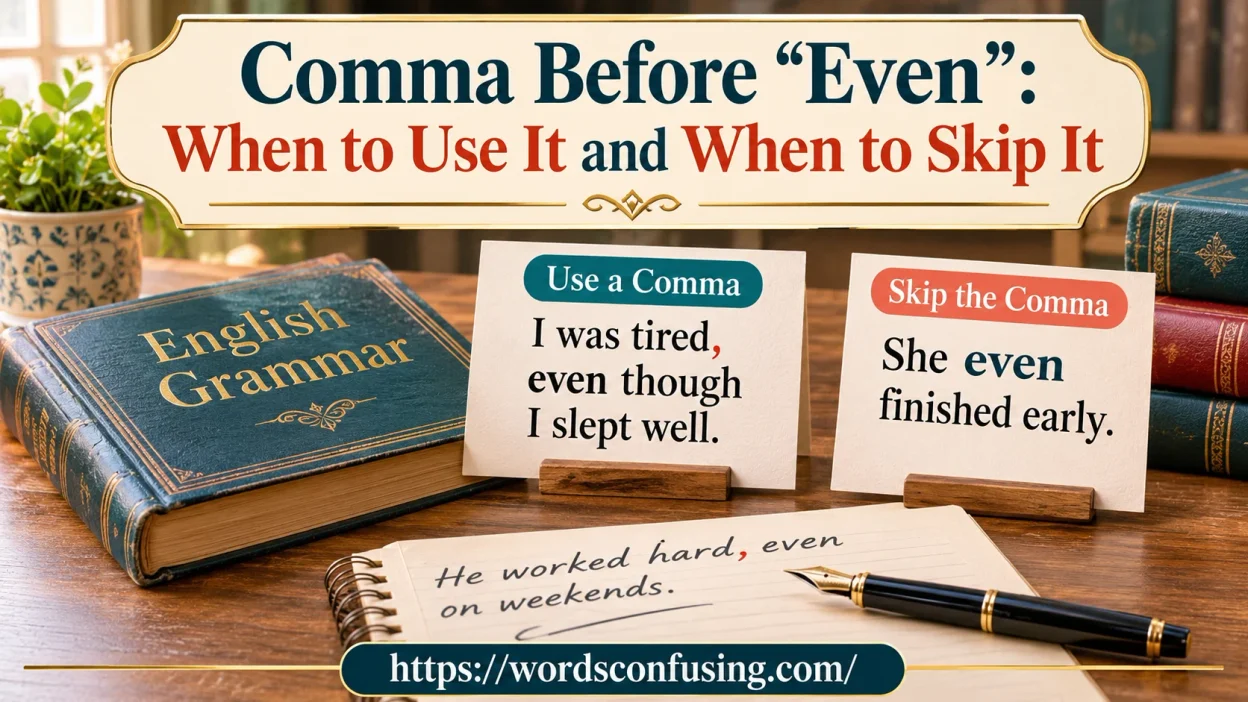
Comma Before “Even”: When to Use It and When to Skip It helps you understand when this word needs punctuation.
Its grammatical function determines how it fits into English usage and sentence structure. Usually, even works as an ordinary adverb that adds emphasis, highlights a surprising detail, or introduces additional information. It also appears in phrases and expressions such as even though, even if, and even so.
These word functions influence comma placement, but they don’t create an automatic comma requirement. Understanding basic English grammar, grammar rules, and common punctuation questions makes punctuation easier for beginners.
In formal writing, professional writing, and everyday writing, consider sentence structure, sentence construction, and sentence patterns before adding commas. For example, “She didn’t even notice the mistake” needs no comma because even adds emphasis naturally.
However, a comma may separate a contrasting phrase, supplementary phrase, or introductory phrase when the sentence meaning requires it. These comma rules apply to emails, reports, presentations, meetings, project management, online booking, booking confirmations, scheduling, and time management.
Whether you’re handling business communication, workplace correspondence, broadcasting scripts, or calendar planning, correct punctuation improves readability, tone, and writing clarity. Practical examples also help prevent common mistakes, maintain punctuation consistency, and strengthen effective communication in everyday situations.
Quick Answer
You don’t usually need a comma before “even.” The word typically adds emphasis without requiring punctuation. However, when a sentence begins with phrases like “even though,” “even if,” or “even when,” place a comma after the introductory clause.
Examples:
- I didn’t even notice the mistake.
- Even though I was tired, I finished my work.
- I’ll help you even if nobody else does.
- Even when she’s busy, she answers my calls.
Remember: The comma depends on sentence structure, not the word even itself.

Do You Need a Comma Before “Even”?
No, you don’t normally need a comma before “even.” The word itself doesn’t require special punctuation. Instead, comma placement depends on the sentence structure and the grammatical role of the surrounding words.
In most sentences, even works as an adverb. It adds emphasis to a verb, adjective, adverb, noun, or another expression.
For example:
- She didn’t even notice the mistake.
- This problem is even harder than the previous one.
- Even my brother understood the instructions.
- He continued working even after midnight.
None of these sentences needs a comma before even. The word fits naturally into the sentence without creating a separate grammatical unit.
However, the situation changes when even appears in longer expressions. Consider the following examples:
- I wanted to attend, but even my closest friends couldn’t come.
- Even though it was raining, we continued playing.
- She kept smiling even when things became difficult.
Notice something important: the commas in these sentences follow ordinary punctuation rules. They don’t appear simply because the word even exists.
A Quick Rule to Remember
| Sentence situation | Comma needed? | Example |
| Even modifies a verb | No | I didn’t even ask. |
| Even modifies an adjective | No | This is even better. |
| Even emphasizes a noun | No | Even Sarah agreed. |
| Even though starts a sentence | Yes, after the introductory clause | Even though I was tired, I worked. |
| Even if starts a sentence | Yes, after the introductory clause | Even if it rains, we’ll go. |
| Even though follows the main clause | Usually no | I worked even though I was tired. |
| Even introduces a supplementary expression | Sometimes | The plan, even with changes, worked. |
The easiest approach is to examine the complete sentence rather than focusing on one word.
When to Use a Comma Before “Even”
Although even doesn’t automatically need a comma, certain sentence structures can place one immediately before it. These situations involve clause boundaries, supplementary information, or other punctuation requirements.
When “Even” Introduces an Additional or Contrasting Thought
Sometimes even appears at the beginning of a phrase that adds emphasis or introduces another idea. A comma may appear before it when another grammatical structure requires separation.
For example:
- I wanted to help, but even my closest friends refused.
- She prepared carefully, yet even that wasn’t enough.
- The instructions were simple, but even experienced workers made mistakes.
In these examples, the comma separates two independent clauses connected by coordinating conjunctions.
Look at this sentence:
I wanted to help, but even my closest friends refused.
It contains two independent clauses:
- I wanted to help.
- Even my closest friends refused.
The comma appears before but because it connects two independent clauses. It doesn’t belong to even.
This distinction matters because you shouldn’t add a comma merely because even introduces an unexpected detail.
When “Even” Appears Inside a Parenthetical Expression
A parenthetical expression adds information without forming an essential part of the sentence’s main structure. Writers often separate these expressions using commas.
Consider this example:
The plan, even with a few changes, worked perfectly.
The phrase even with a few changes adds extra information. The main sentence remains complete without it:
The plan worked perfectly.
Because the additional phrase interrupts the main statement, commas mark its boundaries.
Here are more examples:
- The restaurant, even during busy hours, remained quiet.
- Her explanation, even with several details, was easy to understand.
- The project, even after multiple revisions, looked impressive.
Remember that commas depend on whether the expression is genuinely supplementary. Not every phrase beginning with even needs comma pairs.
When a Comma Separates an Introductory Clause or Phrase
An introductory dependent clause can require a comma before the main clause. This rule applies when the clause begins with expressions such as even though, even if, or even when.
For example:
Even though the road was crowded, we arrived on time.
The introductory clause cannot stand alone as a complete sentence. It depends on the main clause to complete its meaning.
The comma separates these two parts:
- Dependent clause: Even though the road was crowded
- Independent clause: We arrived on time
More examples include:
- Even if you disagree, listen to the complete explanation.
- Even when she’s busy, she answers important messages.
- Even after the meeting ended, several people stayed.
The comma appears after the introductory clause, not immediately before even.
This is one of the most important distinctions to understand when learning this punctuation rule.
Read more: Thank You for Your Insight: 27 Better Ways to Say It and Examples
When You Shouldn’t Put a Comma Before “Even”
Knowing when to leave out a comma is just as important as knowing when to use one. Many writers insert unnecessary commas because they mistake emphasis for a grammatical pause.
In ordinary sentences, even connects smoothly with the word or phrase it modifies. You generally shouldn’t separate these elements with punctuation.
When “Even” Appears Before a Verb
When even modifies a verb, it emphasizes the action or highlights something unexpected. It usually appears directly before the verb or another word associated with it.
No comma separates even from the verb.
Correct examples:
- I didn’t even call him yesterday.
- She even offered to pay for dinner.
- They couldn’t even explain what happened.
- He didn’t even remember my birthday.
- The teacher even praised his unusual answer.
Incorrect examples:
- I didn’t, even call him yesterday.
- She even, offered to pay for dinner.
- They couldn’t, even explain what happened.
These commas interrupt the natural connection between the adverb and the verb.
Think of even as an emphasis button. It strengthens the meaning without creating a separate sentence part.
When “Even” Modifies an Adjective or Adverb
Writers also use even to strengthen adjectives and adverbs. It can emphasize comparisons, unexpected qualities, or changes in degree.
For example:
- This explanation is even clearer.
- The second examination was even harder.
- She runs even faster than before.
- The weather became even colder overnight.
- His latest performance was even more impressive.
None of these sentences needs a comma before even.
Why? Because even directly modifies the following expression. Separating the words would interrupt their grammatical connection.
Compare these examples:
| Incorrect | Correct |
| This option is, even better. | This option is even better. |
| She speaks, even faster now. | She speaks even faster now. |
| The situation became, even worse. | The situation became even worse. |
A useful trick is to check whether even simply strengthens the next word. If it does, you normally don’t need a comma.
When “Even” Appears Before a Noun or Pronoun
Sometimes even emphasizes a person, object, or group. It highlights something unexpected or surprising about that particular noun.
For example:
- Even John understood the difficult instructions.
- Even my parents supported the decision.
- Nobody invited even her to the celebration.
- Even experienced writers make punctuation mistakes.
- The news surprised even the most confident employees.
The word even doesn’t require a comma in these examples.
It simply adds emphasis to the noun or pronoun that follows. A comma would create an unnecessary break.
Remember: Don’t separate even from a noun just because you want the sentence to sound dramatic.
Comma Before “Even Though”
The phrase “even though” introduces a dependent clause that expresses contrast. It shows that something happened despite an unexpected situation or condition.
For example:
Even though I was exhausted, I finished the assignment.
The speaker was tired, but the speaker still completed the work. The phrase even though introduces the contrasting condition.
However, comma placement changes when you move the dependent clause.
When “Even Though” Begins a Sentence
When an even though clause comes before the main clause, place a comma after the introductory clause.
Examples:
- Even though it was cold, we went swimming.
- Even though she apologized, he remained upset.
- Even though the test was difficult, everyone completed it.
- Even though I disagreed, I respected her decision.
- Even though he arrived late, the manager welcomed him.
The comma separates the introductory dependent clause from the main clause.
Without that comma, longer introductory clauses can become harder to read.
When “Even Though” Appears at the End
When the dependent clause follows the main clause, you generally don’t need a comma.
Examples:
- We went swimming even though it was cold.
- He remained upset even though she apologized.
- Everyone completed the test even though it was difficult.
- I respected her decision even though I disagreed.
- The manager welcomed him even though he arrived late.
The main clause appears first, followed by the dependent clause. This arrangement usually reads smoothly without additional punctuation.
When a Comma Before “Even Though” Can Work
A comma may appear before even though when the writer wants to emphasize a contrast or mark an interruption.
For example:
She accepted the invitation, even though she had very little free time.
The comma creates a noticeable pause before the contrasting information. It can make the contrast more prominent.
However, don’t assume every sentence ending with even though requires that comma. In ordinary sentences, the comma is usually unnecessary.
Quick comparison:
| Sentence | Comma placement |
| Even though I was sick, I attended class. | After the introductory clause |
| I attended class even though I was sick. | No comma normally needed |
| I attended class, even though I was sick. | Optional emphasis or stylistic separation |
Comma Before “Even If”
The expression “even if” introduces a condition that may or may not happen. It emphasizes that the main action will remain possible despite that condition.
For example:
Even if it rains, we’ll still attend the event.
The rain represents a possible obstacle. However, it won’t change the speaker’s decision.
The comma rule follows the same general pattern as even though.
When “Even If” Begins a Sentence
Place a comma after an introductory even if clause.
Examples:
- Even if you disagree, you should listen.
- Even if she refuses, we’ll continue with the plan.
- Even if the price increases, I’ll consider buying it.
- Even if nobody helps, we can finish the project.
- Even if he feels nervous, he should try.
Each introductory clause presents a condition before the main statement.
The comma separates the condition from the result or decision.
When “Even If” Appears at the End
When the main clause comes first, you usually don’t need a comma before even if.
Examples:
- I’ll attend even if nobody else comes.
- We’ll continue even if the weather changes.
- She’ll apply even if the competition is strong.
- He’ll support you even if others disagree.
- You can succeed even if the process takes longer.
These sentences connect naturally without commas.
Even If vs. Even Though: What’s the Difference?
These expressions look similar, but they communicate different ideas.
- Even if introduces a possible or hypothetical condition.
- Even though introduces a fact or situation that exists.
Compare:
| Even if | Even though |
| Even if it rains, we’ll play. | Even though it rained, we played. |
| I’ll help even if you refuse. | I’ll help even though you refused. |
| Even if she’s busy, she’ll call. | Even though she’s busy, she’ll call. |
Understanding this difference helps you choose the correct expression. It also makes your sentences more precise.
Comma Before “Even When”
The phrase “even when” introduces a time-related condition. It emphasizes that something happens despite a particular situation or circumstance.
For example:
Even when he’s busy, he answers my calls.
The sentence highlights his willingness to answer despite having other responsibilities.
The comma depends on where the introductory clause appears.
When “Even When” Begins a Sentence
Use a comma after an introductory even when clause.
Examples:
- Even when she’s tired, she finishes her assignments.
- Even when the weather changes, the birds return.
- Even when nobody agrees, he stays calm.
- Even when life gets difficult, she remains hopeful.
The comma separates the introductory time-related clause from the main clause.
When “Even When” Appears Later
When the main clause comes first, a comma generally isn’t necessary.
Examples:
- She finishes her assignments even when she’s tired.
- The birds return even when the weather changes.
- He stays calm even when nobody agrees.
- She remains hopeful even when life gets difficult.
The dependent clause follows the main statement. No additional comma is normally needed.
Beginner tip: When even when starts your sentence, look for the comma after its complete clause. When it appears later, check whether the sentence needs any special separation.
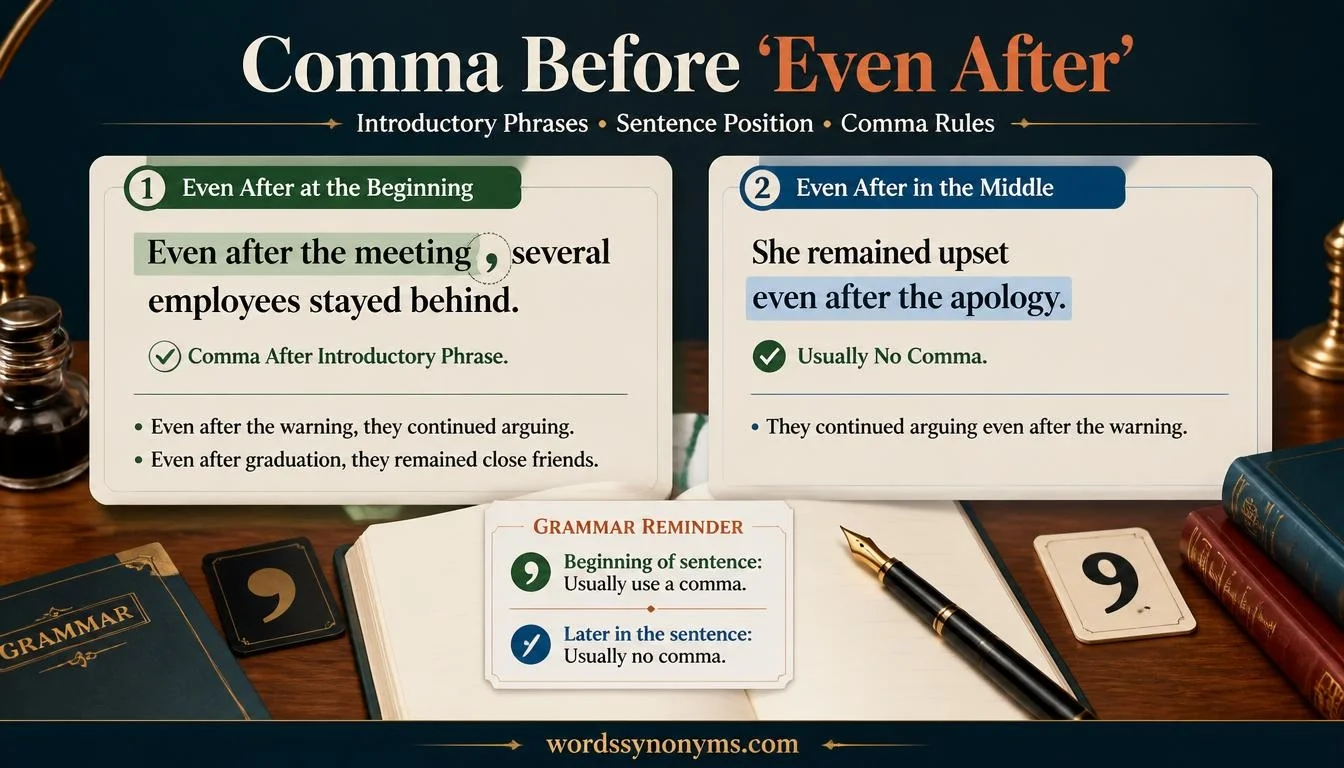
Comma Before “Even After”
The expression “even after” emphasizes that something continues or happens despite a previous event.
Unlike even though, this expression often introduces a prepositional phrase rather than a dependent clause.
Consider:
Even after the apology, she remained upset.
The introductory phrase establishes when something happened. The comma separates that introductory phrase from the main clause.
When “Even After” Begins a Sentence
Use a comma after an introductory even after phrase when it precedes the main clause.
Examples:
- Even after the meeting, several employees stayed behind.
- Even after the warning, they continued arguing.
- Even after several attempts, he couldn’t solve the problem.
- Even after graduation, they remained close friends.
The introductory phrase provides background information before the main statement.
When “Even After” Appears Later
When the phrase appears after the main clause, a comma usually isn’t needed.
Examples:
- She remained upset even after the apology.
- They continued arguing even after the warning.
- He couldn’t solve the problem even after several attempts.
- They remained close friends even after graduation.
The sentence already flows naturally without additional punctuation.
One important distinction: even after doesn’t always introduce a complete dependent clause. Sometimes it introduces a noun phrase, such as the meeting or graduation. Don’t confuse these structures when applying comma rules.
Comma Before “Even So”
“Even so” is a transitional expression that means nevertheless or despite that. Writers use it to connect contrasting ideas.
For example:
The journey was exhausting. Even so, we enjoyed every moment.
The second sentence acknowledges the difficulty while emphasizing the positive outcome.
When “Even So” Begins a Sentence
When even so begins a sentence as a transition, follow it with a comma.
Examples:
- The weather was terrible. Even so, we enjoyed the picnic.
- The assignment was difficult. Even so, she completed it.
- Nobody expected success. Even so, the team kept trying.
- The restaurant was expensive. Even so, we ordered dinner.
The comma separates the transitional expression from the rest of the sentence.
When “Even So” Appears in the Middle
When even so appears inside a sentence as a transitional expression, commas can separate it from the surrounding words.
Examples:
- The proposal was expensive, but even so, everyone supported it.
- She was disappointed, yet even so, she congratulated the winner.
- The journey was difficult, but even so, we continued.
Notice that the comma before even so follows the sentence’s clause structure. The comma after even so marks the transition.
However, punctuation can vary with sentence construction. Don’t insert commas mechanically whenever these two words appear.
Comma Before “Even” at the Beginning of a Sentence
Starting a sentence with even is perfectly acceptable. However, you need to understand whether it introduces a noun, modifies another word, or begins a larger expression.
The word itself doesn’t require a comma after it.
When “Even” Directly Emphasizes Something
No comma is necessary when even modifies a noun or another sentence element.
Examples:
- Even children can understand this simple rule.
- Even experienced teachers make mistakes.
- Even my closest friends forgot the appointment.
- Even small changes can improve your writing.
In each example, even emphasizes the following noun or noun phrase.
When “Even Though” or “Even If” Begins the Sentence
A comma becomes necessary after the introductory dependent clause.
Examples:
- Even though I was nervous, I answered confidently.
- Even if you make mistakes, keep practicing.
- Even when the road is busy, drive carefully.
- Even after the disagreement, they remained friends.
The important point is that the comma separates the introductory clause or phrase from the main clause.
It doesn’t separate even from the words that follow it.
Read more: 5 Terms to Describe Being Hard on the Outside But Soft on the Inside
Comma Before “Even” at the End of a Sentence
The word even can sometimes appear near the end of a sentence. However, writers should distinguish between standard constructions and conversational fragments.
For example:
- I didn’t expect him to agree, not even once.
- She couldn’t understand the explanation, not even after several attempts.
- Nobody remembered the appointment, not even John.
These examples use natural expressions that emphasize an unexpected result.
Notice that the comma before not even separates an additional phrase or follows the sentence’s structure. It isn’t required by the word even.
A sentence ending with even alone can sound incomplete or unusual in standard written English.
For instance, writing “I didn’t expect that, even” may work in certain informal conversations. However, it usually needs more context to communicate a clear meaning.
For polished articles, academic writing, and professional communication, choose complete and natural expressions.
Common Mistakes When Using a Comma Before “Even”
Even experienced writers sometimes misuse commas around even. Most mistakes happen because they focus on the word instead of examining the complete sentence.
Here are common errors worth avoiding.
Adding a Comma Before Every Occurrence of “Even”
This is probably the most common mistake. Some writers assume even introduces a separate thought and needs punctuation.
Incorrect: She didn’t, even understand the question.
Correct: She didn’t even understand the question.
The word even modifies the verb phrase. Nothing needs separating.
Forgetting the Comma After an Introductory Clause
An introductory dependent clause usually needs a comma before the main clause.
Incorrect: Even though the restaurant was crowded we found a table.
Correct: Even though the restaurant was crowded, we found a table.
The comma separates the introductory clause from the independent clause.
Placing a Comma Between a Subject and Its Verb
A subject and its verb generally belong together. Don’t interrupt them with an unnecessary comma.
Incorrect: Even my older brother, understood the instructions.
Correct: Even my older brother understood the instructions.
Here, even my older brother forms the complete subject.
Confusing “Even If” With “Even Though”
These expressions communicate different meanings. Using one instead of the other can change your sentence.
- Even if: Describes a possible or hypothetical condition.
- Even though: Describes an actual situation or fact.
For example:
- Even if it snows, we’ll travel tomorrow.
- Even though it snowed, we traveled yesterday.
The first describes a possibility. The second describes something that actually happened.
Adding Commas Around Essential Information
Not every expression beginning with even is parenthetical. Some information belongs directly to the sentence and shouldn’t be separated.
Incorrect: She continued working, even after the meeting ended, on the report.
Better: She continued working on the report even after the meeting ended.
The second version keeps the sentence’s main structure clear and avoids unnecessary interruptions.
Comma Before “Even”: Correct vs. Incorrect Examples
Sometimes, comparing two sentences makes a punctuation rule easier to remember. The following examples cover common situations beginners encounter.
| Incorrect sentence | Correct sentence | Explanation |
| I didn’t, even notice the mistake. | I didn’t even notice the mistake. | No comma separates the adverb from the verb. |
| Even though I was tired I continued working. | Even though I was tired, I continued working. | Add a comma after the introductory clause. |
| She is, even smarter now. | She is even smarter now. | Don’t separate an adverb from the adjective it modifies. |
| Even if you disagree we should talk. | Even if you disagree, we should talk. | Separate the introductory conditional clause. |
| He continued, even after the warning. | He continued even after the warning. | The ending phrase doesn’t normally need a comma. |
| Even when she’s busy she answers calls. | Even when she’s busy, she answers calls. | Add a comma after the introductory clause. |
| Even my parents, supported the decision. | Even my parents supported the decision. | Don’t separate the subject from its verb. |
| Even after graduation they stayed friends. | Even after graduation, they stayed friends. | Separate the introductory phrase. |
| The trip was difficult. Even so we enjoyed it. | The trip was difficult. Even so, we enjoyed it. | Follow the introductory transition with a comma. |
| The plan, even with changes worked. | The plan, even with changes, worked. | Set off the supplementary expression with two commas. |
These examples show why checking the entire sentence matters. The same word can appear in different grammatical structures.
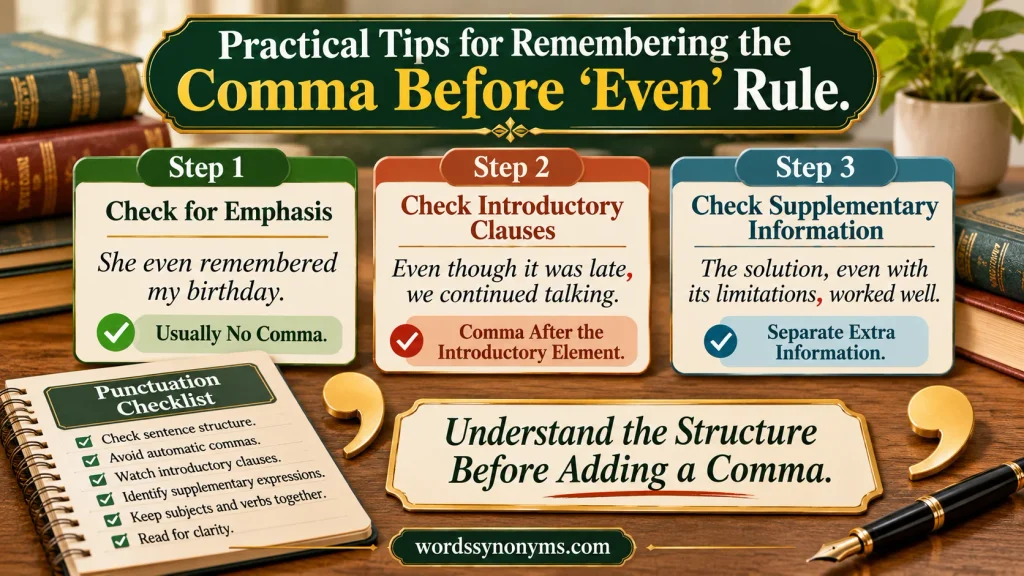
Practical Tips for Remembering the Comma Before “Even” Rule
You don’t need to memorize every possible sentence containing even. A few practical checks can help you make the right punctuation choice.
Keep these tips in mind whenever you’re editing your writing.
- Check the sentence structure: Determine whether even modifies a word, introduces a phrase, or appears in a clause.
- Don’t insert automatic commas: The word even doesn’t require punctuation by itself.
- Watch introductory clauses: Add a comma after introductory clauses beginning with even though, even if, and even when.
- Check introductory phrases: Expressions such as even after graduation generally take a following comma when they introduce the sentence.
- Recognize parenthetical expressions: Use commas around genuinely supplementary information.
- Keep subjects and verbs together: Avoid inserting commas between essential sentence elements.
- Understand the meaning: Distinguish hypothetical conditions from actual situations.
- Read for clarity: Check whether the punctuation helps readers understand the sentence.
A Simple Three-Step Punctuation Test
Before adding a comma before or after even, ask yourself these questions:
Step 1: Does even simply emphasize another word?
If yes, you generally don’t need a comma.
Example: She even remembered my birthday.
Step 2: Does the expression introduce an introductory clause or phrase?
If yes, place a comma after the complete introductory element.
Example: Even though it was late, we continued talking.
Step 3: Does even appear inside a supplementary expression?
If yes, check whether commas should separate that additional information.
Example: The solution, even with its limitations, worked well.
This quick test covers most everyday situations.
FAQs
1. Do you always need a comma before “even”?
No, you don’t usually need a comma before even. When it works as an ordinary adverb, it fits naturally into the sentence without extra punctuation. For example, “I didn’t even notice the change.”
2. When should you put a comma before “even”?
Use a comma when the sentence structure requires one, such as before a supplementary or contrasting phrase. The punctuation depends on the complete sentence, not simply on the word even.
3. Should you use a comma before “even though”?
Usually, no comma is needed immediately before even though. However, when the phrase introduces a dependent clause after an independent clause, a comma generally separates the clauses. For example, “I went outside, even though it was raining.”
4. Is there a comma before “even if”?
Not automatically. When even if introduces a dependent clause after the main clause, a comma is generally unnecessary. For example, “I’ll attend even if nobody else comes.” When the dependent clause comes first, use a comma after it.
5. Do you need a comma before “even so”?
It depends on how even so functions. When it introduces a contrasting sentence or independent clause, a comma usually follows it. For example, “The journey was difficult. Even so, we enjoyed it.”
6. How can beginners avoid comma mistakes with “even”?
Read the complete sentence and identify how even functions. Check whether it emphasizes something, introduces a dependent clause, or connects contrasting information. Learning these patterns through regular examples makes punctuation much easier.
Conclusion
Understanding when to use a comma before “even” doesn’t have to be difficult. The trick is to look at how the word works within your sentence rather than adding punctuation automatically. When even emphasizes something, you generally don’t need a comma. However, longer sentence structures, contrasting information, and introductory expressions may require different punctuation. A little attention to these details can prevent confusing sentences and unnecessary commas.
As you practice, try reading your sentences aloud and checking how each phrase connects. Pay attention to expressions such as even though, even if, and even so because their punctuation depends on their position and purpose. Whether you’re writing an email, completing an assignment, or preparing professional documents, these simple rules will help you write more naturally. Remember, good punctuation isn’t about adding more commas. It’s about putting them in the right places.