
This guide to 5 Words for Someone Who Doesn’t Keep Their Word: Meanings helps you describe broken promises with greater clarity.
Finding words to describe specific types of people can be tricky, especially when explaining unreliable behavior. Suitable synonyms and descriptive terms help you identify an unreliable person or an untrustworthy person without struggling on the spot. Someone who doesn’t keep their word makes promises but often fails to honor them, creating broken promises, damaged trust, and uncertainty.
A stronger vocabulary gives you better word choices to describe personality traits with precision and confidence in personal situations and professional situations. In workplaces, keeping commitments demonstrates reliability, trustworthiness, consistency, and accountability.
Someone who repeatedly fails to honor promises can affect business communication, project management, meetings, and team coordination. Their behavior may also cause confusion with daily scheduling, time management, a shared calendar, and important tasks, including online booking.
This article and guide explore useful options, their meanings, usage, subtle differences, and practical examples. These insights help you express situations through clear communication, professional communication, and effective communication.
Understanding English usage, grammar, and formal writing also makes choosing the right word easier when selecting the most appropriate term for different contexts and creating accurate descriptions of someone who doesn’t keep promises.
Quick Answer
Someone who doesn’t keep their word is generally called unreliable, untrustworthy, or a promise-breaker. However, the most accurate word depends on their behavior and intentions.
Here are five useful words:
| Word | Meaning |
| Unreliable | Someone who regularly fails to fulfill commitments or follow through. |
| Untrustworthy | Someone whose behavior makes them difficult to trust. |
| Deceitful | Someone who deliberately misleads others through dishonesty. |
| Fickle | Someone who frequently changes their mind or intentions. |
| Promise-breaker | Someone who makes promises but fails to fulfill them. |
For example, you might call someone unreliable if they constantly cancel plans. However, deceitful is more appropriate when someone knowingly makes promises they never intend to keep.

5 Words for Someone Who Doesn’t Keep Their Word
Not everyone who breaks a promise behaves dishonestly. Sometimes people forget, misjudge their abilities, or face unexpected circumstances.
However, when broken promises become a repeated pattern, certain words describe that behavior more accurately.
Let’s explore five expressions, their meanings, and practical examples.
Unreliable
Unreliable describes someone you cannot consistently depend on to do what they promise. Such a person might agree to help, make plans, or accept responsibilities but frequently fail to follow through.
For example, imagine asking a friend to pick you up from the airport. They confidently agree but don’t arrive or answer your calls. After several similar experiences, you might consider that friend unreliable.
The word doesn’t necessarily suggest dishonesty or malicious intentions. An unreliable person might genuinely intend to fulfill their promises but struggle with time management, responsibility, or consistency.
Nevertheless, good intentions don’t automatically make someone dependable.
Common signs of an unreliable person include:
- Making promises without considering whether they can fulfill them.
- Frequently canceling plans at the last minute.
- Arriving late without reasonable explanations.
- Forgetting important commitments.
- Agreeing to responsibilities but failing to complete them.
- Repeatedly disappointing people who depend on them.
- Offering excuses instead of taking responsibility.
The distinction between occasional mistakes and consistent unreliability matters. Everyone forgets something occasionally, but repeated behavior creates a pattern.
Example sentences:
- He’s unreliable because he rarely follows through on his promises.
- You shouldn’t depend on an unreliable person to complete important tasks.
- Her unreliable behavior has disappointed her friends several times.
- I stopped asking him for help because he’s simply unreliable.
- An unreliable coworker can make even simple projects unnecessarily difficult.
When should you use unreliable?
Use this word when someone repeatedly fails to fulfill commitments, regardless of whether they intended to disappoint others.
It’s particularly suitable for everyday conversations, workplace discussions, and descriptions of personal relationships.
Untrustworthy
Untrustworthy describes someone whose honesty, integrity, or behavior makes them difficult to trust.
Unlike unreliable, this word focuses more directly on whether someone deserves your confidence. An untrustworthy person might repeatedly break promises, hide important information, or fail to act honestly.
For example, suppose someone promises to keep your personal information private. Later, you discover they’ve shared your secrets with other people.
Their behavior gives you a reason to question their trustworthiness.
Similarly, someone who repeatedly makes commitments and then denies making them may eventually become untrustworthy in your eyes.
Trust depends on more than words. People also judge whether someone’s actions match their promises.
Common signs of an untrustworthy person include:
- Frequently breaking promises without taking responsibility.
- Lying about important matters.
- Sharing confidential information without permission.
- Changing their stories when confronted.
- Making commitments they repeatedly fail to honor.
- Blaming others instead of acknowledging their mistakes.
- Saying whatever benefits them in the moment.
However, being unreliable and being untrustworthy aren’t exactly the same.
An unreliable person might forget an appointment because they’re disorganized. An untrustworthy person might knowingly lie about attending that appointment.
The difference often comes down to honesty and personal integrity.
Example sentences:
- He’s untrustworthy because his promises rarely match his actions.
- I find it difficult to believe anything an untrustworthy person says.
- Her repeated dishonesty has made her seem completely untrustworthy.
- You shouldn’t share confidential information with someone you consider untrustworthy.
- His untrustworthy behavior damaged several important friendships.
When should you use untrustworthy?
Choose this word when someone’s repeated behavior makes you question their honesty or integrity.
It’s especially appropriate when broken promises involve dishonesty, betrayal, or a loss of confidence.
Read more: Comma Before “If”: When Should You Use One?
Deceitful
Deceitful describes someone who intentionally misleads others through lies, false promises, or dishonest behavior.
This word carries a stronger meaning than simply being unreliable. It suggests that someone knows the truth but deliberately creates a false impression.
For instance, imagine a person promises to repay borrowed money next week. However, they already know they have no intention of returning it.
Their promise isn’t merely unfulfilled. It was dishonest from the beginning.
That’s what makes deceitful particularly useful when describing someone who knowingly makes empty promises.
A deceitful person might use convincing words to gain someone’s confidence. Once they get what they want, they may ignore their commitments or invent excuses.
Common signs of deceitful behavior include:
- Making promises they never intend to fulfill.
- Lying about their intentions or actions.
- Giving false assurances to gain someone’s cooperation.
- Hiding important facts to manipulate another person.
- Repeatedly changing their explanations when questioned.
- Pretending to care about commitments they knowingly disregard.
It’s important to distinguish deceitful behavior from ordinary forgetfulness.
Someone who forgets to return a phone call isn’t automatically deceitful. However, someone who deliberately lies about calling back may be acting deceitfully.
Example sentences:
- His deceitful promises made everyone question his intentions.
- She was deceitful when she promised to help despite knowing she wouldn’t.
- I don’t trust his deceitful explanations anymore.
- A deceitful person often uses convincing words to hide dishonest intentions.
- Their deceitful behavior eventually destroyed the relationship.
When should you use deceitful?
Use deceitful when someone deliberately misleads others or makes promises without intending to honor them.
It’s particularly useful when you want to emphasize dishonesty rather than simple irresponsibility.
Fickle
Fickle describes someone whose feelings, opinions, decisions, or intentions change frequently.
A fickle person might enthusiastically agree to something today but completely change their mind tomorrow. Their commitments often depend on their current mood, preferences, or circumstances.
For example, imagine a friend who repeatedly promises to join your weekend plans. Whenever something more interesting comes along, they suddenly cancel.
They might not deliberately intend to deceive you. Instead, their changing preferences make it difficult to depend on their decisions.
That’s where fickle becomes useful.
Although the word doesn’t directly mean someone who breaks promises, it describes a personality trait that can contribute to inconsistent commitments.
Common signs of fickle behavior include:
- Frequently changing plans without much consideration.
- Making decisions based on temporary feelings.
- Showing enthusiasm initially but quickly losing interest.
- Changing opinions whenever circumstances shift.
- Struggling to maintain long-term commitments.
- Abandoning plans when something more appealing appears.
A fickle person isn’t necessarily dishonest or manipulative. They may simply struggle with consistency and commitment.
For example, someone might genuinely intend to attend an event when they accept the invitation. Later, their enthusiasm disappears, and they change their mind.
Example sentences:
- He’s too fickle to stick with the commitments he makes.
- Her fickle nature makes planning anything together difficult.
- I never know whether his promises will last because he’s so fickle.
- A fickle friend might change plans whenever something better comes along.
- His fickle attitude makes long-term commitments challenging.
When should you use fickle?
Use this word when someone frequently changes their mind, preferences, or intentions.
It’s especially appropriate when their broken commitments result from inconsistency rather than deliberate dishonesty.
Promise-Breaker
Promise-breaker is a straightforward expression for someone who makes promises but doesn’t fulfill them.
Unlike some other words on this list, it directly identifies the specific behavior you’re describing.
A promise-breaker might agree to complete a task, help someone, repay a debt, or keep a secret. However, they fail to honor their commitment.
For example, imagine someone repeatedly promises to visit an older relative but never makes time for the visit.
You might describe that person as a promise-breaker because their actions consistently contradict their words.
The expression can describe occasional failures or repeated behavior. However, people usually use it more strongly when someone develops a habit of breaking promises.
Common characteristics of a promise-breaker include:
- Making commitments without following through.
- Repeatedly disappointing people who believe their assurances.
- Breaking verbal agreements without proper explanations.
- Failing to honor personal or professional responsibilities.
- Making the same promises repeatedly without changing behavior.
- Expecting others to accept apologies without meaningful improvement.
The expression is particularly useful because readers immediately understand its meaning.
It doesn’t automatically establish why someone broke a promise. The person might have forgotten, changed their mind, or deliberately misled someone.
The surrounding context explains the reason.
Example sentences:
- Nobody wants to depend on a habitual promise-breaker.
- He’s become known as a promise-breaker among his friends.
- A promise-breaker can damage relationships through repeated disappointment.
- She doesn’t want to make plans with someone who constantly breaks promises.
- His reputation as a promise-breaker makes people question his commitments.
When should you use promise-breaker?
Choose this expression when you want a direct, easily understood description of someone who repeatedly fails to honor promises.
It’s suitable for casual conversations, personal situations, and straightforward writing.

Other Words and Expressions for Someone Who Doesn’t Keep Their Word
The five words above cover several common behaviors associated with broken promises. However, other expressions can describe more specific situations.
Some focus on dishonesty, while others describe inconsistent behavior or unreliable relationships.
Two-Faced
Two-faced describes someone who behaves differently toward different people, often pretending to be friendly while acting dishonestly behind someone’s back.
For example, a coworker might promise to support your project during a meeting. Later, they criticize your work privately and undermine your efforts.
This expression focuses on hypocrisy and insincerity rather than broken promises alone.
Example: “I thought he was supportive, but his two-faced behavior proved otherwise.”
Use two-faced when someone’s public behavior contradicts their private actions.
Dishonest
Dishonest describes someone who lies, cheats, or deliberately hides the truth.
A dishonest person might make false promises to gain someone’s confidence or avoid an uncomfortable conversation.
For example, someone might promise to return borrowed money while knowing they’ve already spent it elsewhere.
However, not every broken promise involves dishonesty. Someone can fail to fulfill a commitment without intentionally misleading anyone.
Example: “His dishonest behavior made it impossible for me to believe his promises.”
Use dishonest when someone’s actions involve lying, deception, or a lack of truthfulness.
Inconsistent
Inconsistent describes someone whose actions, decisions, or behavior frequently change.
An inconsistent person might promise to help with something one day but show little interest the next. Their words and actions don’t follow a dependable pattern.
For example, a manager might repeatedly promise employees better communication but continue ignoring their questions.
The word doesn’t necessarily suggest bad intentions. It simply highlights a lack of consistency.
Example: “Her inconsistent behavior makes it difficult to depend on her commitments.”
Use inconsistent when someone’s behavior changes frequently or their actions don’t match their stated intentions.
Fair-Weather Friend
A fair-weather friend is someone who remains supportive when life feels easy but disappears when difficulties arise.
This expression is particularly useful when describing someone who promises friendship, loyalty, or support but fails to deliver during challenging situations.
For example, a friend might celebrate your achievements and enjoy spending time with you. However, when you face financial difficulties or personal problems, they suddenly become unavailable.
Their friendship seems to depend on convenient circumstances.
Example: “I discovered he was a fair-weather friend when he disappeared during my difficult times.”
Use this expression when someone offers friendship only when things suit them.
Backslider
Backslider describes someone who returns to previous undesirable habits or behavior after making an effort to improve.
The word often appears in religious or moral contexts. However, people also use it more generally when discussing repeated failures to maintain positive changes.
For example, someone might promise to stop wasting money but gradually return to their old spending habits.
Although backslider can describe someone who fails to maintain a commitment, it isn’t a direct synonym for every person who breaks promises.
Example: “He became a backslider after repeatedly abandoning the changes he promised to make.”
Use this word when someone repeatedly returns to old behavior after promising to change.
What Is the Best Word for Someone Who Doesn’t Keep Their Word?
The best word depends on why someone breaks promises and how they behave afterward.
Calling everyone who disappoints you deceitful would be inaccurate. Likewise, describing deliberate dishonesty as simple inconsistency might understate the situation.
Consider these distinctions before choosing an expression.
| Situation | Best word | Why it fits |
| Someone repeatedly fails to complete promised tasks. | Unreliable | They cannot consistently fulfill commitments. |
| Someone’s actions make you question their honesty. | Untrustworthy | Their behavior damages your confidence. |
| Someone knowingly makes false promises. | Deceitful | They deliberately mislead others. |
| Someone frequently changes their mind. | Fickle | Their intentions lack consistency. |
| Someone repeatedly breaks commitments. | Promise-breaker | The expression directly describes their behavior. |
Here are some additional examples to make the differences clearer.
If someone frequently cancels plans: Call them unreliable rather than automatically assuming they’re dishonest.
If someone lies about fulfilling a commitment: Untrustworthy or deceitful might describe their behavior more accurately.
If someone changes their mind constantly: Fickle is suitable when their decisions depend heavily on temporary feelings.
If someone repeatedly breaks promises: Promise-breaker communicates the problem directly.
Ultimately, the most accurate expression describes what someone actually does rather than assuming what they think.

Examples of How to Use Words for Someone Who Doesn’t Keep Their Word in Sentences
Understanding definitions is helpful, but seeing these expressions in everyday situations makes them easier to use.
The following examples show how each word fits naturally into conversations.
| Word | Example sentence |
| Unreliable | He’s unreliable because he never follows through on his commitments. |
| Untrustworthy | I find it difficult to believe an untrustworthy person’s promises. |
| Deceitful | Her deceitful behavior made his promises seem meaningless. |
| Fickle | He’s fickle and constantly changes his mind about commitments. |
| Promise-breaker | Nobody wants to make plans with a habitual promise-breaker. |
| Two-faced | His two-faced behavior surprised everyone who trusted him. |
| Dishonest | She was dishonest about her intentions from the beginning. |
| Inconsistent | His inconsistent actions rarely match his encouraging words. |
| Fair-weather friend | A fair-weather friend disappears when you need support most. |
| Backslider | He became a backslider after returning to his old habits. |
Examples in Different Everyday Situations
At work:
“Mark is unreliable because he repeatedly misses deadlines despite promising to finish everything.”
This sentence describes someone who doesn’t consistently fulfill professional responsibilities.
In friendships:
“She’s a fair-weather friend who disappears whenever life becomes difficult.”
This expression highlights conditional friendship rather than simple forgetfulness.
In romantic relationships:
“I find it difficult to trust him because he keeps breaking his promises.”
This sentence communicates disappointment without automatically labeling the person deceitful.
When dealing with dishonesty:
“His deceitful behavior showed that he never intended to keep his promise.”
Here, deceitful emphasizes deliberate dishonesty.
When someone constantly changes plans:
“He’s so fickle that I never know whether he’ll follow through.”
This sentence highlights changing intentions rather than intentional deception.
Understanding the Difference Between Breaking a Promise and Being Dishonest
A broken promise doesn’t always mean someone has lied. Understanding this distinction helps you describe people’s behavior fairly.
Consider two different situations.
Situation One: An Unfulfilled Promise
Your friend promises to attend your birthday dinner. Unfortunately, an unexpected family emergency prevents them from attending.
They apologize, explain what happened, and acknowledge their commitment.
Although they didn’t keep their promise, their behavior doesn’t necessarily make them dishonest.
Situation Two: A Deliberately False Promise
Another friend promises to attend your birthday dinner. However, they already know they have no intention of coming.
They make the promise simply to avoid an uncomfortable conversation.
This behavior involves dishonesty because they knowingly misrepresented their intentions.
The difference is important.
| Behavior | What it suggests |
| Forgetting a commitment | Poor memory or organization |
| Missing a commitment because of an emergency | Unavoidable circumstances |
| Repeatedly failing to follow through | Unreliability |
| Changing plans whenever something better appears | Fickleness |
| Knowingly making false promises | Deceitfulness |
| Repeatedly damaging someone’s confidence | Untrustworthiness |
A person’s response after breaking a promise also matters.
Someone who takes responsibility and makes a genuine effort to correct their mistake behaves differently from someone who repeatedly offers excuses.
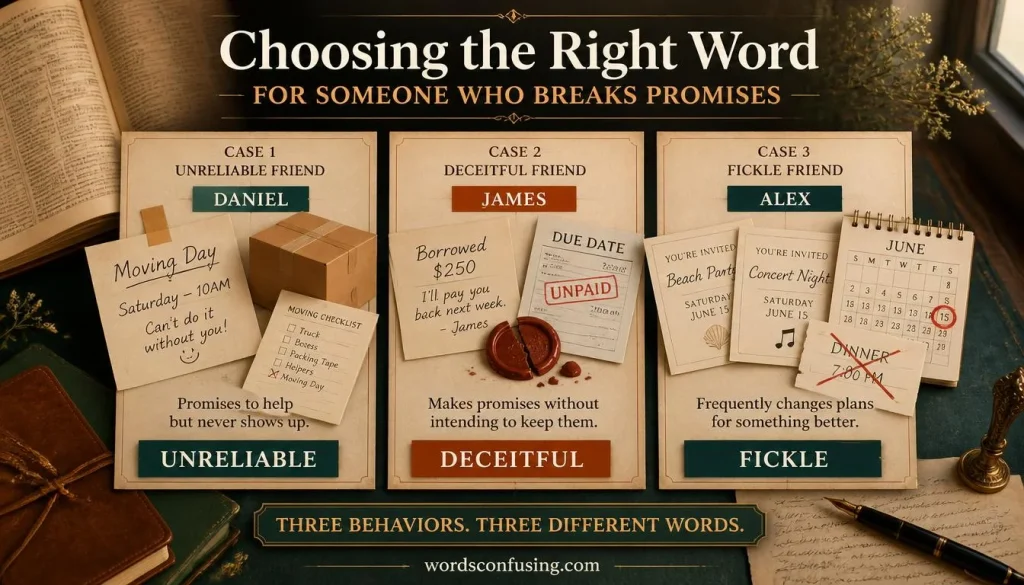
A Simple Case Study: Choosing the Right Word for Someone Who Breaks Promises
Imagine three friends who make similar promises but behave differently.
Their situations demonstrate why choosing the right word matters.
Case One: Daniel, the Unreliable Friend
Daniel promises to help his friend move into a new apartment. However, he forgets the date and doesn’t show up.
This isn’t the first time he’s missed an important commitment. He regularly agrees to help but struggles to follow through.
Best description: Unreliable.
Daniel’s repeated failures show that people cannot consistently depend on him.
Case Two: James, the Deceitful Friend
James promises to repay money he borrowed from a friend. However, he already knows he cannot afford the repayment and has no intention of making it.
He continues making reassuring promises whenever his friend asks about the money.
Best description: Deceitful.
James knowingly misrepresents his intentions to avoid facing the situation honestly.
Case Three: Alex, the Fickle Friend
Alex enthusiastically agrees to attend a weekend event. Later, another invitation arrives, and he immediately changes his plans.
This happens repeatedly whenever something more interesting comes along.
Best description: Fickle.
Alex frequently changes his decisions based on his current preferences.
These examples demonstrate an important point: similar outcomes can have very different explanations.
The right word should reflect the actual behavior rather than simply express frustration.
Read more: Take a Decision vs. Make a Decision: Which Is Correct?
FAQs
1. What do you call someone who never keeps their promises?
You can call such a person unreliable, untrustworthy, or a promise-breaker. These words describe someone who regularly makes commitments but fails to follow through. The best choice depends on their behavior and your relationship with them.
2. What is a polite word for someone who doesn’t keep their word?
Unreliable is a polite and straightforward choice. It describes someone’s behavior without sounding overly insulting. You can also say they are inconsistent or fail to follow through on commitments.
3. What is the difference between unreliable and untrustworthy?
Unreliable describes someone who doesn’t consistently do what they promise. Untrustworthy goes further and suggests that someone cannot be trusted. An unreliable person might forget commitments, while an untrustworthy person may deliberately mislead others.
4. How do you describe someone who constantly breaks promises?
You can describe them as a promise-breaker, dishonest, inconsistent, or undependable. If they repeatedly make commitments without following through, these terms help explain their behavior clearly.
5. Is breaking promises a sign of bad character?
Not always. People sometimes break promises because of unexpected problems, poor planning, or circumstances beyond their control. However, repeatedly making promises without taking responsibility can indicate dishonesty or a lack of accountability.
6. How can you professionally describe someone who doesn’t follow through?
You can use phrases such as unreliable, inconsistent, or unable to meet commitments. In professional communication, focus on specific actions rather than personal criticism. For example, say, “They have missed several agreed deadlines” instead of calling them irresponsible.
Conclusion
Knowing the right words for someone who doesn’t keep their word helps you explain difficult behavior without sounding unnecessarily harsh. Whether you choose unreliable, untrustworthy, or another suitable term, each word highlights a different aspect of broken promises. The important thing is to consider the person’s actions, intentions, and how often they fail to honor their commitments. One missed promise doesn’t always define someone, but repeated behavior can reveal a pattern.
Ultimately, words matter because they shape how others understand a situation. The right vocabulary helps you communicate honestly in personal conversations, workplace discussions, and formal writing. Instead of struggling to describe someone who repeatedly disappoints others, you can now choose a precise expression that fits the situation. Use these words thoughtfully, and remember that actions often reveal more about a person’s character than promises ever will.

Shafiq Ur Rehman is a writer and content contributor at WordsConfusing.com. He enjoys exploring the English language, common word confusions, vocabulary, and practical writing tips. His goal is to make English easier to understand through clear, simple, and useful articles.